
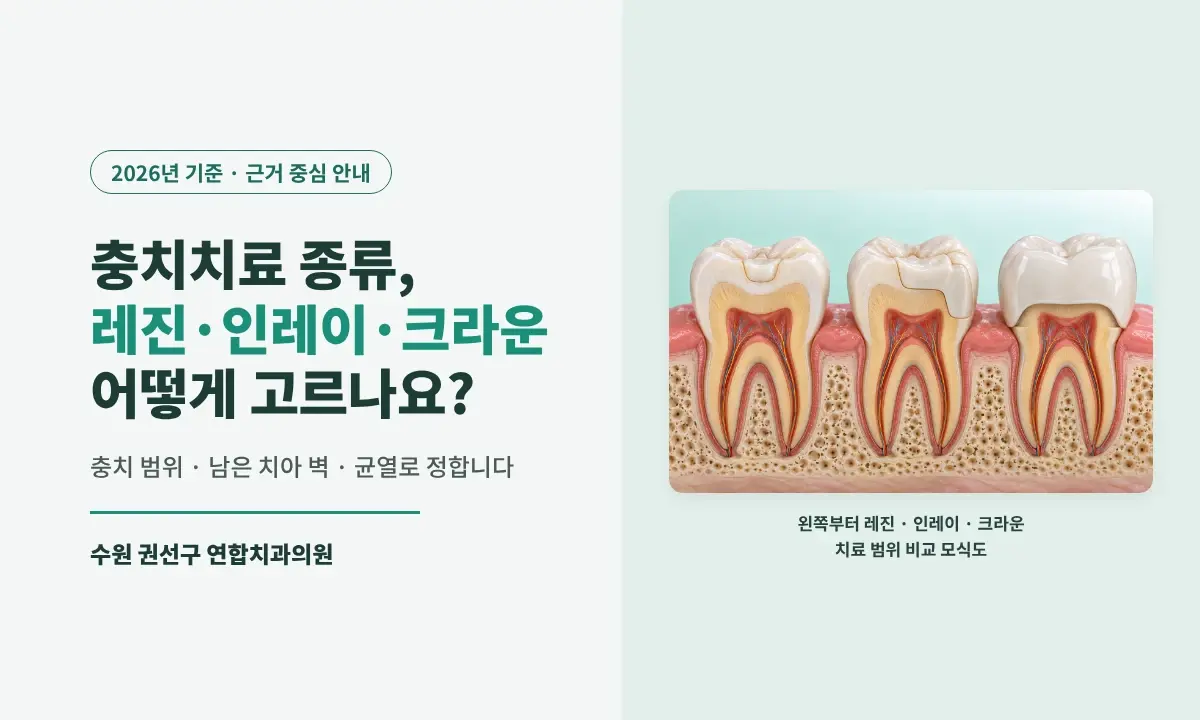
The type of cavity treatment is not decided by depth alone. Yeonhap Dental Clinic chooses among resin, inlay, and crown by looking at the extent of the decay, the remaining tooth walls, and cracks.
Cavity treatment types: how do you choose between resin, inlay, and crown?
Even with the same cavity, some people finish with a resin filling while others are advised to have an inlay or a crown. A resin is a treatment in which the area where decay was removed is filled directly with a tooth-colored material, an inlay is a treatment in which a piece made from an impression is fitted and bonded, and a crown is a treatment that covers the whole tooth.
[Key Answer]
The choice among resin, inlay, and crown is not made by the depth of the cavity alone; it is made by looking together at the extent of the surfaces involved, the thickness of the remaining tooth walls, whether there is a crack, and whether the tooth has had root canal treatment. At Yeonhap Dental Clinic in Gwonseon-gu, Suwon, after checking the condition of your teeth with an oral examination and Q-ray, we explain separately what needs to be fixed and what can be monitored.
[Summary in 4 Lines]
· If a molar cavity is only on the chewing surface (Class I), it is usually a resin, and if it extends to the side surface that touches the neighboring tooth (Class II), it is usually an inlay, but this is not always the case.
· After the decay is removed, if the remaining tooth wall (side wall) is thinner than 2 mm, we mainly consider a crown; this is not a figure set by the literature but our clinic's own criterion.
· For cracks, we decide between a crown and monitoring by looking together at the red fluorescence reaction on Q-ray (an examination that shines light and images the fluorescence response), symptoms, and the extent of the crack; we do not determine the need for treatment from the presence of fluorescence alone.
· As our clinic's policy, a tooth that has had root canal treatment gets a crown, even a front tooth, because front teeth can change color over time.
Written by Dr. Ahn Seong-jin, Chief Director, Yeonhap Dental Clinic
[Table of Contents]
· Cavity treatment types: how do you choose between resin, inlay, and crown?
· How do you distinguish resin from inlay in cavity treatment?
· When is a crown needed after cavity treatment?
· If a tooth has a crack, does it need a crown?
· If a cavity is deep, does it always need root canal treatment?
· Why does a tooth with root canal treatment also get a crown?
Direct filling materials include GI and others in addition to resin. The differences by material, and Bondfill, which our clinic uses for restoring cervical wear, are explained in a separate article; here we focus on the criteria for choosing among resin, inlay, and crown.
The extent of treatment covered by resin, inlay, and crown
| Treatment | How much of the tooth is repaired | When Yeonhap Dental Clinic mainly chooses it |
|---|---|---|
| Resin | The area where decay was removed is filled directly with material | A cavity only on the chewing surface of a molar (Class I) |
| Inlay | A piece made from an impression is fitted and bonded | From a cavity extending to the side surface of a molar (Class II) |
| Crown | Covers the whole tooth | When the remaining tooth wall is thin, a crack that needs treatment, or a tooth that has had root canal treatment |
How do you distinguish resin from inlay in cavity treatment?
We look at which surfaces the cavity involves; in a molar, it is usually a resin if only the chewing surface is involved and an inlay if it extends to the side surface.
In molar cavities, a cavity only in the grooves of the chewing surface is called Class I, and one that extends to the side surface touching the neighboring tooth is called Class II. Yeonhap Dental Clinic usually does a resin for Class I and an inlay from Class II onward, but may decide differently if the cavity is small or enough tooth remains.
The reason we look at the side surface separately is that the edge of the side surface (the marginal ridge) holds the tooth together. In an experiment using extracted premolars, preparing both side surfaces together with the chewing surface reduced tooth stiffness by an average of 63%, with the largest reduction when the marginal ridge was lost (Reeh 1989). This is a laboratory result and not a study that validated our clinic's Class I/Class II distinction.
The process of bonding an inlay can be seen in E.max Inlay: The Bonding Protocol Decides the Result.
When is a crown needed after cavity treatment?
If the tooth wall remaining after the decay is removed is thinner than 2 mm, we mainly consider a crown.
After removing the decay and shaping the tooth, Yeonhap Dental Clinic judges by eye the thickness of the lower part of the remaining tooth wall (side wall), that is, the part toward the floor of the cavity preparation. If this wall is thinner than 2 mm, we judge that it is hard for it to support the pointed part that bears chewing force (the cusp), and we mainly consider a crown. However, not every wall thinner than 2 mm gets a crown; we also look at how far the thinning extends, the bite force on that wall, and whether there is a crack. The 2 mm figure is not validated by the literature; it is our clinic's own criterion.
We currently do not do onlays that cover only part of a cusp; if an inlay is judged unlikely to hold up, we plan a crown.
If a tooth has a crack, does it need a crown?
Not every visible crack gets a crown. Yeonhap Dental Clinic decides whether to place a crown or monitor by looking together at the Q-ray fluorescence reaction, symptoms, and the extent of the crack.
On Q-ray, bacteria inside a crack appear as red fluorescence, but plaque can also look red, so our clinic removes plaque and images again. Red fluorescence is information that helps evaluate a crack, and the presence of a reaction alone cannot determine whether treatment is needed. So we also look at pain when chewing or sensitivity to cold, and whether the crack extends past the edge of the side surface.
If a red reaction remains along the crack even after plaque is removed, we consider a crown; if there is no reaction or symptoms, or the judgment is unclear, we monitor without cutting the tooth. We distinguish the cause according to whether it hurts even at rest or only when chewing, and test the condition of the nerve. If we judge the nerve hard to save, we proceed with root canal treatment followed by a crown.
In research as well, there was no difference in fluorescence readings between a cracked tooth with symptoms and the cracked tooth on the opposite side without symptoms (Lee 2023). Among cracked molars and premolars with living nerves for which monitoring was first recommended, about 80% of the teeth kept the monitoring recommendation over 3 years (Ferracane 2022). The imaging sequence and the limits of the test are summarized in Q-ray Precision Diagnosis: Interpretation, Limits, and Overcoming Them.
If a cavity is deep, does it always need root canal treatment?
No. Even if a cavity looks deep, you only find out whether the nerve is exposed once the decay is removed.
Even when a tooth looks close to the nerve (pulp) in an image, the nerve may not be exposed during removal, and even if it is exposed, if bleeding stops and the condition is good, the nerve may be saved by a partial pulpotomy, in which part of the pulp beneath the exposure is removed and the remaining pulp is protected. So the treatment direction is decided by the condition of the nerve confirmed while removing the decay, and we sometimes tell you in advance that it may differ from the initial plan. What to use to protect the remaining tooth after the nerve is saved is judged separately using the criteria above.
The criteria for stopping bleeding and the process of saving the nerve are summarized in MTA Pulpotomy: Can You Avoid Root Canal Treatment?.
Why does a tooth with root canal treatment also get a crown?
A tooth that has had root canal treatment is hollowed out inside and has usually lost much of its structure to decay, so Yeonhap Dental Clinic's policy is to place a crown as well.
In a retrospective study reviewing 203 root canal-treated teeth, the risk of losing a tooth without a crown was about 6 times that of a crowned tooth (Aquilino 2002). It is an association found in a records-review study, so it does not mean every tooth needs a crown.
Placing a crown on a front tooth is our clinic's policy, not research. Front teeth bear less chewing force but can darken over time, so we proceed to a crown, and when little tooth remains, we may also use a post (fiber post).
The root canal treatment process can be seen in Root Canal Treatment: Why a Rubber Dam Is Essential and the Aseptic Protocol.
Criteria for judging the extent of cavity treatment (Yeonhap Dental Clinic)
| Item to check | Yeonhap Dental Clinic's criterion | Basis and limits |
|---|---|---|
| Surfaces involved by the cavity | Usually resin if only the chewing surface of a molar (Class I), usually inlay if it extends to the side surface (Class II) | Our clinic's policy; varies with cavity size and remaining tooth |
| Thickness of the remaining tooth wall | Mainly consider a crown if thinner than 2 mm | Experiments show weakening when the side surface is lost (Reeh 1989), but no study validated 2 mm |
| Crack | Crown or monitoring, based on fluorescence, symptoms, and extent of the crack | The need for treatment cannot be determined by the presence of red fluorescence alone |
| Nerve exposure | Root canal treatment is not decided by depth alone | Reassess based on whether it is exposed during removal and on bleeding control |
| Root canal-treated tooth | Crown on both front teeth and molars | Association from a retrospective study (Aquilino 2002); for front teeth, our policy because of possible discoloration |
5 things to check when consulting about the extent of cavity treatment in Gwonseon-gu or Tap-dong, Suwon
How much is cut and the cost depend on the extent of the repair, so it helps to ask for the reasons behind the treatment.
Yeonhap Dental Clinic, at 230 Geumho-ro, 5th Floor (Cham Clinic Building, Tap-dong), Gwonseon-gu, Suwon, across from Suwon NongHyup Guun Branch (231 Geumho-ro), has been treating patients in the same location since 2002, with Dr. Ahn Seong-jin, Chief Director and Integrated Dentistry specialist, in charge. If a filling keeps coming off the same spot, also see Why Fillings Keep Coming Off the Same Spot.
· Whether the cavity is only on the chewing surface or extends to the side surface
· If a crown is recommended, what the reason is, such as remaining wall thickness or a crack
· If there is a crack, whether it is a crack to treat or a crack to monitor
· Whether the treatment direction may change while the decay is being removed
· If root canal treatment was done, why a crown is also needed
[Key Takeaways]
✓ Resin, inlay, and crown are chosen not only by cavity depth but by the surfaces involved, the remaining tooth wall, cracks, and whether root canal treatment was done.
✓ A 2 mm side wall, resin for molar Class I and inlay for Class II, and crowns on front teeth after root canal treatment are Yeonhap Dental Clinic's criteria and policies.
✓ Cracks are judged by looking together at fluorescence, symptoms, and extent; the need for treatment is not determined by fluorescence alone.
What I would like to tell you about the extent of cavity treatment from the treatment room
In a cavity treatment consultation, before the size of the cavity in the image, I look at which surfaces it involves and how much tooth will remain after the decay is removed. If the remaining wall is thin or there is a crack that needs treatment, the plan changes toward a crown. There have actually been cases where, looking at the image, I thought root canal treatment would be needed, but when the decay was removed the nerve was not exposed, so I placed MTA (a material that protects the nerve), finished with a resin, and the patient has had no problems since. There have also been cases where the nerve was exposed but bleeding stopped and the condition was good, so I saved the nerve with a partial pulpotomy and finished. Because of such experiences, I do not assume root canal treatment just because a cavity looks deep; I set the direction based on the condition confirmed during removal. A tooth that has been cut does not come back, so repairing only as much as necessary is the principle I try to keep when deciding the extent of treatment.
References
📋 Clinic Information
This post was written in accordance with the Korean Medical Service Act and the Ministry of Health and Welfare's medical advertising guidelines, and is intended to provide medical information. It does not guarantee or assert the effect of any particular treatment. The applicable treatment methods and course may vary depending on each person's oral condition, so please decide on a diagnosis and treatment direction only after a thorough consultation with your dental team.
🦷 Cavity and prosthodontic treatment information: Yeonhap Dental Clinic treatment areas
📍 230 Geumho-ro, 5th Floor (Cham Clinic Building, Tap-dong), Gwonseon-gu, Suwon, Gyeonggi-do
🚕 Across from Suwon NongHyup Guun Branch (231 Geumho-ro) / about 15 minutes by taxi from Suwon Station
🚗 Free parking available in the building
📞 031-293-2207
🌐 yeonhapdental.com
🟡 Open since 2002 / Treatment overseen by Dr. Ahn Seong-jin, Chief Director and Integrated Dentistry specialist
🔗 Online booking and consultation
Frequently asked questions about cavity treatment types
- Cavity treatment types: how do you choose between resin, inlay, and crown?
- It is not decided by the depth of the cavity alone; we look together at the surfaces the cavity involves, the thickness of the tooth wall remaining after the decay is removed, whether there is a crack, and whether the tooth has had root canal treatment. A resin is a treatment that fills material directly, an inlay is a treatment that bonds a piece made from an impression, and a crown is a treatment that covers the whole tooth.
- When are resin and inlay used?
- For molar cavities, Yeonhap Dental Clinic usually does a resin for a cavity only in the grooves of the chewing surface (Class I) and an inlay from a cavity extending to the side surface touching the neighboring tooth (Class II) onward. We may decide differently depending on cavity size and the remaining tooth.
- When is a crown placed after cavity treatment?
- If the tooth wall remaining after the decay is removed is thinner than 2 mm, Yeonhap Dental Clinic mainly considers a crown, and we also look at how far the thinning extends, the bite force, and whether there is a crack. The 2 mm figure is not validated by the literature; it is our clinic's own criterion.
- If a tooth has a crack, does it need a crown?
- Not every visible crack gets a crown. The need for treatment cannot be determined by the red fluorescence on Q-ray (an examination that shines light and images the fluorescence response) alone, so Yeonhap Dental Clinic decides between a crown and monitoring by looking together at the fluorescence reaction, symptoms, and whether the crack extends past the edge of the side surface.
- If a cavity is deep, does it always need root canal treatment?
- No. Even if a cavity looks deep, the nerve (pulp) may not be exposed during removal, and even if it is exposed, if bleeding stops and the condition is good, the nerve may be saved by a partial pulpotomy (a treatment in which part of the pulp beneath the exposure is removed and the remaining pulp is protected).
- Where is Yeonhap Dental Clinic in Tap-dong and Guun-dong, Gwonseon-gu, Suwon?
- We are at 230 Geumho-ro, 5th Floor (Cham Clinic Building, Tap-dong), Gwonseon-gu, Suwon, Gyeonggi-do, across from Suwon NongHyup Guun Branch (231 Geumho-ro). Free parking is available in the building, and we are about 15 minutes by taxi from Suwon Station.
Related pages
Before your visit
This article provides general information on oral health and dental care. Whether treatment is needed, and which method is appropriate, may change after an oral exam and any necessary diagnostic tests. If you have pain, a loose tooth, swelling, or discomfort with a prosthesis, please visit us for a consultation.