
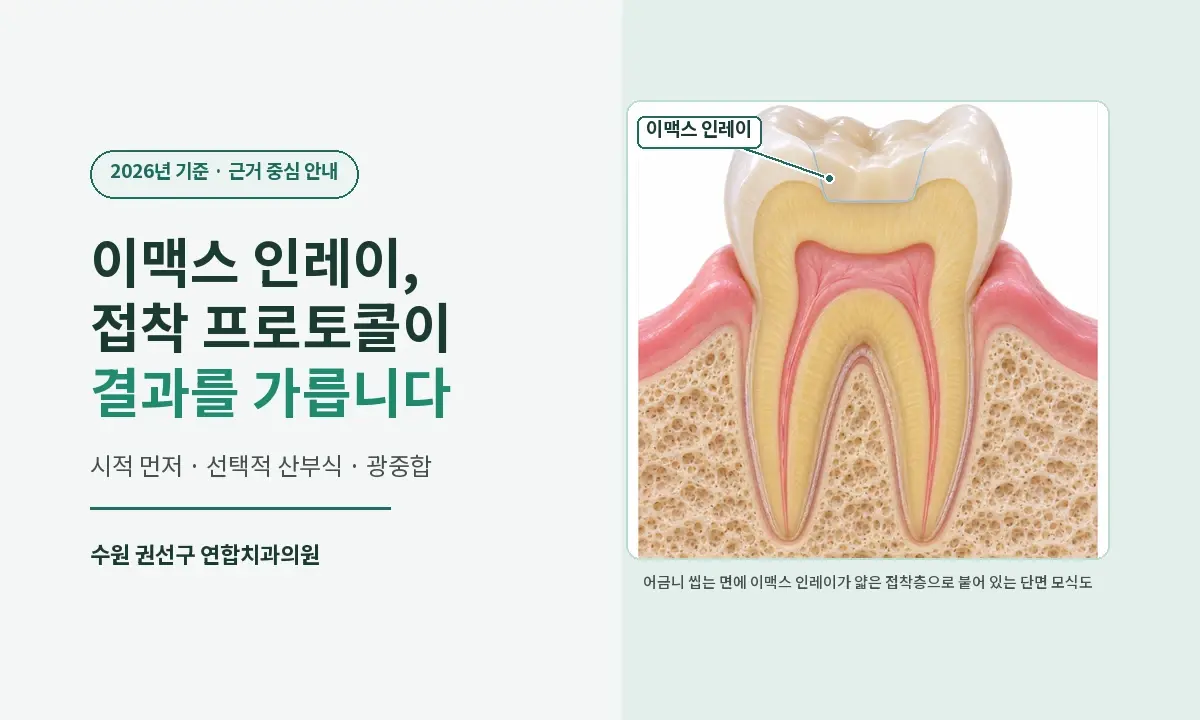
Unlike a gold inlay, which is retained by its shape, an e.max inlay is a restoration retained by bonding. So the completeness of the bonding protocol affects the result as much as the strength of the material. When bonding is done properly, the restoration and the remaining tooth structure behave as one body, but if any single step fails, bonding failure begins at that spot no matter how good the material is. Yeonhap Dental Clinic in Gwonseon-gu, Suwon, keeps to the sequence of doing the try-in first and then treating the ceramic surface, approaches enamel and dentin in different ways on the tooth surface, and, because we use a light-cure-only material, also manages the conditions under which light passes through the ceramic. The steps are not independent items; they are a chain in which each earlier choice determines the next.
Why does bonding decide the result of an e.max inlay?
Because it is a restoration retained by bonding, not one held in place by its shape.
Written by Dr. Ahn Seong-jin, Chief Director, Yeonhap Dental Clinic · Published Sept. 4, 2026 · Last updated Sept. 4, 2026
This article answers the six questions below in order. · Why does bonding decide the result of an e.max inlay? · How is the ceramic surface of an e.max inlay treated (etching and silane)? · Why is the tooth surface of an e.max inlay treated separately with selective acid etching? · What happens if saliva contaminates an e.max inlay during bonding? · How are the resin cement and light curing chosen for an e.max inlay? · Can an e.max inlay that has already come off be bonded back?
When you look into e.max inlays, you mostly hear about the material first: what lithium disilicate is, how strong it is, and so on. That information is not wrong, but what really decides the result comes after it.
The reason lies in how it is retained. A gold inlay is held by its shape in a groove cut into the tooth. Even if bonding is not perfect, the shape holds it. An e.max inlay, by contrast, is a restoration that stays by being bonded. Only when bonding is done properly do the restoration and the remaining tooth structure behave as one body, and only then does it work to draw the side walls of the tooth together rather than spread them apart when chewing force is applied.
Put another way, if bonding is not done properly, the very reason for using e.max disappears. The material's specifications are values written in a catalog, but actual fracture resistance depends on the completeness of bonding, and that completeness depends on what was done in what order in the treatment room.
This article discloses the protocol Yeonhap Dental Clinic follows when bonding an e.max inlay. It also explains why each step sits where it does and what collapses if it is skipped.
작성: 연합치과의원 대표원장 안성진
이맥스 인레이를 알아보시면 재료 이야기를 먼저 듣게 되지만, 결과를 가르는 것은 그 뒤의 붙이는 과정입니다.
[글의 목차]
· 이맥스 인레이 세라믹 면은 어떻게 처리하나요?
· 이맥스 인레이에서 치아 면은 어떻게 처리하나요?
· 이맥스 인레이 접착 중 침이 닿으면 어떻게 하나요?
· 이맥스 인레이는 무엇으로 붙이고 어떻게 굳히나요?
· 떨어진 이맥스 인레이는 다시 붙일 수 있나요?
골드 인레이는 시멘트가 틈을 메우고 와동 형태가 붙잡는 합착 방식이지만, 이맥스 인레이는 치아와 세라믹 표면을 각각 처리해 한 몸처럼 붙이는 접착 방식입니다. 접착이 제대로 되어야 씹는 힘이 걸릴 때 남은 치아 벽을 벌리지 않고 함께 버팁니다. 재료별 차이는 인레이 종류, 골드·하이브리드·이맥스에 정리했습니다. 프레스 방식 이맥스 인레이의 9.9년 추정 생존율은 93.9%로 보고됐지만, 한 개인 치과에서 세라믹을 고른 환자만 본 연구입니다(Malament 2021).
How is the ceramic surface of an e.max inlay treated (etching and silane)?
We do the try-in first, then etch with hydrofluoric acid and apply a universal adhesive.
The order comes first. Yeonhap Dental Clinic puts the try-in, that is, fitting the restoration in the mouth, before treating the ceramic surface. There is a reason for this order.
During try-in, saliva touches the inner surface of the restoration. When salivary proteins stick to the ceramic surface, no matter how good an adhesive is applied over it, a film remains in between. This is why the literature repeatedly points out that saliva contamination during try-in lowers bond strength.
However, if you do the try-in first and then etch the surface with hydrofluoric acid, the contaminated surface layer is removed along with the etching. Rather than cleaning the contamination afterward, the sequence is arranged so that the contamination does not matter.
Hydrofluoric acid etching (HF etching) is applied at 5% concentration for 20 seconds. It selectively dissolves the glass matrix of lithium disilicate to create fine roughness, and the adhesive locks into this roughness. Both concentration and time must be kept; too much collapses the surface structure, and too little leaves the roughness shallow.
After etching, we rinse thoroughly for 15 seconds with water and an air syringe. If residue produced during etching stays on the surface, it interferes with bonding in itself.
For the adhesive, we use a universal bond that contains silane. In ceramic bonding, silane acts as a coupling agent that chemically links the inorganic surface and the organic adhesive, and some universal adhesives include silane in their composition, so it is reported that a separate silanization step can be omitted when bonding glass-ceramic. The product Yeonhap Dental Clinic uses (3M Universal Bond) falls into this category, and it also contains the MDP (10-MDP) functional monomer.
Why is the tooth surface of an e.max inlay treated separately with selective acid etching?
Because enamel and dentin differ in structure and so bond by different mechanisms; this is called selective etching.
Even on the same tooth surface, the way bonding is achieved differs.
Enamel is etched with phosphoric acid (etch-and-rinse). Enamel is a crystalline structure with a high mineral content, so etching the surface with acid creates fine roughness, and the adhesive flows into it and locks in. This method is among the longest-validated bonding approaches.
Dentin is approached with a self-etch method. Dentin has tubules filled with fluid, and if it is etched as strongly as enamel, the collagen fibers can collapse and make bonding less stable instead. So the universal bond is rubbed onto the dentin so that the acidic monomer treats the surface gently while the adhesive components soak in at the same time.
Yeonhap Dental Clinic rubs on the universal bond for 20 seconds, dries it for 5 seconds, and then light-cures it. The rubbing and the drying time are not formalities. Rubbing lets the adhesive soak into the collagen structure at the dentin surface to form a hybrid layer, and the solvent has to evaporate sufficiently so that only the adhesive components remain there. If this step is rushed, it hardens with solvent left behind and the layer is weakened.
In other words, even within a single tooth, different treatments are used for different areas; this approach, in which only the enamel is etched separately with phosphoric acid and the dentin is left to self-etch, is called selective etching.
What happens if saliva contaminates an e.max inlay during bonding?
If the bonding surface is contaminated with saliva or blood, we go back to that step and decontaminate it.
As noted above, doing the try-in first means contamination at that point is resolved at the etching step. The problem comes after that. In the short interval between treating both the ceramic and tooth surfaces and seating the restoration, saliva or blood can sometimes touch them.
If we proceed as is, the adhesive hardens with a thin contaminated layer in it. It looks well bonded on the outside, but the bond is weak, and over time it comes off or begins to leak at the margin.
Yeonhap Dental Clinic returns the contaminated surface to the first step.
· If the tooth surface is contaminated: rinse thoroughly with water to remove the contaminated adhesive, start again from drying, and apply fresh adhesive.
· If the ceramic surface is contaminated: clean it with phosphoric acid and then repeat the bonding process. In a study comparing several methods for saliva contamination of lithium disilicate, phosphoric acid cleaning restored bond strength to the level of the uncontaminated control group, whereas water or alcohol alone did not.
What matters here is isolation. Yeonhap Dental Clinic uses a rubber dam, or, depending on the site and conditions, proceeds without one when moisture control is sufficiently secured. However, that judgment is made before the bonding step, and if it is not secured, we do not push ahead.
It is always better to manage things so that contamination does not occur than to have a procedure to deal with it. The time it takes to go back is much shorter than the time to remake an inlay that has come off.
6 steps of e.max inlay bonding
| Step | What is done | What collapses if it is skipped |
|---|---|---|
| ① Try-in | Fitted first, before treating the ceramic surface | If done after treatment, contamination remains on the bonding surface |
| ② Ceramic surface | 5% hydrofluoric acid etch 20 seconds → rinse 15 seconds → universal bond | Shallow roughness or leftover residue makes bonding shallow |
| ③ Tooth surface | Selective etching: phosphoric acid on enamel / self-etch on dentin | Treatment unsuited to the area makes the bonding layer unstable |
| ④ Isolation | Proceed after securing a rubber dam or moisture control | It hardens with a contaminated layer, causing early loss and marginal leakage |
| ⑤ Bonding and light curing | Flowable resin + high-output curing light | If light does not reach, polymerization is incomplete |
| ⑥ Bite adjustment | Check and adjust personally after seating | Force concentrates at a specific point, raising fracture risk |
How are the resin cement and light curing chosen for an e.max inlay?
We use a light-cured flowable resin as the cement, and that choice makes a high-transmission curing light a requirement.
This is a prime place in Yeonhap Dental Clinic's protocol where one choice leads to the next.
First, we use flowable resin as the cement. A dedicated resin cement is the standard, but flowable composite is treated in the literature as a valid alternative. It has been pointed out that its high inorganic filler content may make it better than resin cement over the long term at the margin, and its low viscosity is reported to contribute to bond strength by helping it lock into the fine roughness of the etched ceramic surface.
Second, we use light-cure only. In studies comparing with dual-cure cement, no advantage in degree of conversion was found, handling was in fact easier with light-cure, and it is reported that the time available to remove excess material before it hardens led to less marginal overhang. If material is left at the margin, that spot becomes a plaque-retentive area, so this difference is not small.
Third, that is why the curing light becomes a requirement. A light-cure-only material works only if the light passes through the ceramic and reaches the cement layer. The literature also summarizes that dual-cure should be used when enough light cannot be secured because of restoration thickness or low translucency, and there is separate research showing that the degree of conversion varies with the shade and thickness of the ceramic.
Yeonhap Dental Clinic's use of a curing light with secured transmission (Deep Cure-S) is not a matter of equipment preference but a required condition that follows from choosing a light-cure-only cement. Once the material is chosen, the equipment is determined, and if the equipment cannot be secured, the material choice itself has to change.
Finally, the bite adjustment. After bonding is complete, I check and adjust the bite myself. In ceramic, a crack can begin at a spot where force concentrates, so adjusting so that force is distributed evenly is the last step of the protocol.
Can an inlay that has already come off be bonded back?
Yeonhap Dental Clinic does not rebond an inlay that has come off; we make a new one.
When patients bring in a restoration that has come off, we get requests to bond it back. Yeonhap Dental Clinic does not do that, for two reasons.
First, it is already contaminated. From the moment it comes off, both the restoration and the tooth surface are exposed to saliva and food. Hardened adhesive and contaminants remain on the ceramic surface, and to fully reverse that you would have to start again from the etching step, but etching a surface that has already been etched once collapses its structure.
Second, the condition of the tooth surface has changed. The dentin that served as the bonding surface has already been treated, and it is hard to expect new bonding on top of it. So Yeonhap Dental Clinic removes a small additional amount from the cavity to expose fresh dentinal tubules that have not been treated, and then makes a new restoration.
You may feel it is a pity to cut a little more tooth. However, if you rebond onto a surface where bonding cannot take hold, the same thing repeats, and next time more would have to be cut. Setting up the conditions once means losing less tooth in the end.
This judgment is the same in other restorations. The principle is not to place a bonding-dependent restoration in a spot where bonding is difficult, and the detailed criteria are covered in Why Fillings Keep Coming Off the Same Spot.
[Key Takeaways]
✓ An e.max inlay is retained by bonding, not shape, so the completeness of the bonding protocol affects the result more than the material specifications.
✓ Yeonhap Dental Clinic keeps to a sequence of doing the try-in first and then treating the ceramic surface so that contamination does not matter, and approaches enamel and dentin in different ways.
✓ Because we use light-cure-only flowable resin, we also manage the conditions under which light passes through the ceramic, and the steps form a chain in which each earlier choice sets the next.
Criteria to check when consulting about an inlay in Gwonseon-gu or Tap-dong, Suwon
The practical test is whether the dentist can explain how it is bonded, rather than which material is used.
Yeonhap Dental Clinic, at 230 Geumho-ro, 5th Floor (Cham Clinic Building, Tap-dong), Gwonseon-gu, Suwon, across from Suwon NongHyup Guun Branch (231 Geumho-ro), has held the same location since 2002. Dr. Ahn Seong-jin, Chief Director and Integrated Dentistry specialist, is currently in charge, and you can see how treatment generally proceeds in General Dentistry Information.
[5 Things to Check in an E.max Inlay Consultation]
· Whether the try-in or the ceramic surface treatment is done first
· Whether there is a set procedure for when saliva touches during bonding
· Whether the dentist can explain the type of cement and why it was chosen
· Whether the bite is personally checked and adjusted after seating
· Whether there is a criterion for rebonding versus remaking an inlay that has come off
✓ 이맥스 인레이는 형태가 아니라 접착으로 유지되므로, 재료보다 붙이는 과정의 완성도가 결과를 좌우합니다.
✓ 연합치과의원은 시적을 먼저 하고 세라믹 면을 처리하며, 치아 면은 아쿠아케어로 정리한 뒤 법랑질과 상아질을 나눠 처리합니다.
✓ 플로어블 복합레진을 광중합으로만 굳히는 만큼 빛이 세라믹을 통과하는 조건까지 관리하고, 마지막에 교합을 직접 조정합니다.
Frequently Asked Questions
- Isn't a good material all an e.max inlay needs?
- The material specifications are values written in a catalog, and actual fracture resistance depends on the completeness of bonding. An e.max inlay is not held by its shape but is a restoration that is bonded on, so the restoration and the tooth behave as one body only when bonding is done properly.
- Why is the try-in done first for an e.max inlay?
- During try-in, saliva touches the inner surface of the restoration, and if you do the try-in first and then etch with hydrofluoric acid, the contaminated surface layer is removed along with the etching. Rather than cleaning the contamination afterward, the sequence is arranged so that it does not matter.
- What do you do if saliva touches an e.max inlay during bonding?
- We go back to that step. The tooth surface is rinsed with water to remove the contaminated adhesive and started again from drying, and the ceramic surface is cleaned with phosphoric acid and the bonding process repeated. In a study, phosphoric acid cleaning restored bond strength to the level of the uncontaminated control group, whereas water or alcohol alone did not.
- Is a rubber dam required for bonding an e.max inlay?
- It depends on the site and conditions. Yeonhap Dental Clinic uses a rubber dam, or proceeds without one when moisture control is sufficiently secured. However, that judgment is made before the bonding step, and if it is not secured, we do not push ahead.
- What cement does Yeonhap Dental Clinic use for e.max inlays?
- We use flowable resin in a light-cure manner. There are reports that its high inorganic filler content is advantageous at the margin, and that with light-cure only the time to remove excess material before hardening was secured, leading to less overhang.
- Why does the curing light matter in bonding an e.max inlay?
- A light-cure-only material works only if the light passes through the ceramic and reaches the cement layer. The literature also summarizes that dual-cure should be used when enough light cannot be secured because of thickness or low translucency, so a curing light with secured transmission (Deep Cure-S) becomes a condition that follows from the material choice.
- Will you rebond an inlay that came off?
- We will do it if you wish, but we do not recommend it. From the moment it came off, both the restoration and the tooth surface were contaminated, and it is hard to expect new bonding on the dentin that served as the bonding surface. We recommend removing a small additional amount from the cavity to expose fresh dentinal tubules and then making a new one.
- Where is Yeonhap Dental Clinic in Tap-dong and Guun-dong, Gwonseon-gu, Suwon?
- We are at 230 Geumho-ro, 5th Floor (Cham Clinic Building, Tap-dong), Gwonseon-gu, Suwon, Gyeonggi-do, across from Suwon NongHyup Guun Branch (231 Geumho-ro). Free parking is available in the building, and we are about 15 minutes by taxi from Suwon Station.
What I would like to tell you before an e.max inlay, from the treatment room
When you consult about an inlay, most people ask about the material first: which material is harder, how long it will last. After answering those questions, I tell you one more thing. This restoration is bonded on, so whatever the material, if the bonding process fails, the failure starts at that spot. That is why I do not change the order. I do the try-in first, etch, keep it from getting wet, check that the light reaches, and look at the bite last. Each step is where it is because of the step before it, so if you skip one, everything after it wobbles. I believe this affects the result more than choosing the material.
[References]
Malament KA, et al. 10.9-year survival of pressed acid etched monolithic e.max lithium disilicate glass-ceramic partial coverage restorations. J Prosthet Dent. 2021;126(4):523-532.
Can cleansing regimens effectively eliminate saliva contamination from lithium disilicate ceramic surface? 2017. PMID 28569445. (Phosphoric acid and cleaning agents restored bond strength to the control-group level / water and isopropanol did not)
The influence of different surface cleansing agents on shear bond strength of contaminated lithium disilicate ceramic. 2021. PMC8373498.
Flowable composite as an alternative to adhesive resin cement in bonding CAD/CAM ceramics: micro-shear bond strength. BDJ Open. 2024. doi:10.1038/s41405-024-00251-2.
Furuse AY, et al. Degree of conversion of a flowable composite light-activated through ceramics of different shades and thicknesses. Braz J Oral Sci. 2015;14:230-233.
Effect of surface coating on bond strength between etched ceramic and resin-based luting agents. PMC6081562. (Silane content in universal adhesives and omission of the silanization step)
Clinic Information
This post was written in accordance with the Korean Medical Service Act and the Ministry of Health and Welfare's medical advertising guidelines, and is intended to provide medical information. It does not guarantee or assert the result of any particular material or treatment. The applicable materials and course differ from person to person depending on the condition of the tooth and the extent of the defect, so please decide on a treatment direction only after a thorough consultation with your dental team.
🦷 General dentistry: Yeonhap Dental Clinic general dentistry
📍 230 Geumho-ro, 5th Floor (Cham Clinic Building, Tap-dong), Gwonseon-gu, Suwon, Gyeonggi-do
🚕 Across from Suwon NongHyup Guun Branch (231 Geumho-ro) / about 15 minutes by taxi from Suwon Station
🚗 Free parking available in the building
📞 031-293-2207
🌐 yeonhapdental.com
🟡 Open since 2002 / Treatment overseen by Dr. Ahn Seong-jin, Chief Director and Integrated Dentistry specialist
🔗 Online booking and consultation
이맥스 인레이 자주 묻는 질문
- 이맥스 인레이는 재료만 좋으면 되는 것 아닌가요?
- 이맥스 인레이는 형태로 물려 있는 것이 아니라 접착으로 붙어 있는 수복물이라, 접착이 제대로 되어야 인레이와 치아가 한 몸처럼 버팁니다. 그래서 연합치과의원은 재료만큼 붙이는 순서를 중요하게 봅니다.
- 이맥스 인레이에서 시적을 먼저 하는 이유가 뭔가요?
- 시적할 때 인레이 안쪽 면에 침이 닿기 때문입니다. 연합치과의원은 시적 뒤 불산 부식과 세척으로 표면을 처리합니다.
- 이맥스 인레이를 붙이기 전에 아쿠아케어는 왜 쓰나요?
- 아쿠아케어는 물과 미세한 입자를 뿌려 치아 면의 오염과 잔여물을 걷어내는 장비입니다. 연합치과의원은 표면이 깨끗해야 접착제가 제대로 붙기 때문에 인레이를 붙이기 직전에 사용합니다.
- 이맥스 인레이 접착 중에 침이 닿으면 어떻게 하나요?
- 연합치과의원은 오염된 면을 그 단계로 되돌려, 치아 면은 물로 씻고 건조한 뒤 접착제를 새로 바르며 세라믹 면은 인산으로 세척한 뒤 접착 과정을 다시 진행합니다. 실험의 초기 측정에서 인산 세척은 대조군과 비슷한 접착강도를 보였지만 물이나 이소프로판올로는 회복되지 않았습니다(Borges 2017).
- 떨어진 이맥스 인레이를 다시 붙여 주시나요?
- 연합치과의원은 떨어진 원인과 인레이의 파절·적합도, 충치, 남은 접착재를 확인해 재접착이 가능한지 판단합니다. 재제작을 우선 권하며, 재접착은 가능한 상태인지 확인한 뒤 진행합니다.
- 수원 권선구 탑동·구운동에서 연합치과의원은 어디에 있나요?
- 연합치과의원은 경기 수원시 권선구 금호로 230, 5층(탑동, 참클리닉빌딩)에 있으며 수원농협 구운지점(금호로 231) 맞은편입니다. 건물 내 무료주차가 가능하고 수원역에서 택시로 약 15분 거리입니다.
Related pages
Before your visit
This article provides general information on oral health and dental care. Whether treatment is needed, and which method is appropriate, may change after an oral exam and any necessary diagnostic tests. If you have pain, a loose tooth, swelling, or discomfort with a prosthesis, please visit us for a consultation.