
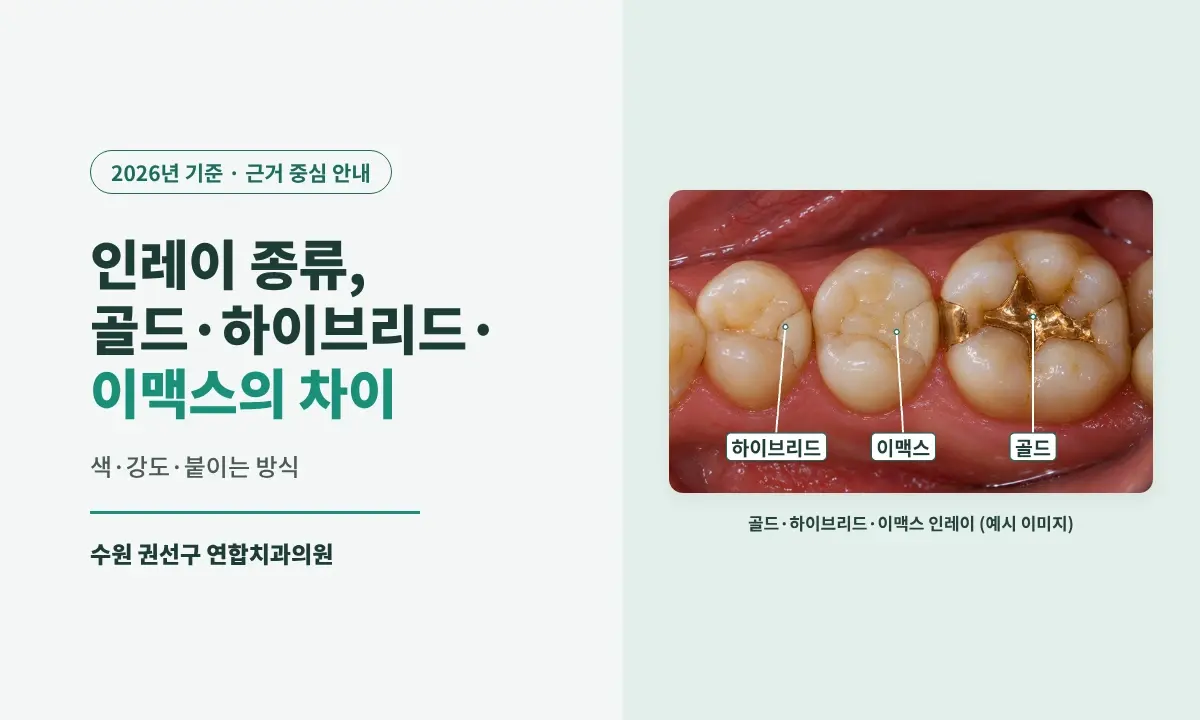
Gold, hybrid, and e.max inlays differ in color, strength, and how they attach to the tooth. Yeonhap Dental Clinic mainly uses e.max, and also uses hybrid inlays for premolars.
How do gold, hybrid, and e.max inlays differ?
An inlay is a treatment in which a restoration made to match the space left after decay is removed is fitted and fixed into the tooth. Once an inlay is chosen, the next decision is the material. Gold, hybrid, and e.max differ in color and in how they stay attached.
[Key Answer]
Gold, hybrid, and e.max are not ranked from better to worse; they are materials that differ in color, strength, and how they stay in place. At Yeonhap Dental Clinic in Gwonseon-gu, Suwon, we mainly use e.max, which is bonded with adhesive, also use hybrid for premolars, and do not place gold inlays.
[Summary in 4 Lines]
· Gold has the advantages of ductility, malleability, and a precise fit, but at Yeonhap Dental Clinic we do not use it because we believe a gold inlay cemented with luting cement transmits chewing force to the tooth wall like a wedge.
· A hybrid inlay is a tooth-colored material. At our clinic we use it on premolars because it costs less than e.max and some damage is easier to repair with composite resin.
· An e.max inlay is made of lithium disilicate ceramic. Its advantages are translucency and a natural tooth-colored look, and it is attached by adhesive bonding.
· Yeonhap Dental Clinic mainly uses e.max, with hybrid inlays for premolars, and does not place gold inlays.
Written by Dr. Ahn Seong-jin, Chief Director, Yeonhap Dental Clinic
[Contents]
· How do gold, hybrid, and e.max inlays differ?
· What are the advantages of gold inlays, and why doesn't Yeonhap Dental Clinic use them?
· How do hybrid and e.max inlays differ?
· How does Yeonhap Dental Clinic choose an inlay material?
This article covers the choice of inlay material. The criteria for deciding the extent of treatment among resin, inlay, and crown are covered in Types of Cavity Treatment: How Do You Choose Between Resin, Inlay, and Crown?.
What separates the three materials is cementation versus bonding. With cementation, cement fills the gap and the shape of the cavity preparation holds the restoration in place; with bonding, the tooth and the restoration surfaces are each treated so that the two are joined as one. For this reason, a cemented restoration must be shaped with walls that lock it in so that it does not come off, while a bonded restoration needs this less. Gold is traditionally cemented, while hybrid and e.max are bonded. The process of bonding e.max is outlined in E.max Inlays: The Bonding Protocol Makes the Difference.
Comparing the 3 inlay materials
| Item | Gold | Hybrid | E.max |
|---|---|---|---|
| Color | Gold | Tooth-colored | Translucent, tooth-colored |
| Advantages | Ductility and malleability, precise fit, resistant to brittle fracture | Tooth-colored; relatively easy to repair with resin if it chips | Translucency and natural tooth color, higher strength than hybrid |
| Main limitations | Gold color is visible | Lower strength than e.max | May crack if too thin, and a cracked one usually has to be remade |
| How it is attached | Mainly cemented with luting cement | Bonded after sandblasting | Bonded after hydrofluoric acid and silane treatment |
| Required thickness and tooth reduction | A cavity shape that provides retention | Minimum thickness per product | Minimum thickness per product and bonding conditions |
| Yeonhap Dental Clinic | Not used for inlays | Premolars | Default material |
What are the advantages of gold inlays, and why doesn't Yeonhap Dental Clinic use them?
Gold has the advantages of ductility, malleability, and a precise fit, but Yeonhap Dental Clinic chooses bonded materials for inlays.
Under force, gold tends to stretch and flatten rather than break (ductility and malleability), so it is resistant to brittle fracture and its margins can be fitted precisely. These advantages show up best in crowns that wrap around the tooth. Yeonhap Dental Clinic believes that with a traditional gold inlay cemented with luting cement, chewing force is transmitted to the remaining tooth wall like a wedge, so we choose bonded e.max and hybrid instead. Cracks in teeth are checked with Q-ray; its interpretation and limits are outlined in Q-ray Precision Diagnosis: Interpretation, Limits, and How to Overcome Them.
How do hybrid and e.max inlays differ?
Both are tooth-colored and attached by bonding, but they differ in strength and in the surface treatment done before bonding.
At our clinic, after treating the surface of each material, we apply a universal bond (containing MDP and silane) and bond with a flowable composite resin that has good flow. For e.max, after hydrofluoric acid creates a rough surface, the silane bonds with the glass component; hybrid is resin that has already hardened, so it is bonded after being roughened by sandblasting. An experiment has reported that sandblasting resin blocks improved bonding (Reymus 2019). The estimated 9.9-year survival rate of pressed e.max inlays was reported as 93.9%, but that study only looked at patients who chose ceramic at a single private dental practice (Malament 2021).
How does Yeonhap Dental Clinic choose an inlay material?
We mainly use e.max, also use hybrid for premolars, and do not place gold inlays.
We use e.max as the default where enamel remains and the conditions for bonding are met. On premolars, we also choose hybrid depending on the condition of the tooth and the chewing force. This is because, at our clinic, it costs less than e.max and some damage is easier to repair with resin. If e.max is not specifically required, we present hybrid as a reasonable option. We do not use gold inlays, for the reasons explained above.
4 things to check when you ask about inlay materials in Tap-dong, Gwonseon-gu, Suwon
Rather than just the name of the material, it helps to ask why that material is being chosen for that particular tooth.
Yeonhap Dental Clinic, across from the Suwon NongHyup Guun Branch (231 Geumho-ro) at 230 Geumho-ro, 5th Floor (Tap-dong, Cham Clinic Building), Gwonseon-gu, Suwon, Gyeonggi-do, has been treating patients at the same location since 2002. Treatment is led by Dr. Ahn Seong-jin, Chief Director and Integrated Dentistry specialist.
· Whether the chosen material stays in by shape or by bonding
· Whether enough tooth remains to provide the thickness that material needs
· If it will be bonded, whether there is enough enamel to bond to
· If there is a material that is not used, whether the reason is explained
[Key Takeaways]
✓ Gold, hybrid, and e.max inlays are not a matter of one being superior; they are materials that differ in color, strength, how they attach, and the thickness they need.
✓ Gold inlays have the advantages of ductility, malleability, and a precise fit, and for inlays Yeonhap Dental Clinic uses bonded e.max and hybrid.
✓ Yeonhap Dental Clinic mainly uses e.max, and also uses hybrid for premolars.
A few words from the treatment room about inlay materials
Patients asking about inlays usually first ask which material is best. I first look at how that tooth needs to be held in place. I use Q-ray a lot in practice, and I have found cracks very often in teeth with gold inlays. When symptoms appeared and we performed root canal treatment, in most cases the crack ran all the way down to the entrance of the root canal. For this reason, for inlays I choose materials that are bonded rather than ones that are fitted by shape, and I give equal weight to bonding that material properly.
References
📋 Clinic Information
This article was written in line with the Medical Service Act and the Ministry of Health and Welfare's medical advertising guidelines, and is intended to provide medical information. It does not guarantee or assert the result of any particular material. The materials that can be used and the course of treatment vary from person to person depending on the condition of the tooth and the extent of the defect, so please decide on a treatment direction only after a thorough consultation with your dental team.
🦷 Inlay and prosthetic treatment information: Yeonhap Dental Clinic Prosthodontic Treatment
📍 230 Geumho-ro, 5th Floor (Tap-dong, Cham Clinic Building), Gwonseon-gu, Suwon, Gyeonggi-do
🚕 Across from the Suwon NongHyup Guun Branch (231 Geumho-ro) / about 15 minutes by taxi from Suwon Station
🚗 Free parking available in the building
📞 031-293-2207
🌐 yeonhapdental.com
🟡 Open since 2002 / Treatment led by Dr. Ahn Seong-jin, Chief Director and Integrated Dentistry specialist
🔗 Online booking and consultation
Gold, Hybrid, and E.max Inlays: Frequently Asked Questions
- How do gold, hybrid, and e.max inlays differ?
- A gold inlay is a gold-colored material that is mainly cemented with luting cement and fitted into the cavity. Hybrid and e.max are tooth-colored materials that attach by bonding, and e.max has higher strength and translucency.
- What are the advantages of gold inlays?
- Gold stretches and flattens under force (ductility and malleability), so it is resistant to brittle fracture and its margins can be fitted precisely. Its limitation is that the gold color is visible.
- Why doesn't Yeonhap Dental Clinic place gold inlays?
- Yeonhap Dental Clinic believes that with a traditional gold inlay cemented with luting cement, chewing force is transmitted to the remaining tooth wall like a wedge, so we choose bonded e.max and hybrid. In practice as well, we often find cracks in teeth with gold inlays on Q-ray examination.
- When is an e.max inlay used?
- Yeonhap Dental Clinic uses e.max inlays as the default where enamel remains and the conditions for bonding are met. E.max is a lithium disilicate ceramic that is bonded after hydrofluoric acid treatment.
- When is a hybrid inlay used?
- Yeonhap Dental Clinic uses hybrid inlays on the small molars (premolars), taking the condition of the tooth and chewing force into account. At our clinic it costs less than e.max, and some damage is easier to repair with resin. If e.max is not specifically required, it is chosen with cost and ease of repair in mind.
- Where is Yeonhap Dental Clinic in Tap-dong and Guun-dong, Gwonseon-gu, Suwon?
- It is at 230 Geumho-ro, 5th Floor (Tap-dong, Cham Clinic Building), Gwonseon-gu, Suwon, Gyeonggi-do, across from the Suwon NongHyup Guun Branch (231 Geumho-ro). Free parking is available in the building, and the clinic is about 15 minutes from Suwon Station by taxi.
Related pages
Before your visit
This article provides general information on oral health and dental care. Whether treatment is needed, and which method is appropriate, may change after an oral exam and any necessary diagnostic tests. If you have pain, a loose tooth, swelling, or discomfort with a prosthesis, please visit us for a consultation.