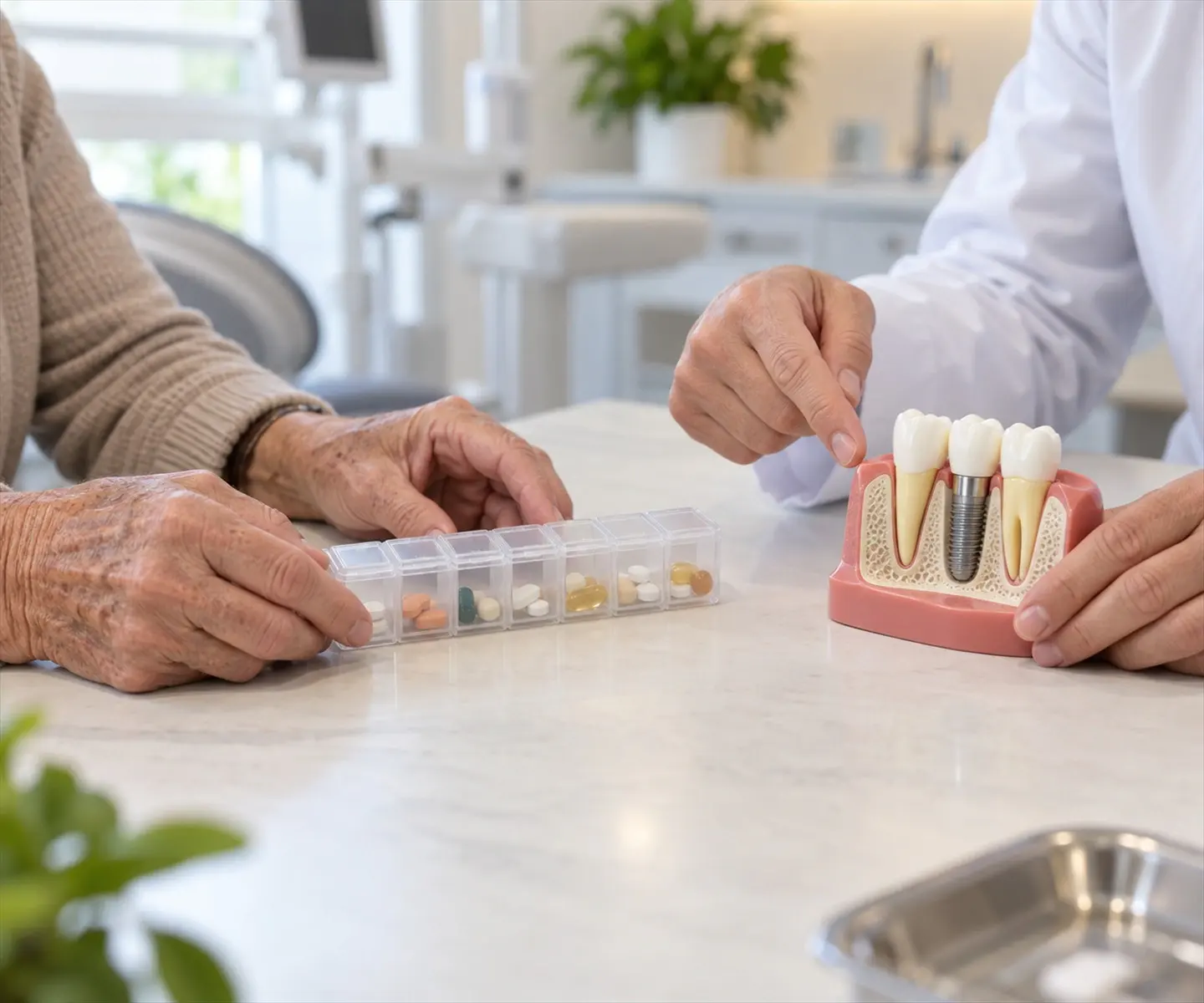
An implant consultation scene with an older patient's pill organizer and an implant model

IMPLANT · MEDICAL CONDITIONS

With a Systemic Condition or Medication, an Implant Has One More Step

In most cases, we can proceed even if you have a chronic condition or take medication. However, depending on the type of medication, a step of checking at the first consultation and coordinating with the prescribing doctor is added.

Medication Check

An implant for someone who takes medication has one more step

Diabetes, blood thinners, and osteoporosis medication are not reasons you cannot get an implant; they are items that we check at the first consultation to set the sequence. At Yeonhap Dental Clinic, we decide this sequence on the first day from your medication list and test values, and we advise that no patient should stop any medication on their own.

Consultation Checklist

What we check at your first consultation

If you take medication, we check the three items below at the first consultation.

  • The full list of medications you take and your HbA1c value from the last 3 months
  • The type of blood thinner and why you take it (whether you have a history of a stent, cerebral infarction, or heart disease)
  • The type of osteoporosis medication, how long you have taken it, and the date of your last injection

By Medication Type

This is how we proceed by type of medication

Diabetes, blood thinners, and osteoporosis medication. These are the three criteria, and adjustments are decided together with the prescribing doctor.

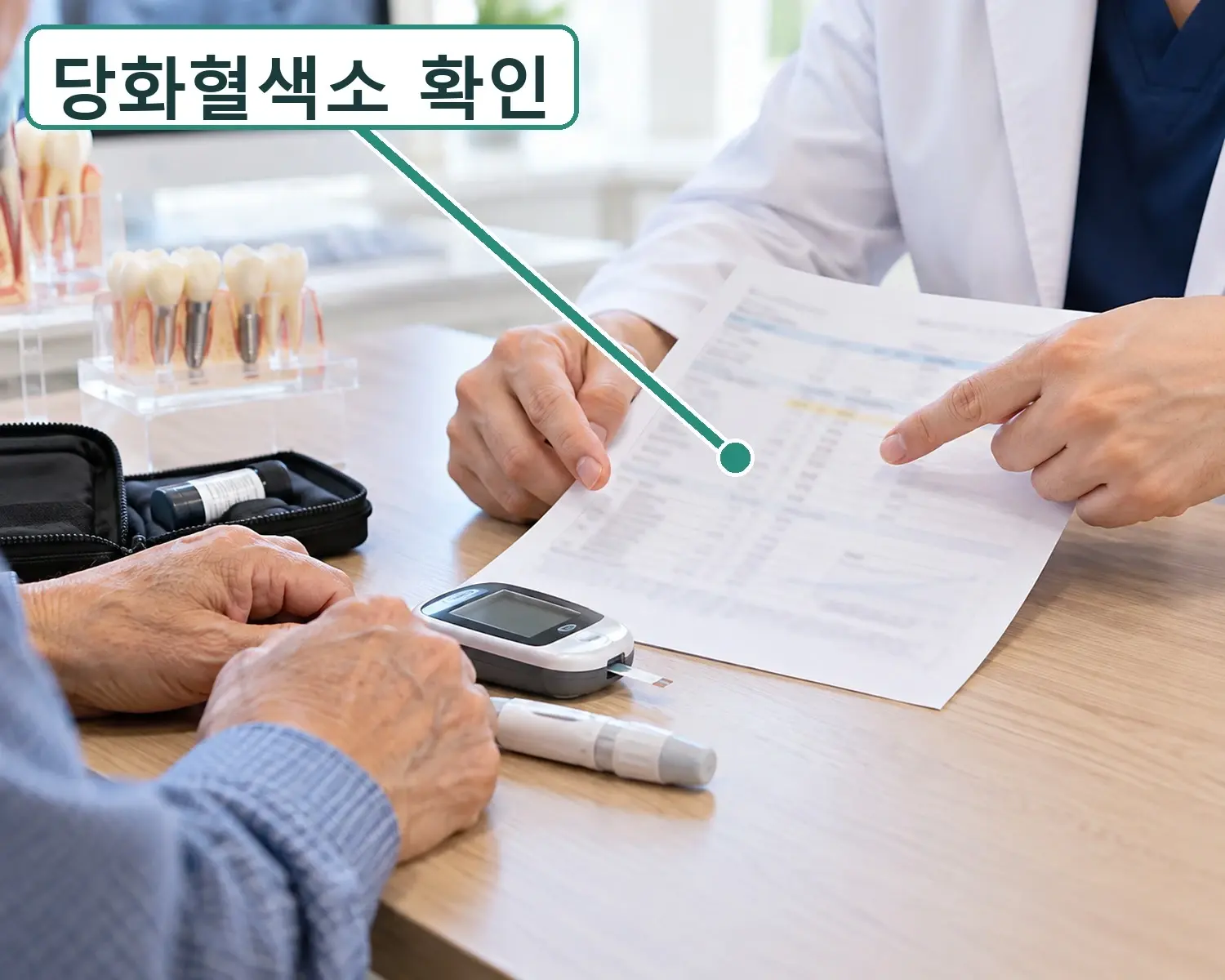
A scene in a dental consultation room explaining to an older patient while looking at a glucose meter and test results together

Diabetes: HbA1c sets the range for proceeding

We set the range for proceeding by your recent HbA1c. In the 7% range, we proceed alongside diet management; in the 8% range, we tell you in advance about the possibility of failure and proceed with stronger management. Well-controlled diabetes is reported to give results similar to those of people without diabetes.

A scene in a dental consultation room checking a patient's medication bag and prescription together

Blood thinners: we check why you take them

We first check why you take it and the extent of the surgery. Whether to stop a medication you are taking is decided in consultation with the prescribing doctor, and if it needs to be continued, surgery is performed while you keep taking it. Warfarin and NOACs are handled the same way, blood pressure medication is taken as usual, and diabetes medication is advised individually depending on the type of drug and your meal plan.

A scene in a dental consultation room setting the surgery date while looking at osteoporosis injection records and a calendar

Osteoporosis medication: we look at the type and duration

For oral osteoporosis medication, we check the duration of use and fracture risk to decide whether to take a drug holiday, and if a holiday is taken, we plan around 2 months. For denosumab, we consider 3-4 months after the last injection, and decide the next injection schedule together with the prescribing doctor. This sequence is meant to lower the risk of osteonecrosis of the jaw.

Timeline and Preparation

From the first day to a month and a half, and the medications we check

Check → adjust → surgery → recovery. The sequence is the same even if you take medication, and the medications we check are defined.

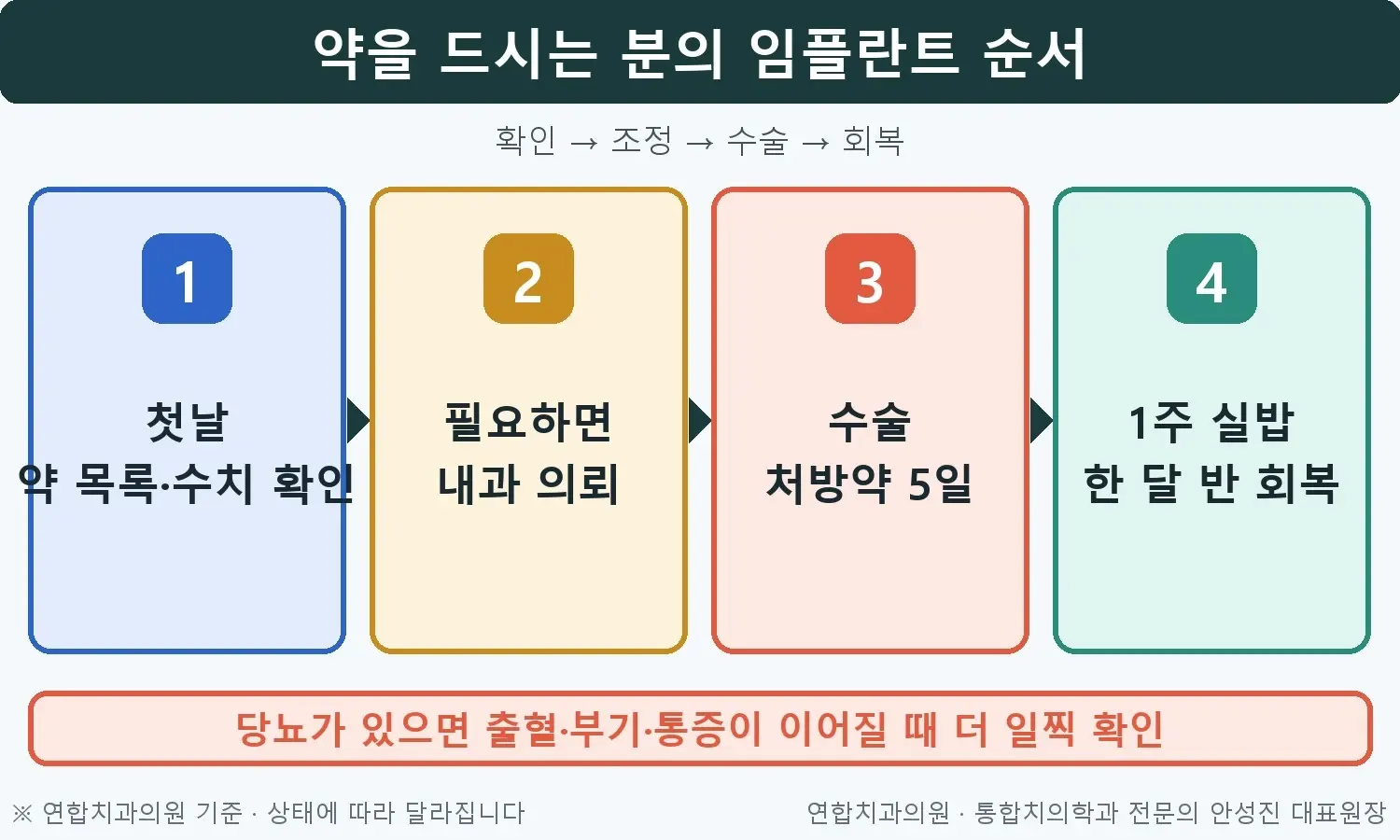
Infographic of the implant sequence for people who take medication: medication list and values on the first day, referral to an internist if needed, surgery, suture check at 1 week and chewing away from the surgical site for about 6 weeks

From the first-day check to a month and a half

If an adjustment is needed, we refer you to your internist, and we advise a 5-day course of prescribed medication after surgery and a suture check at 1 week. For some tooth placements where a fixed provisional prosthesis is not attached right away, you chew away from the surgical site for about 6 weeks. With diabetes, infection can show up later, so if bleeding, swelling, or pain continues, we check sooner.

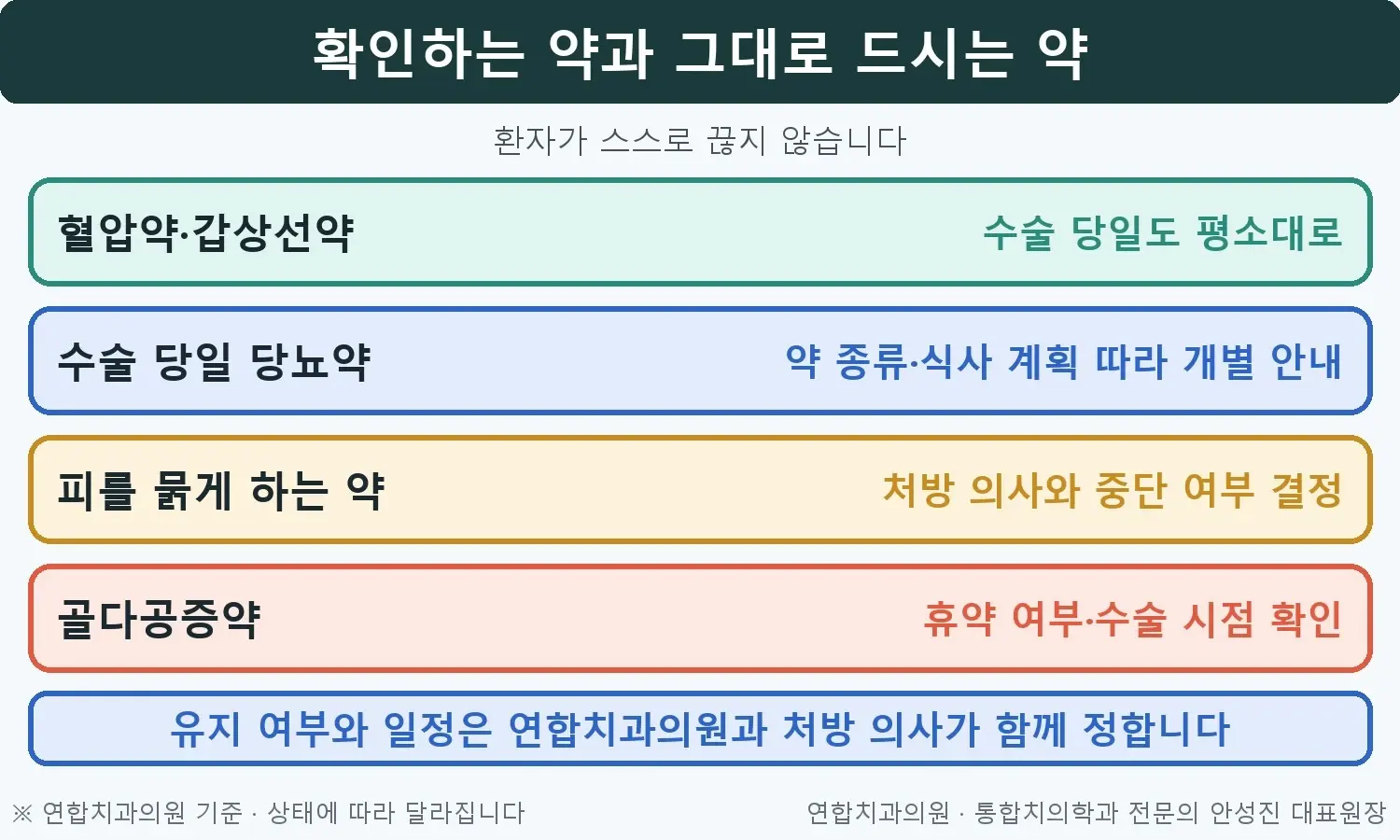
Infographic of medications checked for adjustment and medications continued as usual: blood pressure and thyroid medication as usual; diabetes medication individually advised by drug type and meal and fasting plan; blood thinners and osteoporosis medication checked with the prescribing doctor on whether to continue; patients do not stop on their own

Medications checked for adjustment and medications you keep taking

Blood pressure and thyroid medication are taken as usual, even on the day of surgery. For diabetes medication on the day of surgery, we advise individually after checking the type of drug and your meal and fasting plan, and for blood thinners and osteoporosis medication, we check whether an adjustment is needed. Whether to continue them, and the schedule if a change is needed, are decided together by Yeonhap Dental Clinic and the prescribing doctor, and patients do not stop on their own.

Before Visit

Helpful details before your visit

If you prepare the four items below, the plan can be set on the first day. If you do not have them, we can confirm afterward.

  • Medication list (a prescription or a photo of your medication bag)
  • Your most recent HbA1c value
  • The name of your osteoporosis medication and the date of your last injection
  • Your internist's contact information

Criteria by type of medication, Yeonhap Dental Clinic

Diabetes: HbA1c in the 7% range, we proceed alongside diet management; in the 8% range, we tell you about the possibility of failure and proceed with stronger management. Blood thinners: Whether to stop a medication you are taking is decided in consultation with the prescribing doctor, and if it needs to be continued, surgery is performed while you keep taking it. Dual antiplatelet therapy, warfarin, NOACs, heparin, and the timing of surgery after a stent, myocardial infarction, or stroke are also decided with the prescribing doctor. Osteoporosis medication: For oral bisphosphonates, we decide on a drug holiday by looking at the duration of use and fracture risk (2 months if a holiday is taken), and for denosumab, we consider surgery 3-4 months after the last injection. The schedule for the next injection is also decided. Other chronic conditions: Hypertension and thyroid conditions continue as they are if controlled, dialysis patients are treated the next day, and pregnancy is treated after delivery. For chemotherapy and autoimmune disease, we discuss the plan with the treating doctor; for a prosthetic valve or history of endocarditis, we check on preventive antibiotics; and for acid-suppressing drugs, antidepressants, and smoking, we shorten the check-up interval.

Criteria by type of medication: the evidence and its limits

Diabetes with HbA1c of 7% or lower had results similar to people without diabetes, while above 8% bone loss and inflammatory markers were worse (Shahi 2026). In minor dental surgery, the difference in major bleeding from continuing antiplatelet drugs was not significant, but the certainty of the evidence was very low (Shah 2022), and dental guidelines default to continuing them with local hemostasis (SDCEP 2022). On drug holidays for osteoporosis medication, the 2025 Korean position statement (oral 2 months, denosumab 3-4 months; Kim 2025) and the Asia-Pacific consensus statement saying the evidence for holidays is lacking (Taguchi 2026) differ. Acid-suppressing drugs, antidepressants, and smoking have been reported to be associated with failure (Chrcanovic 2015, 2017). For this reason, Yeonhap Dental Clinic treats the division of how to proceed by HbA1c as its own clinical standard, and decides whether to continue or pause medications and the timing of surgery by checking the type of drug and the patient's condition, consulting the prescribing doctor when needed. References: Shahi 2026, systematic review of implant outcomes in patients with diabetes · Shah 2022, meta-analysis of perioperative management of antiplatelet drugs · SDCEP 2022, dental guidance on anticoagulants and antiplatelet drugs · Kim 2025, Korean position statement on medication-related osteonecrosis of the jaw · Taguchi 2026, Asia-Pacific consensus statement on osteonecrosis of the jaw · Chrcanovic 2015, smoking and implant failure · Chrcanovic 2017, acid-suppressing drugs and implant failure · Chrcanovic 2017, SSRIs and implant failure Treatment results may vary depending on each person's oral condition.

Last updated:

Schedule a consultation by phone or Naver Booking

Leave a few details on our consultation page and we'll get back to you promptly.

Frequently Asked Questions

Q. Can I get an implant if I have diabetes?
Even with diabetes, we proceed with an implant depending on your HbA1c level. If it is in the 7% range, we proceed alongside diet management; if it is in the 8% range, we tell you in advance about the possibility of failure and proceed with stronger management. Well-controlled diabetes is reported to give results similar to those of people without diabetes, and at Yeonhap Dental Clinic we look at your values from the last 3 months and decide the plan on the first day.
Q. Do I need to stop aspirin before an implant?
Whether to stop a medication you are taking is decided in consultation with the prescribing doctor, and if it needs to be continued, surgery is performed while you keep taking it. For blood thinners such as aspirin, we check why you take it and the extent of the surgery together, and for warfarin, NOACs, and heparin as well, we consult the prescribing doctor to confirm whether to continue and what adjustments are needed before surgery. Do not stop any medication on your own; it is decided at the consultation.
Q. I get osteoporosis injections. Can I still get an implant?
Yes, you can. For denosumab injections, we consider surgery 3-4 months after the last injection, and coordinate the healing period after surgery and the date of the next injection with the prescribing doctor in advance. For oral bisphosphonates, we check the duration of use and fracture risk to decide whether to take a drug holiday, and if a holiday is taken, we plan around 2 months. This is the criterion presented in the 2025 Korean position statement, and it is decided together with the prescribing doctor.
Q. Does implant recovery take longer if I take medication?
The basic expected timeline (about 3 months for the lower jaw, 4-6 months for the upper jaw) is the same, but it may vary with how well the condition is controlled and how healing actually goes. With diabetes, infection can show up later, so if bleeding, swelling, or pain continues after surgery, we check sooner. Regardless of whether you take medication, for some tooth placements where a fixed provisional prosthesis is not attached right away, we advise you to chew away from the surgical site for about 6 weeks. For placement on both sides or full-mouth implants, we advise separately depending on the provisional prosthesis and the extent of surgery.
Q. What should I bring to an implant consultation if I take medication?
Four things: a medication list (a prescription or a photo of your medication bag), your HbA1c value from the last 3 months, the name of your osteoporosis medication and the date of your last injection, and your internist's contact information. If you have these four, Yeonhap Dental Clinic decides the implant plan on the first day, and if not, we confirm afterward and decide at your next visit.
Q. I have a cardiac stent. Can I still get an implant?
Yes, you can. However, when it can be done depends on the type and timing of the procedure, so we decide the timing in consultation with the cardiology department. For aspirin as well, we consult cardiology to decide whether to stop it, and if you take aspirin together with clopidogrel, we plan by consulting cardiology on whether to continue the medication and when to operate.