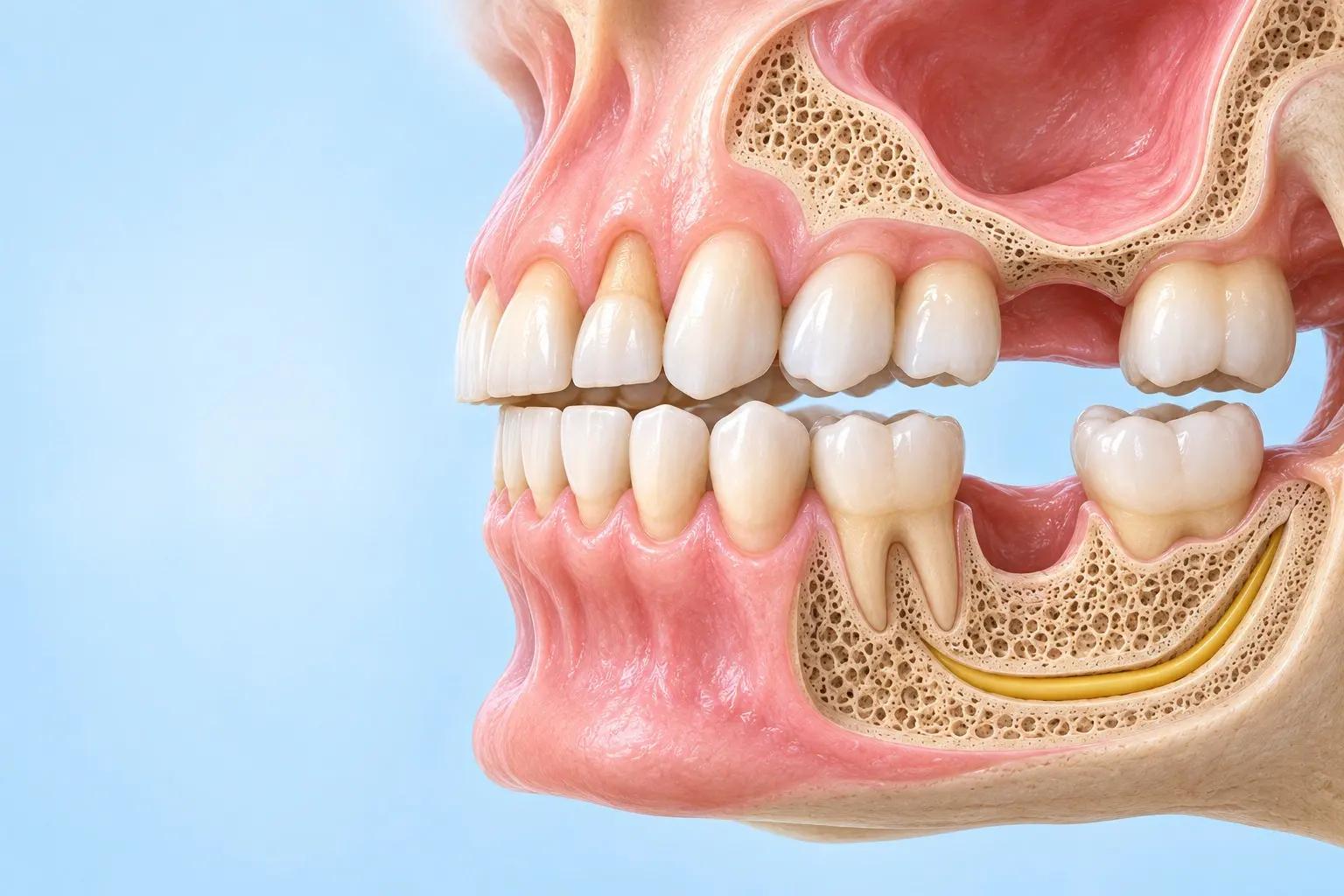
Illustration of the upper and lower jaw in cross-section: a maxillary sinus that has dropped over an empty upper molar site, a nerve canal close to an empty lower molar site, a front tooth with a receded gum line, and a worn front tooth

GWONSEON ADVANCED IMPLANT

Complex Dental Implants Four Things We Check Before Placement

A site with insufficient bone, a site with a receded gum, a site with a lesion in the sinus, and a mouth where the jaw height has dropped and the bite has collapsed. In all four cases, there is one more thing to plan along with placement.

Why Diagnosis Matters

“Complex” does not mean there is no bone; it means there is one more thing to plan together

“Complex” does not mean there is no bone; it means the gum, lesions, and bite must be planned together with placement. At Yeonhap Dental Clinic, we look at four things (insufficient bone, gum, sinus lesions, and bite) and decide what to do first and in what order.

Consultation Checklist

What we check at your first consultation

At the first consultation, we use 3D CT, an oral examination, and a medical history to look at the three items below and decide which case yours is.

  • Cheek-side bone thickness and the height to the sinus and nerve canal (reference values 2 mm, 7 mm, 5 mm)
  • For front teeth, whether the gum line has receded; for molars, whether there is attached gingiva that the toothbrush can reach
  • Whether the sinus looks cloudy (history of sinusitis, nasal symptoms) and whether the jaw height (vertical dimension) has dropped

Treatment Options

Bone, gum, and sinus: each site is handled differently

Bone is resolved by design, gum by grafting, and sinus lesions by irrigation and removal. The bite continues in the treatment plan below.

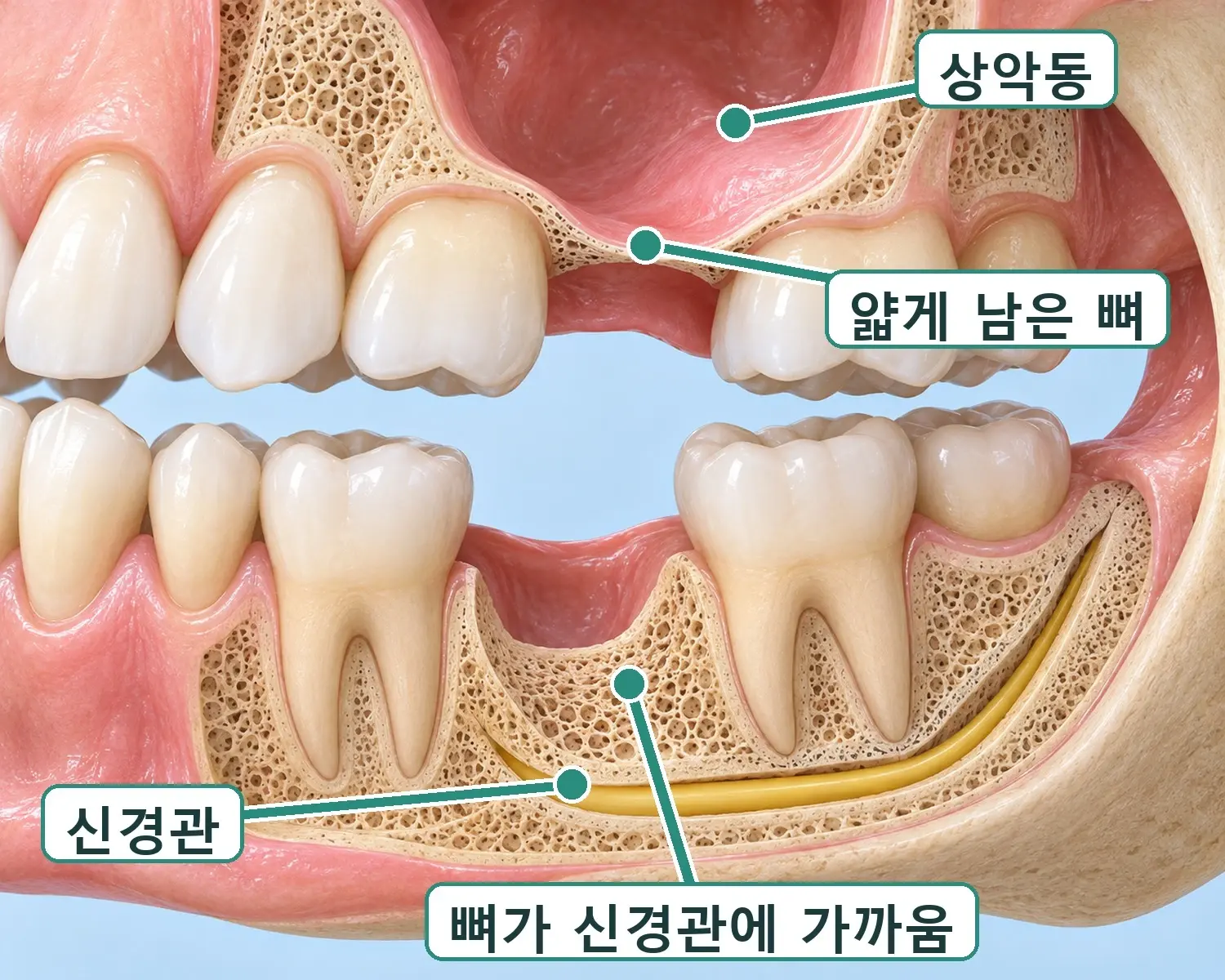
Cross-section diagram of the upper and lower jaw: the maxillary sinus has dropped over an empty upper molar site, leaving thin bone, and the nerve canal runs close below an empty lower molar site

Not enough bone: first, a way to finish within the remaining bone

If the cheek-side bone is under 2 mm, a bone graft is done on the same day as placement; for upper molars, a sinus lift is done if the height to the sinus is under 7 mm; and for lower molars, a short implant is used when a standard-length implant would not leave 2 mm above the nerve canal. We first look for a way to finish within the bone that remains.

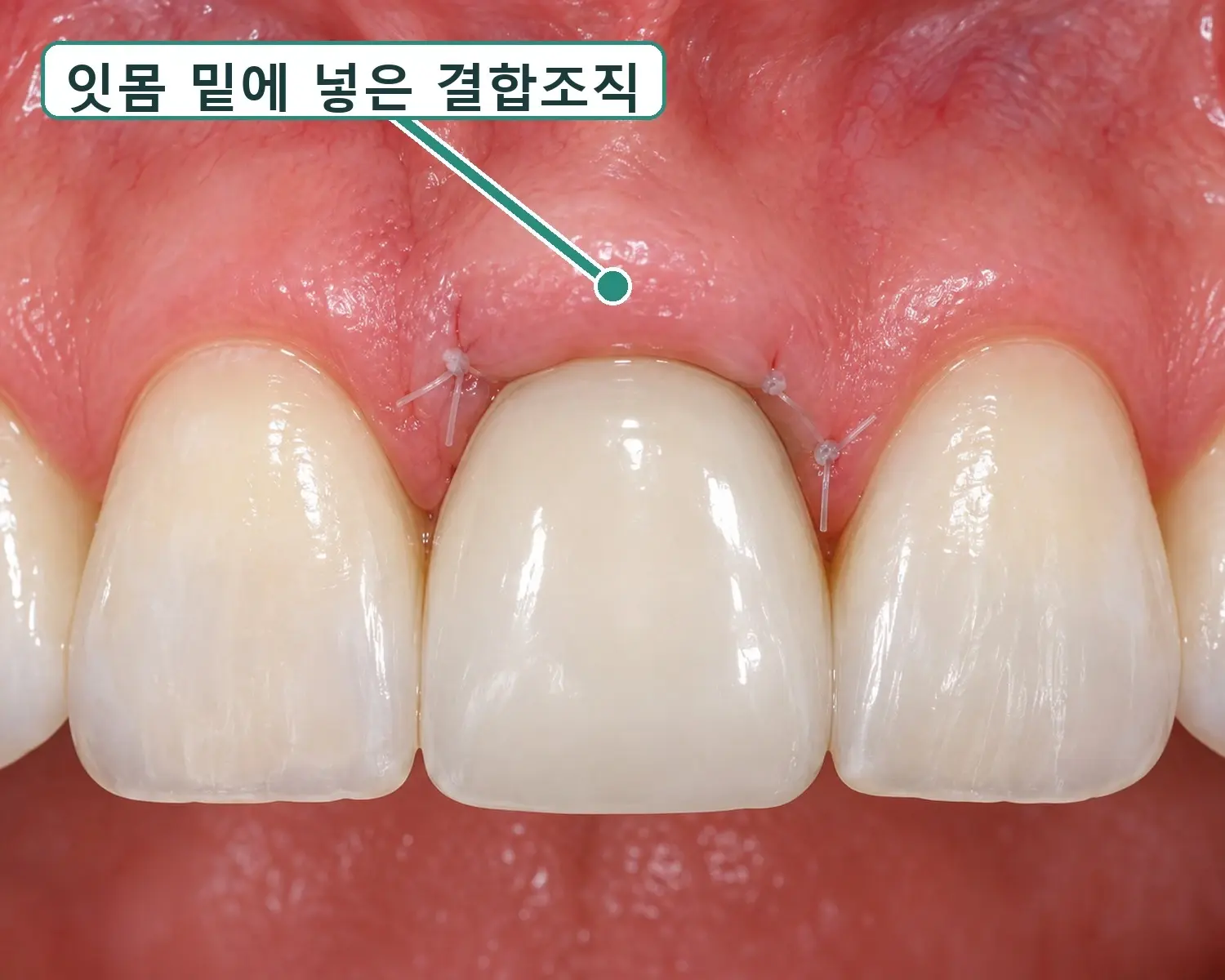
Diagram of a connective tissue graft: connective tissue taken from the palate is placed under the gum at an upper front-tooth implant site with a receded gum line, raising the gum line

Gum: raise it for front teeth, create attached gingiva for molars

For a front tooth whose gum line has receded below the neighboring teeth enough to affect appearance, we raise the gum line with a gum graft on the same day as placement. For a molar, if the attached gingiva needed for cleaning is lacking, we create it with a simple gum procedure (APF) at the second-stage surgery.

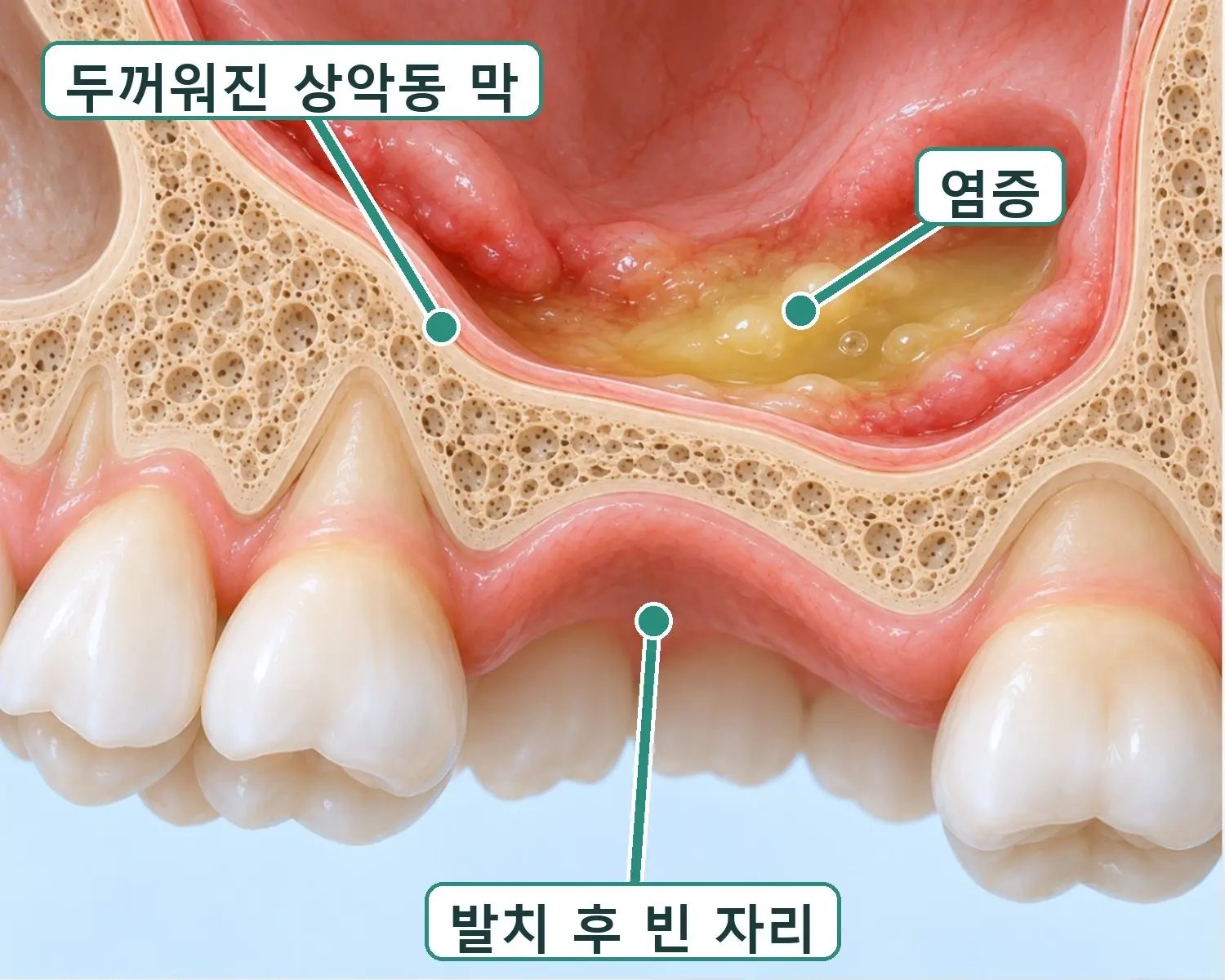
Cross-section diagram of sinusitis at an upper molar, marking the thickened sinus membrane, the inflammation, and the empty space after extraction

Sinus lesion: irrigate or remove it, then continue

For sinusitis, we re-check with CT 3 months after extraction; if it is still present, we give antibiotics for 1 week, and if it still does not settle, we open from the side and irrigate. A fungus ball is aspirated from the side, and if it cannot be removed that way, we open and remove it directly. After irrigation or removal, we check the remaining inflammation and the condition of the membrane, and if we can proceed, we continue with the sinus lift that same day.

Planning Points

We decide the bite and the order before placement

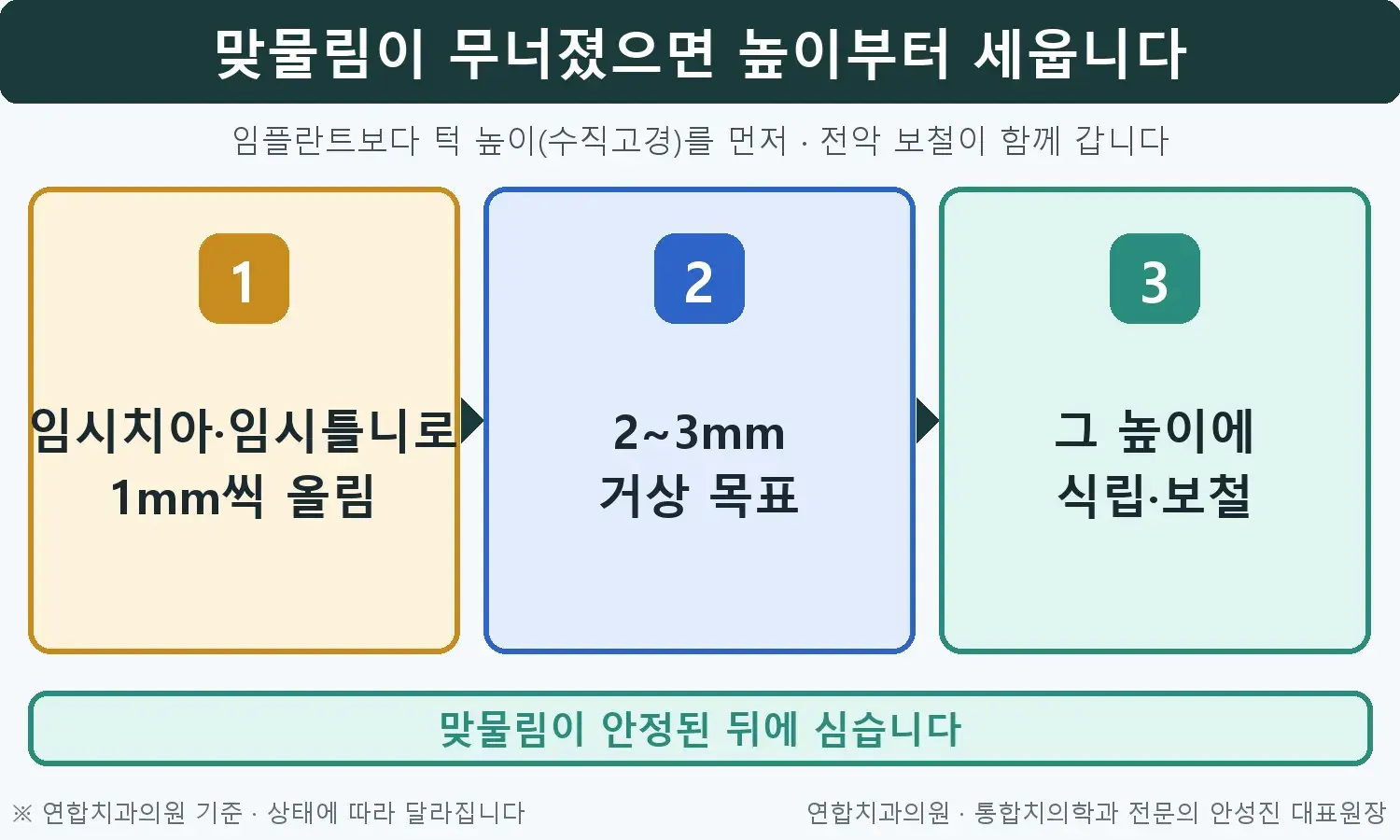
For a mouth where the jaw height (vertical dimension) has dropped and the bite has collapsed, we rebuild the height before the implants, and for sites that cannot be placed on the same day, the order is set in advance.

Infographic on the order of treatment when the bite has collapsed: raise 1 mm at a time with temporary teeth or a temporary denture to gain 2-3 mm, then place implants and make the prosthesis at that height

If the bite has collapsed, we rebuild the height first

If your front teeth are worn and your molars are missing so that your jaw height (vertical dimension) has collapsed, implants are not placed first. We raise the height 1 mm at a time with temporary teeth or a temporary denture, aiming for 2-3 mm, to stabilize the bite first (bite raising), and then place and restore at that height. Because a full-mouth prosthesis goes along with it, this is the most complex case in terms of duration, cost, and difficulty.

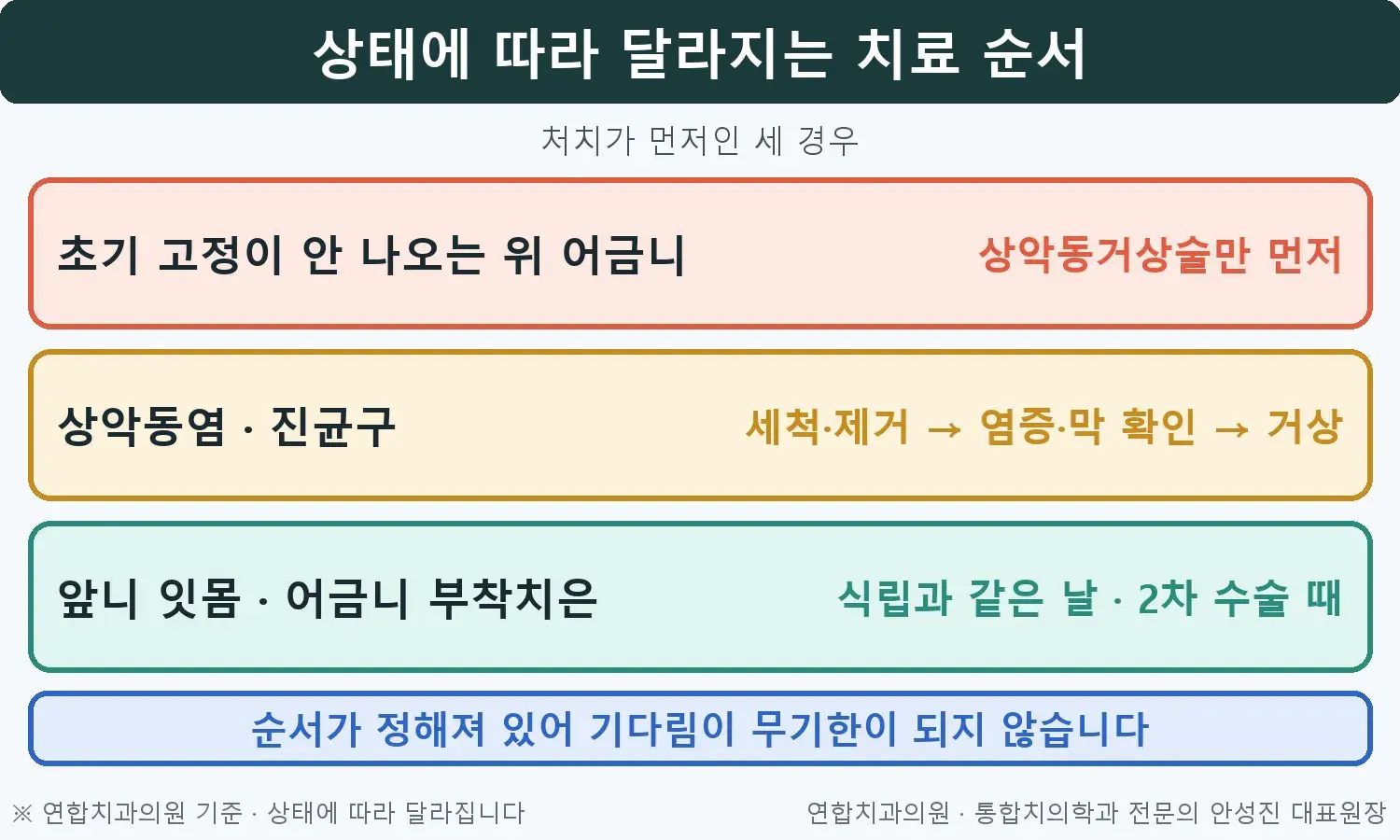
Infographic on treatment order depending on the condition: upper molar without initial stability gets sinus lift first; sinusitis and fungus ball are irrigated or removed, then inflammation and membrane are checked; front-tooth gum on the same day as placement; molar attached gingiva at the second-stage surgery

Treatment order depends on your condition

For an upper molar where initial stability is not achieved, we do the sinus lift alone first and place the implant afterward. For sinusitis and fungus ball, we irrigate or remove them, then check the remaining inflammation and membrane condition before proceeding, and for the front-tooth gum we work on the same day as placement, and for molar attached gingiva at the second-stage surgery. For a lower jaw that needs full-mouth treatment, depending on the bone in the molar area, we use either 6 implants or 4 toward the front, as explained in the All-on-X section.

Before Visit

Helpful details before your visit

If you know the items below before you come, we can tell you at the first consultation which of the four cases applies and the order of treatment.

  • When the tooth was extracted and how much time has passed since
  • Any history of sinusitis, nasal congestion, or runny nose
  • Whether you currently use a denture or bridge, and whether your front teeth have become short from wear
  • Whether you take osteoporosis medication (injection or oral), aspirin, Plavix, etc.

The numbers behind our complex implant criteria, Yeonhap Dental Clinic

Bone: If the cheek-side bone is under 2 mm, a bone graft is done on the same day as placement. For upper molars, a sinus lift is done if the height to the sinus is under 7 mm; for lower molars, 2 mm above the nerve canal is the standard, and if that is not possible we consider a short implant (4-6 mm). As an exception at our clinic, we consider a 4 mm implant for 5 mm of remaining height, and below that we do not plan one. Gum: For a front tooth whose gum line has receded enough to affect appearance, the gum line is raised on the same day with a connective tissue graft (CTG) and coronal advancement of the flap. For molars, if attached gingiva is lacking, an APF is done at the second-stage surgery. Sinus: If sinusitis does not improve with antibiotics, we irrigate from the side, and a fungus ball is removed. If the remaining inflammation and membrane condition allow, we continue with the sinus lift, and if initial stability is achieved, we place the implant together. Bite: If the vertical dimension has collapsed, we raise it 1 mm at a time with temporary teeth or a temporary denture, stabilize at 2-3 mm, then place implants and make a full-mouth prosthesis.

The criteria Yeonhap Dental Clinic follows for complex implants

Sites with a thin cheek-side bone wall are more likely to lose further bone height and have the gum recede during healing, and when a graft was placed on the same day, hard and soft tissues were stable (Monje 2023). In the posterior mandible, short implants had fewer complications than standard implants after vertical bone augmentation, and there was no significant difference in implant failure at 3, 5, and 8 years (Terheyden 2021). The methods and numbers for gum, sinus, and bite are Yeonhap Dental Clinic's own approach. For this reason, Yeonhap Dental Clinic does not place an implant right away based on bone alone; we also look at the gum, any lesions, and the bite, and then decide the plan and the order. What makes a case complex is not whether an implant can be placed, but what has to be done first before placing it. References: Monje 2023, buccal bone wall thickness and changes in peri-implant tissue · Terheyden 2021, meta-analysis of short implants versus vertical bone augmentation Treatment results may vary depending on each person's oral condition.

Last updated:

Schedule a consultation by phone or Naver Booking

Leave a few details on our consultation page and we'll get back to you promptly.

Frequently Asked Questions

Q. I was told I have almost no bone. Can I still get an implant?
It depends on where bone is missing and how much. If the cheek-side bone is thin, a bone graft on the same day; if the upper molar area is low in height, a sinus lift; and if at least 5 mm remains above the nerve canal in a lower molar, a short implant is considered, so most cases can be placed. At Yeonhap Dental Clinic, we rarely perform surgery that builds bone vertically and first look for a way to finish within the bone that remains. For a molar site with less than 5 mm left, we do not plan even a short implant, and in the lower jaw when full-mouth treatment is needed, we change the design to leave that site empty and place implants toward the front.
Q. Can an implant be placed where the gum has receded?
It can be placed, but front teeth and molars are different. For a front tooth whose gum line has receded below the neighboring teeth enough to affect appearance, connective tissue taken from inside the palate is placed under the gum on the same day as placement (connective tissue graft, CTG), and the gum is pulled toward the crown and sutured to raise the gum line. For molars, we give more weight to ease of cleaning and securing attached gingiva than to the height of the gum line, so if there is not enough attached gingiva for the toothbrush to reach, we create it with a simple gum procedure at the second-stage surgery.
Q. Can I get an implant if I have sinusitis?
We do not perform a sinus lift while infection is present, but the wait is not open-ended either. At Yeonhap Dental Clinic, we re-check with CT 3 months after extraction; if it is still present, we give antibiotics for 1 week; and if it still does not settle, we open from the side and irrigate, check the remaining inflammation and the condition of the membrane, and if we can proceed, we continue with the sinus lift that same day. If a fungus ball is suspected, we first try aspiration; if that fails, we open and remove all of it, repair the membrane, check the remaining inflammation and membrane condition, and continue if the sinus lift can go ahead. Implants are placed together when initial stability is secured.
Q. My jaw height has dropped and my bite has collapsed. Can I still get implants?
It can be done, but the implant is not placed first. If the front teeth are worn and the molars are missing so that the jaw height (vertical dimension) has collapsed, we raise it 1 mm at a time with temporary teeth or a temporary denture, aiming for 2-3 mm, to stabilize the bite first, and then place the implants and full-mouth prosthesis at that height. At Yeonhap Dental Clinic, we regard this as the most complex case in terms of duration, cost, and difficulty, and we explain the sequence and timeline first at the initial consultation.
Q. Do complex implants cost a lot more?
The price of the implant itself stays the same, and bone graft material, barrier membrane, sinus lift, and gum graft are added as separate items. Cases in which the bite has collapsed and bite raising and a full-mouth prosthesis go together take the longest and cost the most. At Yeonhap Dental Clinic, we do not include items that are not needed on CT, and we show you on screen which items are added and why, and give you an itemized estimate.