
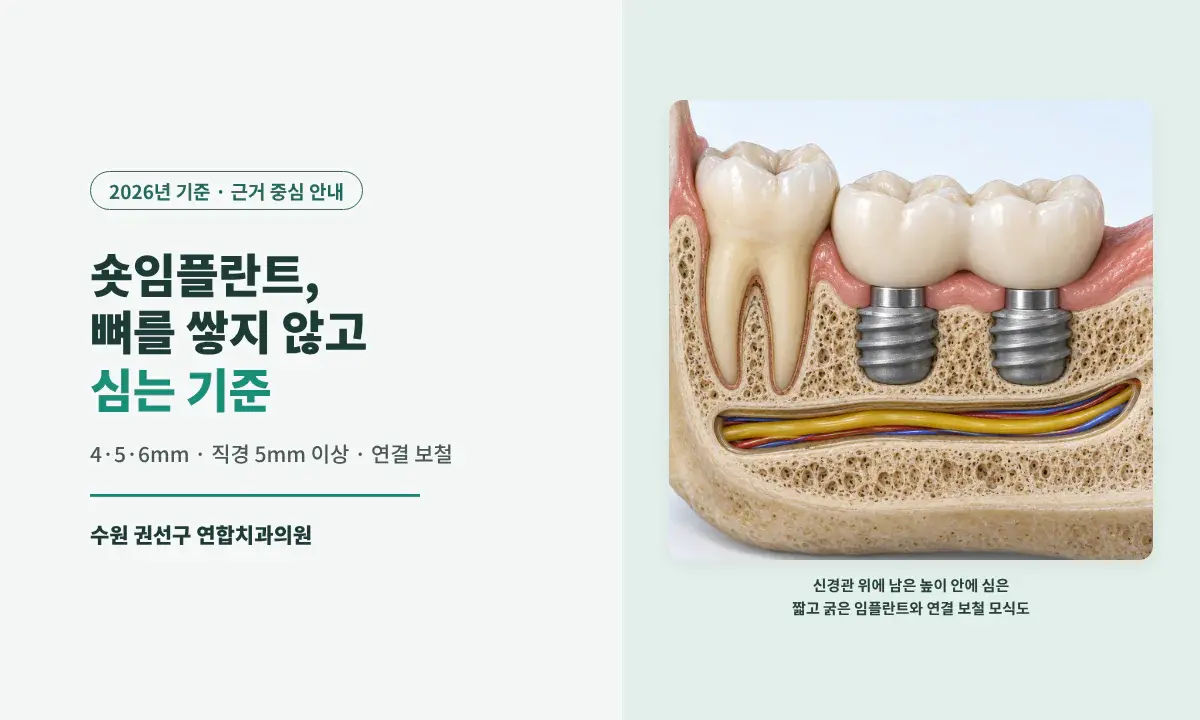
When there is not enough height above the nerve canal in a lower molar, the choices are vertical bone augmentation followed by a standard-length implant, or a short implant placed within the remaining height. In meta-analyses comparing the two, the short implant side had fewer complications and less marginal bone loss, but there are also reviews in which long implants had higher survival. At Yeonhap Dental Clinic in Tap-dong, Gwonseon-gu, Suwon, we consider a short implant 4–6 mm long and 5 mm or more in diameter when a standard length cannot be placed with a 2 mm margin above the nerve canal, and when 5 mm of height remains we apply our clinic's exception of placing a 4 mm implant, leaving a 1 mm margin.
Who are short implants for?
In an implant consultation for a lower molar, hearing that there is not enough bone and bone has to be built up first can make you worry right away that there will be one more surgery and a longer timeline. But building up bone is not the only answer.
[Key Answer]
A short implant is used for patients in whom the bone height above the nerve canal in a lower molar is insufficient to place a standard length. At Yeonhap Dental Clinic in Tap-dong, Suwon, when a length of 7 mm or more cannot be placed with a 2 mm margin above the nerve canal, we consider a short implant 4, 5, or 6 mm long and 5 mm or more in diameter instead of bone-building surgery.
[4-Line Summary]
· In lower molars, the length cannot be increased because of the nerve canal, so when height is insufficient we consider a short implant first.
· Yeonhap Dental Clinic's short implants are 4, 5, or 6 mm long and 5 mm or more in diameter, and if there is an implant next to them, we connect the crowns.
· A 2 mm margin above the nerve canal is the standard, and for short implants we have a clinic exception of placing a 4 mm implant where 5 mm of height remains, leaving a 1 mm margin.
· In upper molars the floor of the maxillary sinus can be raised, so we consider a sinus lift rather than a short implant.
Written by: Dr. Ahn Seong-jin, Chief Director, Yeonhap Dental Clinic
[Table of Contents]
· Why do we use short implants in lower molars?
· How long is a short implant, and why do we increase the diameter?
· How does Yeonhap Dental Clinic in Tap-dong, Suwon decide the margin above the nerve canal?
· Why do we use a sinus lift instead of a short implant in upper molars?
· Why is a short implant prosthesis connected to the neighboring implant?
The purpose of a short implant is not to place something small but to finish treatment within the remaining height without vertical bone augmentation (surgery that builds bone upward). Vertical bone augmentation builds bone with graft material and a barrier membrane, which means a larger surgical area and a longer timeline, along with the burden of graft exposure and infection.
This article explains in turn when short implants are used in lower molars, how length, diameter, and the nerve canal margin are decided, why upper molars are handled differently, and why the prosthesis is connected. Bone grafting in general is covered in Implant Bone Grafts: When and How.
Why do we use short implants in lower molars?
In lower molars the length cannot be increased because of the nerve canal, and the bone quality is good, so it is a site where even a short implant has a favorable chance of achieving primary stability.
The inferior alveolar nerve runs through the lower jaw. If an implant touches this nerve, abnormal sensation can occur in the lip and chin, so Yeonhap Dental Clinic's standard is to leave 2 mm between the tip of the implant and the nerve canal when placing a standard length (7 mm or more). When bone resorption means a standard length cannot be placed while keeping this distance, we first consider reducing the length rather than building bone. Placement criteria for lower molar sites in general are summarized in Molar Implants.
Bone quality is also a reason. The lower jaw molar area has a higher proportion of dense cortical bone than the upper jaw, so primary stability tends to be good. Primary stability is especially important for short implants because they have a small area in contact with bone, and the lower jaw offers favorable conditions for that.
Studies also support this choice. In a meta-analysis of randomized controlled trials comparing short implants of 7 mm or less with long implants after vertical augmentation in the posterior mandible (Terheyden 2021), the short implant side had a lower risk of complications (RR 0.34) and less marginal bone loss, by 0.32 mm at 3 years, 0.65 mm at 5 years, and 0.88 mm at 8 years. Implant failure showed no significant difference at 3, 5, or 8 years, and the authors concluded that the outcomes of the two methods are similar over the first 5 years.
In a meta-analysis looking at atrophic jaws as a whole (Yang 2016, 6 randomized controlled trials, 837 implants), the augmentation group also had more failures (p=0.006), complications (p=0.01), and marginal bone loss (p=0.0004). However, the abstract does not separate the site or the augmentation method, so we do not read it directly as results for 4–6 mm implants in lower molars.
How long is a short implant, and why do we increase the diameter?
Yeonhap Dental Clinic's short implants are 4, 5, or 6 mm long and 5 mm or more in diameter, and 7 mm or more is considered a standard length.
The length criterion for short implants differs from study to study. Definitions of 6 mm or less, 7 mm or less, 8 mm or less, and 8.5 mm or less are all in use, so when reading figures in a paper you need to check up to which length that study counted as a short implant.
When we reduce length, we increase diameter. The area where an implant contacts bone is determined not only by length but also by diameter, so the design compensates with diameter for the support area lost in length. A short, narrow implant and a short, wide implant are completely different conditions.
This does not mean that short implants are the same as long ones. In a review of randomized controlled trials comparing short implants of 6 mm or less with implants longer than 6 mm (Emfietzoglou 2024, 16 trials), the survival rate of long implants was significantly higher, and the 95% confidence interval of the difference was 2–5 percentage points. There was no difference in marginal bone loss, peri-implantitis, or technical complications. That is why Yeonhap Dental Clinic places a standard length when there is height for one, and uses short implants in situations where bone would otherwise have to be built up.
The studies cited in this article did not directly verify our clinic's combination of 4–6 mm length and diameter of 5 mm or more. This combination is our clinic's clinical standard.
Comparison of study results for short and long implants
| Item | Short implants | Long implant comparison group in each study |
|---|---|---|
| Surgery | Placement within the remaining height | Additional surgery when augmentation is needed |
| Complications | Lower risk (RR 0.34, Terheyden) | Higher than with short implants |
| Marginal bone loss | Less by 0.32 mm at 3 years, 0.65 mm at 5 years, 0.88 mm at 8 years (Terheyden) | More than with short implants |
| Implant failure | No significant difference at 3, 5, and 8 years (Terheyden) | No significant difference at 3, 5, and 8 years |
| Atrophic jaws as a whole | Fewer failures, complications, and bone loss (Yang) | More: failure p=0.006, complications p=0.01, bone loss p=0.0004 |
| Comparison with concurrent augmentation | Reported survival 93.91%, 0.513 mm less bone loss (Abayov) | Reported survival 91.83% (augmentation methods and placement timing mixed) |
| Comparison including native bone | Lower survival (95% confidence interval of the difference 2–5 percentage points, Emfietzoglou) | Higher survival |
| Remaining osseointegrated length at 5 years | 2.94–4.44 mm (Terheyden) | 7.97–8.62 mm |
How does Yeonhap Dental Clinic in Tap-dong, Suwon decide the margin above the nerve canal?
The standard is 2 mm, and only for short implants do we have a clinic exception of placing a 4 mm implant where 5 mm of height remains, leaving a 1 mm margin.
We measure the remaining height to the nerve canal on a 3D CT, and if a standard length (7 mm or more) can be placed while leaving 2 mm between the implant tip and the nerve canal, we place the standard length. When that margin cannot be obtained, we consider a short implant.
For short implants, we sometimes leave a margin smaller than 2 mm. If 5 mm of height remains above the nerve canal, we place a 4 mm implant, and the margin is 1 mm. This is our clinic's clinical judgment, distinct from the standard of 2 mm.
In this case the implant site is prepared with a CAS drill, advancing 1 mm at a time. The studies cited in this article did not directly verify the safety of this method or of a 1 mm margin.
The minimum height is 5 mm. If 5 mm does not remain above the nerve canal, we do not plan a short implant either. In cases treated at our clinic, most patients who did not have even 5 mm in a lower molar also had few remaining teeth or poor gum condition, close to a state in which all teeth were lost. In that case, we consider an All-on-4 design that treats the whole arch, leaves the molar area empty, and places implants in the four front positions. How the design changes with the height above the nerve canal in the lower full arch is summarized in Full-Mouth Implants in Gwonseon-gu.
Why do we use a sinus lift instead of a short implant in upper molars?
In upper molars the floor of the maxillary sinus can be raised to create height, so at these sites Yeonhap Dental Clinic considers a sinus lift rather than a short implant.
The nerve canal of the lower jaw is a boundary that cannot be crossed, but in the upper jaw the floor membrane of the maxillary sinus can be lifted to create bone space beneath it. That is why our clinic chooses to place implants of 7 mm or more in upper molars.
Another reason our clinic considers is that the back of the upper jaw has softer bone than the lower jaw, which is unfavorable for obtaining primary stability with a short implant that has a small contact area with bone.
This is Yeonhap Dental Clinic's selection criterion and does not mean that short implants in the upper jaw are impossible or generally inferior. When and how a sinus lift is done is covered in Sinus Lift: Yeonhap Dental Clinic's 3 Treatment Criteria.
Why is a short implant prosthesis connected to the neighboring implant?
When there is an implant next to a short implant, Yeonhap Dental Clinic finishes with a connected prosthesis, and when placing only one, we adjust the bite more precisely.
A short implant has a short portion embedded in bone, while the height of the prosthesis on top stays the same. That is why our clinic chooses a connected prosthesis, taking into account load distribution that shares chewing force among several implants.
The literature's conclusions differ depending on the subjects. A review that looked only at short implants of 8.5 mm or less (Li 2022, 1,506 implants) found no difference in survival, marginal bone loss, or mechanical complications between splinted and non-splinted. A review of adjacent posterior implants without a length restriction (Pascoal 2025, 2,085 implants) found more mechanical complications on the non-splinted side (RR 0.37). A connected prosthesis is not something the literature has concluded; it is the approach our clinic chose after looking at these results.
When there is no implant next to it to connect to, we also place a single short implant. In that case we adjust the height so that when you bite down firmly, Shimstock (a very thin film for checking the bite) pulls out and only articulating paper makes contact, and we always eliminate lateral interference that catches when the jaw moves sideways.
A connected prosthesis does not allow floss to pass through, so we also explain how to use interdental brushes or Super Floss.
Criteria for applying short implants (Yeonhap Dental Clinic)
| Item | Clinic standard | Relationship to the literature |
|---|---|---|
| Definition of a short implant | Length 4, 5, or 6 mm | Definitions in the literature vary from 6 to 8.5 mm or less |
| Diameter | 5 mm or more | No results in the cited literature split by this condition |
| Main site of application | Lower molars | Terheyden studied the posterior mandible |
| Margin above the nerve canal (standard) | 2 mm, planning standard for a standard length (7 mm or more) | Clinic standard |
| Margin above the nerve canal (exception) | For short implants, less than 2 mm allowed; 4 mm where 5 mm remains → 1 mm margin | Not verified in the cited literature; clinic clinical judgment |
| Minimum height | At least 5 mm above the nerve canal. Below that, we do not plan a short implant at that site, and where full-arch treatment is needed we consider an All-on-4 design | Clinic standard |
| Drilling | Advance 1 mm at a time with a CAS drill | Clinic technique |
| Prosthesis | Connected to the neighboring implant; when single, bite adjusted so Shimstock pulls out and lateral interference is eliminated | No difference in the review limited to short implants (Li); more mechanical complications when non-splinted in posterior implants overall (Pascoal) |
| Upper molars | Sinus lift instead of a short implant, 7 mm or more | Clinic selection criterion |
5 things to check when consulting about short implants in Gwonseon-gu and Tap-dong, Suwon
If you have been told you do not have enough bone, the standard for a consultation is whether you also heard about options other than a bone graft and their limits.
· Whether they explain, with CT measurements, whether it is height or width that is lacking and how many millimeters remain to the nerve canal
· How many millimeters of margin above the nerve canal they plan, and whether they distinguish the standard from the exception
· Whether they decide the length and diameter of the short implant together
· Whether they explain if the prosthesis will be connected and, if so, how to clean it
· Whether they also explain the limits of short implants and the other options (augmentation, full-arch design)
[Key Takeaways]
✓ When a standard length cannot be placed with 2 mm above the nerve canal in a lower molar, we consider a short implant 4, 5, or 6 mm long and 5 mm or more in diameter.
✓ For short implants, our clinic has an exception of placing a 4 mm implant where 5 mm remains, leaving a 1 mm margin, and below 5 mm we do not plan a short implant either.
✓ In studies comparing with vertical augmentation, the short implant side had fewer complications and less marginal bone loss, but there are also reviews in which long implants had higher survival.
A Few Words from the Treatment Room About Short Implants
I do not decide on a bone graft right away just because a lower molar lacks bone. First, on CT, I look at the remaining height to the nerve canal and the width of the bone together. My judgment takes into account whether I can secure thickness even if I reduce the length, and whether the implant can be connected to a neighboring one. If it is a site where only one implant can go, I adjust the bite more precisely. I do not force an implant into a site that has less than 5 mm above the nerve canal. Most such patients also have few other teeth left, so we change the plan to full-arch treatment such as All-on-4, and for a site where only one or two molars are missing I would consider a partial denture rather than an implant, but I have not actually met such a case, and in most cases the plan was settled on short implants. This is why the treatment I recommend can differ even when two patients have both been told "there isn't enough bone."
References
Treatment Information
This post was written in compliance with the Korean Medical Service Act and the Ministry of Health and Welfare's medical advertising guidelines, and is intended to provide medical information. It does not guarantee or assert the result of any specific treatment. The methods that can be applied and the course of treatment differ from person to person depending on the remaining bone height above the nerve canal, bone quality, and general health, so please be sure to consult fully with your dental team before deciding on diagnosis and treatment direction.
📋 Treatment Information
🦷 Short implant information: Molar Implants in Suwon
📍 5th Floor, 230 Geumho-ro, Gwonseon-gu, Suwon, Gyeonggi-do (Tap-dong, Cham Clinic Building)
🚕 Across from Suwon NongHyup Guun Branch (231 Geumho-ro) / about 15 minutes by taxi from Suwon Station
🚗 Free parking available in the building
📞 031-293-2207
🌐 yeonhapdental.com
🟡 Opened in 2002 / Treatment overseen by Dr. Ahn Seong-jin, Chief Director and Integrated Dentistry specialist
🔗 Online booking and consultation
Short Implants: Frequently Asked Questions
- How long is a short implant?
- The definition differs from study to study, and anything from 6 mm or less up to 8.5 mm or less is used. Yeonhap Dental Clinic's short implants are 4, 5, or 6 mm long and 5 mm or more in diameter, and 7 mm or more is considered a standard length.
- Is a short implant also placed 2 mm away from the nerve canal?
- The 2 mm margin above the nerve canal is the standard when planning a standard length, and we consider a short implant when that margin cannot be obtained. For short implants, at our clinic's discretion we sometimes leave a margin smaller than 2 mm. If 5 mm of height remains above the nerve canal, we place a 4 mm implant, and the margin becomes 1 mm. The studies cited in this article did not directly verify the safety of this exception.
- How much bone has to remain for a short implant?
- Yeonhap Dental Clinic plans a short implant only when at least 5 mm remains above the nerve canal, and below that we do not plan a short implant at that site. In cases treated at our clinic, most of these patients also had few remaining teeth or poor gum condition, and we considered an All-on-4 design that treats the whole arch, leaves that molar area empty, and places implants in the four front positions.
- Isn't it a loss to get a short implant instead of a bone graft?
- It depends on what it is compared with. In studies comparing with augmentation, the short implant side had fewer complications and less marginal bone loss, and in the posterior mandible meta-analysis the difference in failure at 3, 5, and 8 years was not significant. On the other hand, in a comparison that included long implants in native bone, the survival of long implants was significantly higher (95% confidence interval of the difference 2–5 percentage points).
- Are short implants used only in lower molars?
- Yeonhap Dental Clinic mainly uses them in lower molars. In upper molars the floor of the maxillary sinus can be raised to create height, so we consider a sinus lift instead of a short implant and place 7 mm or more. This is our clinic's selection criterion and does not mean that short implants in the upper jaw are impossible.
- Why is a short implant connected to the neighboring implant?
- A short implant has a short length embedded in bone, so when there is an implant next to it, Yeonhap Dental Clinic chooses a connected prosthesis, taking load distribution into account. When there is no implant next to it to connect to, we also place a single one, but we adjust it so that Shimstock pulls out and only articulating paper makes contact, and we always eliminate lateral interference. In a review of short implants of 8.5 mm or less, there was no significant difference between splinted and non-splinted, and in a review of posterior implants overall, the non-splinted side had more mechanical complications.
- Aren't short implants weak?
- Support is not determined by length alone. The area in contact with bone is also determined by diameter, so Yeonhap Dental Clinic uses a diameter of 5 mm or more for short implants. However, the 6 studies cited in this article did not directly verify the long-term results of our clinic's combination of length, diameter, and connected prosthesis. That is why we monitor progress with regular check-ups.
Related pages
Before your visit
This article provides general information on oral health and dental care. Whether treatment is needed, and which method is appropriate, may change after an oral exam and any necessary diagnostic tests. If you have pain, a loose tooth, swelling, or discomfort with a prosthesis, please visit us for a consultation.