
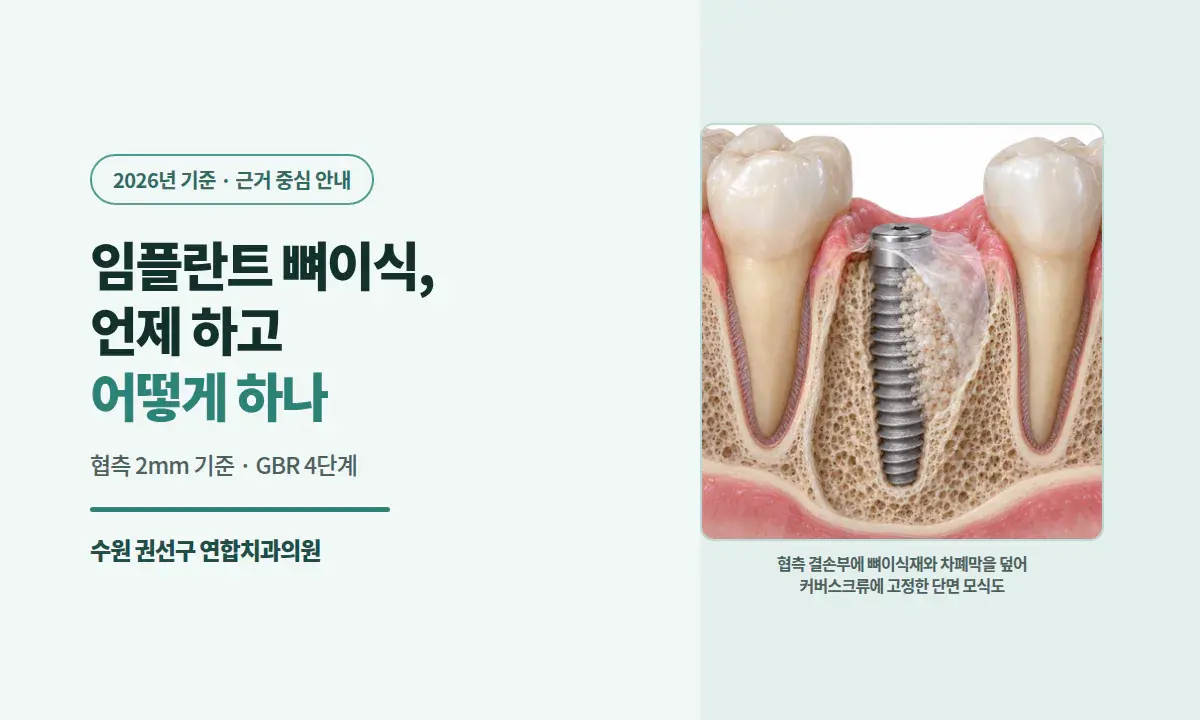
When you hear at an implant consultation that a bone graft is needed, the first worry is that the surgery will get bigger. Yeonhap Dental Clinic in Gwonseon-gu, Suwon first uses 3D CT to check whether a position can be found that leaves 2 mm of bone on the cheek side of the implant and 1.5 mm on the tongue side, and if so, we do not graft. A report that marginal bone loss decreased significantly as bone thickness approached 1.8 to 2 mm is the basis for this standard (Spray 2000), and when a graft is needed, we do it on the same day as placement in four steps: decortication, xenograft, barrier membrane, and fixation.
When is a bone graft needed for an implant?
It is needed when the thickness of bone surrounding the implant does not reach the standard value.
[Key Answer]
An implant bone graft is needed not because the jawbone is lacking, but when the bone surrounding the implant does not reach 2 mm on the cheek side and 1.5 mm on the tongue side. Yeonhap Dental Clinic in Gwonseon-gu, Suwon first uses 3D CT to look for a site that gives these values by varying the position and angle of placement, and if one is found, we do not graft.
[Summary in 4 Lines]
· Yeonhap Dental Clinic first checks with 3D CT whether a site is available that leaves 2 mm on the cheek side and 1.5 mm on the tongue side, and if it can be secured, we do not do a bone graft.
· Based on a report that marginal bone loss decreased as the buccal bone thickness from placement to second-stage surgery approached 1.8 to 2 mm (Spray 2000), Yeonhap Dental Clinic uses 2 mm as the standard for deciding whether to graft.
· A graft is a means of bringing the thickness up to the standard value; it is not a procedure to add more on a site that already reaches it.
· If a graft is needed, we proceed in four steps: decortication, xenograft, barrier membrane, and fixation.
Written by Dr. Ahn Seong-jin, Chief Director, Yeonhap Dental Clinic
[Contents]
· When is a bone graft needed for an implant?
· Why is 2 mm the standard in implant bone grafting?
· How do you know when a bone graft is not needed?
· If an implant bone graft is needed, how is it done?
· Why does the membrane covering the bone graft material need to be fixed?
· Are there cases where it is better not to do an implant bone graft?
When people hear at an implant consultation that their bone is lacking, most worry first that the surgery will get bigger. In fact, a bone graft widens the extent of surgery and adds the possibility of complications such as graft exposure or infection. That is why we need to first sort out whether it is needed at all.
Yeonhap Dental Clinic decides this with a single measurement: whether there is a position where, once the implant is placed, 2 mm of bone remains on the cheek side and 1.5 mm on the tongue or palate side. If a site that secures this thickness can be found, we do not graft.
The order matters here. It is not “the bone is lacking, so we graft”; we first check whether, when thickness, position, and angle are designed in three dimensions, there is a site that gives the standard value. This is because even in the same jawbone, the thickness that surrounds the implant changes if the position and angle of placement change.
Why is 2 mm the standard in implant bone grafting?
It is based on a primary study showing that bone loss decreased significantly as bone thickness approached 1.8 to 2 mm.
When the bone surrounding an implant is thin, it is more likely to resorb over time. In a study that directly measured the buccal bone thickness at placement of more than 3,000 implants and followed them to the second-stage surgery, marginal bone loss decreased significantly as the remaining thickness approached 1.8 to 2 mm, and bone gain was even observed in some (Spray 2000).
However, this threshold is not given the same value in every study. A systematic review that synthesized buccal bone thickness and changes in the tissue around implants states that the definition of the critical thickness is inconsistent across studies, but also concludes that greater vertical bone loss and mucosal recession on thin buccal bone walls are consistent across clinical and preclinical data (Monje 2023). So 2 mm is not a single correct answer settled by the literature; it is a baseline we have set on the safe side.
For this reason, Yeonhap Dental Clinic uses 2 mm not as a margin that is nice to have but as a threshold we do not go below. The literature does not guarantee this value as a safety boundary; it is the standard our clinic set after seeing consistent reports of greater bone loss and gum recession on thin cheek-side bone.
So this is how Yeonhap Dental Clinic sees the nature of a graft. A graft is a means of bringing the thickness to 2 mm when it does not reach it; it is not a procedure to add more on a site that already reaches it. If a site that gives the standard value has been found, there is no reason to add graft material on top of it.
The tongue-side 1.5 mm is set lower than the cheek side. The cheek side is relatively thin and vulnerable to resorption, so the standard is set higher there.
Measurements used to decide on an implant bone graft
| Measurement item | Standard value | Basis and meaning |
|---|---|---|
| Buccal (cheek-side) bone thickness | 2mm | Marginal bone loss decreases the closer it is to 1.8 to 2 mm (Spray 2000, placement to second-stage surgery) · our clinic's standard |
| Lingual or palatal bone thickness | 1.5mm | Less vulnerable to resorption than the cheek side, so a lower standard is applied |
| How it is checked | 3D CT three-dimensional analysis | Thickness simulation while varying the position and angle of placement |
| Decision | Placement without a graft if the standard is met | A graft is a means of reaching the standard |
How do you know when a bone graft is not needed?
We use 3D CT to look for a site that gives the standard value while varying the position and angle of placement.
It cannot be known from a panoramic X-ray, because a two-dimensional image does not show the thickness on the cheek and tongue sides. This is why Yeonhap Dental Clinic measures with 3D CT.
The measurement is not simply measuring the amount of remaining bone. Even at the same site, the thickness that surrounds the implant differs with the position and angle at which it is placed, so the task is to find whether a combination exists that gives the standard value. The choice of diameter also comes in. A wider implant increases the supporting area but makes the surrounding bone thinner, so both values are considered together.
However, the range in which the position can be moved is within the cheek-to-tongue width of the opposing teeth. Going beyond it puts chewing force on the implant at an angle, and in that case we do not avoid grafting. For a front tooth placed on the day of extraction, the gap on the cheek side is filled with graft material rather than being replaced by repositioning.
When height is lacking, the answer differs by site. For lower molars, the length cannot be increased because of the nerve canal, so instead of stacking bone vertically, we consider short implants with a diameter of 5 mm or more and lengths of 4, 5, or 6 mm. For upper molars, height is created with a sinus lift.
If the standard value still cannot be reached after this process, we then plan a graft. With this order, a graft does not become the default.
The same standard value is also used when deciding placement depth. In what order 2 mm on the buccal side and 1.5 mm on the lingual side are secured is covered in What Decides Implant Placement Depth?.
If an implant bone graft is needed, how is it done?
Yeonhap Dental Clinic proceeds in four steps: decortication, xenograft, barrier membrane, and fixation.
First is decortication. Several small holes are made in the outer cortical bone of the graft site. This creates a pathway for blood and cells from the inner cancellous bone to reach the graft material.
Here it is better to state the evidence precisely. In a human study comparing cortical perforation versus none, new bone volume was higher in the perforated group, 27.8% versus 25.3%, but the difference was not statistically significant (p=0.13). On the other hand, the number of microvessels was significantly higher in the perforated group (p=0.01). In other words, the confirmed effect of this technique is not so much that more bone forms as that blood supply is opened up. Graft material is not living tissue on its own, so it begins to be replaced by new bone only after blood vessels grow in.
Second is the xenograft. We use bovine bone that has been mineral-processed. This material degrades slowly and so keeps its volume for a long time, and implants placed in bone grafted with particulate graft material and a collagen membrane are reported to have a high survival rate (review of 20 studies, Wessing 2018). We do not harvest autogenous bone from another site; we mix in bone fragments collected when drilling the implant site at a low speed of 50 rpm without water.
Third is the barrier membrane. The graft material is covered with a resorbable barrier membrane. Soft tissue of the gum grows much faster than bone, so without a membrane the gum fills the space where bone should form first. Yeonhap Dental Clinic uses a resorbable membrane of the acellular dermal type (MegaDerm PLUS).
Fourth is fixation. This part is discussed separately in the next section.
A bone graft is done on the same day as implant placement. We do not do staged surgery, where the graft is done first and the implant is placed months later, or socket preservation, so the bone graft does not lengthen the overall timeline.
To see the steps and cost items in one place, we have outlined them in Bone Graft Implants in Suwon.
Why does the membrane covering the bone graft material need to be fixed?
If the membrane moves, the graft material beneath it moves too, which works against stable bone formation.
Covering with a barrier membrane is not enough. If the gum moves while chewing or speaking, the membrane beneath is pushed, and when the membrane is pushed, the graft particles scatter. This is a common way grafts fail.
The literature also reports that membrane fixation is weakly associated with greater vertical bone gain (Wessing 2018). So how the membrane is held in place is one pillar of the technique.
Because Yeonhap Dental Clinic does the bone graft on the same day as placement, the membrane is fixed by anchoring it to the implant.
· Fixation with a wide cover cap or healing abutment: a small hole is made in the barrier membrane, which is passed over a wide cover cap (WCC) or healing abutment and secured to the implant. The wide head presses and holds the membrane, making the implant itself the fixation point.
· Large grafts: if that alone does not hold the membrane, bone tacks (pins) are added. The bone tacks used at our clinic are not removed separately.
The purpose is the same whichever method is used: to keep the graft material in place during the several months while bone forms.
The combinations of graft material, membrane, and fixation we use are outlined in Bone Graft Implants in Tap-dong.
Yeonhap Dental Clinic's four steps of bone grafting
| Step | What it does | Confirmed effect |
|---|---|---|
| Decortication | Perforating the outer bone to secure a pathway for blood supply | Microvessel count significantly increased (p=0.01) / new bone 27.8 vs. 25.3%, no significant difference |
| Xenograft | Mineral-processed bovine bone maintains volume | High survival rate reported for implants on particulate graft plus collagen membrane GBR (Wessing 2018) |
| Barrier membrane | Blocks soft tissue infiltration (MegaDerm PLUS) | Prevents the gum from filling the bone space first |
| Fixation | Anchored to a wide cover cap or healing abutment, with bone tacks added for wide grafts | Membrane fixation weakly associated with greater vertical bone gain (Wessing 2018) |
Are there cases where it is better not to do an implant bone graft?
If a site that secures the standard value can be found, it is better not to graft.
A bone graft in itself widens the extent of surgery. When the gum is opened widely, graft material is placed, a membrane is laid, and more sutures are needed, the body reacts accordingly. If graft exposure or infection occurs, the graft fails and in some cases you have to start over from the beginning.
Studies comparing bone augmentation and short implants also report a difference in surgical burden. In a meta-analysis of randomized controlled trials comparing bone augmentation and short implants in atrophic jaws (Yang 2016, 6 trials, 837 implants), implant failure (p=0.006), complications (p=0.01), and marginal bone loss (p=0.0004) were greater in the augmentation group.
That is why Yeonhap Dental Clinic keeps to the order: first look for a site that gives the standard value, and if it is found, do not graft. If our clinic's standard is met and there is no separate need for a graft, we do not add one.
However, the opposite also needs to be said clearly. If a graft is avoided when the standard value cannot be reached, the implant ends up in thin bone, and the result is what Monje 2023 shows. The goal is not to avoid grafting but to graft only when needed. When it is judged necessary, we graft on the same day as placement. However, we rarely do vertical bone augmentation, which stacks bone vertically, and when height is lacking, we recommend short implants for lower molars and a sinus lift for upper molars. The criteria for short implants are covered in Who Are Short Implants For?.
[Key Takeaways]
✓ Yeonhap Dental Clinic decides on a graft by whether 2 mm on the buccal side and 1.5 mm on the lingual side can be secured, and if they can, we do not graft.
✓ This standard is based on a report that marginal bone loss decreased significantly as the remaining buccal bone thickness approached 1.8 to 2 mm (Spray 2000).
✓ When a graft is needed, we proceed on the same day as placement in four steps: decortication, xenograft, barrier membrane, and fixation, and the membrane is anchored to a wide cover cap or healing abutment fastened to the implant.
What to check when you ask about a bone graft in Tap-dong, Gwonseon-gu, Suwon
A practical standard for a consultation is whether the reason a graft is needed is explained in measured values.
Yeonhap Dental Clinic, across from the Suwon NongHyup Guun Branch (231 Geumho-ro) at 230 Geumho-ro, 5th Floor (Tap-dong, Cham Clinic Building), Gwonseon-gu, Suwon, Gyeonggi-do, has kept the same location since 2002. Treatment is currently led by Dr. Ahn Seong-jin, Chief Director and Integrated Dentistry specialist, and the process from placement to the prosthesis is available at Implant Care.
[5 things to check when you are told a bone graft is needed]
· Whether they explain with numbers whether it is thickness or height that is lacking, and by how much
· Whether they measured with 3D CT while varying the position and angle of placement
· Whether they also considered methods that work without a graft
· Whether they can explain the type of graft material and membrane and the fixation method
· Whether they also tell you what increases with a graft (extent of surgery, possibility of complications)
To those who have been told they need an implant bone graft
When people hear that their bone is lacking, they usually ask whether it really has to be done and how big the surgery is. I first look on the CT for a position that gives 2 mm on the cheek side and 1.5 mm on the tongue side. If such a site is found within the cheek-to-tongue width of the opposing teeth, I do not graft; if I place a front tooth on the day of extraction and a gap forms on the cheek side, or if the position cannot be moved, I graft on the same day as placement. For sites lacking height, rather than stacking bone vertically, I recommend short implants for lower molars and a sinus lift for upper molars. If we decide to graft, I consider the whole set to include anchoring the membrane to the implant so it does not move and closing the gum. I once had a case where the membrane became exposed through the gum at a grafted site. At that time, the graft material had been placed fairly thickly, and although the amount of bone secured was reduced by the membrane exposure, there were no problems in the later course of the implant. Since that experience, I have been more careful about suturing. We graft only where needed, and we show you the reason on the CT screen together.
References
Danesh-Sani SA, Tarnow D, Yip JK, Mojaver R. The influence of cortical bone perforation on guided bone regeneration in humans. Int J Oral Maxillofac Surg. 2017;46(2):261-266. (new bone 27.8% vs. 25.3%, p=0.13 / microvessel count p=0.01)
Wessing B, Lettner S, Zechner W. Guided bone regeneration with collagen membranes and particulate graft materials: a systematic review and meta-analysis. Int J Oral Maxillofac Implants. 2018;33(1):87-100. (membrane fixation and vertical bone gain, xenograft outcomes)
Clinic Information
This article was written in line with the Medical Service Act and the Ministry of Health and Welfare's medical advertising guidelines, and is intended to provide medical information. It does not guarantee or assert the result of any particular treatment. The methods that can be used and the course of treatment vary from person to person depending on the remaining bone conditions and the site, so please decide on diagnosis and treatment direction only after a thorough consultation with your dental team.
📋 Clinic Information
🦷 Implant bone graft treatment information: Bone Graft Implants in Suwon
📍 230 Geumho-ro, 5th Floor (Tap-dong, Cham Clinic Building), Gwonseon-gu, Suwon, Gyeonggi-do
🚕 Across from the Suwon NongHyup Guun Branch (231 Geumho-ro) / about 15 minutes by taxi from Suwon Station
🚗 Free parking available in the building
📞 031-293-2207
🌐 yeonhapdental.com
🟡 Open since 2002 / Treatment led by Dr. Ahn Seong-jin, Chief Director and Integrated Dentistry specialist
🔗 Online booking and consultation
Frequently Asked Questions
- How do I know if an implant bone graft is really necessary?
- Yeonhap Dental Clinic uses 3D CT to check whether a position can be found that secures 2 mm of bone on the cheek side and 1.5 mm on the tongue side of the implant. If such a site can be found, we do not graft.
- Why does 2 mm of buccal bone matter in implant bone grafting?
- There is a report that marginal bone loss decreased significantly as the remaining thickness of buccal bone around the implant approached 1.8 to 2 mm (Spray 2000). However, the criteria for defining the critical thickness differ by study, so Yeonhap Dental Clinic uses 2 mm as a baseline set on the safe side.
- Is an implant stronger with a bone graft than without one?
- An implant bone graft is a means of bringing the thickness up when it does not reach the standard value; it is not a procedure that makes things stronger by adding more on a site that already reaches it.
- Can't the need for an implant bone graft be known from a panoramic X-ray alone?
- A panoramic X-ray cannot be used to judge whether an implant bone graft is needed. A two-dimensional image does not show the thickness on the cheek and tongue sides, so judging thickness requires 3D CT three-dimensional analysis.
- How much more pain and swelling does an implant bone graft cause?
- How much pain and swelling an implant bone graft causes varies from person to person and cannot be stated definitively, but the extent of surgery does increase because the gum is opened widely and graft material and a membrane are placed. Yeonhap Dental Clinic does the bone graft on the same day as placement, so you do not undergo an extra surgery, and the overall timeline is not lengthened.
- What graft material is used in an implant bone graft?
- Yeonhap Dental Clinic uses mineral-processed bovine bone (xenograft) for implant bone grafts and mixes in the patient's own bone fragments collected during drilling. A xenograft degrades slowly and keeps its volume for a long time, and implants placed on bone grafted with particulate graft and a collagen membrane are reported to have a high survival rate (Wessing 2018).
- Does the membrane covering the graft material in an implant bone graft have to be removed later?
- A resorbable barrier membrane is used in implant bone grafts, so it does not need to be removed separately. Yeonhap Dental Clinic anchors the membrane to a wide cover cap or healing abutment fastened to the implant, and adds bone tacks for wide grafts. The bone tacks used at our clinic are not removed separately.
- Where is Yeonhap Dental Clinic in Tap-dong and Guun-dong, Gwonseon-gu, Suwon?
- Yeonhap Dental Clinic is located at 230 Geumho-ro, 5th Floor (Tap-dong, Cham Clinic Building), Gwonseon-gu, Suwon, Gyeonggi-do, across from the Suwon NongHyup Guun Branch (231 Geumho-ro). Free parking is available in the building, and the clinic is about 15 minutes from Suwon Station by taxi.
Related pages
Before your visit
This article provides general information on oral health and dental care. Whether treatment is needed, and which method is appropriate, may change after an oral exam and any necessary diagnostic tests. If you have pain, a loose tooth, swelling, or discomfort with a prosthesis, please visit us for a consultation.