
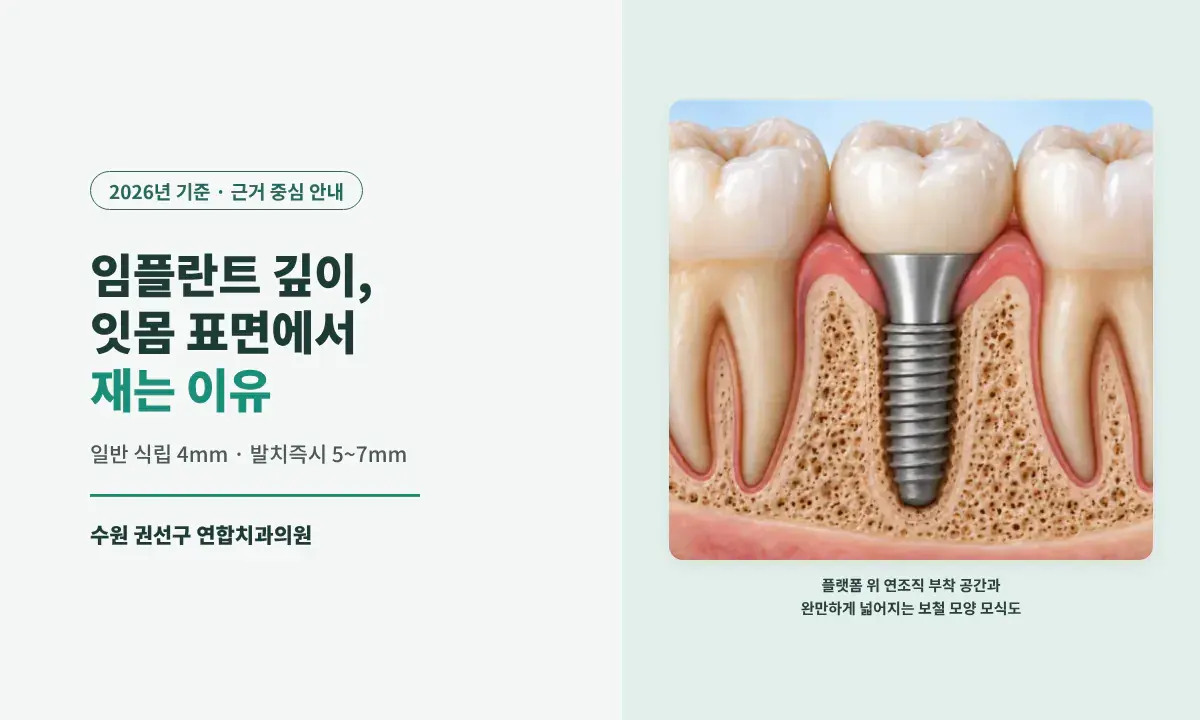
Peri-implantitis is an inflammatory disease linked to plaque, and placement depth, gum thickness, and prosthesis shape are conditions that determine how easy the area is to clean and maintain. Yeonhap Dental Clinic in Gwonseon-gu, Suwon measures depth from the gum surface to the implant platform, plans 4 mm for standard placement and usually 5 to 7 mm for immediate placement after extraction, and aims to build the prosthesis with an emergence angle within 30 degrees.
How are peri-implantitis and placement depth related?
Peri-implantitis is an inflammatory disease linked to plaque (bacterial biofilm), and placement depth, gum thickness, and prosthesis shape are conditions that determine how easy the area is to clean and maintain.
Written by Dr. Ahn Seong-jin, Chief Director, Yeonhap Dental Clinic
This article answers the following six questions in turn.
· How are peri-implantitis and placement depth related?
· What secures the space for the gum to attach?
· What does 4 mm below the soft tissue top secure?
· How does implant depth change with gum thickness?
· Is deeper placement always better?
· Can placement depth alone prevent peri-implantitis?
When people talk about peri-implantitis, maintenance usually comes first: clean well and have regular check-ups. That is true, but something is decided before that: whether the shape is one that can be cleaned.
In natural teeth, the zone at the boundary where the tooth meets the gum that is occupied by epithelial attachment and connective tissue attachment is reported in humans to average about 2.04 mm (Gargiulo 1961). This value is an average for natural teeth and is not a figure that directly sets our 4 mm standard for implants, but it is the same in that around an implant as well, a certain vertical space is needed for soft tissue to attach and form a barrier. If this space is lacking, a change in which bone remodels and creates the space can occur early in healing.
The problem comes after that. If the upper part of the implant is exposed by the amount the bone has dropped, a shape that a toothbrush or floss can hardly reach may remain. This early bone change is not peri-implantitis in itself, but if it becomes a condition in which plaque is hard to remove, it becomes unfavorable for managing peri-implantitis. This is why peri-implantitis is a matter of maintenance and also relates to structure.
That is why Yeonhap Dental Clinic plans and secures this space before surgery. Placement depth is the result of that plan, and this article walks through those criteria in order.
What secures the space for the gum to attach?
Yeonhap Dental Clinic measures implant placement depth from the soft tissue top, not from the jawbone.
In the literature, placement depth is usually expressed relative to the alveolar bone crest. If it is above the crest, it is called supracrestal, and if below, subcrestal. It is a convenient way to describe the positional relationship between the implant and the bone.
However, depth relative to the crest alone does not tell you how thick the gum above it is, so how much vertical space remains for the gum to attach has to be assessed separately. Even at the same crest height, the conditions differ between a person with 3 mm of gum and one with 1 mm.
There is a randomized study comparing placement approaches in thin gum. In patients with vertical soft tissue of 2 mm or less only, a group placed 1.5 mm below the crest was compared with a group placed at crest level and thickened with a healing abutment, and the 2-year marginal bone loss was 0.18 mm and 0.51 mm respectively, lower in the subcrestal group (Linkevicius 2020). It is not a study directly comparing thin and thick gum, but it shows that placing deeper in thin gum can be one alternative.
So Yeonhap Dental Clinic uses the gum surface as the reference point. If depth is measured from the gum surface to the implant platform, each person's different gum thickness enters the depth plan. This also means that depth is not the goal but a means of securing space.
How this attachment zone changes restoration planning in natural teeth is covered in Crown Lengthening: How Much Bone to Remove.
Difference between crest-based and soft-tissue-top-based approaches from a peri-implantitis perspective
| Comparison item | Crest-based | Soft-tissue-top-based |
|---|---|---|
| Starting point of measurement | Alveolar bone crest | Gum surface |
| How it is expressed | Supracrestal or subcrestal by some mm | Some mm below the soft tissue top |
| Value directly controlled | Positional relationship between the implant and the bone | Vertical space needed for soft tissue attachment and barrier formation |
| Reflects soft tissue thickness | Not included in the depth value, so separate assessment is needed | Included in the depth value |
| When the gum is thin | Separate judgment needed | Deeper relative to the bone |
| When the gum is thick | Separate judgment needed | Automatically shallower; additional judgment needed |
| Applied at our clinic | For reference | Standard value |
What does 4 mm below the soft tissue top aim to secure?
It is the sum of the space for the gum to attach and the room for the prosthetic structure above it to sit.
For standard placement, Yeonhap Dental Clinic plans for the implant platform to sit 4 mm below the gum surface (soft tissue top). If the gum is thick, the 4 mm point may still be above the bone, so the implant is placed deeper than that. This is not a value set by the literature but Yeonhap Dental Clinic's clinical standard.
Two things are included in these 4 mm. One is the vertical space needed for soft tissue around the implant to attach and form a barrier, and the other is the room for the prosthetic structure that will sit above it. When this space is secured, we expect less need for the bone to remodel to create space in early healing.
What is important here is that 4 mm is a value measured from the gum surface, not a depth below the bone crest. If the same 4 mm is applied to a patient with 3 mm of gum and one with 1 mm, the positions of the two implants are completely different relative to the bone. Yeonhap Dental Clinic sees this as actually correct. The space needed for the gum to attach is the same for both people, but to secure that space, the one with thinner gum has to go lower.
This value is not estimated by eye. Gum thickness is measured directly with a depth gauge (a probe with markings), and the crest position and bone condition are checked together with 3D CT, so that where the platform will sit is planned before surgery.
How does implant depth change with gum thickness?
With thin gum it is deeper relative to the bone, and with thick gum there are cases where it has to go even lower than the standard value.
Let me explain the two directions separately.
When the gum is thin: going 4 mm down from the gum surface puts that point below the bone. Relative to the bone, it is deep, but relative to the space for the gum to attach, it is as much as needed. The position and angle standards for front teeth with thin cheek-side bone and gum are outlined in Front-Tooth Implants in Suwon.
When the gum is thick: one more judgment comes in here, because even 4 mm below the soft tissue top may still be above the bone. Placing the platform there would leave the upper part of the implant exposed without being surrounded by bone.
So in such cases the implant goes lower than 4 mm. This is because having the platform sit within the bone takes priority over keeping to the standard value.
In short, the directions are opposite. When the gum is thin, we go lower to create space, and when it is thick, we go lower to keep the platform within the bone. This is why Yeonhap Dental Clinic's depth judgment is run as a range, not a single number.
How does depth change with immediate implant placement after extraction?
It is decided by considering not only the height seen on the day of extraction but also the remaining bone and the possibility of change during healing.
The bone height right after extraction is not the final height. In particular, when the cheek-side bone is already thin or the loss is large, the bone height after healing may be lower than what is seen on the day of surgery. If depth is set only by the height on that day, the platform may be exposed above the bone a few months later, and as mentioned earlier, that shape becomes a condition that is hard to clean.
So for immediate placement after extraction, Yeonhap Dental Clinic places the implant usually 5 to 7 mm below the gum surface. Because we cannot exactly calculate how much bone will be lost later, we evaluate the current bone with 3D CT and plan the depth while considering the possibility of change during healing. When cheek-side bone loss is large, we consider up to 9 mm as an exception; this is the upper limit our clinic actually uses for exceptions and is not an upper limit verified by the studies cited. Other conditions for immediate placement are outlined in Immediate Implants After Extraction.
As a result, this judgment can also be a choice that reduces the extent of bone grafting. This is because, rather than filling the height that will be lost with graft material, the implant is positioned below it from the start. However, depth does not substitute for grafting the gap on the cheek side of a front tooth or for securing the bone thickness needed on the cheek side.
It does not mean every immediate placement after extraction is placed at the same depth. Within the usual range, we adjust according to the remaining bone and the degree of buccal bone loss, and the judgment is based on 3D CT evaluation.
Implant placement depth by situation
| Situation | Platform position (relative to the gum surface) | Basis for judgment |
|---|---|---|
| Standard placement | 4 mm standard | Secures space for soft tissue attachment |
| Thin soft tissue | Secures 4 mm | Early bone remodeling possible if space is lacking |
| Thick soft tissue | Deeper than 4 mm | Prevents the platform from sitting outside the bone |
| Immediate placement after extraction | Usually 5 to 7 mm | Considers the remaining bone and the possibility of change during healing |
| Exception with large buccal bone loss | Up to 9 mm as an exception (our clinic's exception limit) | Not a literature-verified value; judged individually |
Is deeper placement always better?
Early bone change in implants placed deep below the crest is reported differently depending on the study conditions.
Reading this far, it might sound as if deeper is better. It is not.
In a randomized study that divided 56 mandibular molar implants into crest-level and subcrestal groups, marginal bone loss was greater in the subcrestal group until about 6 months after placement (Hedayatipanah 2024). In contrast, in a 1-year clinical study, the 12-month remodeling in the group placed more than 1 mm below the crest averaged 0.71 mm, but no significant difference was observed between placement depth groups (Quispe-López 2024). In the thin-gum patient study, bone remodeling above the platform in the group placed 1.5 mm below the crest was 1.17 mm, but marginal bone loss was actually lower than in the crest-level group (Linkevicius 2020).
These results differ in measurement criteria (bone remodeling above the platform versus marginal bone loss), subjects, and observation period. So it is hard to read them as a general rule that deeper means greater bone loss; with deep placement early remodeling occurs, and how much the implant is covered by bone afterward has to be looked at separately.
This is why Yeonhap Dental Clinic runs depth as a range and stops at a maximum of 9 mm even in exceptional cases. Weighing the benefit of securing space against the cost of early bone remodeling, the principle is not to place deep for its own sake but to go only as low as needed. The 9 mm limit is our clinic's clinical judgment and not an upper limit set by the literature.
Can placement depth alone prevent peri-implantitis?
It cannot. Depth creates the conditions, and the shape that sits on top decides the rest.
Once depth has secured the space, the next question is what fills that space.
Because implants are smaller in diameter than natural teeth, matching the size of the chewing surface requires the prosthesis to flare out as it passes through the gum. This flaring shape is called the emergence profile, and the angle between the long axis of the implant and the flaring prosthesis surface is called the emergence angle. It is a different value from the tilt between the implant axis and the crown axis.
If this angle is steep, a corner that is hard to clean can form between the abutment and the gum. In a systematic review pooling three studies, an emergence angle over 30 degrees was associated with a higher prevalence of peri-implantitis in some crestal-level implant studies, and the authors did not establish a causal relationship (Soulami 2022). Yeonhap Dental Clinic makes custom abutments aiming to design the emergence angle at which the prosthesis flares within 30 degrees.
Placement depth and abutment shape are not separate problems. If enough depth is secured, there is room to build a gentle angle above it; if depth is lacking, the prosthesis has no choice but to flare abruptly over a short distance. In effect, judgments at the surgical stage predetermine how difficult maintenance will be at the prosthetic stage. Our clinic's standards, which decide depth, axis, and prosthesis shape together, are outlined in Depth, Angle, and Prosthesis Shape That Decide 10 Years.
And even if both are in place, without maintenance it is of no use. Structure only creates a shape that can be cleaned; actually cleaning it comes afterward. Yeonhap Dental Clinic makes this plan at the placement planning stage to create conditions in which that maintenance is possible.
[Key Takeaways]
✓ Peri-implantitis is an inflammatory disease linked to plaque, and placement depth, gum thickness, and prosthesis shape are conditions that determine how easy the area is to clean and maintain.
✓ Yeonhap Dental Clinic measures depth from the gum surface to the platform, with 4 mm for standard placement (deeper if the gum is thick) and usually 5 to 7 mm for immediate placement after extraction as our clinic's standard. In thin gum, there is a study in which subcrestal placement had less marginal bone loss than the approach of thickening the gum (Linkevicius 2020).
✓ Depth comes at the cost of early bone remodeling, so even in exceptional cases we stop at a maximum of 9 mm, and abutments are made aiming at an emergence angle within 30 degrees. An angle over 30 degrees is reported to be associated with a higher prevalence of peri-implantitis (Soulami 2022).
What to check when you ask about implants in Tap-dong, Gwonseon-gu, Suwon
A practical standard for an implant consultation is whether the placement position can be explained in numbers before surgery.
Yeonhap Dental Clinic, across from the Suwon NongHyup Guun Branch (231 Geumho-ro) at 230 Geumho-ro, 5th Floor (Tap-dong, Cham Clinic Building), Gwonseon-gu, Suwon, Gyeonggi-do, has kept the same location since 2002. Treatment is currently led by Dr. Ahn Seong-jin, Chief Director and Integrated Dentistry specialist.
[5 things to check in an implant placement plan]
· Whether they can explain what the placement depth is measured from
· Whether they measure gum thickness directly, with a depth gauge or similar, and reflect it in the plan
· Whether they evaluate the bone with 3D CT and plan the placement position before surgery
· Whether, for immediate placement after extraction, they plan while considering the remaining bone and the possibility of change during healing
· Whether the abutment is prefabricated or made to fit the shape
Frequently Asked Questions
- Why does peri-implantitis occur?
- Peri-implantitis is an inflammatory disease linked to plaque (bacterial biofilm) accumulated around the implant. If the space for the gum to attach is lacking, so that the bone remodels early or the prosthesis flares steeply, a shape that is hard to clean can remain, and such conditions make maintenance difficult and are unfavorable for peri-implantitis.
- If an implant is placed deeper, does peri-implantitis occur less?
- Depth is a value for securing space for soft tissue to attach, not a treatment that prevents peri-implantitis. Early bone change from deep placement is reported differently depending on the study conditions, and Yeonhap Dental Clinic runs a range based on 4 mm for standard placement and usually 5 to 7 mm for immediate placement after extraction.
- Is thin gum unfavorable for peri-implantitis?
- When the gum is thin, there may not be enough space for soft tissue to attach, and early bone change can occur. In a randomized study of patients with vertical soft tissue of 2 mm or less, the group placed 1.5 mm below the crest had less 2-year marginal bone loss than the group placed at crest level with thickened gum (Linkevicius 2020). Yeonhap Dental Clinic checks gum thickness and bone position with a depth gauge and 3D CT and reflects them in the depth.
- How does measuring implant placement depth from the gum differ from measuring it from the bone?
- Depth relative to the crest alone does not tell you the gum thickness above it, so separate assessment is needed. Measuring from the gum surface builds each person's different gum thickness into the depth plan, so the space for soft tissue to attach can be planned directly.
- Does depth change if an implant is placed right after extraction?
- For immediate placement after extraction, the implant is placed usually 5 to 7 mm below the gum surface, deeper than for standard placement. Because we cannot calculate exactly how much bone will be lost after extraction, we evaluate the current bone with 3D CT and decide the depth while considering the possibility of change during healing.
- If an implant is placed deeply, is a bone graft unnecessary?
- In some cases the extent of grafting can be reduced, because instead of filling the height that will be lost with graft material, the implant is positioned below it from the start. However, depth does not substitute for grafting the gap on the cheek side of a front tooth or for securing the bone thickness needed on the cheek side.
- Is the shape of the implant abutment related to peri-implantitis?
- The emergence angle is the angle between the long axis of the implant and the flaring prosthesis surface, and angles over 30 degrees were associated with a higher prevalence of peri-implantitis in some studies (Soulami 2022). A causal relationship has not been established, but a steep angle can create corners that are hard to clean, so Yeonhap Dental Clinic makes custom abutments aiming for within 30 degrees.
- Where is Yeonhap Dental Clinic in Tap-dong and Guun-dong, Gwonseon-gu, Suwon?
- Yeonhap Dental Clinic is located at 230 Geumho-ro, 5th Floor (Tap-dong, Cham Clinic Building), Gwonseon-gu, Suwon, Gyeonggi-do, across from the Suwon NongHyup Guun Branch (231 Geumho-ro). Free parking is available in the building, and the clinic is about 15 minutes from Suwon Station by taxi.
A few words from the treatment room for those planning an implant
Once peri-implantitis has developed and you come in, there is not much that can be done (the criteria for judging cases that have already developed are outlined in Implant Reoperation in Suwon). So I spend my time on not creating those conditions. How deep to place an implant may look like something that can be decided on the day of surgery, but I do not think so. Gum thickness differs from person to person, and the bone of an extraction socket settles at a different height months later. We cannot calculate that change exactly, but if we do not look at the current bone before surgery and take the possibility of change into account, we only find out the result months later. That is why I look with 3D CT first. I see deciding depth not as the moment of placing the implant but as deciding how the following ten years will be managed.
📚 References
Clinic Information
This article was written in line with the Medical Service Act and the Ministry of Health and Welfare's medical advertising guidelines, and is intended to provide medical information. It does not guarantee or assert the effect of any particular treatment. The procedures that can be used and the course of treatment vary depending on each person's oral condition, bone quality, and soft tissue condition, so please decide on diagnosis and treatment direction only after a thorough consultation with your dental team.
📋 Clinic Information
🦷 Implant placement depth treatment information: Depth, Angle, and Prosthesis Shape That Decide 10 Years
📍 230 Geumho-ro, 5th Floor (Tap-dong, Cham Clinic Building), Gwonseon-gu, Suwon, Gyeonggi-do
🚕 Across from the Suwon NongHyup Guun Branch (231 Geumho-ro) / about 15 minutes by taxi from Suwon Station
🚗 Free parking available in the building
📞 031-293-2207
🌐 yeonhapdental.com
🟡 Open since 2002 / Treatment led by Dr. Ahn Seong-jin, Chief Director and Integrated Dentistry specialist
🔗 Online booking and consultation
Related pages
Before your visit
This article provides general information on oral health and dental care. Whether treatment is needed, and which method is appropriate, may change after an oral exam and any necessary diagnostic tests. If you have pain, a loose tooth, swelling, or discomfort with a prosthesis, please visit us for a consultation.