
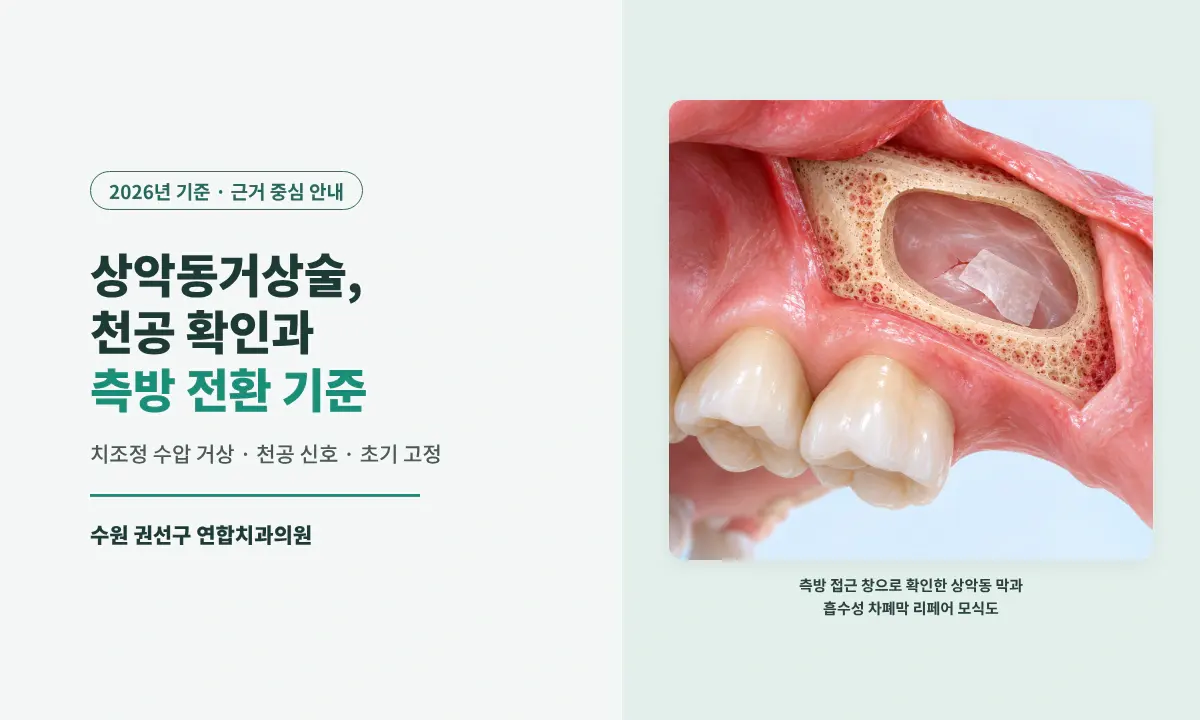
The crestal approach to a sinus lift is not always riskier than the lateral approach; the risk depends on the remaining bone, the condition of the membrane, and the instruments used. At Yeonhap Dental Clinic in Gwonseon-gu, Suwon, among crestal approaches we first consider the hydraulic lift that raises the membrane with saline pressure, treat unclear perforation signs as a perforation and switch to the lateral approach on the same day, and judge whether to place the implant separately based on primary stability.
Is the crestal approach to a sinus lift riskier than the lateral approach?
A sinus lift is surgery that raises the floor membrane of the maxillary sinus above the upper molars to create bone height for an implant. There is the crestal approach, which raises the membrane through the hole where the implant will go, and the lateral approach, which opens a window in the side wall of the upper jawbone and raises the membrane while looking at it directly. When you are recommended the crestal approach with its smaller incision, it is natural to wonder whether it is riskier by comparison.
[Key Answer]
The crestal approach to a sinus lift is not always riskier than the lateral approach; the risk depends on the remaining bone height, the condition of the membrane, and the instruments used. Yeonhap Dental Clinic in Gwonseon-gu, Suwon first considers a crestal approach that raises the membrane with hydraulic pressure, and if signs of perforation (a tear in the floor membrane of the sinus) are unclear, we treat it as perforated and switch to the lateral approach on the same day.
[4-Line Summary]
· A meta-analysis comparing the two approaches with 6 mm or less of remaining bone found no significant difference in implant survival, membrane perforation, or marginal bone loss (Shi 2023).
· Hammer-tapped osteotome techniques have more reports of membrane perforation and dizziness, and caution is recommended (Kadkhodazadeh 2024); Yeonhap Dental Clinic raises the membrane with hydraulic pressure.
· The crestal approach does not allow the membrane to be seen directly, so a perforation can be missed; Yeonhap Dental Clinic looks at several signs together and treats an unclear case as a perforation.
· When we switch to the lateral approach, we cover and repair the torn membrane and place a bone graft, and if primary stability (how firmly the implant grips the bone at the moment of placement) is secured we place the implant on the same day; if not, we do only the lift and place the implant 4–5 months later.
Written by: Dr. Ahn Seong-jin, Chief Director, Yeonhap Dental Clinic
[Table of Contents]
· Where does the risk of the crestal approach to a sinus lift come from?
· What is different about a hydraulic lift in a sinus lift?
· How is membrane perforation confirmed during a sinus lift?
· What do we do when the judgment about perforation is unclear during a sinus lift?
· How is a sinus lift carried out when there is sinusitis?
· Up to what point does remaining bone height serve as the criterion in a sinus lift?
This article covers the risks that can arise with the crestal approach, how to check for them, and the criteria for switching to the lateral approach.
Where does the risk of the crestal approach to a sinus lift come from?
The risk of the crestal approach comes from the way force is concentrated on the membrane and from a structure in which the membrane cannot be seen directly.
The first is force. In the traditional crestal approach, the floor of the sinus is tapped up with an instrument called an osteotome, and in studies using manual osteotomes there were more reports of membrane perforation and dizziness, so caution is recommended (Kadkhodazadeh 2024).
The second is visibility. The crestal approach is a closed technique performed through a small hole, so the membrane cannot be seen directly. If graft material is placed without knowing there is a perforation, the graft material can enter the sinus and raise the risk of infection or graft failure.
The lower the remaining bone, the greater the risk of perforation. In a study of 670 sites where crestal lifting was done with an osseodensification bur, the perforation rate was 7.31%, and remaining bone of 3 mm or less was a risk factor (Mazor 2024). However, the instrument in that study differs from our clinic's hydraulic lift.
Risk factors of the crestal approach to a sinus lift and our response (Yeonhap Dental Clinic)
| Risk factor | Problem that can arise | Our response |
|---|---|---|
| Force applied to the membrane | Instrument strikes concentrated on one point | Pushes the membrane up with saline pressure |
| The membrane cannot be seen directly | A perforation can be missed | Check several signs together |
| Judgment about perforation is unclear | Risk of placing graft material while missing a perforation | Treat as a perforation and switch to the lateral approach on the same day |
| After switching to the lateral approach | Surgery tends to be stopped or replanned | Membrane repair and bone graft; implant placed the same day if primary stability is secured |
| Primary stability not secured | Simultaneous placement is difficult | Do only the lift and place the implant 4–5 months later |
What is different about a hydraulic lift in a sinus lift?
A hydraulic lift raises the membrane with saline pressure instead of pushing it directly with an instrument.
After opening through the bone floor, saline is injected, and the liquid spreads under the membrane and lifts it. Only the way force is delivered is different; the risk of perforation does not disappear. If the membrane is very thin or there is a septum, it can tear whichever method is used.
Yeonhap Dental Clinic performs the crestal approach without an incision or with a minimal incision, so swelling tends to be less. Because the membrane is raised through a small placement hole, we measure the remaining bone height, the shape of the sinus floor, septa, and membrane thickness in advance on a 3D CT.
How is membrane perforation confirmed during a sinus lift?
Yeonhap Dental Clinic does not judge sinus membrane perforation from a single test; we look at several signs together.
· Whether air leaks when the patient pinches the nose and exhales (Valsalva test)
· Whether bubbles form on aspiration
· Whether the injected saline leaks into the nose
· Whether the elasticity of the membrane felt through the instrument changes
No single sign is complete on its own, so we look at them together. The detection performance of this combination has not been verified by studies; it is our clinic's confirmation procedure. If we still cannot decide, we check for a fluid layer inside the sinus with CBCT.
Imaging also has limits. In an experiment using excised sheep heads, the proportion of perforations found on periapical radiographs was 98% when contrast was used and 20% with saline alone (Youssef 2024). This is not a study that directly verified our clinic's method of checking with CBCT after saline injection.
What do we do when the judgment about perforation is unclear during a sinus lift?
When the judgment about perforation is unclear, Yeonhap Dental Clinic treats it as perforated and switches to the lateral approach on the same day.
When we switch to the lateral approach, we open a window in the side wall of the sinus, check the membrane directly, repair the torn area with a resorbable barrier membrane, and then place a bone graft. If primary stability is secured, we place the implant on the same day; if not, we do only the lift and place the implant 4–5 months later. In this case the lifted bone has already settled firmly, so after placement the prosthesis is usually attached in about 3 months.
If no method of switching has been prepared, there is an incentive to simply push ahead in an unclear situation. Because we know we can switch to the lateral approach on the same day, it becomes easier to make the judgment to stop and check when things are unclear.
Criteria for switching the sinus lift approach (Yeonhap Dental Clinic)
| Situation | Judgment | Action |
|---|---|---|
| No abnormal signs | Stay with the crestal approach | After the hydraulic lift, check primary stability and place the implant |
| Any one sign is abnormal | Perforation suspected | Check with CBCT if needed, then decide |
| Judgment unclear | Treated as perforated | Switch to the lateral approach on the same day |
| Perforation confirmed | Switch to the lateral approach | Resorbable barrier membrane repair → bone graft |
| Primary stability secured | Simultaneous placement | Implant placed on the same day as the lift |
| Primary stability not secured | Lift first | Implant placed 4–5 months later, then prosthesis after about 3 months |
| Sinusitis present | Treat the inflammation first | If no improvement after reassessment and antibiotics, decide whether to proceed after lateral irrigation |
How is a sinus lift carried out when there is sinusitis?
When there is sinusitis, treating the inflammation comes before the sinus lift.
After an extraction, we recheck with CBCT 3 months later, and if inflammation remains, we reassess after 1 week of antibiotics. If there is no improvement, we irrigate through the lateral approach, check the remaining inflammation and the condition of the membrane, and if it is possible to proceed, continue with the lift on the same day. If needed, we involve an ENT specialist, and whether to place the implant is judged separately by primary stability during surgery.
At our clinic, in cases that reached this irrigation step, most had remaining inflammation and a membrane condition that allowed us to proceed, and primary stability was also secured, so the lift and placement were both completed on the same day. The timing and sequence for rechecking sinusitis after an extraction are covered in When Sinusitis Won't Settle Before an Implant.
Up to what point does remaining bone height serve as the criterion in a sinus lift?
Remaining bone height is the starting point for choosing the sinus lift approach, but it is not the only criterion.
In addition to remaining bone height, Yeonhap Dental Clinic also looks at the thickness of the sinus membrane, the presence of inflammation, and the likelihood of primary stability. We make the plan with a 3D CT, and check the actual primary stability during surgery. If the membrane is healthy and primary stability is secured, we consider the crestal approach even when the remaining bone is low, and if the membrane condition is poor, we go lateral even when the height is sufficient.
The crestal approach at a site with very low remaining bone is not a general indication and is considered only under selected conditions. The choice of approach by remaining bone height and the timeline after a lift are summarized in Sinus Lift: Yeonhap Dental Clinic's 3 Treatment Criteria.
5 things to check when consulting about a sinus lift in Gwonseon-gu and Tap-dong, Suwon
In a sinus lift consultation, the standard is whether they first tell you the conditions in which it cannot be done and what they do then.
· Whether they measure the remaining bone height and the sinus membrane condition together on a 3D CT
· Whether they explain why they chose crestal or lateral
· Whether they explain how perforation is checked during surgery
· Whether they tell you in advance what happens if a perforation occurs and when the implant will be placed
· Whether they explain how the sequence is decided when there is sinusitis
[Key Takeaways]
✓ The risk of the crestal approach comes from the way force is concentrated on the membrane and from a structure in which the membrane cannot be seen directly, and Yeonhap Dental Clinic responds with a hydraulic lift and confirmation by several signs.
✓ When the judgment about perforation is unclear, we treat it as perforated, switch to the lateral approach on the same day, and perform membrane repair and a bone graft.
✓ If primary stability is secured we place the implant on the same day; if not, we do only the lift and place the implant 4–5 months later, and the prosthesis is usually attached about 3 months after placement.
A Few Words from the Treatment Room About the Crestal Approach to a Sinus Lift
In a sinus lift, I think what is decided before starting shapes the result more than what the hands do. If you do not decide in advance how much bone remains, what condition the membrane is in, and which way to judge when things are unclear, the urge to keep going tends to win during surgery. That is why I set the rule first that an unclear case is treated as torn, and there were in fact several times when the perforation signs were unclear and I switched to the lateral approach on the same day. There was also a case where a very small perforation was found only on the CT after surgery. It was small, so the lifted bone settled well, but that experience made me more careful about the confirmation process. This is why I look first at whether the conditions allow lifting, rather than whether it can be lifted.
References
📋 Treatment Information
This post was written in compliance with the Korean Medical Service Act and the Ministry of Health and Welfare's medical advertising guidelines, and is intended to provide medical information. It does not guarantee or assert the result of any specific treatment. The approach that can be applied and the course of treatment differ from person to person depending on residual bone height and the condition of the sinus, so please be sure to consult fully with your dental team before deciding on diagnosis and treatment direction.
🦷 Sinus lift implant information: Sinus Lift Implants in Suwon
📍 5th Floor, 230 Geumho-ro, Gwonseon-gu, Suwon, Gyeonggi-do (Tap-dong, Cham Clinic Building)
🚕 Across from Suwon NongHyup Guun Branch (231 Geumho-ro) / about 15 minutes by taxi from Suwon Station
🚗 Free parking available in the building
📞 031-293-2207
🌐 yeonhapdental.com
🟡 Opened in 2002 / Treatment overseen by Dr. Ahn Seong-jin, Chief Director and Integrated Dentistry specialist
🔗 Online booking and consultation
Crestal Approach to a Sinus Lift: Frequently Asked Questions
- Is the crestal approach to a sinus lift riskier than the lateral approach?
- Not always. A meta-analysis comparing the approaches with 6 mm or less of remaining bone found no significant difference in survival, membrane perforation (a tear in the sinus membrane), or marginal bone loss, although the included studies had a high risk of bias, which limits interpretation (Shi 2023), and the risk depends on the remaining bone, the membrane condition, and the instruments used.
- Is the crestal approach to a sinus lift possible with 4 mm of remaining bone?
- Even with 4 mm of remaining bone, the crestal approach can be considered depending on conditions. Yeonhap Dental Clinic plans the approach by looking at the remaining bone and membrane condition on a 3D CT, and if the signs that the membrane has torn (perforation) are unclear during surgery, we switch to the lateral approach. Whether to place the implant on the same day is judged separately by primary stability, meaning how firmly the implant grips the bone at the moment of placement.
- Is the surgery stopped if the membrane tears during a sinus lift?
- A torn membrane does not necessarily mean the surgery is stopped. Yeonhap Dental Clinic switches to the lateral approach on the same day, checks the membrane directly, and if it can be repaired, proceeds with repair and a bone graft. If primary stability is secured we place the implant, and if not, we do the lift first.
- Can a sinus membrane perforation go unnoticed?
- The crestal approach to a sinus lift is a closed technique in which the membrane cannot be seen directly, so a perforation, a tear in the sinus membrane, can be missed during surgery. That is why Yeonhap Dental Clinic looks at several signs together and treats an unclear case as a perforation.
- Are the sinus lift and implant placement done in one visit?
- If primary stability, meaning the implant grips the bone firmly at the moment of placement, is secured, we place the implant on the same day. If it is not secured, we do only the lift and place the implant 4–5 months later, and the prosthesis is usually attached about 3 months after placement (our clinic's standard).
- Does a hydraulic lift in a sinus lift prevent perforation?
- No. A hydraulic lift differs from pushing directly with an instrument only in how force is delivered, and if the membrane is thin or there is a septum, a perforation, a tear in the membrane, can still occur.
- Is a sinus lift possible if I have chronic sinusitis?
- It is possible depending on the condition after the inflammation has been treated. If there is no improvement after reassessment following extraction and antibiotic treatment, Yeonhap Dental Clinic irrigates through the lateral approach and decides whether to proceed with the lift based on the remaining inflammation and the membrane condition. If needed, we involve an ENT specialist.
- Where is Yeonhap Dental Clinic in Tap-dong and Guun-dong, Gwonseon-gu, Suwon?
- Yeonhap Dental Clinic is located on the 5th floor at 230 Geumho-ro, Gwonseon-gu, Suwon, Gyeonggi-do (Tap-dong, Cham Clinic Building), across from Suwon NongHyup Guun Branch (231 Geumho-ro). Free parking is available in the building, and we are about 15 minutes by taxi from Suwon Station.
Related pages
Before your visit
This article provides general information on oral health and dental care. Whether treatment is needed, and which method is appropriate, may change after an oral exam and any necessary diagnostic tests. If you have pain, a loose tooth, swelling, or discomfort with a prosthesis, please visit us for a consultation.