
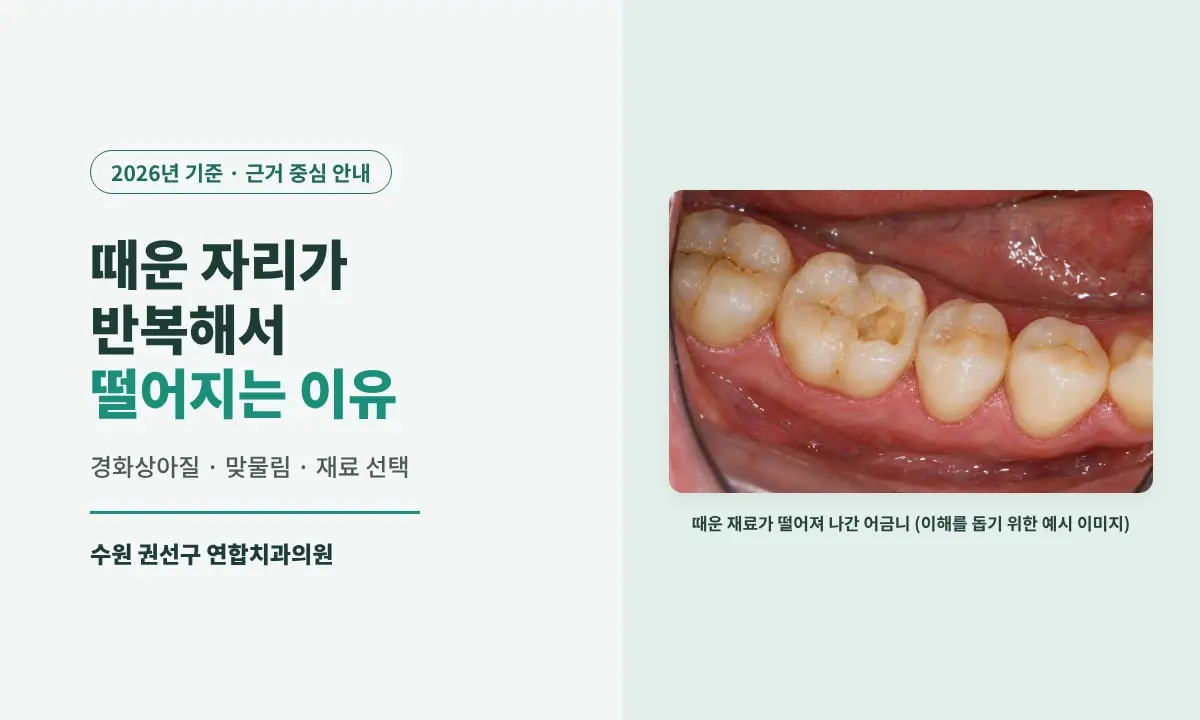
When a filling keeps coming off, the condition of the tooth, the bite, and chewing habits all need to be looked at together. Yeonhap Dental Clinic chooses the material again to fit the conditions we have checked.
Why does a filling keep coming off?
When the same spot has to be refilled a second or third time, the first suspicion falls on the procedure. But repeated loss can involve several conditions acting together, such as the condition of the tooth surface, the bonding material used, chewing force, and cracks.
[Key Answer]
There is more than one reason a filling keeps coming off, and besides the condition of the tooth surface, we need to check the bite, chewing habits, and cracks. Yeonhap Dental Clinic in Gwonseon-gu, Suwon decides, according to the cause we find, whether to restore again with the same material or switch to a different material or restoration extent.
[4-Line Summary]
· Dentin that has long been exposed to force and stimulation can become sclerotic dentin (dentin that adhesive has difficulty soaking into), in which the tiny tubules are blocked and the surface has hardened.
· Sclerotic dentin is reported to have lower bond strength in the laboratory, but clinically the bonding material and chewing force also play a part.
· At a site where a filling has come off again, Yeonhap Dental Clinic checks lateral interference (the tooth touching first when the jaw moves sideways), eating habits, the condition of the tooth surface, and cracks.
· In refilling under these conditions, for cervical abrasion we mostly choose Bondfill, for hardened Class I cavities mainly GI, and for Class II cavities mainly a ceramic inlay, depending on the size of the defect.
Written by: Dr. Ahn Seong-jin, Chief Director, Yeonhap Dental Clinic
[Table of Contents]
· Why does a filling keep coming off?
· What is sclerotic dentin, and why is bonding difficult?
· What does Yeonhap Dental Clinic check at a site where a filling has come off again?
· What does Yeonhap Dental Clinic choose differently when refilling?
The sites where this repeats are usually the same few: spots where the neck of the tooth is worn away (cervical abrasion), spots on the chewing surface worn into a hollow (dimples), chipped corners, and sites where an old amalgam was removed.
In a study that observed cervical lesions for 2 years, no difference in loss rate according to sclerosis was confirmed (Van Dijken 2004). This does not prove that sclerotic dentin has no effect, but repeated loss should not be pinned on the condition of the tooth surface alone, and other conditions need to be checked as well.
What is sclerotic dentin, and why is bonding difficult?
It is a state in which the tiny tubules of the dentin are blocked with minerals and the surface has become excessively hard, so there is less room for adhesive to soak in, and bonding becomes difficult.
Resin bonds to the tooth surface through an adhesive. In sclerotic dentin, the hypermineralized layer on the surface (a layer hardened by accumulated minerals) and blocked dentinal tubules (the tiny tubes of the dentin) can make it difficult for the adhesive to penetrate and form a bonding layer. Laboratory studies report lower bond strength than in normal dentin (Tay 2004). This is evidence that bonding is difficult, not evidence that it is impossible.
A review pooling 8 laboratory studies reported that some surface treatments may raise bond strength. However, the quality of the evidence is low, and the findings do not confirm an actual reduction in loss (Hamdi 2025).
Sclerotic dentin is not a disease; it is the result of the tooth hardening itself in response to long-term stimulation. However, that hardness can work against bonding.
What does Yeonhap Dental Clinic check at a site where a filling has come off again?
We look together at the bite and chewing habits, the condition of the tooth surface, and any chipped areas and cracks.
First we check lateral interference and eating habits. If force falls first on that tooth when the jaw moves sideways, or if you often chew hard food, force will fall repeatedly on the same spot no matter what material is used. For the tooth surface, we look together at color (dark, yellowish), gloss (glassy and shiny, so a probe slides), degree of wear, and chipped areas. A chipped area is also a sign that strong force has been applied to that spot.
When replacing an amalgam, we check these items at the site where it was removed and then choose the material. Amalgam is held in place by fitting into the cavity rather than by bonding, so switching to a bonded material can reveal conditions that had not shown up before. If a crack is suspected, we also look at the Q-ray image, and its interpretation and limits are summarized in Q-ray Precision Diagnosis: Interpretation, Limits, and Compensation.
What we check at a site where a filling has come off again (Yeonhap Dental Clinic)
| Item checked | What we look at | What changes depending on the result |
|---|---|---|
| Lateral interference and eating habits | Whether the tooth touches first when the jaw moves sideways, and whether you often chew hard food | Consider the cause of force concentration and how to respond |
| Condition of the tooth surface | Color, gloss, degree of wear | Consider reusing the previous material or choosing a different one |
| Chipped areas and cracks | Signs of chipping, crack lines | Extent of restoration (consider inlay or crown) |
What does Yeonhap Dental Clinic choose differently when refilling?
According to the cause we find, we decide whether to restore again with the same material or switch to a different material or restoration extent.
We fill most cervical abrasion with Bondfill (a resin-based restorative that bonds directly to the tooth). We use ordinary resin only when cost is a concern or you would like a more natural color match.
At our clinic, in refilling under these conditions, we mainly choose GI (glass ionomer) for a hardened Class I cavity (a defect only on the chewing surface) and a ceramic inlay for a Class II cavity that includes the proximal surface. This can vary with the size of the defect and the remaining tooth condition. Directly placed resin hardens and shrinks throughout the whole material that fills the cavity, whereas an inlay is a piece that has already been hardened and is attached with a thin cement layer, so the volume that shrinks is small. This is our clinic's reason for choosing the material, and it does not cite a study verifying that this difference reduces loss in sclerotic dentin.
If the defect is wide or there is a crack that needs treatment, we also consider a crown, and the criteria are the same as in Cavity Treatment Types: How to Choose Between Resin, Inlay, and Crown. Differences among materials are covered in a separate article.
Choice of material when refilling (Yeonhap Dental Clinic)
| Site / situation | Yeonhap Dental Clinic's choice | Reason for the choice |
|---|---|---|
| Cervical abrasion | Mostly Bondfill | Ordinary resin only when cost or color is the priority |
| Hardened Class I cavity | Mainly GI | Bonds chemically to the tooth |
| Class II cavity including the proximal surface | Mainly ceramic inlay | A hardened piece attached with a thin cement layer |
| Wide defect or a crack that needs treatment | Consider a crown after a core | Same criteria as the cavity treatment types column |
4 things to check before refilling in Gwonseon-gu and Tap-dong, Suwon
The practical standard for a consultation is whether they first explain why it came off and then choose the material.
Yeonhap Dental Clinic, across from Suwon NongHyup Guun Branch (231 Geumho-ro), on the 5th floor at 230 Geumho-ro, Gwonseon-gu, Suwon, Gyeonggi-do (Tap-dong, Cham Clinic Building), has treated patients in the same place since 2002, and Dr. Ahn Seong-jin, Chief Director and Integrated Dentistry specialist, oversees treatment.
· Whether they explain why it came off in terms of the condition of the tooth and the bite
· Whether they offer options other than refilling with the same material
· Whether there are criteria for how the material changes with the extent of the defect
· Whether they also check for cracks and chipped areas
[Key Takeaways]
✓ Repeated loss is not explained by the condition of the tooth surface alone; the bonding material, chewing force, and cracks can also play a part.
✓ Sclerotic dentin is a condition in which bond strength is reported to be lower in the laboratory; bonding is difficult, not impossible.
✓ After checking lateral interference, eating habits, and the condition of the tooth, Yeonhap Dental Clinic decides again on the material and extent among Bondfill, GI, ceramic inlay, and crown.
A Few Words from the Treatment Room for Patients Refilling the Same Spot
When the same spot comes off again, people first wonder whether they went to the wrong dentist or whether something is wrong with their teeth. Before refilling, I first look at whether force falls first on that tooth when the jaw moves sideways, what foods you usually like to chew, and whether the tooth surface is dark and shiny. Depending on the result, we decide whether to refill with the same material, switch to Bondfill or GI, or use an inlay if the extent is wide. I have also had the experience in practice of switching a site that was being filled with resin to GI and finding that postoperative pain decreased. I think that what matters is not skill at refilling but first checking why it came off and choosing the material that fits that site.
References
📋 Treatment Information
This post was written in compliance with the Korean Medical Service Act and the Ministry of Health and Welfare's medical advertising guidelines, and is intended to provide medical information. It does not guarantee or assert the result of any specific material or treatment. The materials that can be applied and the course of treatment differ from person to person depending on the condition of the tooth and the extent of the defect, so please be sure to consult fully with your dental team before deciding on treatment direction.
🦷 Cavity and prosthodontic treatment information: Yeonhap Dental Clinic Treatment Departments
📍 5th Floor, 230 Geumho-ro, Gwonseon-gu, Suwon, Gyeonggi-do (Tap-dong, Cham Clinic Building)
🚕 Across from Suwon NongHyup Guun Branch (231 Geumho-ro) / about 15 minutes by taxi from Suwon Station
🚗 Free parking available in the building
📞 031-293-2207
🌐 yeonhapdental.com
🟡 Opened in 2002 / Treatment overseen by Dr. Ahn Seong-jin, Chief Director and Integrated Dentistry specialist
🔗 Online booking and consultation
When a Filling Keeps Coming Off: Frequently Asked Questions
- My filling keeps coming off. Did I go to the wrong dentist?
- We cannot conclude that. Several conditions can act together when a filling keeps coming off, including the condition of the tooth surface, the bonding material, the bite and chewing force, and cracks, so the cause needs to be checked first.
- What is sclerotic dentin?
- It is a state in which the tiny tubules of dentin that has long been exposed to force and stimulation are blocked with minerals and the surface has hardened. There is less room for adhesive to soak in, so bond strength is reported to be lower in the laboratory, but bonding is not impossible.
- Can the sclerotic dentin surface just be ground down and re-bonded?
- A review pooling laboratory studies reported that applying phosphoric acid for a long time or grinding the surface may raise bond strength. However, the quality of the evidence is low, and the findings do not confirm an actual reduction in loss.
- What is used to fill cervical abrasion where the neck of the tooth is worn away?
- Yeonhap Dental Clinic fills most cervical abrasion with Bondfill (a resin-based restorative that bonds directly to the tooth), and uses ordinary resin when cost is a concern or you would like a more natural color match.
- What do you check when the same spot comes off again?
- Yeonhap Dental Clinic checks whether the tooth touches first when the jaw moves sideways (lateral interference), whether you often chew hard food, the color, gloss, and wear of the tooth surface, and any chipped areas and cracks, and then decides the material and extent.
- Where is Yeonhap Dental Clinic in Tap-dong and Guun-dong, Gwonseon-gu, Suwon?
- We are located on the 5th floor at 230 Geumho-ro, Gwonseon-gu, Suwon, Gyeonggi-do (Tap-dong, Cham Clinic Building), across from Suwon NongHyup Guun Branch (231 Geumho-ro). Free parking is available in the building, and we are about 15 minutes by taxi from Suwon Station.
Related pages
Before your visit
This article provides general information on oral health and dental care. Whether treatment is needed, and which method is appropriate, may change after an oral exam and any necessary diagnostic tests. If you have pain, a loose tooth, swelling, or discomfort with a prosthesis, please visit us for a consultation.