
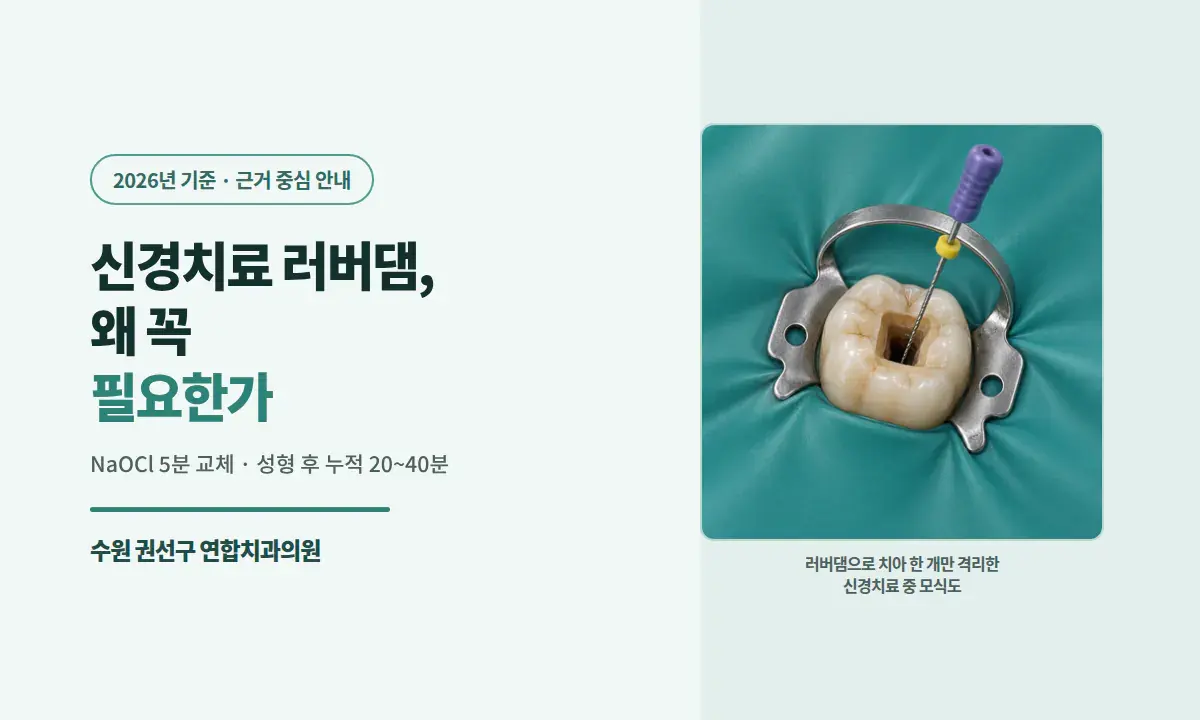
One of the conditions that influences the outcome of root canal treatment is keeping the canal from being re-contaminated by saliva and bacteria during treatment. At Yeonhap Dental Clinic in Gwonseon-gu, Suwon, we place a rubber dam for every root canal treatment, and from the point the canal has been enlarged to the planned size until it is filled, we replace sodium hypochlorite solution of 6% or higher every 5 minutes, for a total contact time of 20–40 minutes.
What exactly does a rubber dam do in root canal treatment?
When you hear that a rubber sheet will be placed over your face during root canal treatment, it is natural to wonder why it is needed. Root canal treatment removes infected nerve tissue from the root canal, the channel inside the tooth root where the nerve runs, then disinfects and seals it, and a rubber dam is a device that leaves only the tooth being treated exposed and covers the rest of the mouth with a thin rubber sheet.
[Key Answer]
A rubber dam blocks the path by which saliva and bacteria enter the root canal during treatment, and also keeps the disinfectant placed in the canal from slipping into the mouth. At Yeonhap Dental Clinic, we place a rubber dam for every root canal treatment, and from the point the canal has been enlarged to the planned size until filling (sealing the disinfected canal with material), we replace the disinfectant every 5 minutes, for a total contact time of 20–40 minutes.
[4-Line Summary]
· In a cohort that followed more than 510,000 teeth receiving initial root canal treatment, the risk of extraction was lower, with a hazard ratio of 0.81, on the side where a rubber dam was used (Lin 2014).
· Yeonhap Dental Clinic uses sodium hypochlorite (NaOCl) solution with a labeled concentration of 6% or higher without dilution, and keeps it in contact for a total of 20–40 minutes from the end of canal shaping until filling.
· In a laboratory study, bacterial reduction was greater with periodic replacement and a longer contact time, but it is not a clinical study that directly verified our clinic's concentration and timing (Silva 2026).
· After root canal treatment, the tooth gets a core (the part that rebuilds the lost shape) and a separate crown, and if not enough tooth structure remains to hold the core, a fiber post is used as well.
Written by: Dr. Ahn Seong-jin, Chief Director, Yeonhap Dental Clinic
[Table of Contents]
· What exactly does a rubber dam do in root canal treatment?
· In what order does Yeonhap Dental Clinic perform root canal treatment?
· How much root canal disinfectant (NaOCl) do we use, and how?
· If root canal treatment fails, do we choose retreatment or apicoectomy?
· What about the core and crown after root canal treatment?
A rubber dam leaves only the one tooth to be treated exposed through a hole and covers the rest of the mouth with a rubber sheet. It blocks saliva, blood, and oral bacteria from flowing into the treatment site, and also prevents the disinfectant placed in the canal from going down the back of the throat or into the mouth. It also helps visibility, because the treatment site stays clean and clearly visible.
In a nationwide cohort that followed 517,234 teeth receiving initial root canal treatment, the average 3.43-year survival rate was 90.3% on the side where a rubber dam was used and 88.8% where it was not, and even after adjusting for age, tooth type, diabetes, hypertension, and other factors, the hazard ratio for extraction on the rubber dam side was 0.81 (Lin 2014).
However, even with a rubber dam, the entire root canal does not become completely sterile. It is a device that reduces the contamination routes a person can control, and that is why Yeonhap Dental Clinic uses a rubber dam without exception.
To place a rubber dam properly, the tooth needs a wall for the retaining clamp to grip. For a tooth whose walls have largely collapsed from decay, we build up the wall first and then place the rubber dam.
In what order does Yeonhap Dental Clinic perform root canal treatment?
It proceeds in 8 steps from diagnosis to the prosthesis, and at each step we focus on reducing contamination and excessive instrument force.
First, we assess the condition with an oral exam and periapical radiograph (a small X-ray that captures down to the root tip), and add a 3D CT when the canal shape or a lesion at the root tip needs a closer look. We do not take a CT for every root canal treatment.
In the step of creating a path to the end of the canal, we first confirm patency (the state in which a file passes through to the opening at the end of the canal) with a thin #10 K-file (a hand-turned stainless steel file), and then enlarge the canal with nickel-titanium rotary files. For canals where the K-file does not go in easily, we approach with a C+ hand file, and for canals that are severely calcified from the entrance, a One-G glide path file (an instrument that creates a path in advance for the rotary file to follow) can help. In a bent path such as a ledge (a step formed on the canal wall), rotary instruments are at a disadvantage, so we supplement with a C+ file with a bent tip. How the two instruments are used together is covered in detail in Limits of Calcified Canals and How to Overcome Them.
In a study that prospectively followed 2,484 roots, securing patency at the end of the canal, irrigating as close to the root tip as possible, and a good coronal restoration (the part of the tooth visible above the gum) were reported as factors associated with healing (Ng 2011). This study did not verify our clinic's file combination or disinfection time, but the direction each step aims to protect is the same.
The 8 steps of root canal treatment at Yeonhap Dental Clinic
| Step | Yeonhap Dental Clinic's approach | Problem we aim to reduce |
|---|---|---|
| ① Diagnosis | Oral exam, periapical radiograph, 3D CT if needed | Missing the canal shape or a lesion at the root tip |
| ② Painless anesthesia | 3 steps: gargle anesthesia + topical ointment anesthesia + i-JECT automatic anesthesia device | Pain during the anesthesia process |
| ③ Rubber dam isolation | For a tooth with collapsed walls, build up the wall first, then place it | Saliva and bacteria entering, disinfectant slipping into the mouth |
| ④ Removal of infected tissue | Remove inflamed or necrotic nerve tissue | Sources of infection inside the canal |
| ⑤ Securing patency and a pathway | Confirm that a #10 K-file passes through to the end of the canal; use C+ or One-G if needed | Canal deformation caused by forcing through a blocked section |
| ⑥ Shaping and disinfection | Enlarge to the planned size (MAF), then replace NaOCl of 6% or higher every 5 minutes for a cumulative 20–40 minutes | Bacteria remaining inside the canal |
| ⑦ Medicament and filling | Calcipex (calcium hydroxide medicament) between visits, canal filling when conditions allow | Re-contamination between visits, empty space inside the canal |
| ⑧ Core and crown | Resin or GI core + separate crown; fiber post if the core is difficult to retain | Pathways of re-leakage toward the crown of the tooth, fracture |
How much root canal disinfectant (NaOCl) do we use, and how?
Yeonhap Dental Clinic uses sodium hypochlorite solution of 6% or higher without dilution, and keeps it in contact for a total of 20–40 minutes from the end of canal shaping until filling.
Sodium hypochlorite (NaOCl) is a representative disinfectant that dissolves organic tissue inside the canal and reduces bacteria. Our clinic uses a solution with a labeled concentration of 6% or higher without diluting it. From the point the canal has been enlarged to the planned size (MAF), we begin soaking, in which the disinfectant is left in the canal, and we replace it with fresh solution every 5 minutes.
The 20–40 minutes is not the time to fill at one time but the soaking time added up across several visits from the end of shaping until filling. For example, if shaping is finished at the first visit and you soak for 10 minutes, we add another 10–30 minutes on the day of filling.
At our clinic, when the cumulative soaking time after shaping reaches 20 minutes, we check whether exudate (fluid seeping from inside the canal) or bubbling continues to rise, together with the condition of the canal. If it continues to be observed, we soak up to a cumulative 40 minutes, and if it persists after that, we enlarge and irrigate further that day, place Calcipex, and reassess at the next visit. Exudate or bubbling alone does not establish that infection remains or that the enlargement is insufficient; this is our clinic's way of proceeding.
Yeonhap Dental Clinic does not use EDTA (an irrigant that helps remove the mineral component of the canal and the smear layer) uniformly in every canal; where needed, such as in severely calcified canals or retreatment, we rinse with EDTA and finish with NaOCl. The study mentioned above also reported finishing with NaOCl after EDTA in retreatment as a factor associated with healing (Ng 2011).
Between visits, we leave Calcipex (calcium hydroxide medicament) in the canal, and the interval between visits is usually 1 week and does not exceed 1 month. This does not mean that dividing treatment into several visits is better; it is the approach our clinic has chosen.
There is a laboratory study on replacing the disinfectant. In bovine incisors cultured with bacteria, a method of continuously flowing 20 mL of 1% NaOCl for 4 minutes was compared with a method of placing 5 mL and replacing it four times at 5-minute intervals, and bacteria decreased more with replacement. Both methods ended with EDTA and ultrasonic activation (Silva 2026). Because this is a laboratory study and its concentration, time, and finishing steps differ from ours, it should not be read as evidence that our clinic's protocol is better clinically.
Some places in the canal, such as side branches and calcified sections, are hard for instruments and disinfectant to reach, so not all contamination can be eliminated. The role of this step is to reduce the contamination routes a person can control.
If root canal treatment fails, do we choose retreatment or apicoectomy?
If we can re-enter the canal, we look at retreatment first, and if re-entry is difficult or a lesion remains after retreatment, we consider apicoectomy.
Retreatment removes the existing filling material and disinfects and fills the canal again, while apicoectomy is surgery that approaches from the gum side and removes the root tip and the surrounding inflammation. Yeonhap Dental Clinic performs apicoectomy itself, and chooses it in the following cases.
· When it is difficult to remove a post or crown
· When the lesion at the root tip does not shrink even after retreatment
· When it is difficult to secure patency during retreatment
A systematic review comparing the two treatments reported success rates of 77.8% for apicoectomy and 70.9% for retreatment in studies with 2–4 years of follow-up, and 83.0% for retreatment and 71.8% for apicoectomy in studies with 4–6 years of follow-up (Torabinejad 2009). These are values pooled from studies with different follow-up periods, not values from continuously following the same patients, and because they come from studies through 2009, they do not represent today's microsurgery results.
A recent meta-analysis of retreatment alone reported success rates of 71% at 1–3 years and 77% at 4–5 years using strict criteria, and teeth with a lesion at the root tip had lower success rates (Olivieri 2024).
For that reason, Yeonhap Dental Clinic presents this treatment not as one that guarantees an outcome but as preservation treatment to find out whether a natural tooth can be saved before extraction. You can see the process at Root Canal and Conservative Treatment Information.
Retreatment vs. apicoectomy (Yeonhap Dental Clinic)
| Comparison item | Root canal retreatment | Apicoectomy |
|---|---|---|
| Approach | Reopens the root canal from inside the tooth | Incises the gum to approach the root tip |
| When our clinic chooses it | When we can re-enter the root canal | Difficult to remove post or crown, lesion persists after retreatment, difficult to secure patency |
| Success rate in 2–4 year follow-up studies | About 70.9% (Torabinejad 2009) | About 77.8% (Torabinejad 2009) |
| Success rate in 4–6 year follow-up studies | About 83.0% (Torabinejad 2009) | About 71.8% (Torabinejad 2009) |
| Recent meta-analysis | 71% at 1–3 years, 77% at 4–5 years (strict criteria, Olivieri 2024) | Not cited in this article |
| Anesthesia and isolation | 3-step painless anesthesia + rubber dam | 3-step painless anesthesia |
| When the result is poor | Reassess the cause and consider apicoectomy | Reassess the cause and the possibility of preservation |
What about the core and crown after root canal treatment?
After root canal treatment, the tooth gets a core to rebuild its shape and then a separate crown, and if not enough tooth structure remains to hold the core, a fiber post is used as well.
Teeth undergoing root canal treatment have often already lost a lot of tooth structure to decay, fracture, and the opening made for treatment. With thinner remaining walls, they break easily under chewing force, so teeth that bear a lot of force, such as molars, are protected with a crown that covers the whole tooth.
A core rebuilds the collapsed tooth shape with resin or GI (glass ionomer, a restorative material that bonds to teeth) to make a post to support the crown, and the crown is a prosthesis made separately and placed over it. Yeonhap Dental Clinic's standard is to build a core and then place a separate crown.
If not enough tooth structure remains to hold the core, a fiber post (a thin post made of glass fiber) is placed in the canal to hold the core. At our clinic we usually consider a fiber post when half or more of the crown has been lost, and decide by looking at the remaining tooth walls and whether the core can be retained. A post is for retaining the core and is not a device to make the root stronger, so we use it only when needed.
If very little tooth wall remains, we may need to first secure a wall (ferrule) for the crown to wrap around. This continues in Crown Lengthening: How Much Bone to Remove.
For any prosthesis, I personally check and adjust the bite before it is placed.
5 things to check when choosing a root canal clinic in Gwonseon-gu and Tap-dong, Suwon
The practical standard for choosing a root canal clinic is whether they explain the isolation, disinfection, and preservation sequence in specific terms.
Yeonhap Dental Clinic, across from Suwon NongHyup Guun Branch (231 Geumho-ro), on the 5th floor at 230 Geumho-ro, Gwonseon-gu, Suwon, Gyeonggi-do (Tap-dong, Cham Clinic Building), has treated patients in the same place since 2002, and Dr. Ahn Seong-jin, Chief Director and Integrated Dentistry specialist, oversees treatment. Even after treatment is finished, we follow the progress together at regular check-ups.
· Whether a rubber dam is placed for every root canal treatment, and what they do for a tooth with collapsed walls
· Whether they explain the type and concentration of the disinfectant and the contact time in specific terms
· What instruments and sequence they use when the canal does not open easily
· Whether they consider preservation options such as retreatment or apicoectomy before extraction
· Whether they explain the core and crown plan and bite adjustment after treatment
[Key Takeaways]
✓ A rubber dam blocks the path by which saliva and bacteria enter the canal and also keeps the disinfectant from slipping into the mouth, and Yeonhap Dental Clinic applies it to every root canal treatment.
✓ Yeonhap Dental Clinic keeps NaOCl of 6% or higher in contact without dilution, replacing it every 5 minutes from after canal shaping until filling, for a total of 20–40 minutes. This is our clinic's protocol and not a method whose clinical superiority has been directly verified.
✓ After root canal treatment, the tooth is finished with a core and a separate crown, and if not enough tooth structure remains to hold the core, a fiber post is used as well.
A Few Words from the Treatment Room About Rubber Dams and Root Canal Treatment
Before starting root canal treatment, I first look at whether the tooth can take a rubber dam properly. If it is placed as-is on a tooth whose walls have collapsed from decay, gaps form and it is pointless, so I build up the wall first and then place it. I once placed a rubber dam without building up the wall, the disinfectant slipped into the mouth, and it was dangerous, so I have kept to this order ever since. A rubber dam reduces the risk of disinfectant slipping into the mouth and also helps visibility of the treatment site. Diagnosis is similar. Having once nearly missed a lesion at the root tip of a tooth that looked fine on the outside, I take an additional 3D CT to check when a standard radiograph leaves the judgment unclear. For disinfection, I fill the set time, and I finish after checking that nothing more is rising from the canal opening. I think that the less visible the place where treatment happens, the more keeping to the set sequence protects the outcome.
References
📋 Treatment Information
This post was written in compliance with the Korean Medical Service Act and the Ministry of Health and Welfare's medical advertising guidelines, and is intended to provide medical information. It does not guarantee or assert the result of any specific treatment. The treatment that can be applied and the course of treatment differ from person to person depending on the condition of the root canal and the remaining tooth structure, so please be sure to consult fully with your dental team before deciding on diagnosis and treatment direction.
🦷 Root canal and conservative treatment information: Yeonhap Dental Clinic Root Canal Treatment Information
📍 5th Floor, 230 Geumho-ro, Gwonseon-gu, Suwon, Gyeonggi-do (Tap-dong, Cham Clinic Building)
🚕 Across from Suwon NongHyup Guun Branch (231 Geumho-ro) / about 15 minutes by taxi from Suwon Station
🚗 Free parking available in the building
📞 031-293-2207
🌐 yeonhapdental.com
🟡 Opened in 2002 / Treatment overseen by Dr. Ahn Seong-jin, Chief Director and Integrated Dentistry specialist
🔗 Online booking and consultation
Rubber Dam Root Canal Treatment: Frequently Asked Questions
- Doesn't a rubber dam make it hard to breathe during root canal treatment?
- Even with a rubber dam (a rubber sheet that covers the mouth leaving only the tooth being treated exposed), you can breathe through your nose, and most people adjust within a few minutes. Many patients even find it more comfortable because the risk of the disinfectant going down the throat is reduced.
- Is a rubber dam used for every root canal treatment?
- Yes. Yeonhap Dental Clinic places a rubber dam for both root canal treatment and retreatment, and for a tooth whose walls have collapsed from decay, we build up the wall first and then place it. However, even with a rubber dam, the canal does not become completely sterile; it is a device that reduces the routes by which saliva and bacteria can enter.
- How many visits does root canal treatment take?
- At Yeonhap Dental Clinic, front teeth and premolars are usually finished in 2 visits and molars in 3. If the lesion at the root tip is large or the root canal (the nerve channel inside the tooth root) is severely calcified, 1–2 more visits may be needed, and the interval between visits is usually 1 week.
- What happens if root canal treatment is stopped partway?
- If a temporary seal stays in place for a long time, the seal weakens and the canal can become contaminated again, and treatment may have to be redone from the beginning or the prognosis may worsen. Yeonhap Dental Clinic schedules visits so that the medicament placed in the canal between visits does not exceed 1 month.
- Why does a tooth need a crown after root canal treatment?
- Teeth undergoing root canal treatment lose a lot of tooth structure to decay, fracture, and the treatment process, so they break easily. Yeonhap Dental Clinic builds a core (the part that rebuilds the lost shape) and then places a separate crown, and if not enough tooth structure remains to hold the core, a fiber post is used as well.
- Does retreatment take longer than the first root canal treatment?
- Generally it takes longer. This is because the process of removing the existing filling and reopening blocked or calcified canals is added, and if necessary we check the canal shape in advance with a 3D CT.
- When is apicoectomy done after root canal treatment?
- Yeonhap Dental Clinic considers apicoectomy (surgery that removes the root tip and surrounding inflammation) and performs it ourselves when it is difficult to remove a post or crown, when the lesion at the root tip does not shrink even after retreatment, or when it is difficult to create a path to the end of the canal during retreatment. A success rate of about 77.8% was reported in studies with 2–4 years of follow-up (Torabinejad 2009), but results can vary depending on the condition of the tooth.
- Where is Yeonhap Dental Clinic in Tap-dong and Guun-dong, Gwonseon-gu, Suwon?
- We are located on the 5th floor at 230 Geumho-ro, Gwonseon-gu, Suwon, Gyeonggi-do (Tap-dong, Cham Clinic Building), across from Suwon NongHyup Guun Branch (231 Geumho-ro). Free parking is available in the building, and we are about 15 minutes by taxi from Suwon Station.
Related pages
Before your visit
This article provides general information on oral health and dental care. Whether treatment is needed, and which method is appropriate, may change after an oral exam and any necessary diagnostic tests. If you have pain, a loose tooth, swelling, or discomfort with a prosthesis, please visit us for a consultation.