
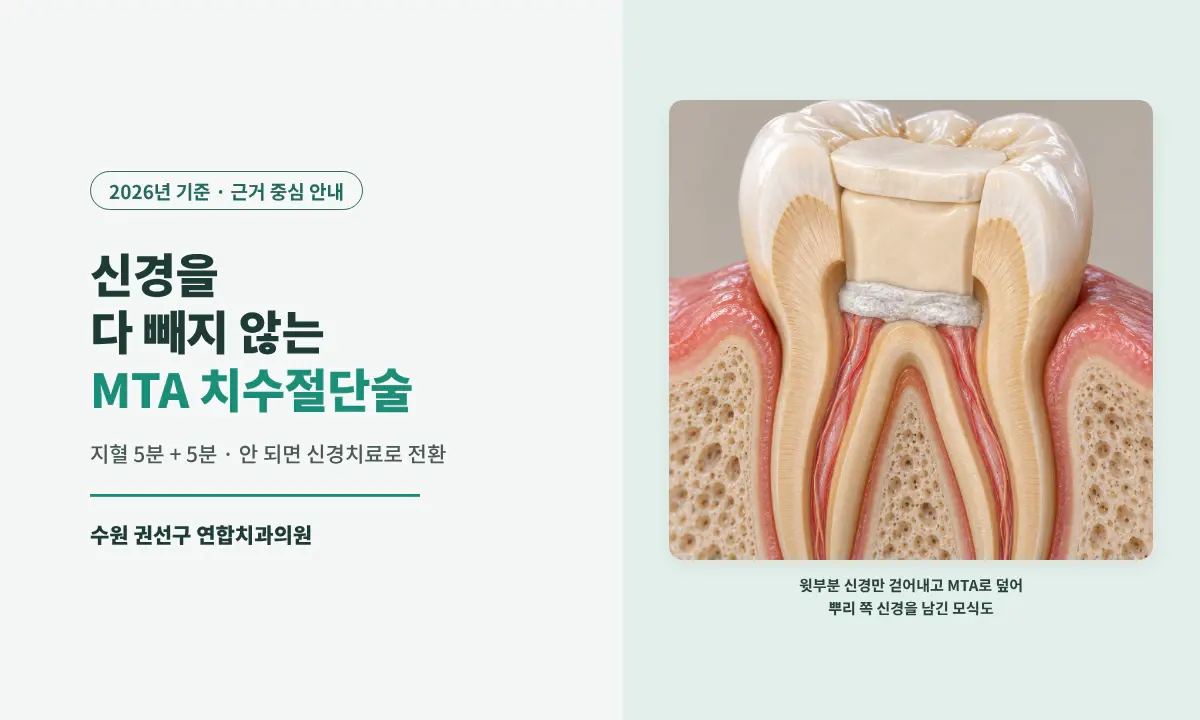
Even when decay has reached the nerve, if the inflammation is limited to the upper part, a pulpotomy may allow the nerve in the root to be kept alive. At Yeonhap Dental Clinic in Gwonseon-gu, Suwon, we isolate the tooth with a rubber dam, check for bleeding control using sodium hypochlorite of 6% or higher for 5 minutes (and 5 more minutes if needed), cover with MTA if the bleeding stops, and switch to root canal treatment on the spot if it does not.
Is a pulpotomy that keeps the nerve alive possible without root canal treatment?
When people hear that decay has reached the nerve, most think of root canal treatment. Inside the tooth is the pulp, which contains nerves and blood vessels. Root canal treatment (endodontic treatment) removes this pulp all the way to the root tips and fills the canals. A pulpotomy removes only the inflamed upper part and leaves the pulp in the root.
[Key Answer]
Even when decay has reached the nerve, if the inflammation is limited to the upper part, a pulpotomy may allow the nerve in the root to be kept alive. Yeonhap Dental Clinic selects suitable teeth based on symptoms and X-rays, then makes the final decision by whether the cut surface stops bleeding (hemostasis) within a set time. If it stops, we cover it with Endocem MTA (a calcium silicate-based material that protects the nerve); if it does not, we switch to root canal treatment on the spot.
[Summary in 4 Lines]
· A pulpotomy removes only the inflamed upper part of the nerve and keeps the nerve in the root alive; the cut surface is covered with MTA.
· Yeonhap Dental Clinic checks for bleeding control with a sodium hypochlorite (NaOCl) solution of 6% or higher for 5 minutes, and 5 more minutes if needed; if the bleeding still does not stop, we switch to root canal treatment on the spot.
· In a pooled analysis of randomized controlled trials, the success rate at 12 months or longer was 86.7%, but it was lower, at 82.4%, for teeth with irreversible pulpitis (a condition in which the nerve inflammation is judged unlikely to recover) (Li 2024).
· On the day of treatment, we seal the tooth above the MTA with a composite resin restoration or a core and temporary restoration, and if an inlay or crown is needed, it is placed at the next visit.
Written by Dr. Ahn Seong-jin, Chief Director, Yeonhap Dental Clinic
[Contents]
· Is a pulpotomy that keeps the nerve alive possible without root canal treatment?
· How do root canal treatment and pulpotomy differ?
· How is it decided whether a pulpotomy is possible?
· What is the success rate of MTA pulpotomy?
· How does Yeonhap Dental Clinic perform MTA pulpotomy?
· How is the tooth restored and followed up after a pulpotomy?
In the past, when decay exposed the nerve, most cases went straight to root canal treatment that removed the entire pulp. Today, when the inflammation is limited to the upper part, removing only that part and keeping the rest below is an approach supported by evidence. The American Association of Endodontists has stated that a pre-treatment diagnosis of irreversible pulpitis does not necessarily mean the entire nerve must be removed (AAE 2021).
However, this is not possible for every tooth, and it is more accurate to understand it as an option to try keeping the nerve when conditions are right. For that reason, this article explains not only the cases where it works but also those where it does not, and those where treatment changes to root canal treatment midway.
How do root canal treatment and pulpotomy differ?
The difference is how much of the nerve is removed. Root canal treatment removes all of it down to the root tips, while a pulpotomy removes only the inflamed upper part.
The pulp runs from the pulp chamber in the crown of the tooth into the root canals inside the roots. When decay is deep and the nerve is exposed, inflammation reaches the upper part first, and the part in the root may still be healthy. A pulpotomy cuts the nerve at that boundary and covers the cut surface with MTA to protect the nerve below.
There are two types, depending on how much is removed.
· Partial pulpotomy: removes only about 2 to 3 mm below the exposed area of the nerve.
· Full (coronal) pulpotomy: removes all of the nerve in the crown of the tooth, down to the canal orifices (where the canals in the roots begin).
At our clinic, we choose a partial pulpotomy when the nerve is unexpectedly exposed during cavity treatment, and we sometimes choose a full pulpotomy when we plan a crown on a tooth with a live nerve and perform the pulpotomy in advance. This is not a fixed formula; it is decided by the condition of the tooth. In a pooled analysis of randomized controlled trials as well, the type of procedure, partial or full, did not have a significant effect on the success rate (Li 2024).
Keeping the nerve means the tooth keeps its sensation. If a problem arises, you can notice it through sensitivity or pain, and because the root canals do not need to be widened, less of the tooth is removed.
Pulpotomy versus root canal treatment
| Comparison item | Pulpotomy | Root canal treatment (endodontic treatment) |
|---|---|---|
| Extent removed | Inflamed upper part of the nerve | The entire nerve down to the root tips |
| Tissue left | The nerve in the root is kept alive | None |
| Material used to cover or fill | Calcium silicate material such as MTA | Root canal filling with gutta-percha and sealer |
| Conditions for use | When symptom and imaging conditions are met and bleeding stops | Most cases in which the nerve is unlikely to recover |
| Follow-up checks | Nerve response, symptoms, X-rays | Symptoms, X-rays |
How is it decided whether a pulpotomy is possible?
We narrow down candidates by symptoms and X-rays, and make the final decision by whether the cut surface stops bleeding.
Before starting, we check whether the pain occurs only with stimulation or continues even at rest, whether there has been pain that wakes you at night or does not settle with painkillers, whether the tooth hurts when tapped, and whether X-rays show a lesion at the root tip. If this kind of pain has lasted a long time, if tapping causes severe pain, or if a root-tip lesion is visible, Yeonhap Dental Clinic does not judge in favor of keeping the nerve. The same applies when the nerve is suspected to be already dead or too little tooth remains to restore.
If the conditions are met, we cut the nerve and then check for bleeding control. If bleeding on the cut surface stops within a set time, we take it to mean the inflammation in the nerve below is limited; if it keeps seeping, the inflammation has likely extended down into the root. The American Association of Endodontists summarizes that soaking the cut pulp in sodium hypochlorite for 5 to 10 minutes to control bleeding is common, though recommended times may vary, and states that solutions from diluted concentrations up to full product strength can be used safely in direct contact with pulp tissue (AAE 2021).
For this reason, the diagnosis is confirmed during treatment. Because some things can only be known once the tooth is opened and the nerve cut, we explain at the consultation both the cases that end as a pulpotomy and those that change to root canal treatment before we begin.
We check for cracks first as well. Before a pulpotomy, Yeonhap Dental Clinic always checks for cracks with Q-ray (a diagnostic device that shines light to show decay and cracks by fluorescence). In a study that followed 199 cracked teeth without root canal treatment and with reversible pulpitis (nerve inflammation that can recover if the cause is removed) for 3 years or more, 29.1% progressed to irreversible pulpitis or pulp necrosis, and without a crown covering the whole tooth, the odds ratio for complications was 8.74 (Wu 2019). It is not a pulpotomy study, but it shows that covering a cracked tooth is important in the design. The reading range and limits of Q-ray are covered in Q-ray Precision Diagnosis: Interpretation, Limits, and How to Overcome Them.
What is the success rate of MTA pulpotomy?
Pooled analyses of studies report a success rate in the mid-to-high 80% range, but the numbers vary with the condition of the nerve and the study conditions.
In a pooled analysis of 25 randomized controlled trials, the success rate at 12 months or longer was 86.7%. Teeth with irreversible pulpitis had a rate of 82.4%, lower than the 92.0% for teeth with normal pulp or reversible pulpitis (p=0.013), and root maturity and the type of procedure, partial or full, had no significant effect. In the same analysis, MTA had a higher success rate than calcium hydroxide (88.2% versus 79.1%). However, the certainty of the evidence was rated very low to low (Li 2024).
In another analysis of only teeth with irreversible pulpitis, the success rate was 86%, and fully developed roots had 83%, lower than the 96% of immature roots (p=0.02, Ather 2022). The two analyses reach different conclusions about the effect of root maturity. Because most adult teeth have fully developed roots, rather than expecting the average figure, it is important to look at the conditions of your own tooth.
A retrospective study that followed 1,257 teeth at a single private dental practice for an average of 42 months reported a success rate of 91.6% and a tooth survival rate of 99.1%. Symptomatic irreversible pulpitis (hazard ratio 1.97) and a root-tip lesion (hazard ratio 2.98) were factors associated with failure, and whether the tooth was restored with amalgam or composite resin was also reported as a related factor (Asgary 2024). This study included direct pulp capping (covering only the exposed area without cutting the nerve) and used a calcium silicate material other than MTA, so its numbers cannot be applied directly to our method.
If a pulpotomy fails, treatment moves on to root canal treatment. In that case, the MTA placed over the pulp has to be removed to get in, and if the canals have narrowed, we approach them using the methods outlined in Calcified Canals: Limits and How to Overcome Them.
Reported pulpotomy success rates by condition
| Subjects and conditions | Reported success rate | Source and study scope |
|---|---|---|
| All teeth, 12 months or longer | 86.7% | Analysis of 25 randomized controlled trials (Li 2024) |
| Normal pulp or reversible pulpitis | 92.0% | Subgroup analysis of the same study (Li 2024) |
| Irreversible pulpitis | 82.4% | Subgroup analysis of the same study (Li 2024) |
| MTA versus calcium hydroxide | 88.2% versus 79.1% | Direct comparison in the same study (Li 2024) |
| All teeth with irreversible pulpitis | 86% | Analysis of 11 studies (Ather 2022) |
| Irreversible pulpitis, mature roots | 83% | Subgroup analysis of the same study (Ather 2022) |
| Irreversible pulpitis, immature roots | 96% | Subgroup analysis of the same study (Ather 2022) |
How does Yeonhap Dental Clinic perform MTA pulpotomy?
We isolate the tooth with a rubber dam, check bleeding control with sodium hypochlorite of 6% or higher, and cover with Endocem MTA if the bleeding stops.
The main risk in treatments that keep the nerve alive is saliva and bacteria reaching the exposed nerve. Yeonhap Dental Clinic works with a rubber dam in place (a rubber sheet that covers the mouth, leaving only the tooth being treated exposed). A rubber dam does not create a completely sterile environment, but it reduces the routes of contamination that people can control. This is covered in more detail in Why a Rubber Dam Is Essential in Root Canal Treatment.
· We press the cut surface of the nerve for 5 minutes with cotton soaked in undiluted sodium hypochlorite of 6% or higher. It is the same product used to disinfect during root canal treatment.
· If the bleeding has stopped after 5 minutes, we cover it with Endocem MTA.
· If it has not stopped, we allow 5 more minutes, and if it still does not stop, we switch to root canal treatment on the spot.
We give only two chances. If we begin waiting a third or fourth time, it stops being a judgment and becomes hope, and in the end you may have to go through treatment twice.
How is the tooth restored and followed up after a pulpotomy?
If the final restoration is planned in resin, we finish with resin on the same day; if an inlay or crown is needed, we complete a core and temporary restoration on the same day and place the final one at the next visit.
Yeonhap Dental Clinic decides the final restoration after a pulpotomy based on the remaining tooth structure, the size of the cavity (the space left after decay is removed), and whether there are cracks. For a partial pulpotomy in a small cavity where direct restoration was planned from the start, we finish the treatment that day with a resin restoration over the MTA.
When an inlay or crown is needed, we build a core (the part that rebuilds the broken-down shape) over the MTA on the same day, seal the tooth with a temporary material or temporary tooth, and place the final prosthesis at the next visit. In either case, we seal the top on the same day the MTA is placed.
The American Association of Endodontists also recommends restoring right after vital pulp therapy, and summarizes reports that the shorter the interval between treatment and the base restoration, the better the outcome. It recommends doing any additional tooth reduction for a covering prosthesis after an appropriate period (AAE 2021).
I adjust the bite of the final prosthesis myself. A tooth whose nerve has been kept alive still has sensation, so a high bite shows up as symptoms right away.
After treatment, we check every 6 months whether any sensitivity remains, whether there is pain at rest, and whether the X-ray shows changes at the root tip.
5 things to check when you ask about pulpotomy in Tap-dong, Gwonseon-gu, Suwon
Beyond whether the nerve can be kept alive, a practical standard for a consultation is whether you are also told in advance what happens if it cannot.
Yeonhap Dental Clinic, across from the Suwon NongHyup Guun Branch (231 Geumho-ro) at 230 Geumho-ro, 5th Floor (Tap-dong, Cham Clinic Building), Gwonseon-gu, Suwon, Gyeonggi-do, has been treating patients at the same location since 2002. Treatment is led by Dr. Ahn Seong-jin, Chief Director and Integrated Dentistry specialist. It helps our assessment if you can tell us when and in what situations the pain occurs and whether you have ever been woken at night and taken painkillers. The treatment process is available at Root Canal and Conservative Treatment.
· Whether you are first told, based on symptoms and X-rays, if you are a candidate for pulpotomy
· Whether you are told in advance how long bleeding control is checked and when treatment changes to root canal treatment if it does not stop
· Whether treatment is done with the tooth isolated by a rubber dam
· Whether cracks are checked and how the final restoration is decided
· Whether you are told when and what will be checked after treatment
[Key Takeaways]
✓ A pulpotomy removes only the inflamed upper part of the nerve and keeps the nerve in the root; Yeonhap Dental Clinic selects teeth by symptoms and X-rays, then makes the final decision by bleeding control.
✓ The success rate at 12 months or longer is reported as 86.7%, but it is lower, at 82.4%, for teeth with irreversible pulpitis, and the subjects and conditions differ between studies.
✓ On the day of treatment, we seal the tooth with a resin restoration or a core and temporary restoration, place an inlay or crown at the next visit if needed, and check progress every 6 months.
A few words from the treatment room about MTA pulpotomy
The first thing I look at in this treatment is whether, judging by symptoms and images, the tooth is one worth trying to keep the nerve in. Keeping the nerve preserves sensation and means less tooth is removed, so I would like to go that way when possible, but to keep that wish from overriding my judgment, I set the bleeding-control criteria in advance and follow them. I look at 5 minutes and then 5 more, and there have in fact been cases where the bleeding still did not stop and we switched to root canal treatment on the spot. There have also been cases where a tooth with a live nerve developed pain after a crown, we performed a pulpotomy, but the symptoms continued and we ultimately switched to root canal treatment. For symptoms that appear after a crown, the line between pulpitis that a pulpotomy can resolve and pulpitis that needs root canal treatment can be unclear. That does not mean we always perform a pulpotomy before a crown; we decide based on the condition of the tooth. Treatment that keeps the nerve is an option to try when conditions are right, and I see a midway change to root canal treatment not as a failure but as another path that we explain to you in advance.
References
📋 Clinic Information
This article was written in line with the Medical Service Act and the Ministry of Health and Welfare's medical advertising guidelines, and is intended to provide medical information. It does not guarantee or assert the effect or result of any particular treatment. The procedures that can be used and the course of treatment vary from person to person depending on the condition of the nerve and the tooth, so please decide on diagnosis and treatment direction only after a thorough consultation with your dental team.
🦷 Root canal treatment information: Yeonhap Dental Clinic Root Canal and Conservative Treatment
📍 230 Geumho-ro, 5th Floor (Tap-dong, Cham Clinic Building), Gwonseon-gu, Suwon, Gyeonggi-do
🚕 Across from the Suwon NongHyup Guun Branch (231 Geumho-ro) / about 15 minutes by taxi from Suwon Station
🚗 Free parking available in the building
📞 031-293-2207
🌐 yeonhapdental.com
🟡 Open since 2002 / Treatment led by Dr. Ahn Seong-jin, Chief Director and Integrated Dentistry specialist
🔗 Online booking and consultation
MTA Pulpotomy: Frequently Asked Questions
- What is MTA pulpotomy?
- It is a treatment that does not remove the entire nerve (pulp) inside the tooth, but cuts away only the inflamed upper part and covers the surface with MTA (a calcium silicate-based material that protects the nerve) to keep the nerve in the root alive. When the nerve remains, the tooth keeps its sensation, and less of the tooth is removed than with root canal treatment.
- If decay has reached the nerve, is root canal treatment always necessary?
- Not necessarily. The American Association of Endodontists has stated that a diagnosis of irreversible pulpitis (a condition in which the nerve inflammation is judged unlikely to recover) does not necessarily mean the entire nerve must be removed (AAE 2021). However, if there has been long-lasting spontaneous pain or a root-tip lesion, Yeonhap Dental Clinic does not judge in favor of keeping the nerve.
- How is it decided whether a pulpotomy is possible?
- We narrow down candidates by symptoms and X-rays, and make the final decision by whether the cut surface of the nerve stops bleeding (hemostasis). Yeonhap Dental Clinic checks for 5 minutes with sodium hypochlorite of 6% or higher, allows 5 more minutes if the bleeding has not stopped, and switches to root canal treatment on the spot if it still does not stop.
- What is the success rate of MTA pulpotomy?
- In a pooled analysis of 25 randomized controlled trials, the success rate at 12 months or longer was 86.7%, and it was lower, at 82.4%, for teeth with irreversible pulpitis (nerve inflammation unlikely to recover) (Li 2024). In an analysis of only teeth with irreversible pulpitis, fully developed roots were reported at 83% (Ather 2022).
- Can a pulpotomy change to root canal treatment midway?
- Yes. If the bleeding does not stop within a set time after the nerve is cut, we judge that the inflammation has likely extended down into the root and proceed with root canal treatment on the spot. Yeonhap Dental Clinic explains both possibilities before we begin.
- After a pulpotomy, is the tooth finished with resin or covered with a crown?
- It depends on the remaining tooth structure, the size of the cavity, and whether there are cracks. For a small cavity where a resin restoration was planned from the start, we finish with resin over the MTA on the same day; if an inlay or crown is needed, we seal the tooth that day with a core (the part that rebuilds the broken-down shape) and a temporary restoration and place the final one at the next visit.
- Which is better, MTA or Biodentine?
- The results differ between studies. An analysis of teeth with irreversible pulpitis reported that Biodentine had a higher success rate than MTA (Ather 2022), while another analysis of randomized controlled trials reported no significant difference between MTA and other materials (Li 2024). In the Li 2024 analysis, MTA had a significantly higher success rate than calcium hydroxide, and Biodentine was also numerically higher, but a statistically significant difference was not found.
- Where is Yeonhap Dental Clinic in Tap-dong and Guun-dong, Gwonseon-gu, Suwon?
- It is at 230 Geumho-ro, 5th Floor (Tap-dong, Cham Clinic Building), Gwonseon-gu, Suwon, Gyeonggi-do, across from the Suwon NongHyup Guun Branch (231 Geumho-ro). Free parking is available in the building, and the clinic is about 15 minutes from Suwon Station by taxi.
Related pages
Before your visit
This article provides general information on oral health and dental care. Whether treatment is needed, and which method is appropriate, may change after an oral exam and any necessary diagnostic tests. If you have pain, a loose tooth, swelling, or discomfort with a prosthesis, please visit us for a consultation.