
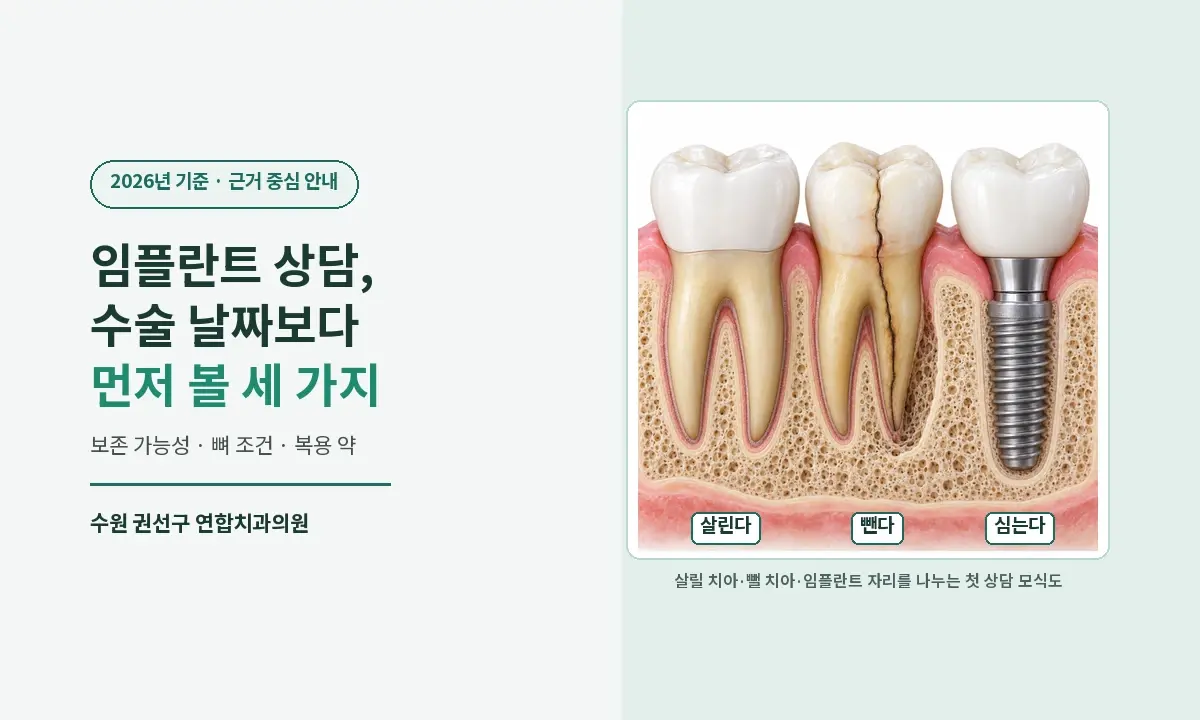
The worries patients most often have before an implant consultation are whether we will suggest pulling even healthy teeth, and whether the medications they take will be a problem for surgery. At Yeonhap Dental Clinic, we do not set a surgery date at the first consultation. First we evaluate whether the remaining tooth can be saved, using Q-ray and the Trios 6 intraoral scanner among other tools; we measure bone thickness and the distance to the nerve canal on 3D CT to confirm what is possible; and we check your medications and systemic conditions to adjust the plan. Yeonhap Dental Clinic in Gwonseon-gu, Suwon talks about a placement plan only after these three have been sorted out.
What do we do first on the first day of an implant consultation?
At the first consultation, we first check whether the tooth can be saved, not the surgery date.
Written by: Dr. Ahn Seong-jin, Chief Director, Yeonhap Dental Clinic · Published July 26, 2026 · Last updated September 3, 2026
This article answers the following five questions in turn. · What do we do first on the first day of an implant consultation? · How do we judge whether a tooth can be saved before an implant? · What is the standard behind being told you do not have enough bone for an implant? · How is an implant planned if you are taking medication? · What should you ask in an implant consultation?
There are two worries that patients preparing for an implant consultation often have: whether we will suggest pulling even healthy teeth, and whether surgery would be risky because of the medications they are taking.
The first consultation at Yeonhap Dental Clinic does not start from a surgical plan. The sequence is fixed. We first evaluate whether the remaining tooth can be saved, using Q-ray and the Trios 6 intraoral scanner among other tools; we measure the bone condition on 3D CT to confirm what is possible; and we check your medications and systemic conditions to adjust the plan. Only after these three are sorted out do the number and extent of implants come out.
The reason for this order is simple: even the best implant cannot beat the tooth that was originally there. If you skip what needs to be checked first, you end up making an irreversible decision first.
· 빠진 개수만큼 심지 않고, 공간과 뼈에 따라 개수를 줄일 수 있는지 첫날 CT에서 정합니다.
작성: 연합치과의원 대표원장 안성진
임플란트 상담을 앞두고 계신 분들이 자주 하시는 걱정이 둘 있습니다. 멀쩡한 치아까지 뽑자고 하지 않을까, 그리고 복용 중인 약 때문에 수술이 위험하지 않을까 하는 것입니다.
[글의 목차]
· 임플란트 전에 살릴 수 있는지는 어떻게 판단하나요?
· 임플란트에서 뼈가 부족하다는 말은 무엇을 기준으로 하나요?
· 임플란트는 빠진 개수만큼 심어야 하나요?
· 복용 중인 약이 있으면 임플란트를 어떻게 계획하나요?
연합치과의원은 남은 치아를 살릴 수 있는지 큐레이(Q-Ray), 트리오스 6(Trios 6) 등으로 먼저 평가하고, 3D CT로 뼈 상태를 계측하고, 복용 약과 전신질환을 확인해 순서를 정합니다. 첫 상담의 순서는 빼기 전에 살릴 수 있는지부터 봅니다에 정리했습니다.
방법은 통합치의학과 전문의가 큐레이와 CT 화면으로 직접 설명하고, 방법이 정해진 뒤에 상담실장이 항목별 비용을 안내합니다.
How do we judge whether a tooth can be saved before an implant?
We judge by the amount and location of the remaining tooth structure and whether a margin can be secured.
Even for a tooth scheduled for extraction, we first check whether there is a possibility of keeping it. If the decay has reached the nerve, we look at whether it can be kept with root canal treatment, and if a tooth that has already had root canal treatment has recurred, with root canal retreatment or apicoectomy. In the literature, these procedures are reported to have success rates in the 70–80% range, but this figure goes lower for teeth with a poor prognosis from the start.
Even if a tooth remains, if a crown cannot be placed on it, it ends in extraction. That is why we also check the margin, the boundary of sound tooth structure that the crown grips. If this boundary lies below the gum, bone has to be reshaped to expose it or it has to be brought up with resin, and which of these is possible enters the judgment. Detailed criteria are covered in Crown Lengthening: How Much Bone to Remove.
When a crack is suspected, we also check the Q-ray fluorescence reaction to understand its extent. However, a red reaction is not by itself a reason for treatment, so we remove the plaque and take the image again to sort out what the signal really is. What fluorescence can and cannot see is covered in Precision Diagnosis at a Dental Clinic in Gwonseon-gu, Suwon: Interpreting Q-ray, Its Limits, and How We Compensate.
To sum up, the question at this stage is not "pull it or not" but "how many years can we use it if we keep it?" If that answer does not come out, we do not move on to an implant plan.
Three things checked at the first implant consultation
| Item checked | What we look at | Criteria used for judgment |
|---|---|---|
| Preservation potential | Remaining tooth structure, margin position, presence of cracks | Whether a ferrule of 1.5–2 mm can be secured |
| Bone conditions | Bone thickness and height, distance to the nerve canal, sinus condition | 2 mm buccal, 1.5 mm lingual, 4 mm below the soft-tissue top |
| Systemic condition | Medications, whether chronic conditions are controlled | History of antithrombotic and antiresorptive drugs |
What is the standard behind being told you do not have enough bone for an implant?
We judge by measuring bone thickness and height and the distance to the nerve canal on 3D CT.
"Not enough bone" is a phrase used often, but its meaning is vague unless the standard is given with it. The values Yeonhap Dental Clinic measures are fixed.
In the horizontal direction, we look at the thickness of bone surrounding the implant. The standard is to secure a position where 2 mm remains on the cheek side and 1.5 mm on the tongue side, and the basis is a report that marginal bone loss was observed to be about 10 times greater when buccal bone at placement was under 2 mm than when it was 2 mm or more (Monje 2023). Details are covered in Implant Bone Grafts: When and How.
In the vertical direction, we look at the depth from the gum. The reason is that this value is closely related to peri-implantitis. To minimize peri-implantitis, Yeonhap Dental Clinic plans so that the top of the implant sits 4 mm below the top of the soft tissue, and this value is adjusted according to gum thickness. The calculation method is covered in Peri-implantitis and Placement Depth.
In the lower jaw the distance to the nerve canal is added, and in upper molars the height to the maxillary sinus. On the sinus side there are ways to raise the floor even when residual bone is lacking, so being told there is not enough does not mean it is impossible.
We judge bone grafts in the same way. Rather than the order "it's lacking, so graft," we first check whether there are sites that can be solved without a graft when thickness, position, and angle are designed in three dimensions. Considering short implants as well, treatment can sometimes be completed within the remaining bone. However, this is chosen in a state where all the necessary procedures could be performed, and is different from avoiding them because they cannot be performed.
How is an implant planned if you are taking medication?
Antithrombotic drugs and antiresorptive drugs can change the plan itself, so you must let us know.
There are three things you need to tell us at the consultation.
First, antithrombotic drugs. If you are taking antiplatelet drugs such as aspirin or Plavix, or warfarin or novel oral anticoagulants, the plan for controlling bleeding changes. Please do not stop them on your own; just let us know that you take them. If needed, we consult the prescribing physician.
Second, antiresorptive drugs. If you are receiving bisphosphonates or denosumab for osteoporosis, the risk of medication-related osteonecrosis of the jaw must be considered. The level of risk differs with the route and duration of administration, so when you started and which drug you have used matters.
Third, how well it is controlled. Diabetes, high blood pressure, or epilepsy by themselves do not rule out an implant, but if blood sugar is not controlled it affects healing and infection risk. It helps if you know your recent test values.
This information changes not only whether surgery is possible but also the sequence. For example, if a condition needs control, we sort that out first, and if there is a history of antiresorptive drugs, we first consider a design that reduces the extent of the incision.
Information that is helpful to organize before an implant consultation
| Item | What to tell us | Effect on the plan |
|---|---|---|
| Time of extraction | When the tooth was lost | Degree of bone resorption, whether the opposing tooth has over-erupted |
| Current symptoms | Pain, swelling, looseness | Whether inflammation needs to be treated first |
| Existing prostheses | History of using dentures or bridges | Condition of adjacent teeth, extent of the design |
| Antithrombotic drugs | Aspirin, Plavix, anticoagulants | Plan for controlling bleeding, consultation with the prescribing physician |
| Antiresorptive drugs | Osteoporosis medication and duration of use | Assessment of the risk of jaw osteonecrosis, adjustment of the invasive extent |
| Diabetes | Recent HbA1c value | Healing and infection risk, whether control comes first |
| Liver disease | Diagnosis such as cirrhosis or hepatitis | Change in the bleeding control plan due to reduced clotting factors |
What should you ask in an implant consultation?
If you ask questions that can be answered with numbers, the basis for the plan becomes visible.
We often hear that people don't know what to ask at a consultation. The five questions below can be asked at any dental clinic, and how specific the answers are lets you gauge the basis of the plan.
[5 Things to Check in an Implant Consultation]
· Why this tooth cannot be saved — whether it is explained by the remaining tooth structure and margin position
· If bone is lacking, which value is lacking — thickness or height, and by how much
· If a bone graft is needed, why — whether they also tell you the cases where it is not needed
· How many implants are placed and why that number — only as many as needed, not more
· When you return after surgery — whether the follow-up schedule is set
The last item is surprisingly important. Yeonhap Dental Clinic prescribes about 5 days of medication on the day of surgery, always checks after 1 week, and judges osseointegration at 1 month. If these points are missed, problems are discovered late. What we look at at each point is covered in What Determines Pain in Implant Surgery.
[Key Takeaways]
✓ The first consultation starts not with the surgery date but with an evaluation of preservation potential, and a judgment that a tooth cannot be saved needs the basis of remaining tooth structure and margin position.
✓ Bone conditions are measured on 3D CT. A bone thickness of 2 mm buccal and 1.5 mm lingual and a depth of 4 mm below the soft-tissue top are the reference values, and the extent of any bone graft is decided from these measurements.
✓ A history of antithrombotic and antiresorptive drugs changes not only whether surgery is possible but also the sequence and invasive extent, so you must let us know.
About Yeonhap Dental Clinic in Gwonseon-gu and Tap-dong, Suwon
Yeonhap Dental Clinic, located across from Suwon NongHyup Guun Branch (231 Geumho-ro), on the 5th floor at 230 Geumho-ro, Gwonseon-gu, Suwon, Gyeonggi-do (Tap-dong, Cham Clinic Building), has stayed in the same place since 2002. Today, Dr. Ahn Seong-jin, Chief Director and Integrated Dentistry specialist, oversees treatment, and you can see the process from diagnosis through placement, prosthesis, and aftercare in Implant Information.
When conditions on the sinus side are the issue, they are covered separately in Sinus Lift: Limits of the Crestal Approach and How to Overcome Them.
Frequently Asked Questions
- Do you set the surgery date right at the first implant consultation?
- No. Yeonhap Dental Clinic talks about a placement plan only after the evaluation of preservation potential, 3D CT measurements, and the check of your systemic condition are finished. Once those three are sorted out, the number and extent come out.
- I'm worried that at an implant consultation they will suggest pulling even teeth that look fine.
- Even for a tooth scheduled for extraction, we first check whether it can be kept with root canal treatment, retreatment, or apicoectomy. A judgment that it cannot be saved needs the basis of remaining tooth structure and margin position, and we explain that basis to you.
- I was told I don't have enough bone for an implant. What exactly is lacking?
- Thickness and height are different matters. Yeonhap Dental Clinic measures against a bone thickness of 2 mm on the cheek side and 1.5 mm on the tongue side and a depth of 4 mm below the soft-tissue top, and tells you which value is lacking and by how much.
- Is a bone graft always necessary for an implant?
- Not in every case. We first check on 3D CT whether there are sites that can be solved without a graft when thickness, position, and angle are designed, and we also consider short implants. We do it only to the extent needed.
- I take aspirin or Plavix. Is implant surgery possible?
- In most cases we proceed without stopping. However, the plan for controlling bleeding changes, so you must let us know that you take them; please do not stop on your own, just tell us. If needed, we consult the prescribing physician.
- Can I get an implant even if I take osteoporosis medication?
- For antiresorptive drugs such as bisphosphonates or denosumab, the risk of medication-related osteonecrosis of the jaw must be considered. The level of risk differs with the route and duration of administration, so if you tell us when you started and which drug you have used, we plan by adjusting the invasive extent.
- Does National Health Insurance cover implants?
- National Health Insurance members aged 65 or older can receive up to 2 implants per lifetime at a 30% patient copayment rate. However, bone grafts and sinus lifts are not covered by NHI and are charged separately, so we explain the covered and non-covered areas separately.
- Where is Yeonhap Dental Clinic in Tap-dong and Guun-dong, Gwonseon-gu, Suwon?
- Yeonhap Dental Clinic is located on the 5th floor at 230 Geumho-ro, Gwonseon-gu, Suwon, Gyeonggi-do (Tap-dong, Cham Clinic Building), across from Suwon NongHyup Guun Branch (231 Geumho-ro). Free parking is available in the building, and we are about 15 minutes by taxi from Suwon Station.
Treatment Information
This post was written in compliance with the Korean Medical Service Act and the Ministry of Health and Welfare's medical advertising guidelines, and is intended to provide medical information. It does not guarantee or assert the result of any specific treatment. The plan that can be applied and the course of treatment differ from person to person depending on oral condition and general health, so please be sure to consult fully with your dental team before deciding on diagnosis and treatment direction.
🦷 Implant information: Yeonhap Dental Clinic Implant Information
📍 5th Floor, 230 Geumho-ro, Gwonseon-gu, Suwon, Gyeonggi-do (Tap-dong, Cham Clinic Building)
🚕 Across from Suwon NongHyup Guun Branch (231 Geumho-ro) / about 15 minutes by taxi from Suwon Station
🚗 Free parking available in the building
📞 031-293-2207
🌐 yeonhapdental.com
🟡 Opened in 2002 / Treatment overseen by Dr. Ahn Seong-jin, Chief Director and Integrated Dentistry specialist
🔗 Online booking and consultation
📋 진료 안내
본 게시글은 의료법 및 보건복지부 의료광고 가이드라인을 준수해 작성되었으며, 의학 정보 제공을 목적으로 합니다. 특정 치료의 효과나 비용을 보장하거나 단정하지 않으며, 구강 상태와 전신 건강에 따라 적용 가능한 계획과 경과는 개인마다 다르므로 진단과 치료 방향은 반드시 의료진과 충분히 상담하신 뒤 결정하시기 바랍니다.
🦷 임플란트 상담 안내: 빼기 전에 살릴 수 있는지부터 봅니다
📍 경기 수원시 권선구 금호로 230, 5층 (탑동, 참클리닉빌딩)
🚕 수원농협 구운지점(금호로 231) 맞은편 / 수원역 택시 약 15분
🚗 건물 내 무료주차 가능
📞 031-293-2207
🌐 yeonhapdental.com
🟡 2002년 개원 / 통합치의학과 전문의 안성진 대표원장 책임 진료
🔗 온라인 예약 및 상담
임플란트 상담 자주 묻는 질문
- 임플란트 첫 상담에서 바로 수술 날짜를 잡나요?
- 아닙니다. 연합치과의원은 보존 가능성 평가와 3D CT 계측, 복용 약과 전신 상태 확인이 끝난 뒤에 식립 개수와 범위를 말씀드립니다.
- 임플란트 상담에서 멀쩡해 보이는 치아까지 뽑자고 할까 봐 걱정됩니다.
- 연합치과의원은 큐레이 형광 반응과 증상·구강검사·3D CT로 균열과 주변 뼈 상태를 함께 평가하고, 크라운·치주치료·신경치료 등으로 치아를 남길 수 있는지 먼저 검토합니다. 뺀다는 결론이면 그 근거를 화면으로 함께 보여 드립니다.
- 임플란트에서 뼈가 부족하다는데 정확히 무엇이 부족한 건가요?
- 두께와 높이는 다른 이야기입니다. 연합치과의원은 볼 쪽 2mm·혀 쪽 1.5mm의 뼈 두께와, 위 어금니는 상악동까지 잔존골 7mm 이상인지를 기준으로 계측하고, 어느 값이 얼마나 부족한지를 함께 말씀드립니다.
- 임플란트 골이식은 꼭 해야 하나요?
- 모든 경우에 필요하지는 않으며, 연합치과의원은 보철이 가능한 위치·각도에서 볼 쪽 2mm·혀 쪽 1.5mm가 확보되는 자리가 나오면 이식하지 않습니다. 다만 앞니를 발치한 날 바로 심을 때 생기는 볼 쪽 틈은 이 기준과 별개로 이식재로 채웁니다.
- 아스피린이나 플라빅스를 먹고 있는데 임플란트 수술이 가능한가요?
- 대부분 진행할 수 있으며, 복용 이유와 수술 범위를 확인한 뒤 처방 의사와 상의해 중단 여부를 정하고 유지가 필요하면 복용한 채 수술합니다. 스스로 끊지 마시고 복용 사실을 알려 주세요.
- 골다공증 약을 먹고 있어도 임플란트가 되나요?
- 약 종류와 상태에 따라 진행할 수 있으며, 국내 2025년 입장문 기준으로 데노수맙은 마지막 주사 뒤 3~4개월, 먹는 비스포스포네이트는 휴약 시 2개월을 참고합니다. 휴약 근거에는 한계가 있어 복용 기간·골절 위험과 다음 주사 일정까지 처방 의사와 함께 정합니다.
- 임플란트에 건강보험이 적용되나요?
- 만 65세 이상이고 치아가 일부 남아 있으면 위턱·아래턱을 합쳐 평생 2개까지 건강보험이 적용되며, 일반 건강보험 본인부담률은 30%입니다. 뼈이식과 상악동거상술은 급여에 포함되지 않아 필요하면 별도로 발생합니다.
- 수원 권선구 탑동·구운동에서 연합치과의원은 어디에 있나요?
- 연합치과의원은 경기 수원시 권선구 금호로 230, 5층(탑동, 참클리닉빌딩)에 있으며 수원농협 구운지점(금호로 231) 맞은편입니다. 건물 내 무료주차가 가능하고 수원역에서 택시로 약 15분 거리입니다.
Related pages
Before your visit
This article provides general information on oral health and dental care. Whether treatment is needed, and which method is appropriate, may change after an oral exam and any necessary diagnostic tests. If you have pain, a loose tooth, swelling, or discomfort with a prosthesis, please visit us for a consultation.