
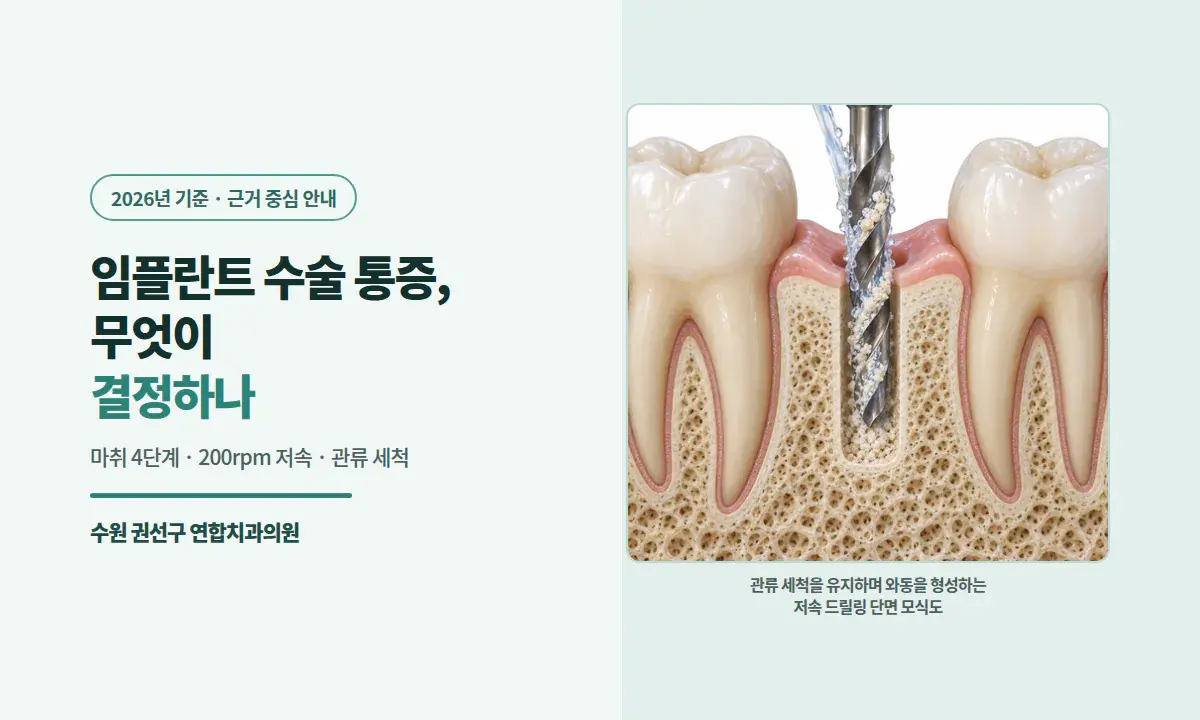
Implant pain varies with individual sensitivity and anxiety, and with the condition and extent of the surgical site. Yeonhap Dental Clinic in Gwonseon-gu, Suwon uses gargle anesthesia, topical anesthetic ointment, and an automatic anesthesia device as the standard, adds pressure for sensitive areas such as the palate, and reduces discomfort with a low-speed drill at around 200 rpm, flapless or minimal-incision planning, and follow-up at 1 week and 1 month after surgery.
What does pain in implant surgery depend on?
Many people put off implants because of surgical pain. Implant surgery opens the gum or makes a small opening, creates a hole in the bone, and places an artificial tooth root, so pain and swelling can occur after the anesthesia wears off.
[Key Answer]
Implant pain varies with individual sensitivity and anxiety, and with the condition and extent of the surgical site. Yeonhap Dental Clinic divides the anesthesia process, plans drill use and the extent of incision and bone grafting to reduce discomfort, and checks recovery at set times after surgery.
[Summary in 4 Lines]
· For anesthesia, gargle anesthesia, topical ointment, and an automatic anesthesia device (a device that delivers the anesthetic at a steady rate) are the standard, and sensitive areas such as the palate get added pressure to reduce discomfort during the injection.
· Bone is cut with a low-speed drill at around 200 rpm under water cooling. In a bovine bone experiment, the 200 rpm condition with irrigation did not reach the critical temperature, but it was not a study comparing patients' pain (Paeßens 2025).
· We look at the bone with a 3D CT and the gums with an oral examination, and if conditions allow, place the implant with a flapless or minimal-incision approach.
· After surgery, we check recovery at 1 week and 1 month, and if pain or swelling gets worse, you can contact us before then.
Written by Dr. Ahn Seong-jin, Chief Director, Yeonhap Dental Clinic
[Contents]
· What does pain in implant surgery depend on?
· How is implant anesthesia divided, and which anesthetic is used?
· How does the implant drill speed affect pain and bone?
· How does the extent of the incision affect pain and swelling after implant surgery?
· When is a bone graft done together with an implant?
· What is checked, and when, after implant surgery?
Pain occurs in three main phases: the moment the anesthetic injection is given, the vibration and sound while the bone is cut, and the period after surgery while the tissue recovers. Each phase has a different cause, so the ways to reduce it differ as well.
Even for the same surgery, how much pain people feel differs from person to person, and anxiety about dental treatment, inflammation at the surgical site, whether a bone graft is done, and the extent of surgery all play a part. The anesthesia, drilling, incision, and post-operative checks below are the parts Yeonhap Dental Clinic can adjust, and there is no study that has verified our entire approach as a single package. For that reason, for each item we explain the evidence in the literature and our clinic's policy separately.
Before recommending an implant, Yeonhap Dental Clinic first checks whether the tooth can be saved by root canal retreatment, apicoectomy, or similar treatment. What we look at in the consultation before surgery is outlined in Implant Consultation: Three Things We Check on the First Day.
How is implant anesthesia divided, and which anesthetic is used?
Gargle anesthesia, topical ointment, and an automatic anesthesia device are the standard, pressure is added for sensitive areas such as the palate, and articaine is used for infiltration anesthesia.
The uncomfortable moments of an anesthetic injection are when the needle passes through the gum and when the tissue is pressed as the anesthetic goes in. Yeonhap Dental Clinic reduces these two moments by dividing the process into steps.
· Gargle anesthesia: first dulls the surface sensation of the mucosa in the mouth.
· Topical ointment: applied to the injection site to reduce the stimulation of the needle entering.
· Automatic anesthesia device (i-JECT): equipment that, instead of a hand, delivers the anesthetic at a steady speed and pressure.
· Palatal pressure: the palatal gum is firmly attached to the bone, leaving little room for the anesthetic to spread, so we press the injection site with a cotton swab before inserting the needle. This is a pressure anesthesia method introduced in local anesthesia textbooks.
So for surgery that requires palatal anesthesia, such as for upper molars, it becomes four-step anesthesia. The purpose of dividing the steps is to reduce discomfort during the injection; it does not mean there is no pain at all.
For anesthetic, except for the inferior alveolar nerve block (anesthesia placed near the nerve trunk of the lower jaw), we use articaine for infiltration anesthesia (anesthesia placed close to the treatment site). In a 2011 meta-analysis, for pulpal anesthesia, which blocks sensation inside the tooth by infiltration, the odds of success with articaine were higher than with lidocaine (Brandt 2011). However, it was not a result comparing implant surgery only.
In a 2026 meta-analysis pooling 36 randomized controlled trials, articaine was reported to have advantages in onset time, duration, and pain scores for infiltration anesthesia, but there was no significant difference in anesthesia success rate. For nerve blocks as well, an advantage of articaine in onset and duration was reported (Gong 2026). Using the conventional anesthetic for the inferior alveolar nerve block is our clinic's choice, and along with the choice of anesthetic, we consider an injection method suited to the site and adequate confirmation of numbness to be important.
Results of studies comparing articaine and lidocaine
| Outcome assessed | Reported results for articaine | Source and conditions |
|---|---|---|
| Success of infiltration pulpal anesthesia | Odds of success 3.81 times those of lidocaine | Brandt 2011, meta-analysis of dental anesthesia studies |
| Infiltration anesthesia success rate | No significant difference from lidocaine | Gong 2026, meta-analysis of randomized controlled trials |
| Infiltration anesthesia onset time | Reported about 1.3 minutes faster | Gong 2026, same analysis |
| Infiltration anesthesia duration | Reported about 19 minutes longer | Gong 2026, same analysis |
| Infiltration anesthesia pain score | Reported lower | Gong 2026, same analysis |
| Nerve block onset and duration | Faster onset and longer duration | Gong 2026, same analysis |
How does the implant drill speed affect pain and bone?
Yeonhap Dental Clinic cuts bone with a low-speed drill of 150 to 400 rpm, mainly around 200 rpm, cooled with water.
Bone is vulnerable to heat, and if the temperature rises a lot during cutting, bone cells can be damaged. In an experiment using bovine bone, not only the drill speed but also whether irrigation was used and how much the drill diameter was widened affected the temperature rise, and the 200 rpm condition with irrigation did not reach the critical temperature set by the study. In the experimental groups without irrigation, temperatures above 47°C were observed even at low rotation speeds (Paeßens 2025).
For this reason, we consider irrigation with water to cool the bone as important as speed. However, this study did not compare patients' pain, so we do not assert from this result alone that a low-speed drill hurts less or reduces failure.
There is also vibration and sound. In practice, we see that the slower the rotation, the less vibration and noise is transmitted to the hand and jaw. This is our clinic's observation, not a figure from the literature.
Our clinic also uses thin specialty drills. Going at a low speed does not necessarily make the whole surgery longer; the actual time depends on the condition of the bone, the number of implants placed, the drill steps used, and whether a bone graft is done.
How does the extent of the incision affect pain and swelling after implant surgery?
The wider the gum is opened, the larger the area to suture and the more tissue there is to heal, so Yeonhap Dental Clinic places implants flapless or with a minimal incision when conditions allow.
Flapless placement is a method of placing the implant through a small opening without lifting the gum, and a minimal incision opens only as small an area as needed. Lifting and opening the gum widely increases the area to be sutured, and swelling and pain after surgery may increase as well.
Whether flapless placement is possible is decided by looking together at the bone shape seen on the 3D CT and the gum condition confirmed in the oral examination (gum thickness and the width of firm gum). When the surgical site must be seen directly, we proceed with an incision. For this reason, Yeonhap Dental Clinic does not insist on flapless only, and explains the approach as flapless or minimal incision.
Even when placing flapless or with a minimal incision, how deep to place the implant is judged separately, and that standard is covered in How Implant Placement Depth Affects Peri-implantitis.
When is a bone graft done together with an implant?
Yeonhap Dental Clinic first considers whether a suitable position can be found within the remaining bone so that the implant can be placed without a graft, and if a graft is needed, it is done on the same day as placement.
The standard is the thickness of bone remaining around the implant. Using 3D CT, we first look for a position where 2 mm of bone remains on the cheek side and 1.5 mm on the tongue or palate side. For back teeth, this thickness is often secured by adjusting position and angle, and for lower back teeth with insufficient height, we may consider a short implant (an implant of shorter length).
For front teeth, if there is no 2 mm of bone on the cheek side, the gum may recede over time, so a graft is done together. Studies pointing in the direction that thicker cheek-side bone means less change in the bone around the implant have been summarized (Monje 2023), but they are not studies comparing pain.
Reducing the extent of surgery is not the same as omitting a necessary treatment, and whether a bone graft is needed and how much will be explained in advance. The criteria for deciding when a graft is needed are outlined in Implant Bone Grafts: When and How They Are Done.
What is checked, and when, after implant surgery?
Medication is prescribed on the day of surgery, and recovery is checked 1 week and 1 month later.
· Day of surgery: about 5 days of medication is prescribed. This is to manage with medication the period when swelling and pain are greatest.
· 1 week later: we check whether the wound is healing well and whether pain and swelling are decreasing.
· 1 month later: we check the healing and any abnormal findings again. A single check does not confirm successful osseointegration (the implant bonding firmly to the bone); we decide the timing of the prosthesis by looking at the later course and any necessary tests together.
Pain and swelling after surgery gradually decrease as you recover. Conversely, if pain or swelling keeps getting worse, or pus or fever appears, please contact us without waiting for the scheduled check. After an examination to confirm the cause, we decide on the necessary treatment and medication.
5 things to check when you are worried about implant pain in Tap-dong, Gwonseon-gu, Suwon
If you are very worried about pain, a practical standard for a consultation is to be told in advance about the anesthesia, the extent of surgery, and how to contact us after surgery.
Yeonhap Dental Clinic, across from the Suwon NongHyup Guun Branch (231 Geumho-ro) at 230 Geumho-ro, 5th Floor (Tap-dong, Cham Clinic Building), Gwonseon-gu, Suwon, Gyeonggi-do, has been treating patients at the same location since 2002. Treatment is led by Dr. Ahn Seong-jin, Chief Director and Integrated Dentistry specialist. For an overview of our implant care, see Dental Implant Care.
· Whether you told us in advance if anesthesia did not work well or hurt a lot in previous dental treatment
· Whether we checked the medications you take and any problems when you take painkillers
· Whether you were told in advance the expected extent of incision and bone grafting
· Whether you were told if the surgery requires palatal anesthesia and how the anesthesia is divided
· Whether you were told when and how to contact us if pain gets worse after surgery
[Key Takeaways]
✓ Implant pain differs from person to person, and Yeonhap Dental Clinic reduces discomfort by planning the parts that can be adjusted: anesthesia, drilling, the extent of incision and bone grafting, and post-operative checks.
✓ For anesthesia, gargle anesthesia, topical ointment, and an automatic anesthesia device are the standard, pressure is added for sensitive areas such as the palate, and bone is cut with a low-speed drill at around 200 rpm under water cooling.
✓ If conditions allow, we place the implant flapless or with a minimal incision, and check at 1 week and 1 month after surgery; if pain or swelling gets worse, you can contact us before then.
A few words from the treatment room about implant surgery pain
Before surgery, I first look at which area needs anesthesia, whether the gum has to be opened, and whether a bone graft is also needed. If palatal anesthesia is needed, as for upper molars, I add one more step; if the bone and gum conditions allow, I proceed flapless or with a minimal incision, and if I need to see directly, I make an incision. The palate is an area where many patients said it hurt during the injection even with the automatic anesthesia device (i-JECT), so for that spot in particular I add a pressure step and take special care. When cutting bone as well, I see in practice that lowering the rotation reduces the vibration transmitted to the hand. Even so, pain cannot be eliminated completely, so I check in person at 1 week and 1 month after surgery and tell patients to contact us right away if pain gets worse in between. Rather than a promise that it will not hurt, I believe what I can do is not skip any single thing that can reduce discomfort.
References
📋 Clinic Information
This article was written in line with the Medical Service Act and the Ministry of Health and Welfare's medical advertising guidelines, and is intended to provide medical information. It does not guarantee or assert the effect of any particular treatment. The procedures that can be used and the course of treatment vary depending on each person's oral condition, general health, and bone quality, so please decide on diagnosis and treatment direction only after a thorough consultation with your dental team.
🦷 Implant pain consultation information: Implant Pain Consultation in Suwon: There Are Reasons Surgery Can Hurt Less
📍 230 Geumho-ro, 5th Floor (Tap-dong, Cham Clinic Building), Gwonseon-gu, Suwon, Gyeonggi-do
🚕 Across from the Suwon NongHyup Guun Branch (231 Geumho-ro) / about 15 minutes by taxi from Suwon Station
🚗 Free parking available in the building
📞 031-293-2207
🌐 yeonhapdental.com
🟡 Open since 2002 / Treatment led by Dr. Ahn Seong-jin, Chief Director and Integrated Dentistry specialist
🔗 Online booking and consultation
Implant Surgery Pain: Frequently Asked Questions
- Do you feel pain during implant surgery?
- When anesthesia is adequate, pain during surgery is mostly controlled, but you may still feel pressure or vibration, and this varies from person to person. Yeonhap Dental Clinic uses gargle anesthesia, topical ointment, and an automatic anesthesia device as the standard, and adds pressure for sensitive areas such as the palate to reduce discomfort during the injection.
- Why does palatal anesthesia hurt especially for upper molar implants?
- This is because the palatal gum is firmly attached to the bone, leaving little room for the anesthetic to spread. Many patients at Yeonhap Dental Clinic said this area hurts even with an automatic anesthesia device (a device that delivers the anesthetic at a steady rate), so we add a pressure step in which the injection site is pressed with a cotton swab before the needle is inserted.
- I am worried about the vibration and sound of bone cutting during implant surgery.
- Yeonhap Dental Clinic mainly uses a low-speed drill at around 200 rpm, and in practice we see that the slower the rotation, the less vibration and noise there is. The study on the heat of low-speed drills was a bovine bone experiment, so we do not assert from this result alone that pain is reduced.
- Does a low-speed drill make implant surgery longer?
- Going at a low speed does not necessarily make the whole surgery longer. The actual time depends on the condition of the bone, the number of implants placed, the drill steps used, and whether a bone graft is done.
- Does every implant need a bone graft?
- No. Yeonhap Dental Clinic first looks with 3D CT for a position where 2 mm of bone remains on the cheek side and 1.5 mm on the tongue or palate side, and for back teeth, we sometimes place implants without a graft by adjusting position and angle or using short implants (implants of shorter length). If cheek-side bone is lacking, as in front teeth, we graft along with placement, and whether it is needed and how much is explained in advance.
- Can anyone have a flapless implant?
- No. Whether flapless placement (a method of placing the implant through a small opening without lifting the gum) is possible is decided by looking together at the bone shape seen on CT and the gum condition confirmed in the oral examination. When the surgical site must be seen directly, we proceed with an incision.
- How soon after implant surgery will I feel better?
- Pain and swelling can be uncomfortable until about 2 to 3 days after surgery and then often gradually decrease. The recovery speed differs depending on the extent of surgery and whether a bone graft was done. Yeonhap Dental Clinic checks at 1 week and 1 month after surgery, and tells patients to contact us even before the check if pain or swelling keeps getting worse or pus or fever appears.
- Where is Yeonhap Dental Clinic in Tap-dong and Guun-dong, Gwonseon-gu, Suwon?
- It is at 230 Geumho-ro, 5th Floor (Tap-dong, Cham Clinic Building), Gwonseon-gu, Suwon, Gyeonggi-do, across from the Suwon NongHyup Guun Branch (231 Geumho-ro). Free parking is available in the building, and the clinic is about 15 minutes from Suwon Station by taxi.
Related pages
Before your visit
This article provides general information on oral health and dental care. Whether treatment is needed, and which method is appropriate, may change after an oral exam and any necessary diagnostic tests. If you have pain, a loose tooth, swelling, or discomfort with a prosthesis, please visit us for a consultation.