
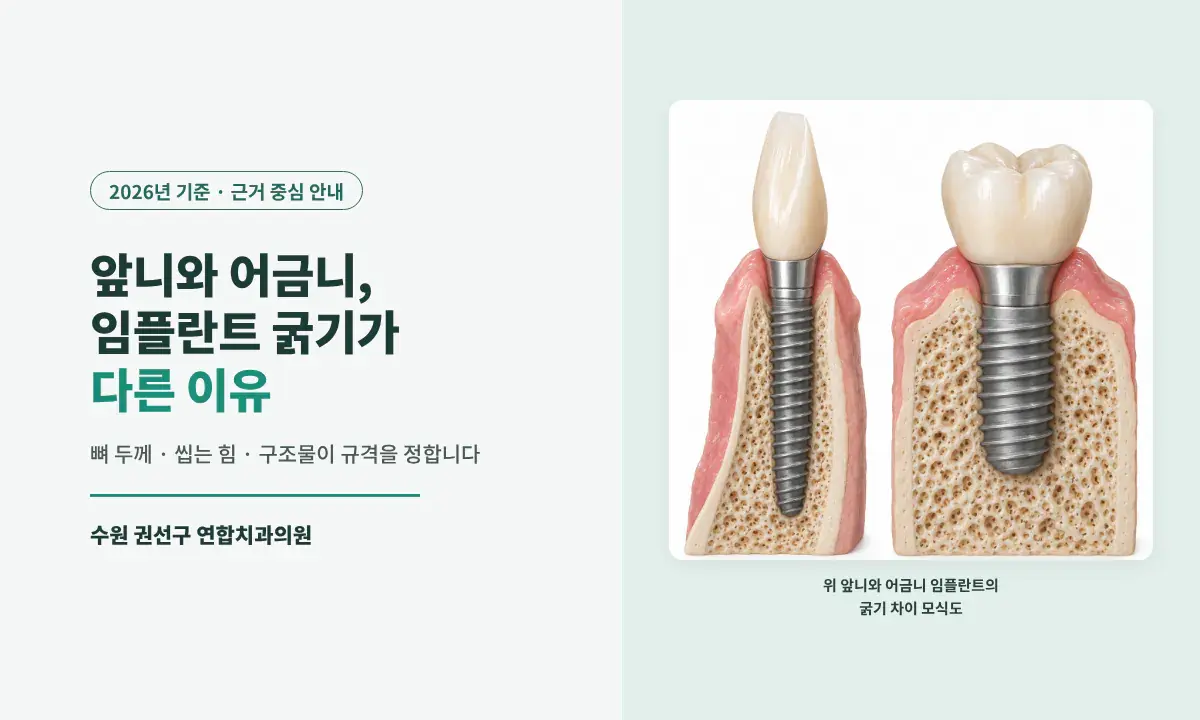
The same implant size is not used uniformly for front teeth and molars. For upper front teeth, where the bone is thin, we use thin implants of 3.0 to 4.0 mm diameter, and for molars, where chewing force is high, thick implants of 4.0 to 5.0 mm (premolars 4.0 to 4.5, molars 4.5 to 5.0). Yeonhap Dental Clinic sets the diameter, length, and number for each site on the first day from the CT, and places upper front-tooth implants at a position that does not extend forward of the line of the incisal edges of neighboring teeth.
How do front-tooth and molar implants in Suwon differ?
The fee for front teeth and molars can differ, but not simply because of implant thickness. This is because whether a bone graft, temporary teeth, a sinus lift, or an aesthetic prosthesis is needed varies along with the size for each site.
[Key Answer]
Front-tooth and molar implants differ in diameter, length, and number. For upper front teeth, the cheek-side bone is thin, so we use 3.0 to 4.0 mm (for the lower central incisors, if the bone is thin, a 2.5 to 3.0 mm one-piece implant), and for molars, because chewing force is high, we use 4.0 to 5.0 mm (premolars 4.0 to 4.5, molars 4.5 to 5.0) in length of 7 mm or more. The number is not the same as the number of missing teeth, and each site has its own standard.
[Summary in 4 Lines]
· For front teeth, bone thickness and the gumline set the size; for molars, chewing force and the location of the nerve canal and sinus set it.
· For lower front teeth, we place a 4.0 mm diameter at the canine (tooth 3), and for the central incisors (nos. 1 and 2), where the bone is thin, we use a 2.5 to 3.0 mm one-piece implant (MS). However, implants under 3.0 mm in diameter are reported to have an odds ratio of failure of 4.54 compared with standard diameter (Schiegnitz 2018).
· For molars, the basic size is 4.0 to 5.0 mm in diameter (premolars 4.0 to 4.5, molars 4.5 to 5.0) and 7 mm or more in length. For lower molars, if it is hard to leave 2 mm above the nerve canal, we consider a short implant of 5.0 mm diameter and 4 to 6 mm length, and for upper molars, we secure length with a sinus lift. Yeonhap Dental Clinic regards 6 mm or less as a short implant.
· As to number, for six front-tooth sites the principle is 2 implants below and 3 above, and for molars 1 per site, with 2 or 3 for three sites and 3 or 4 for four sites. We place one even if only a single no. 7 molar is missing, because there is a report that supraeruption was observed in 83% of sites with no opposing tooth (Craddock 2004).
Written by Dr. Ahn Seong-jin, Chief Director, Yeonhap Dental Clinic
[Contents]
· Why do implant diameter and length differ by site?
· What size is used for front-tooth implants in Suwon?
· Why are molar implants thick, and how long do they need to be?
· Do you place as many implants as missing teeth?
· When does Yeonhap Dental Clinic in Gwonseon-gu, Suwon decide the size for each site?
An implant is an artificial tooth made up of a fixture (the screw placed in the bone), an abutment (the post), and a crown (the tooth-shaped prosthesis). Fixtures come in a range of diameters and lengths depending on the manufacturer, and in the literature the estimated 10-year survival rate of implants supporting a single crown is reported as 95.2% (Jung 2012). Yeonhap Dental Clinic sets these sizes in advance for each site and confirms them on the first day from the CT, according to the bone at that site.
This article covers separately for front teeth and molars what diameter and length are used, how many are placed, and even the cases where those standards do not apply. This article was written as of September 2026.
Why do implant diameter and length differ by site?
Three things set the implant size: the bone thickness, chewing force, and structures to avoid at that site.
Bone thickness comes first. Around an implant, 2 mm of bone on the cheek side and 1.5 mm on the tongue side need to remain, but at front-tooth sites the bone itself is thin, so placing a thick implant cannot produce this thickness. In the Nohra 2018 study summarized in the Monje 2023 review, bone loss one year after prosthesis connection was reported as 0.36 mm in the group with less than 2 mm of cheek-side bone and 0.03 mm in the group with 2 mm or more. There is also an observational study in which more bone was seen to be added when 1.8 mm or more of cheek-side bone remained after placement (Spray 2000). So where the bone is thin, making the implant thinner comes first.
Chewing force is second. Molars are where food is crushed, so the force is large, and front teeth are where food is cut, so the force is small. A thick implant is needed where force is borne, and thin implants are not used where force is large.
Structures to avoid are third. Above the upper molars is the maxillary sinus (the air space beside the nose), below the lower molars is the inferior alveolar nerve canal (the large nerve running through the lower jaw), and above the upper front teeth is the nasal floor (the bottom of the nose). Length is set by the bone height remaining up to these structures. So even the same implant gets a different size depending on where it is placed. The conditions for choosing a short implant when height is lacking are covered in Criteria for Placing a Short Implant Without Bone Grafting.
Implant diameter and length standards by site (Yeonhap Dental Clinic)
| Site | Diameter | Length |
|---|---|---|
| Lower front canine (tooth 3) | 4.0mm | 8.5 mm or more |
| Lower front central incisors (nos. 1 and 2) | If bone is thin, one-piece MS 2.5 to 3.0 mm | 13mm |
| Upper front central incisor (tooth 1) | 3.5~4.0mm | 8.5 mm or more |
| Upper front lateral incisor (tooth 2) | 3.0~3.5mm | 8.5 mm or more |
| Upper front canine (tooth 3) | 4.0mm | 10 mm preferred |
| Premolars (nos. 4 and 5) | No. 4: 4.0 mm · No. 5: 4.5 mm | 7 mm or more |
| Molars (nos. 6 and 7) | 4.5 to 5.0 mm, sometimes thicker | 7 mm or more · for lower molars, if there is not enough room above the nerve canal, 4 to 6 mm at 5.0 mm diameter |
| Upper molars after a sinus lift | 4.5~5.0mm | 8.5mm |
What size is used for front-tooth implants in Suwon?
Front-tooth implants are placed thin, deep, and inside the line of the incisal edges of neighboring teeth.
At front-tooth sites the cheek-side bone is thin, so diameter is decided first. For upper front teeth, we use 3.5 to 4.0 mm for the central incisor (tooth 1), 3.0 to 3.5 mm for the lateral incisor (tooth 2), and 4.0 mm for the canine (tooth 3), with a length of 8.5 mm or more and 10 mm preferred for the canine. For lower front teeth, we place 4.0 mm at the canine, and for the middle four teeth (nos. 1 and 2), where the bone is often thin, we use a one-piece implant (MS) of 2.5 to 3.0 mm diameter and 13 mm length. In a one-piece implant the fixture and abutment are a single body, so the crown is attached with cement.
Limits of thin implants
· Implants under 3.0 mm in diameter are reported to have an odds ratio of failure of 4.54 compared with standard diameter (Schiegnitz 2018). For 3.0 to 3.25 mm, no significant difference in survival from standard diameter was observed. However, this result does not guarantee the same outcome for a specific product or for the lower front teeth.
· So Yeonhap Dental Clinic does not use MS implants where chewing force is large, and uses them only where force is small and the bone is thin, such as the lower front teeth.
Position is based on the line connecting the incisal edges (the cutting edges of the front teeth) of neighboring teeth. If the implant is biased toward the cheek, the gumline rises and the crown becomes longer than the adjacent tooth, and the literature calls such a site the danger zone (Buser 2004). Yeonhap Dental Clinic applies this concept as the line of the incisal edges of neighboring teeth, and places front-tooth implants biased toward the palate but inside the incisal edge line, at a depth of 4 mm below the gum surface for standard placement. The depth standard is covered in What Decides Implant Placement Depth?.
Extraction and temporary teeth
· For front teeth, if the infection can be removed, the gum has not collapsed, and initial stability is achieved, we place the implant on the same day as extraction in most cases.
· For a temporary front tooth, an insertion torque of 30 Ncm or more is the minimum condition, and we decide whether to attach it by also looking at other conditions such as the bite and deep bite. When one is attached, it is adjusted so that no direct biting force falls on it; this is immediate provisionalization, not immediate loading in which you chew on it.
· If a temporary tooth is not attached on the day, depending on stability, we protect the implant with a low healing abutment (a cap that comes through the gum) or a cover screw, and sometimes go to the final prosthesis after about 3 months with a flipper (temporary partial denture).
Why are molar implants thick, and how long do they need to be?
Molar implants use a diameter of 4.0 to 5.0 mm (premolars 4.0 to 4.5, molars 4.5 to 5.0) because of chewing force, and the length is set by the bone remaining up to the sinus and nerve canal.
For premolars, we use 4.0 mm for no. 4 and 4.5 mm for no. 5, and for molars (nos. 6 and 7) 4.5 to 5.0 mm, sometimes thicker. Length of 7 mm or more is the basic. Since these sites bear large forces, diameter is secured first, and length is matched to the bone height remaining at the site.
For upper molars, the bone height remaining up to the maxillary sinus is the reference. If the residual bone is 7 mm or more, we place directly, and if it is lacking, we raise it with a sinus lift and place an 8.5 mm length. For upper molars we choose a sinus lift rather than a short implant, because the sinus floor is a structure that can be raised, so securing length is the better route.
Lower molars are the opposite. Below them is the inferior alveolar nerve canal, so leaving 2 mm above the canal is the basic, and it is hard to stack bone upward. If 2 mm cannot be left, Yeonhap Dental Clinic first considers a short implant of 5.0 mm diameter and 4 to 6 mm length instead of building up bone, and checks whether the CT shows enough height to go in while leaving a safe distance to the canal. Yeonhap Dental Clinic regards 6 mm or less as a short implant and 7 mm and above as standard length. So we also perform a sinus lift on upper molars only when the residual bone is under 7 mm. In a meta-analysis of randomized trials of upper molars, no significant difference in survival was observed between 5 to 8 mm short implants and implants over 8 mm after a sinus lift (RR 1.00), and complications were fewer with short implants (RR 0.58, Fan 2017). Yeonhap Dental Clinic secures length with a sinus lift in the upper jaw and uses short implants in the lower jaw.
This does not mean a short implant is always better than a long one. In the ITI consensus report, the survival rate of short implants (6 mm or less) followed for 1 to 5 years was reported as 86.7 to 100%, a wider range than the 95 to 100% of standard implants (Jung 2018). The treatment standards by molar site are outlined in Molar Implants in Suwon.
Do you place as many implants as missing teeth?
No. For front teeth we place fewer than the number missing, and for molars the principle is 1 per site, with 2 or 3 for three sites and 3 or 4 for four sites depending on the bone.
Front-tooth sites are narrow and the force is small, so a design that connects the implants is possible. If all six upper front-tooth sites (3 to 3) are missing, we place 3: one at each canine, plus one more at a site among the four front teeth where the bone is good. For 3 to 4 sites we place 2, for 2 sites 1 to 2 depending on tooth size, and for 1 site 1, and if the lateral incisor is small, we may place just one and connect it with a cantilever (a prosthesis extended to one side). For the six lower front-tooth sites, 2 implants at the canines on both sides make six teeth; for 3 to 4 sites it is 2 (MS possible), and for 1 to 2 sites it is 1.
Molars bear force, so the principle is 1 per site. For 2 sites it is 2, for 3 sites 2 or 3, and for 4 sites 3 or 4. When placing 2 for 3 sites, the middle is connected. Which one is chosen is decided on the first day from the CT based on bone thickness and height and on chewing force.
We place one even if only a single no. 7 molar is missing. If a molar is left empty, the opposing tooth comes down into the space; supraeruption (a tooth coming down or up) was observed in 83% of sites with no opposing tooth, and up to 5.4 mm has been reported (Craddock 2004). Depending on how much it has erupted, that tooth may also need treatment, so Yeonhap Dental Clinic leans toward placing an implant even for a single missing no. 7.
However, this standard applies when some teeth remain. When an entire jaw is missing, a separate principle applies: the design is based on 12 teeth, with no. 7 added later, and that is covered in 5 Treatment Options for Completely Edentulous Cases.
Number of missing teeth and implants placed by site (Yeonhap Dental Clinic)
| Missing site | Number placed | Reason |
|---|---|---|
| Upper front, 1 site | 1 | Single 3.0 to 4.0 mm diameter |
| Upper front, 2 sites | 1 to 2 | Depending on tooth size; cantilever if the lateral incisor is small |
| Upper front, 3 to 4 sites | 2 | Connected between them |
| Upper front, 5 to 6 sites | 3 | One at each canine + 1 at a site with good bone |
| Lower front, 1 to 2 sites | 1 | MS implant if the bone is thin |
| Lower front, 3 to 4 sites | 2 | MS implant possible |
| Lower front, 5 to 6 sites | 2 | 4.0 mm diameter at each canine |
| Molars, 2 sites | 2 | Principle of 1 per site |
| Molars, 3 sites | 2 or 3 | If 2, the middle is connected |
| Molars, 4 sites | 3 or 4 | Decided by bone and chewing force |
| Single no. 7 molar | 1 | Prevents supraeruption of the opposing tooth |
When does Yeonhap Dental Clinic in Gwonseon-gu, Suwon decide the size for each site?
On the first visit, we measure the bone thickness and height at that site with 3D CT and choose the matching row from the size table.
The size table is the starting point, and the CT decides the final size. For front teeth we measure the cheek-side bone thickness and the distance to the incisal edge line, and for molars the height remaining up to the sinus and nerve canal, in millimeters, before confirming diameter and length. Whether a bone graft is needed is also settled at this point, and if the position can be moved to one that gives 2 mm on the cheek side, we do not graft. That judgment is covered in Implant Bone Grafts: When and How They Are Done.
5 things we check when deciding the size for each site
· Cheek-side bone thickness: whether it is a diameter that leaves 2 mm after the implant is placed
· Height remaining up to structures: whether it is a length that fits while leaving 7 mm at the sinus and 2 mm above the nerve canal (if difficult, a short implant is considered)
· Chewing force: the lower limit of diameter differs for front teeth and molars
· Number and position of missing sites: whether they can be connected or whether 1 per site is needed
· Front-tooth position: whether it can be placed inside the incisal edge line of neighboring teeth
When these five conflict, bone thickness takes priority. Rather than building up a lot of bone to fit a thick implant, choosing a diameter that suits the bone lasts longer. However, the size table does not cover every case, and for sites where the bone is very thin or the height is extremely low, there is also the option of leaving the site empty and changing the design.
[Key Takeaways]
✓ Yeonhap Dental Clinic's standard is a diameter of 3.0 to 4.0 mm and length of 8.5 mm or more for upper front-tooth implants, and a diameter of 4.0 to 5.0 mm (premolars 4.0 to 4.5, molars 4.5 to 5.0) and length of 7 mm or more for molar implants.
✓ Under 3.0 mm in diameter is reported to have an odds ratio of failure of 4.54 compared with standard diameter (Schiegnitz 2018), so it is used only where force is small, such as the lower front teeth, and short implants for lower molars are used at 5.0 mm diameter and 4 to 6 mm length when there is not enough room above the nerve canal.
✓ As to number, for six front-tooth sites it is 2 below and 3 above, for 2 upper front-tooth sites 1 to 2, and for 3 molar sites 2 or 3, and a single missing no. 7 is placed considering supraeruption (observed in 83%) (Craddock 2004).
If you are planning an implant consultation in Tap-dong, Gwonseon-gu, Suwon
The numbers to check differ depending on the site, so if you tell us the site first, the consultation goes faster.
Yeonhap Dental Clinic, across from the Suwon NongHyup Guun Branch (231 Geumho-ro) at 230 Geumho-ro, 5th Floor (Tap-dong, Cham Clinic Building), Gwonseon-gu, Suwon, Gyeonggi-do, has kept the same location since opening in 2002. Treatment is currently led by Dr. Ahn Seong-jin, Chief Director and Integrated Dentistry specialist.
Good to know before your consultation
· For front teeth, how much gum shows when you smile is something to check before the size
· For molars, what is measured, the maxillary sinus or the nerve canal, depends on whether it is upper or lower
· For a site missing for a long time, we also check whether the opposing tooth has come down
Deciding the size for each site takes about 30 minutes at the first visit, and you can make the decision at home.
A few words from the treatment room about implant thickness
I do not use the statement that a thick implant is a good implant as it stands. The right thickness is what the bone at that site allows, and an implant thicker than the bone may look solid on the day of placement but shows up years later as the cheek-side bone recedes.
That was also the reason I started using 2.5 mm one-piece implants in the lower front teeth. At that site, a thin implant that sits fully within the bone lasted longer than building up a lot of bone to place a thick one. However, I do not use the same implant in molars. I also take at face value the reports that under 3.0 mm in diameter failed more than standard diameter.
The size table by site is a starting point I have adjusted over several years, not a conclusion. There are days I meet bone that is not in the table, and in that case I choose to leave the site empty or change the design. I should also say that this judgment is an area where clinicians may differ.
References
Schiegnitz E, Al-Nawas B. Narrow-diameter implants: A systematic review and meta-analysis. Clin Oral Implants Res. 2018;29 Suppl 16:21-40. — survival rate 94.7% under 3.0 mm diameter, failure OR 4.54 vs. standard; no significant difference at 3.0 to 3.25 mm
Jung RE, Al-Nawas B, Araujo M, et al. Group 1 ITI Consensus Report: The influence of implant length and design and medications on clinical and patient-reported outcomes. Clin Oral Implants Res. 2018;29 Suppl 16:69-77. — followed for 1 to 5 years, short implants (6 mm or less) 86.7 to 100%, standard 95 to 100%
Fan T, Li Y, Deng WW, Wu T, Zhang W. Short Implants (5 to 8 mm) Versus Longer Implants (>8 mm) with Sinus Lifting in Atrophic Posterior Maxilla: A Meta-Analysis of RCTs. Clin Implant Dent Relat Res. 2017;19(1):207-215. — 7 RCTs on upper molars, survival RR 1.00, complications RR 0.58
Monje A, Roccuzzo A, Buser D, Wang HL. Influence of buccal bone wall thickness on the peri-implant hard and soft tissue dimensional changes: A systematic review. Clin Oral Implants Res. 2023;34(3):157-176. — greater hard and soft tissue change with thin cheek-side bone; summarizes the Nohra 2018 figures (0.36 vs. 0.03 mm)
Nohra J, Dagher M, Matni G, Mokbel N, Jobaili E, Naaman N. Effect of Primary Stability and Soft- and Hard-Tissue Thickness on Marginal Bone Loss: A Prospective Pilot Study. Implant Dent. 2018;27(5):542-546. — prospective pilot study of 39 implants; minimal marginal bone change with 2 mm or more of cheek-side bone
Spray JR, Black CG, Morris HF, Ochi S. The influence of bone thickness on facial marginal bone response: stage 1 placement through stage 2 uncovering. Ann Periodontol. 2000;5(1):119-128. — tendency toward bone gain when 1.8 mm or more of cheek-side bone remains (not an immediate placement study)
Buser D, Martin W, Belser UC. Optimizing esthetics for implant restorations in the anterior maxilla: anatomic and surgical considerations. Int J Oral Maxillofac Implants. 2004;19 Suppl:43-61. — concept of safe zone and danger zone for front-tooth implant position
Craddock HL, Youngson CC. A study of the incidence of overeruption and occlusal interferences in unopposed posterior teeth. Br Dent J. 2004;196(6):341-348. — supraeruption in 83% of sites without an opposing tooth, up to 5.4 mm
Jung RE, Zembic A, Pjetursson BE, Zwahlen M, Thoma DS. Systematic review of the survival rate and the incidence of biological, technical, and aesthetic complications of single crowns on implants. Clin Oral Implants Res. 2012;23 Suppl 6:2-21. — estimated survival of implants supporting a single crown 97.2% at 5 years, 95.2% at 10 years
Clinic Information
This article was written in line with the Medical Service Act and the Ministry of Health and Welfare's medical advertising guidelines, and is intended to provide medical information. It does not guarantee or assert the result of any particular size or treatment. The implant sizes and numbers that can be used vary from person to person depending on bone thickness and height and on general health, so please decide on diagnosis and treatment direction only after a thorough consultation with your dental team.
📋 Clinic Information
🦷 Front-tooth and molar implant treatment information: Front-Tooth Implants in Suwon · Molar Implants in Suwon
📍 230 Geumho-ro, 5th Floor (Tap-dong, Cham Clinic Building), Gwonseon-gu, Suwon, Gyeonggi-do
🚕 Across from the Suwon NongHyup Guun Branch (231 Geumho-ro) / about 15 minutes by taxi from Suwon Station
🚗 Free parking available in the building
📞 031-293-2207
🌐 yeonhapdental.com
🟡 Open since 2002 / Treatment led by Dr. Ahn Seong-jin, Chief Director and Integrated Dentistry specialist
🔗 Online booking and consultation
Front-Tooth and Molar Implants: Frequently Asked Questions
- Do front-tooth implants use thinner ones than molar implants?
- Front-tooth implants use a thinner diameter than molars. Yeonhap Dental Clinic uses 3.0 to 4.0 mm for upper front teeth, a 2.5 to 3.0 mm one-piece implant for the lower central incisor sites, and 4.0 to 5.0 mm (premolars 4.0 to 4.5, molars 4.5 to 5.0) for molars. This is because the cheek-side bone of front teeth is thin, and a thick implant would not leave the 2 mm of bone that should remain.
- Do thin implants have a higher risk of failure?
- Thin implants under 3.0 mm in diameter are reported to have an odds ratio of failure of 4.54 compared with standard diameter (Schiegnitz 2018). So Yeonhap Dental Clinic uses thin implants only in the lower front teeth, where chewing force is small, and not in molars. In the same study, no significant difference in survival from standard diameter was observed at 3.0 to 3.25 mm.
- Why does the placement position of a front-tooth implant matter?
- If a front-tooth implant is biased toward the cheek, the gumline rises and the crown becomes longer than the adjacent tooth, and the literature calls such a site the danger zone (Buser 2004). Yeonhap Dental Clinic applies this concept as the line of the incisal edges of neighboring teeth, placing front-tooth implants biased toward the palate and inside the incisal edge line, at a depth of 4 mm below the gum surface for standard placement.
- Can a temporary tooth be attached on the day a front-tooth implant is placed?
- For a front-tooth implant, if an insertion torque of 30 Ncm or more is achieved and other conditions such as bite and deep bite are met, a temporary tooth is attached on the day of placement and adjusted so that no direct biting force falls on it. This is immediate provisionalization, not immediate loading in which you chew on it. If a temporary tooth is not attached on the day, after placement you may spend about 3 months with a flipper before going to the final prosthesis.
- How many mm long does a molar implant need to be?
- For molar implants, 7 mm or more in length is the basic, and for upper molars after a sinus lift we place 8.5 mm. For lower molars, leaving 2 mm above the nerve canal is the basic, and if that is hard to secure, Yeonhap Dental Clinic considers a short implant of 5.0 mm diameter and 4 to 6 mm length. In a study of upper molars, no significant difference in survival was observed between 5 to 8 mm short implants and long implants after a sinus lift (Fan 2017).
- If three molars are missing, do you place three implants?
- If three molars are missing, Yeonhap Dental Clinic places 2 or 3. For molars the principle is 1 per site, but 2 or 3 for three sites and 3 or 4 for four sites depending on bone and chewing force, and when placing 2, the middle is connected. Which one is chosen is decided by measuring bone thickness and height on the CT on the first day.
- If only the no. 7 molar is missing, do I have to get an implant?
- Even if only a single no. 7 molar is missing, Yeonhap Dental Clinic leans toward placing an implant. Supraeruption, in which the opposing tooth comes down, was observed in 83% of sites with no opposing tooth, and up to 5.4 mm has been reported (Craddock 2004). Depending on how much it has erupted, that tooth may also need treatment, so we lean toward placing an implant rather than leaving it empty.
- Where can I get a front-tooth implant consultation in Tap-dong, Gwonseon-gu, Suwon?
- Yeonhap Dental Clinic is at 230 Geumho-ro, 5th Floor (Tap-dong, Cham Clinic Building), Gwonseon-gu, Suwon, Gyeonggi-do, across from the Suwon NongHyup Guun Branch (231 Geumho-ro). At the first visit we measure bone thickness and height with 3D CT and decide the diameter, length, and number for each site; free parking is available in the building, and the clinic is about 15 minutes from Suwon Station by taxi.
Related pages
Before your visit
This article provides general information on oral health and dental care. Whether treatment is needed, and which method is appropriate, may change after an oral exam and any necessary diagnostic tests. If you have pain, a loose tooth, swelling, or discomfort with a prosthesis, please visit us for a consultation.