
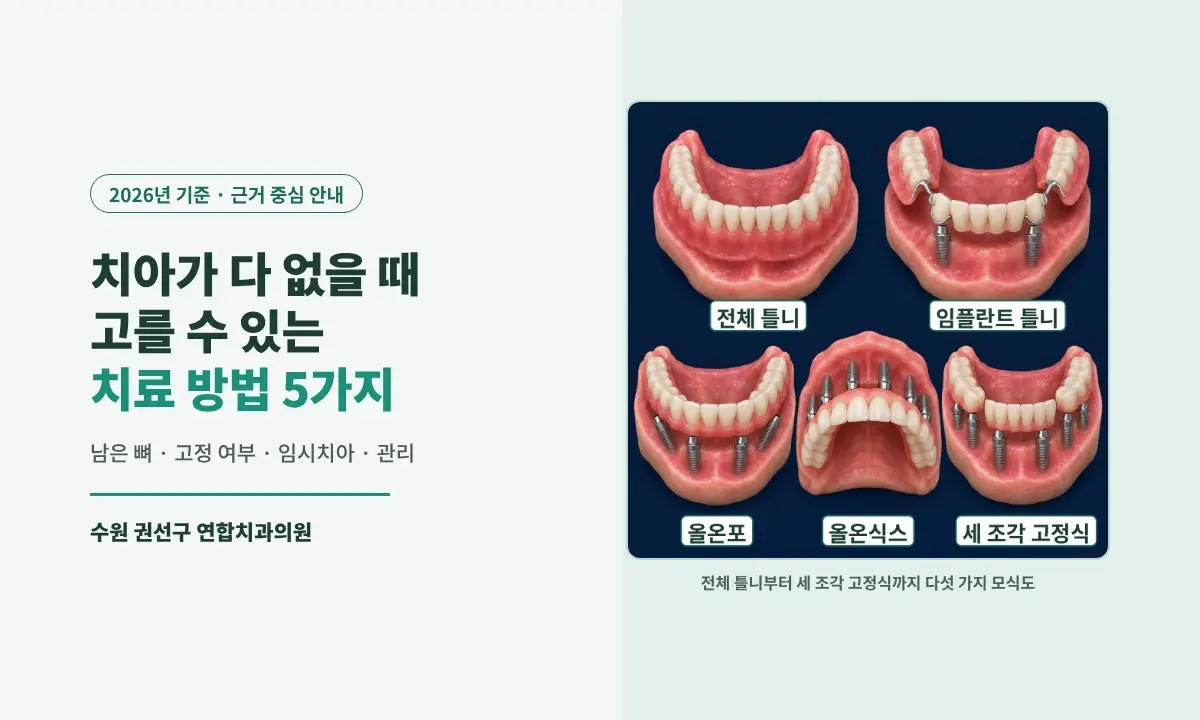
When all teeth are missing, Yeonhap Dental Clinic compares five treatment options: complete denture, implant-supported denture, All-on-4, All-on-6, and three-piece fixed. The choice depends on remaining bone, whether the prosthesis is fixed, cost and insurance, and maintenance.
How many treatment options are there when you have no teeth at all?
When you consult after losing all your teeth, you hear different answers at each clinic, such as dentures, four implants, or six.
[Key Answer]
There are several ways to restore a jaw with no teeth, from removable dentures to fixed implants. Yeonhap Dental Clinic compares five: complete denture, implant-supported denture, All-on-4, All-on-6, and three-piece fixed; the remaining bone sets the range of what is possible, and cost, insurance, and maintenance decide the choice within it.
[Summary in 4 Lines]
· The methods Yeonhap Dental Clinic compares are five, from a complete denture with 0 implants to the three-piece fixed type, and the implant counts reflect our clinic's own design standards.
· Whether each site yields 2 mm of bone on the cheek side and 1.5 mm on the tongue or palate side determines which methods are possible.
· Even when four sites are available in the lower jaw, we compare All-on-4 and an implant-supported denture together according to cost, insurance, and maintenance conditions.
· Implants for a completely edentulous jaw are not currently covered by National Health Insurance, and an expansion to cover 2 implants is scheduled from January 2027.
Written by Dr. Ahn Seong-jin, Chief Director, Yeonhap Dental Clinic
[Table of Contents]
· How do the five treatment options for a completely edentulous jaw differ?
· How do the options for a completely edentulous jaw divide according to the remaining bone?
· When can temporary teeth be placed in a completely edentulous jaw?
· How much do treatment periods differ among the options for a completely edentulous jaw?
· In what order does Yeonhap Dental Clinic decide the method for a completely edentulous jaw?
How do the five treatment options for a completely edentulous jaw differ?
The five differ in the number of implants placed and in whether the prosthesis is removable or fixed in the mouth.
A complete denture and an implant-supported denture (IARPD) are removed and reinserted, while full-arch implants (All-on-X) and full-mouth implants (three-piece fixed) are fixed types that the patient does not remove. The full-arch type is considered as All-on-4 with 4 implants in the lower jaw and All-on-6 with 6 in the upper jaw, and even a fixed type must be cleaned daily with a toothbrush and interdental brushes and checked at regular check-ups. The implant-supported denture design is in the implant-assisted removable partial denture (IARPD) column.
If the bone allows, Yeonhap Dental Clinic first considers the three-piece fixed type, in which only the affected piece can be repaired or replaced. The standard is 12 teeth up to tooth no. 6; if that proves insufficient after use, we check the placement conditions and add one implant at tooth no. 7 on each side. In our clinic's experience, about 1 in 10 patients adds them. It can also be planned as 14 teeth from the start, and in this design the total number of implants is the same even if added later (8 in the lower jaw and 9 in the upper jaw).
Number of implants and prosthesis form by treatment option for a completely edentulous jaw
| Method | Number and position of implants (our clinic's standard) | Prosthesis |
|---|---|---|
| Complete denture | 0 | Removable denture |
| Implant-supported denture (IARPD) | 2 in the lower jaw (33, 43) / 4 in the upper jaw (12, 14, 22, 24) | Fixed front bridge + removable partial denture |
| All-on-4 (lower jaw) | 4 (32, 34, 42, 44) | One-piece fixed |
| All-on-6 (upper jaw) | 6 | One-piece fixed |
| Three-piece fixed | 12 teeth up to tooth no. 6 as the standard; at least 6 in the lower jaw / at least 7 in the upper jaw | Fixed prosthesis divided into three pieces |
How do the options for a completely edentulous jaw divide according to the remaining bone?
The number of sites that meet our clinic's reference values sets the range of possible methods.
Yeonhap Dental Clinic looks for positions where 2 mm of bone remains on the cheek side of the implant and 1.5 mm on the tongue or palate side; if the reference values are not met, we first try changing the position and angle and then consider a bone graft. If the remaining bone height above the nerve canal in a lower molar area is less than 5 mm, we do not plan a short implant there and consider All-on-4 at the four front sites (criteria for short implants). In the upper jaw, when placement in the front tooth area is difficult or the goal is to reduce cost, we consider All-on-6 instead of the three-piece fixed type, and in the molar area a sinus lift (a procedure that adds bone toward the maxillary sinus, the empty space above the upper molars) is often done together.
When can temporary teeth be placed in a completely edentulous jaw?
When four implants in the lower jaw or six in the upper jaw are secured, each at least 4 mm in diameter, at least 8.5 mm in length, and with an initial stability of at least 30 Ncm, we connect them and place fixed temporary teeth on the same day or within 1 week.
The international consensus also lists sufficient primary stability as a precondition for immediate loading of a fixed full arch (placing temporary teeth right after implant placement), but it has not directly validated our clinic's figures or implant-count combinations (Gallucci 2014). About 90% of our clinic's lower full-arch cases met this condition. For an upper jaw that has had a sinus lift at the same time, our clinic does not place immediate fixed temporary teeth and uses a temporary denture. The temporary denture is either a repaired or adjusted version of the existing denture or a newly made one if needed.
How much do treatment periods differ among the options for a completely edentulous jaw?
A complete denture takes about 1 month, a fixed implant prosthesis about 4 months in the lower jaw, and the upper jaw about 4 to 8 months depending on immediate loading and a sinus lift.
For implant treatment, the period is stated from placement to the final prosthesis, and for a complete denture, by fabrication time. If extractions are needed, we first see whether same-day placement is possible, and if not, we wait at least 2 months for front teeth and 3 months for molars before placing, so that waiting is added separately. The schedule by site and situation is in Suwon Implant Treatment Period.
Period, maintenance, and National Health Insurance by treatment option for a completely edentulous jaw
| Method | Period (our clinic's estimate) | Maintenance / National Health Insurance |
|---|---|---|
| Complete denture | About 1 month to make; about 2 months if after extraction | Check-up 6 months after adjustment / covered once every 7 years for patients aged 65 and over |
| Implant-supported denture | About 5 months in the lower jaw (including making the bridge and partial denture); the upper jaw depends on healing | Clean the denture daily and adjust the clasps / implants for a completely edentulous jaw are currently non-covered |
| All-on-4 and three-piece fixed (lower jaw) | About 4 months after placement | Check-up every 6 months, and for the three-piece type only the affected piece is repaired / currently non-covered |
| All-on-6 and three-piece fixed (upper jaw) | About 4 to 8 months. Depends on whether immediate loading is possible, the remaining bone, the state of stability and healing, and the timing of implant placement relative to a sinus lift | Check-up every 6 months / currently non-covered |
In what order does Yeonhap Dental Clinic decide the method for a completely edentulous jaw?
We first set the possible range from the remaining bone, and within it look together at cost, insurance, the approach you prefer, and maintenance conditions.
When four sites are available in the lower jaw, we also consider All-on-4, but depending on cost and maintenance conditions some patients choose an implant-supported denture, and if insurance conditions are met we also compare insurance options. A fixed prosthesis requires checking for loose screws, changes in the bite, and peri-implantitis every 6 months, so if that upkeep would be difficult, a removable option may actually be better.
Implants for a completely edentulous jaw are not currently covered by National Health Insurance; only complete dentures are covered, once every 7 years for patients aged 65 and over. An expansion of coverage to 2 implants for completely edentulous patients from January 2027 has been announced; those who have already received an NHI-covered complete denture must wait until 7 years have passed, and the detailed application must be confirmed in the follow-up notice. Insurance overall is summarized in Suwon Implant Insurance.
· Whether the dentist explains, with measured values, how many sites can take an implant given the remaining bone
· Whether fixed and removable options were compared together with cost and insurance
· When temporary teeth can be placed, and how the finished prosthesis is checked and repaired
[Key Takeaways]
✓ Yeonhap Dental Clinic compares five options: complete denture, implant-supported denture, All-on-4, All-on-6, and three-piece fixed; the numbers and positions follow our clinic's design standards.
✓ The possible range is set by 2 mm on the cheek side and 1.5 mm on the tongue or palate side at each site, and within it the choice is made by cost, insurance, the approach you prefer, and maintenance.
✓ A fixed prosthesis takes about 4 months in the lower jaw and about 4 to 8 months in the upper jaw, and an expansion of NHI coverage for implants in a completely edentulous jaw is scheduled for January 2027.
For those facing a consultation after losing all their teeth
When someone comes in having lost all their teeth, most first ask how much it will cost and how many implants will be placed. Before that, I look at the remaining bone on CT, because the possible methods narrow only once the number of sites that can take an implant is settled. In fact, about 90% of our clinic's lower full-arch cases met the conditions for fixed temporary teeth on the same day to within 1 week, and about 1 in 10 patients using the three-piece fixed type added tooth no. 7. That is why I do not decide a method first and fit the bone to it; I measure the bone first and choose the method together with you within it.
References
📋 Clinic Information
This post was written in accordance with the Korean Medical Service Act and the Ministry of Health and Welfare's medical advertising guidelines, and is intended to provide medical information. It does not guarantee or assert any treatment result or cost. The applicable methods and course differ from person to person depending on the remaining bone and the condition of the opposing teeth, so please decide on a diagnosis and treatment direction only after a thorough consultation with your dental team.
🦷 Implant information: Yeonhap Dental Clinic implant information
📍 230 Geumho-ro, 5th Floor (Cham Clinic Building, Tap-dong), Gwonseon-gu, Suwon, Gyeonggi-do
🚕 Across from Suwon NongHyup Guun Branch (231 Geumho-ro) / about 15 minutes by taxi from Suwon Station
🚗 Free parking available in the building
📞 031-293-2207
🌐 yeonhapdental.com
🟡 Open since 2002 / Treatment overseen by Dr. Ahn Seong-jin, Chief Director and Integrated Dentistry specialist
🔗 Online booking and consultation
Frequently asked questions about treatment of a completely edentulous jaw
- How many implants are placed in one jaw for full-mouth implants?
- By our clinic's standard, All-on-4 in the lower jaw uses 4 implants and All-on-6 in the upper jaw uses 6, while the three-piece fixed type making 12 teeth up to tooth no. 6 uses at least 6 in the lower jaw and at least 7 in the upper jaw. Making 14 teeth up to tooth no. 7 takes 8 in the lower jaw and 9 in the upper jaw, and the number depends on the remaining bone.
- How do All-on-4 and All-on-6 differ?
- Our clinic designs All-on-4 with 4 implants in the lower jaw and All-on-6 with 6 in the upper jaw, and places a one-piece fixed prosthesis. Yeonhap Dental Clinic considers All-on-4 when bone height in the lower molar area is insufficient, and All-on-6 when placement in the upper front tooth area is difficult or the goal is to reduce cost.
- Can temporary teeth for full-mouth implants be placed on the day of surgery?
- When four implants in the lower jaw or six in the upper jaw are secured, each at least 4 mm in diameter, at least 8.5 mm in length, and with an initial stability of at least 30 Ncm, we connect them and place fixed temporary teeth on the same day or within 1 week. About 90% of our clinic's lower full-arch cases met this, and we do not place them immediately in an upper jaw that has had a sinus lift at the same time.
- How long does full-mouth implant treatment take?
- By our clinic's standard, we expect about 4 months from placement to the final prosthesis in the lower jaw and about 4 to 8 months in the upper jaw. In the upper jaw this depends on whether immediate loading is possible and on the bone and healing. If a sinus lift is done first, we give you the total timeline from the first surgery separately, and we also distinguish the waiting time when implants are placed after an extraction.
- Does National Health Insurance cover implants if I have no teeth at all?
- Implants for a completely edentulous jaw are not currently covered by National Health Insurance; only complete dentures are covered, once every 7 years for patients aged 65 and over. An expansion of coverage to 2 implants for completely edentulous patients from January 2027 has been announced; those who have received an NHI-covered complete denture must wait until 7 years have passed, and the detailed criteria must be confirmed in the follow-up notice.
- What should I prepare for a consultation for a completely edentulous jaw at Yeonhap Dental Clinic in Gwonseon-gu, Suwon?
- It helps to bring a summary of when your teeth began to be lost, your history of dentures or implants, and your history of using NHI-covered dentures or implants. If you also tell us about blood thinners, osteoporosis medication, and your blood sugar levels, we reflect them in the plan, and the remaining bone is checked on 3D CT on the day of your consultation.
Related pages
Before your visit
This article provides general information on oral health and dental care. Whether treatment is needed, and which method is appropriate, may change after an oral exam and any necessary diagnostic tests. If you have pain, a loose tooth, swelling, or discomfort with a prosthesis, please visit us for a consultation.