
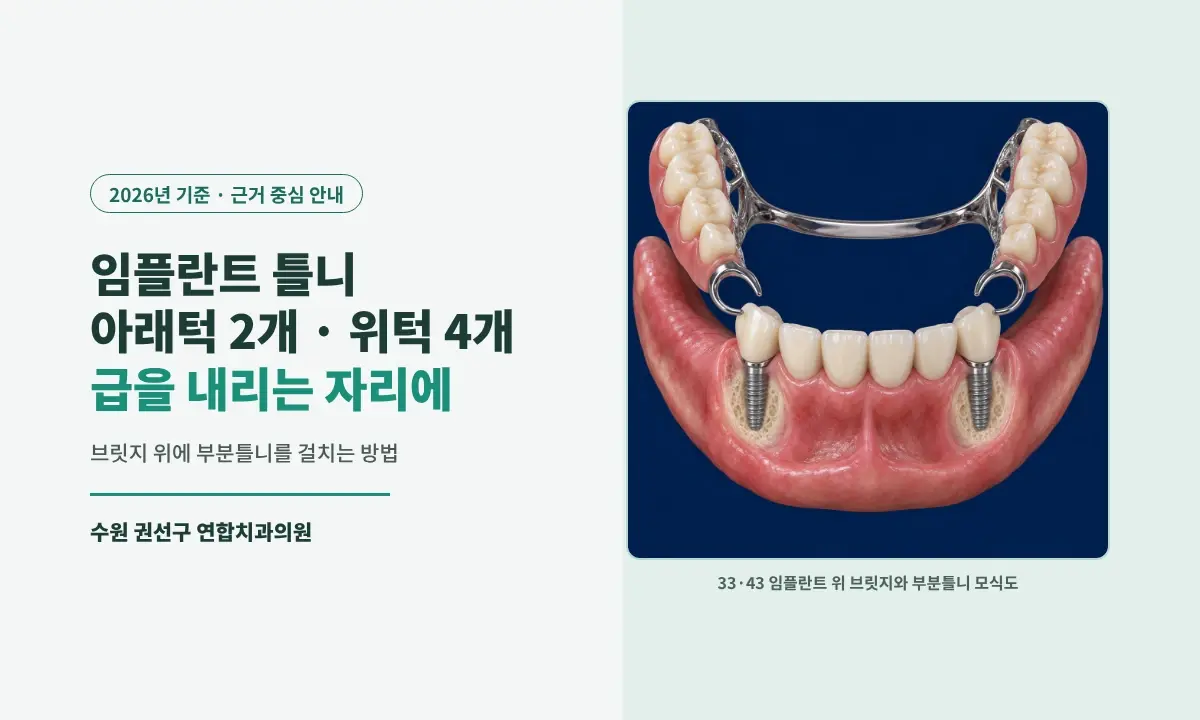
An implant-assisted denture (IARPD) is a treatment in which implants support a removable partial denture. Yeonhap Dental Clinic fixes a bridge on the implants and hooks the partial denture on with clasps, using two implants (33 and 43) for a fully edentulous lower jaw and four for a fully edentulous upper jaw.
How many implants does an implant denture in Suwon use, and where are they placed?
If your denture keeps floating and is uncomfortable but placing many implants feels like too much, there is a method in which a bridge is built on a few implants and a partial denture is hooked onto it. With no teeth at all, our clinic's standard is two implants at the canine positions on both sides in the lower jaw and four in the upper jaw; if teeth remain, the positions are set to suit those teeth.
[Key Answer]
An implant-assisted denture (IARPD) is a treatment in which implants support a removable partial denture. In a fully edentulous lower jaw, Yeonhap Dental Clinic fixes a 6-front-tooth bridge on 2 implants at 33 and 43, and hooks a partial denture onto that bridge with clasps.
[Summary in 4 Lines]
· Yeonhap Dental Clinic hooks the partial denture with clasps onto a PFM bridge with a metal occlusal surface on the implants, and does not do snap-on overdentures.
· Our clinic's standard is 2 implants at 33 and 43 for a fully edentulous lower jaw and 4 for a fully edentulous upper jaw, and if four sites are available in the lower jaw, we also consider full-arch implants.
· If natural teeth remain, the bridge is placed at the site that supports the rear end of the denture resting on the gum.
· For the lower jaw, after waiting about 3 months, it takes about 1.5 months from the second-stage surgery, about 5 months in total.
Written by Dr. Ahn Seong-jin, Chief Director, Yeonhap Dental Clinic
[Contents]
· How does an implant-assisted denture (IARPD) differ from a snap-on overdenture?
· Why are 2 implants placed at 33 and 43 for the lower-jaw implant denture?
· If natural teeth remain, how are the implant denture sites decided?
· Why does the upper-jaw implant denture use 4 implants instead of 2?
· What size and material are used for an implant denture?
· How long does implant denture treatment take, and what denture do I wear in the meantime?
· How much of an implant denture does National Health Insurance cover?
· When do we consider another treatment instead of an implant denture?
This article covers Yeonhap Dental Clinic's bridge-type design; a comparison of treatment options for fully edentulous cases is in 5 Treatment Options for Completely Edentulous Cases.
How does an implant-assisted denture (IARPD) differ from a snap-on overdenture?
Yeonhap Dental Clinic's implant denture hooks a partial denture onto a bridge on the implants, while an overdenture snaps a denture directly onto attachments on the implants.
IARPD (implant-assisted removable partial denture) comes in several types, and our clinic hooks the partial denture's clasps and rests onto the bridge. An overdenture fits the denture onto devices such as a bar, ball, or locator, and a “snap-on” is a form in which a rubber ring is fitted onto a button-type component.
The reasons our clinic uses the bridge type are insurance coverage and maintenance parts. A partial denture on a bridge may be covered by NHI if conditions are met, and there are no parts such as rubber rings to replace. However, relining (reinforcing the inside of the denture), clasp adjustment, repairs, and screw checks are still needed, and such maintenance has also been reported in studies (de Freitas 2012).
Comparing Yeonhap Dental Clinic's implant denture (IARPD) and a snap-on overdenture
| Item | Yeonhap Dental Clinic implant denture (IARPD) | Snap-on overdenture |
|---|---|---|
| Connection method | Clasps and rests hooked onto a bridge (fixed) on the implants | A rubber ring inside the denture snaps onto a button-type component on the implants |
| Front tooth area (basic lower jaw design) | Fixed with a bridge (not removed) | Included in the denture (removed) |
| Current NHI | Under conditions, the implants and the partial denture are each covered; the intermediate teeth of the bridge are not covered | Excluded from coverage as an attachment denture |
| Replacement of snap-on retention parts | None (maintenance such as relining and clasp adjustment is still needed) | Rubber rings are replaced when worn |
Why are 2 implants placed at 33 and 43 for the lower-jaw implant denture?
For a fully edentulous lower jaw, Yeonhap Dental Clinic fixes six front teeth as a bridge on 2 implants at the canines on both sides (33 and 43), changing a complete denture that floated on a narrow ridge into a partial denture anchored at the front.
With implants at 33 and 43, the rear end still rests on the gum, but the bridge takes the lifting motion at the front and the force is divided symmetrically left and right. If the same two implants were placed on one side at the molars, the force and the denture's axis of rotation would be biased to one side. Why a lower complete denture floats is covered in Why a Lower Complete Denture Is Uncomfortable.
If natural teeth remain, how are the implant denture sites decided?
If natural teeth remain, Yeonhap Dental Clinic looks at the remaining teeth and the molars that bite against them, and places the bridge on the side where the rear end of the denture rests on the gum.
The rear end resting on the gum sinks during chewing and wobbles the clasp tooth, so the key is to support that side with a bridge to reduce the movement. In a meta-analysis of converting lower partial dentures missing teeth at the back on both sides into implant dentures, satisfaction and chewing function improved (Park 2020). For example, if only the lower front teeth remain, the bridge is placed at the molar site on the side where more upper molars bite against it, so that it takes the force.
Why does the upper-jaw implant denture use 4 implants instead of 2?
The upper jaw often has soft bone and low height because of the maxillary sinus (the air space beside the nose), so for a fully edentulous upper jaw, Yeonhap Dental Clinic does not use 2 implants but connects 4 with a bridge.
This is because the implants must also take the rotation of a denture resting on the gum at both rear sides, and this is not a figure from the literature but our clinic's clinical standard. For a partially edentulous upper jaw, the bridge sites are decided by looking at the remaining teeth and the teeth that bite against them.
Design standard for Yeonhap Dental Clinic's implant denture (IARPD)
| Situation | Implant position and number | Bridge and partial denture |
|---|---|---|
| Fully edentulous lower jaw | 2 implants at 33 and 43 (canines on both sides) | 6-unit front tooth bridge + partial denture on both rear sides |
| Partially edentulous lower jaw (only front teeth remain) | 34 and 36, or 44 and 46, on the side with more opposing molars | A 3-unit bridge supports the rear end on one side |
| Fully edentulous upper jaw | 4 implants at 12, 14, 22, and 24 (lateral incisors and first premolars on both sides) | 8-unit bridge + partial denture on both rear sides |
| Fully edentulous upper jaw, when placement at the front teeth is difficult | 14 and 16, and 24 and 26, 4 in total | A partial denture is hooked onto 3-unit bridges on both sides, with a sinus lift if needed |
| Partially edentulous upper jaw (only molars on one side remain) | 24 and 26 on the opposite side | 3-unit bridge; the rear ends of the denture on both sides are anchored to teeth and the bridge |
| Partially edentulous upper jaw (only front teeth remain) | 14 and 16 on the side with lower molars | A 3-unit bridge supports the rear end on one side |
What size and material are used for an implant denture?
Yeonhap Dental Clinic places implants of 4.0 mm diameter and 10 mm length, and makes the bridge in PFM with a metal occlusal surface.
Because the implants must take the rotation of the bridge and denture for a long time, a length of 10 mm is our clinic's standard, and if the bone width allows, we raise the diameter to 4.5 mm. The metal chewing surface is for designing, adjusting, and repolishing the clasp and rest surfaces; for NHI-covered implants one can choose between PFM and zirconia, so PFM is chosen for this design, not for insurance reasons.
How long does implant denture treatment take, and what denture do I wear in the meantime?
A lower-jaw implant denture takes about 5 months in total, and for the upper jaw the schedule varies with healing.
For the lower jaw, the second-stage surgery is done about 3 months after placement, followed by about 2 weeks for the bridge and about 1 month for the partial denture. For the upper jaw, the timing of the second-stage surgery is set by the extent of the sinus lift or bone graft and by stability and healing; if the condition is good, we proceed to the final PFM bridge, and if there is a lot of bone grafting or stepwise loading is needed, we go through a temporary bridge (temporary teeth) to the final bridge, and making the partial denture takes about 1 month.
While you wait, your current denture is relined by hollowing out the inside and filling it with a soft material. We check for infection 1 week after surgery, and at 1 month we check the periapical X-ray, pain, and pus. After completion, you remove and clean the denture every day, and we check the bridge and denture at 6-month intervals.
How much of an implant denture does National Health Insurance cover?
For partially edentulous patients aged 65 or older, NHI may cover 2 implants and the partial denture separately, while the intermediate teeth of the bridge, additional implants, bone grafts, and sinus lifts are not covered.
NHI covers 2 implants per lifetime, and the partial denture once every 7 years per jaw when it can be made using the remaining teeth, with a patient copayment of 30% for each. The two coverages apply according to their own eligibility, coverage history, and design conditions, and attachment dentures are excluded.
Natural teeth to keep are judged by prognosis. For fully edentulous patients, coverage of 2 implants for those aged 65 or older is scheduled to expand from January 2027 (decided by the Health Insurance Policy Deliberation Committee on September 8, 2026), and those who received a covered complete denture become eligible after 7 years. Detailed criteria will be announced after the official notice, and the system overall is outlined in Implant Insurance in Suwon.
When do we consider another treatment instead of an implant denture?
If four sites are available in the lower jaw, we also consider full-arch implants (All-on-4). However, if NHI conditions are met, some patients choose an implant denture to make use of the 2 NHI-covered implants and the NHI-covered partial denture together. For a fully edentulous upper jaw, we first consider a complete denture or full-arch implants using 6 implants.
If a 10 mm implant, our clinic's standard, is difficult to place at 33 and 43 in the lower jaw, or only 2 can be placed in a fully edentulous upper jaw, we plan a complete denture or another approach.
Three things to check when you ask about implant dentures
· Whether a 10 mm implant fits at the support sites on the 3D CT (33 and 43 in the lower jaw, four sites in the upper jaw), and whether four sites are available in the lower jaw
· Where the remaining teeth and the molars that bite against them are
· Whether your current denture can be temporarily repaired for use, whether you are eligible for NHI coverage, and your remaining coverage history
[Key Takeaways]
✓ Yeonhap Dental Clinic's implant denture hooks a partial denture with clasps onto a PFM bridge with a metal occlusal surface, and we do not do snap-on overdentures.
✓ Our clinic's standard is 2 implants at 33 and 43 for a fully edentulous lower jaw and 4 for a fully edentulous upper jaw, and for partially edentulous cases the positions and number are decided by looking at the remaining teeth and opposing teeth.
✓ The lower jaw takes about 5 months in total; if four sites are available, we also consider full-arch implants, and for a fully edentulous upper jaw we first consider a complete denture or 6-implant full-arch implants.
A few words from the treatment room about implant dentures
When a patient comes saying their lower denture keeps floating, I first look on the CT at whether a 10 mm implant fits at the two canine sites. If four sites are available, I also explain full-arch implants that are not removed, but quite a few patients choose an implant denture to use 2 NHI-covered implants and an NHI-covered partial denture together when the coverage conditions are met. Most of the patients for whom I built a bridge on two sites and hooked a partial denture found it much more comfortable than their lower complete denture, with fewer sore spots, and complaints that the denture was loose almost disappeared. In some cases the clasps loosened with use, but a simple adjustment resolved it.
References
📋 Clinic Information
This article was written in line with the Medical Service Act and the Ministry of Health and Welfare's medical advertising guidelines, and is intended to provide medical information. It does not guarantee or assert the result of an implant denture. The number and positions of implants and the application of NHI coverage may vary depending on the remaining bone and teeth, the opposing teeth, and general health, so please decide on diagnosis and treatment direction only after a thorough consultation with your dental team.
🦷 Implant denture treatment information: Implant Dentures: Who Can Manage With Two and Who Cannot
📍 230 Geumho-ro, 5th Floor (Tap-dong, Cham Clinic Building), Gwonseon-gu, Suwon, Gyeonggi-do
🚕 Across from the Suwon NongHyup Guun Branch (231 Geumho-ro) / about 15 minutes by taxi from Suwon Station
🚗 Free parking available in the building
📞 031-293-2207
🌐 yeonhapdental.com
🟡 Open since 2002 / Treatment led by Dr. Ahn Seong-jin, Chief Director and Integrated Dentistry specialist
🔗 Online booking and consultation
Implant Dentures: Frequently Asked Questions
- What is an implant-assisted denture (IARPD)?
- An implant-assisted denture (IARPD) is a treatment in which implants support a removable partial denture. In Yeonhap Dental Clinic's basic design for a fully edentulous lower jaw, the front teeth are fixed with a bridge on implants at 33 and 43, and only the rear partial denture is removed and reinserted.
- How many implants does an implant denture use, and where are they placed?
- For a fully edentulous lower jaw, Yeonhap Dental Clinic places 2 implants at 33 and 43, and for a fully edentulous upper jaw, 4 implants at 12, 14, 22, and 24. For partially edentulous cases, the positions and number that support the rear end of the denture are decided by looking at the remaining teeth and the molars that bite against them, and all of these are our clinic's clinical standards.
- How do an implant denture and a snap-on overdenture differ?
- Yeonhap Dental Clinic's implant denture hooks a partial denture onto a bridge with clasps, while a snap-on overdenture fits a rubber ring inside the denture onto button-shaped components. The snap-on type requires periodic replacement of the rubber ring and is excluded from NHI coverage, and both types need maintenance such as relining and repairs.
- Does National Health Insurance cover implant dentures?
- For partially edentulous patients aged 65 or older, NHI may cover 2 implants and the partial denture separately, while the intermediate teeth of the bridge, additional implants, and bone grafts are not covered. For fully edentulous patients, coverage of 2 implants for those aged 65 or older is scheduled to expand from January 2027.
- How long does implant denture treatment take?
- For the lower jaw, after waiting about 3 months, it takes about 1.5 months from the second-stage surgery to completion of the bridge and partial denture, about 5 months in total. For the upper jaw it varies with the extent of the sinus lift or bone graft and with healing, so we guide you according to your condition, and in the meantime you continue using your current denture after it is repaired.
- Where can I get an implant denture consultation in Gwonseon-gu, Suwon?
- Yeonhap Dental Clinic is at 230 Geumho-ro, 5th Floor (Tap-dong, Cham Clinic Building), Gwonseon-gu, Suwon, Gyeonggi-do, across from the Suwon NongHyup Guun Branch (231 Geumho-ro). At the first visit we check the canine sites and whether four sites are available with a 3D CT, and free parking is available in the building.
Related pages
Before your visit
This article provides general information on oral health and dental care. Whether treatment is needed, and which method is appropriate, may change after an oral exam and any necessary diagnostic tests. If you have pain, a loose tooth, swelling, or discomfort with a prosthesis, please visit us for a consultation.