
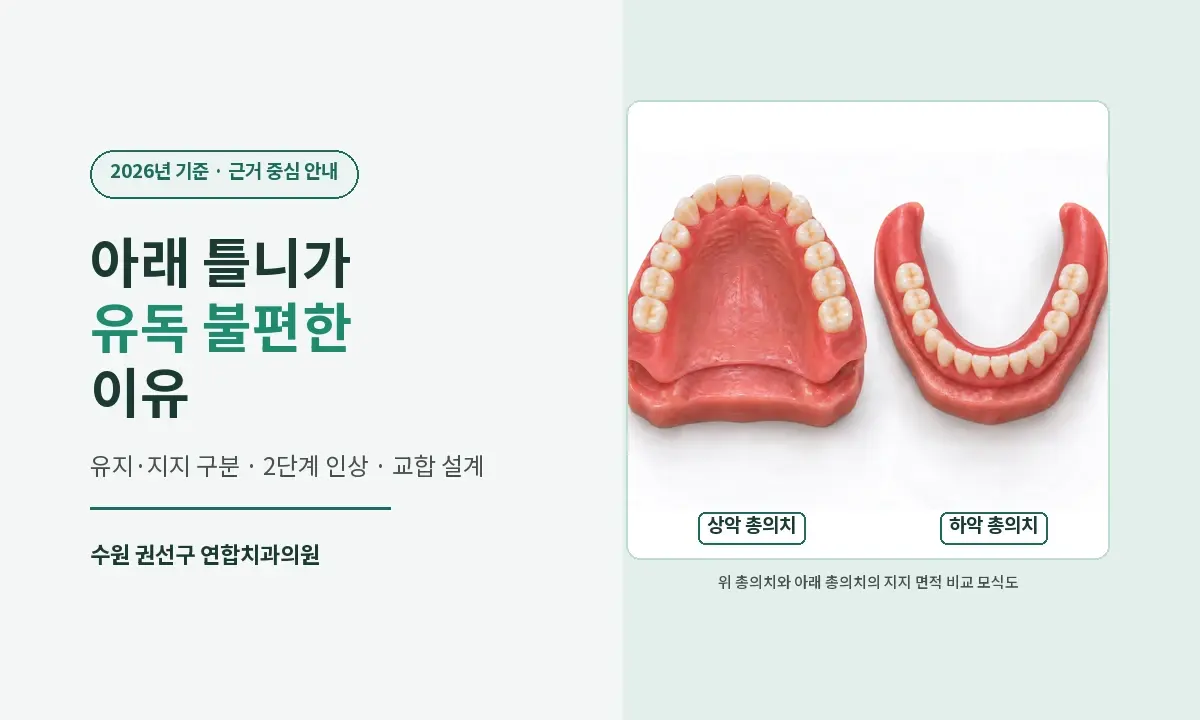
Lower denture discomfort should be divided into a problem of coming loose (retention) and a problem of pain when chewing (support). The lower jaw offers only about half the supporting area of the upper jaw, so chewing pressure concentrates on the gums. For the lower jaw only, Yeonhap Dental Clinic in Gwonseon-gu, Suwon takes impressions in two stages and uses a bite design that directs force to the center of the ridge.
Why do lower dentures hurt when chewing?
The complaint I hear most often in the treatment room at Yeonhap Dental Clinic from people who wear lower dentures is not “it doesn't stay in” but “it hurts when I chew.” A denture that rests on the gums alone in a jaw with no teeth is called a complete denture, and a lower complete denture (mandibular complete denture) has a narrower supporting area than the upper one, so discomfort when chewing tends to be greater.
[Key Answer]
Lower denture discomfort divides into retention (coming loose) and support (pain when chewing). The mandible (lower jaw) has only about half the supporting area of the maxilla (upper jaw), so more pressure concentrates when you chew. Yeonhap Dental Clinic takes mandibular impressions in two stages and gathers force with lingualized occlusion (an arrangement in which only the inner cusps of the upper molars make contact).
[Summary in 4 Lines]
· For lower dentures, we separate the problem of coming loose (retention) from the problem of pain when chewing (support); pain when chewing is a support problem.
· For the lower jaw only, Yeonhap Dental Clinic takes the impression (mold) in two stages (tissue conditioner, then pressure with silicone light body).
· The bite uses lingualized occlusion to gather force at the center of the ridge (the bony ridge of the gums); if resorption is severe, we lower the cusp inclination and adjust so that both sides touch together.
· After fitting, we check every 6 months, and perform a reline (refilling the inside of the denture) when retention declines.
Written by Dr. Ahn Seong-jin, Chief Director, Yeonhap Dental Clinic
[Contents]
· How do upper and lower dentures differ?
· Why are lower denture impressions taken twice?
· How is the lower denture bite designed?
· How often does a lower denture need adjustment?
· When can a lower denture not solve the problem?
Lower denture discomfort has to be separated into parts. If the denture floats or comes loose, it is a retention problem; if the gums are pressed and hurt when chewing, it is a support problem. Covering the retromolar pad (the gum mound at the very back of the lower jaw) accurately and fitting the inner surface and the edges well helps retention, but that alone does not resolve pain when chewing.
What patients actually cannot tolerate is the moment of chewing. When they try to eat, the gums are pressed and hurt, so they start avoiding hard foods, and in the end they cannot chew properly even with dentures.
Retention is the denture staying in place, and support is the denture bearing the chewing force. This article focuses on the support problem of pain when chewing, explaining in order the reasons, how Yeonhap Dental Clinic responds, and the limits.
How do upper and lower dentures differ?
The supporting area is different. The lower jaw is about half that of the upper.
An upper complete denture is supported not only by the gums but by the entire palate. Force is spread over a wide area, so less pressure concentrates in one spot when you chew.
The lower jaw does not have that area. The literature puts the supporting area of the mandible at about half that of the maxilla (Jain 2023). In addition, the tongue and the floor of the mouth move right beside that narrow area.
Under the same force, half the area means the pressure is that much greater (about twice). This is why lower dentures hurt more.
When the ridge resorbs, the conditions get worse. After teeth are lost, the bone of the gums gradually lowers over time, and the area available for support shrinks further. In a study comparing a group with a low mandibular ridge and a group with a normal one (28 people), chewing efficiency was 12.41% versus 30.25%, less than half, and significant differences were found in retention, chewing ability, and comfort when wearing the denture (Policastro 2020).
For reference, the maximum bite force of people who wear complete dentures is reported to be much lower than with natural teeth. In a study comparing 80 people with natural teeth and 80 people with complete dentures, the average maximum bite force was 41.3 kg and 4.43 kg, respectively (Tripathi 2014). So the force produced with a complete denture is weaker than with natural teeth, and a lower complete denture has to bear even that force over a narrow area.
This is why Yeonhap Dental Clinic uses different methods for the upper and lower jaws. Because the conditions differ, both the impression taking and the bite design differ.
Differences in conditions between upper and lower complete dentures
| Comparison item | Upper complete denture | Lower complete denture |
|---|---|---|
| Supporting area | Gums + palate | Gums only, about half of the upper jaw |
| Retention | Covers up to behind the vibrating line and is held by negative pressure | Covers up to the retromolar pad to help retention |
| Surrounding tissue | Relatively stable | The tongue and floor of the mouth are adjacent and move |
| Pressure when chewing | Spread over a wide area | Concentrated on a narrow area |
| Main clinical problem | Less than with the lower jaw | Pain when chewing |
| Yeonhap Dental Clinic impression | Taken once | Taken in 2 stages |
Why are lower denture impressions taken twice?
To reflect both the shape of the tissue when it is not pressed and the shape when it is pressed during chewing.
There are two approaches to taking an impression.
· Pressureless impression: taken while pressing the tissue as little as possible. The shape is accurate, but the denture may sink by the amount the tissue is pressed during chewing.
· Pressure impression: taken with the tissue pressed. It fits during chewing, but when the force is released the tissue recovers and the denture may become loose.
Yeonhap Dental Clinic applies the two methods separately on the lower jaw.
Stage 1, tissue conditioner: tissue conditioner (a soft material that sets slowly) is placed in a custom tray, and the impression and border molding (the process of shaping the denture edges to the movement of the lips, cheeks, and tongue) are done at the same time. This material flows and sets slowly, so it does not press the tissue hard, creating conditions close to a pressureless impression.
At the same time, the movements of the tongue and cheeks while you speak and swallow are captured in the impression. Structures such as the retromolar pad and the buccal shelf (the area on the outer side of the lower molars that supports the denture) are recorded, and based on this the artificial teeth are arranged where the muscles are in balance.
Stage 2, silicone light body: a thin layer of silicone light body is spread over the stage 1 impression, and the impression is taken again. At this point, force is applied once or twice on both sides at the sites of teeth no. 5 and 6 (second premolar and first molar), and then border molding is done. This stage reflects the amount the tissue is actually pressed during chewing.
The two stages are a process meant to reduce unnecessary deformation of the tissue while also reflecting the pressed state under function. This is why Yeonhap Dental Clinic takes the lower jaw impression in two stages.
The upper jaw is taken in one step. This is because the impression is extended past the pterygomaxillary notch (the concave area at the very back of the upper jaw) and the vibrating line (the border with the movable part at the back of the palate), so that covering these areas creates negative pressure (the force that makes the denture cling to the gums as if by suction). Regular body is used for the border and light body for the inner surface, with pressure applied at the teeth no. 5 and 6 sites followed by border molding. Only the lower jaw is split into two stages because its conditions are more demanding.
How is the lower denture bite designed?
We apply a design that gathers force at the center of the ridge.
Even with an accurate impression, if the chewing force is applied in the wrong direction the denture shifts and the gums hurt. That is why the bite design has to go together with it.
Lingualized occlusion: an arrangement in which only the palatal cusps of the upper molars (the lingual cusps) touch the concave central fossa of the chewing surface of the lower molars. The contact points are gathered into one, so force is transmitted to the center of the ridge and the lateral force that pushes sideways is reduced.
The upper cusps also push down on the lower denture, which helps retention as well. In effect, it spreads the force and presses the denture down into place at the same time.
Lowering the cusp inclination: when ridge resorption is severe, we lower the cusp inclination of the lower artificial teeth. A steep inclination increases the force that slides the denture sideways during chewing, and lowering it reduces that force.
Bilateral balanced occlusion: if only one side makes contact when you chew, the opposite side lifts and the denture rocks. We adjust so that both sides touch together to reduce the denture lifting when you chew on one side.
All three have the same purpose. It is to adjust the direction and contact of the chewing force so that the denture is less likely to be pushed sideways or lifted.
How often does a lower denture need adjustment?
We check every 6 months and perform a reline when retention declines.
Even after a denture is made, the bone of the gums keeps changing. It lowers little by little as chewing force is applied, and a gap forms between the denture and the gums. When the gap widens, the denture moves, and when it moves, pressure concentrates at certain points and it starts to hurt again.
Yeonhap Dental Clinic checks on a 6-month cycle.
· If retention has declined: the inner surface is refilled with a reline
· If retention and fit are fine: no adjustment, and on to the next 6-month check
We do not reline unconditionally at set intervals; the principle is to do it when needed. If pain, sores, or looseness appear, have it checked right away, even before your check-up.
Putting off a reline makes problems bigger. If you keep wearing the denture with a gap, the spots where the gums are pressed are irritated repeatedly, and bone resorption at those sites may speed up. Then the supporting area shrinks again, and you are back to the original problem.
Yeonhap Dental Clinic's lower complete denture protocol
| Step | Method | Purpose |
|---|---|---|
| Stage 1 impression | Custom tray + tissue conditioner, border molding at the same time | Close to pressureless conditions, records muscle shape |
| Stage 2 impression | Silicone light body, border molding after pressure at teeth no. 5 and 6 sites | Reflects the pressed state during chewing |
| Bite pattern | Lingualized occlusion | Concentrates force at the center of the ridge, reduces lateral force |
| Artificial tooth arrangement | Lower cusp inclination if resorption is severe | Reduces sliding force |
| Bite adjustment | Bilateral balanced occlusion | Reduces lifting caused by one-sided contact |
| Maintenance | 6-month check; reline if retention declines | Prevents pressure concentration caused by a gap |
When can a lower denture not solve the problem?
If natural upper molars remain, a lower complete denture alone often cannot withstand the chewing pressure.
The methods so far assume that both the upper and lower jaws have complete dentures. When both jaws have dentures, the forces on each side are similar in size and balance is easy to achieve.
There are cases where these conditions break down: when natural teeth remain in the upper molars and only the lower jaw has a complete denture.
The force produced by upper natural teeth is much greater than that of a complete denture, so the lower complete denture has to bear that force over a narrow area about half that of the upper jaw, and the burden can become large. Even when the impression and bite are adjusted, the gums often struggle to withstand that pressure.
The opposite situation is different. In my practice, most people with natural teeth in the lower jaw and a complete denture in the upper jaw have adapted. This is because the upper jaw, including the palate, has a wide area that can spread the force.
That is why Yeonhap Dental Clinic first checks the condition of the opposing teeth. If natural upper molars remain, we generally do not recommend a lower complete denture alone and first propose support with implants. Whether to go with an implant-supported denture or fixed full-arch implants is decided by looking together at what is possible with the remaining bone, cost, insurance, maintenance, and the approach you prefer, and this is outlined in 5 Treatment Options for Completely Edentulous Cases.
5 things to check when you ask about lower dentures in Tap-dong, Gwonseon-gu, Suwon
A practical standard for a consultation is whether lower denture discomfort is explained separately as a retention problem or a support problem.
Yeonhap Dental Clinic, across from the Suwon NongHyup Guun Branch (231 Geumho-ro) at 230 Geumho-ro, 5th Floor (Tap-dong, Cham Clinic Building), Gwonseon-gu, Suwon, Gyeonggi-do, has kept the same location since 2002. Treatment is currently led by Dr. Ahn Seong-jin, Chief Director and Integrated Dentistry specialist. If a lower denture keeps being uncomfortable, the approach of reinforcing support with implants is covered in Implant Dentures: Three Key Points.
· Whether they ask separately about not staying in and pain when chewing
· Whether they can explain how the impression is taken
· Whether they tell you in advance how the bite will be adjusted
· Whether they check if the opposing teeth are natural and plan accordingly
· Whether they explain the check-up interval and the criteria for relining after fitting
[Key Takeaways]
✓ For lower dentures, retention (does it stay in place?) and support (does it bear the chewing force?) are considered separately, and pain when chewing is a support problem. The mandible has about half the supporting area of the maxilla, so the gums receive greater pressure under the same force.
✓ For the lower jaw only, Yeonhap Dental Clinic takes the impression in two stages (tissue conditioner, then pressure with silicone light body), gathers force at the center of the ridge with lingualized occlusion, and lowers the cusp inclination if ridge resorption is severe.
✓ If natural upper molars remain, a complete denture often cannot withstand that pressure, so we consider reinforcing support with implants.
A few words from the treatment room about lower dentures
When people who had dentures made but still cannot chew properly come to see me, I first ask separately whether the denture comes loose or hurts when chewing. Most of the time it is the latter, and I look not only at the fit and bite of the denture but also at the narrow supporting area of the lower jaw. With half the area to support, the same force presses harder. That is why I take the impression twice for the lower jaw only. One is to capture the shape of the tissue when it is not pressed, and the other is to capture how much it is pressed during chewing; it is more trouble, but I consider that difference important for reducing discomfort when chewing. This method has its limits, though. If natural upper molars remain, a lower denture alone often cannot withstand that force, and in that case I discuss other options with you.
References
📋 Clinic Information
This article was written in line with the Medical Service Act and the Ministry of Health and Welfare's medical advertising guidelines, and is intended to provide medical information. It does not guarantee or assert the result of any particular treatment. The methods that can be used and the course of treatment vary from person to person depending on the remaining ridge and the condition of the opposing teeth, so please decide on diagnosis and treatment direction only after a thorough consultation with your dental team.
🦷 Prosthetic and denture treatment information: Yeonhap Dental Clinic Prosthodontic Treatment
📍 230 Geumho-ro, 5th Floor (Tap-dong, Cham Clinic Building), Gwonseon-gu, Suwon, Gyeonggi-do
🚕 Across from the Suwon NongHyup Guun Branch (231 Geumho-ro) / about 15 minutes by taxi from Suwon Station
🚗 Free parking available in the building
📞 031-293-2207
🌐 yeonhapdental.com
🟡 Open since 2002 / Treatment led by Dr. Ahn Seong-jin, Chief Director and Integrated Dentistry specialist
🔗 Online booking and consultation
Lower Dentures (Mandibular Complete Dentures): Frequently Asked Questions
- Why do lower dentures hurt when chewing?
- The mandible (lower jaw) has about half the supporting area for a denture compared with the maxilla (upper jaw). Even under the same force, the pressure on the gums is that much greater, so pain when chewing is more likely. This is a support problem that must be considered separately from the retention problem of a denture coming loose.
- Are a lower denture that keeps coming loose and pain when chewing different problems?
- A denture that floats or comes loose is a retention problem, and pain when chewing is a support problem of bearing the chewing force; they are different. Retention is improved by covering up to the retromolar pad and fitting the inner surface and the edges, while pain when chewing is addressed separately through the impression and bite design.
- Why is the lower denture impression taken twice?
- Yeonhap Dental Clinic takes the lower impression in two stages to capture both the shape of the tissue when it is not pressed and the shape when it is pressed during chewing. Stage 1 is taken with tissue conditioner under nearly pressureless conditions to record the shape created by the muscles, and stage 2 applies pressure with silicone at the sites of teeth no. 5 and 6 (second premolar and first molar) to reflect the actual state during function.
- Is the upper denture impression also taken twice?
- Yeonhap Dental Clinic takes the upper impression in one step. It is extended to cover past the concave area at the very back of the upper jaw (pterygomaxillary notch) and the border at the back of the palate (vibrating line) so that the denture clings as if by suction (negative pressure); only the lower jaw is split into two stages because its support conditions are more demanding.
- Is the lower denture bite adjusted differently from regular teeth?
- It is different. Yeonhap Dental Clinic applies lingualized occlusion, in which the lingual cusps of the upper teeth touch the central fossa of the lower teeth, to gather force at the center of the ridge. If ridge resorption is severe, we lower the cusp inclination of the lower artificial teeth and adjust with bilateral balanced occlusion so that both sides touch together.
- How often does a denture need adjustment after it is made?
- Yeonhap Dental Clinic checks every 6 months; if retention has declined, the inner surface is refilled with a reline, and if retention and fit are fine, we move on to the next check-up without adjustment. If pain, sores, or looseness appear, have it checked even before your check-up.
- Can I have a denture only on the bottom if I have natural teeth on top?
- If natural upper molars remain, Yeonhap Dental Clinic generally does not recommend a lower complete denture alone and first proposes support with implants. The chewing force of natural teeth is much greater than that of a complete denture, and the lower denture has to bear that force over a narrow area about half that of the upper jaw, so the burden can become large.
- Where is Yeonhap Dental Clinic in Tap-dong and Guun-dong, Gwonseon-gu, Suwon?
- Yeonhap Dental Clinic is located at 230 Geumho-ro, 5th Floor (Tap-dong, Cham Clinic Building), Gwonseon-gu, Suwon, Gyeonggi-do, across from the Suwon NongHyup Guun Branch (231 Geumho-ro). Free parking is available in the building, and the clinic is about 15 minutes from Suwon Station by taxi.
Related pages
Before your visit
This article provides general information on oral health and dental care. Whether treatment is needed, and which method is appropriate, may change after an oral exam and any necessary diagnostic tests. If you have pain, a loose tooth, swelling, or discomfort with a prosthesis, please visit us for a consultation.