
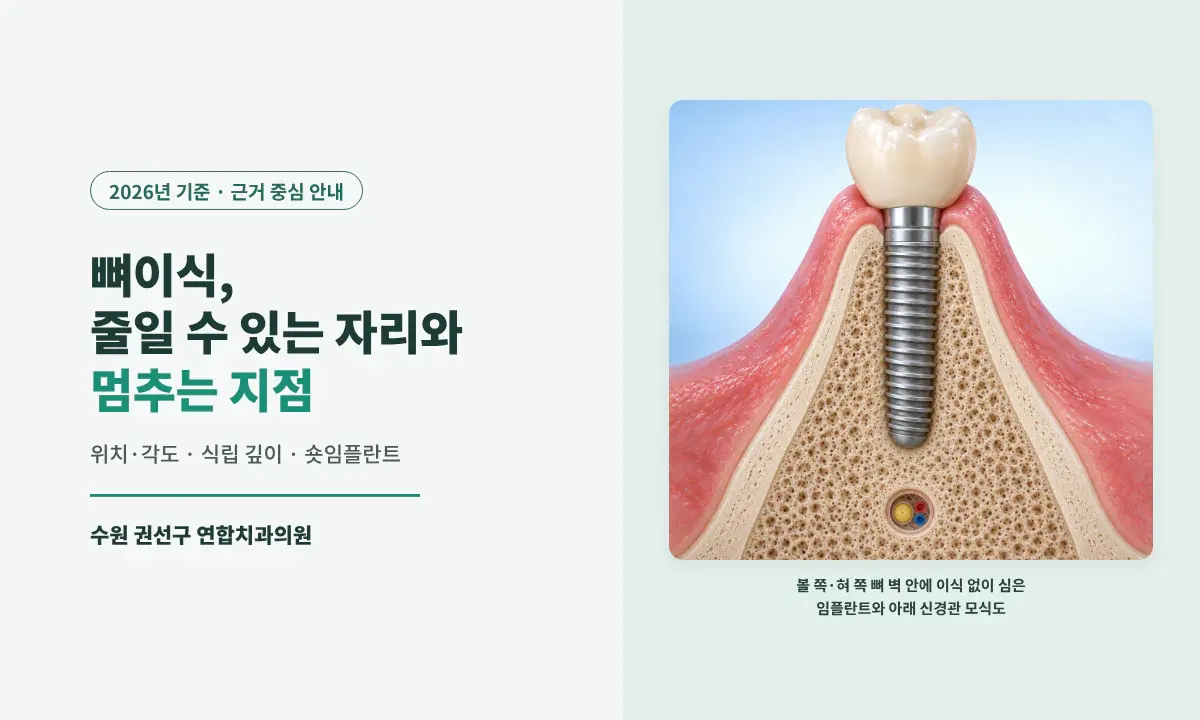
If you have been advised to have a bone graft for an implant, start by separating whether what is lacking is thickness or height. This article summarizes, by the standards of Yeonhap Dental Clinic in Gwonseon-gu, Suwon, how far position and angle, placement depth, and short implants can reduce grafting, and the points where we do not skip the graft.
Can the bone graft for an implant that a dental clinic recommended be reduced?
When you are told you need a bone graft, it is natural to first wonder whether you really need that much and whether there are other methods.
[Key Answer]
For an implant bone graft, we first separate whether thickness or height is lacking, and then we can consider whether it can be reduced by position and angle, placement depth, or a shorter implant. At Yeonhap Dental Clinic in Gwonseon-gu, Suwon, we do not reduce grafting if 2 mm on the cheek side and 1.5 mm on the tongue side cannot be obtained within the width of the occluding tooth, or if a cheek-side gap forms in an immediate front-tooth placement.
[4-Line Summary]
· First, we use 3D CT to separate whether what is lacking is thickness on the cheek or tongue side, or height up to the nerve canal or sinus.
· For thickness, if moving the position and angle within the width of the occluding tooth gives 2 mm on the cheek side and 1.5 mm on the tongue side, we do not graft.
· In immediate placement after extraction, placing the implant usually 5–7 mm below the gum surface can also reduce the extent of grafting, and for insufficient height in a lower molar we consider a 4, 5, or 6 mm short implant.
· If the reference values are obtained only by moving outside that width, or if a cheek-side gap forms in an immediate front-tooth placement, we do not skip the graft.
Written by: Dr. Ahn Seong-jin, Chief Director, Yeonhap Dental Clinic
[Table of Contents]
· If you have been advised to have an implant bone graft, should you first look at what is lacking?
· Can moving the position and angle reduce an implant bone graft?
· Can adjusting the placement depth reduce an implant bone graft?
· Can short implants avoid an implant bone graft in lower molars?
· In what cases should an implant bone graft not be reduced?
· What if an implant bone graft is still needed?
Reducing bone grafting does not mean avoiding grafts at all costs. It is a process of first checking what needs to be checked, looking at the alternatives to consider in order, and stopping at the point where we should stop.
This article covers that sequence and its limits. The criteria for when a graft is needed and the evidence for surgical methods are summarized separately.
If you have been advised to have an implant bone graft, should you first look at what is lacking?
The alternatives to consider depend on whether thickness or height is lacking, so this distinction is the first step.
Thickness is the bone remaining on the cheek side and the tongue and palate side when the implant is surrounded. Height is the distance to the nerve canal in the lower jaw and to the maxillary sinus in the upper jaw. Even for the same explanation of "not enough bone," the methods that can be used differ depending on which of the two is lacking.
Yeonhap Dental Clinic makes this distinction with 3D CT, because a panoramic image cannot show the thickness on the cheek side and tongue side.
When the height to the maxillary sinus is insufficient in an upper molar, we explain it as a separate procedure called a sinus lift, and even then, a lack of thickness is evaluated separately.
Can moving the position and angle reduce an implant bone graft?
When thickness is insufficient, if we find a site where moving the position and angle leaves 2 mm on the cheek side and 1.5 mm on the tongue side, we do not graft.
Even in the same jawbone, the thickness of the surrounding bone differs depending on where and at what angle the implant is placed. Yeonhap Dental Clinic first looks on 3D CT, changing position, angle, and diameter, for a combination that meets this standard. 2 mm on the cheek side and 1.5 mm on the tongue side are clinical criteria our clinic applies with reference to the literature.
The range within which we can move is within the cheek-to-tongue width of the occluding tooth. Going outside that makes chewing force act on the implant at a slant, so in that case we graft rather than relying on position adjustment. The reasons a graft is added by site are summarized in Bone Graft Implants.
Can adjusting the placement depth reduce an implant bone graft?
In immediate placement after extraction, a depth decision can in effect reduce the extent of grafting, but depth is a way of positioning within the remaining bone and not a way of creating bone.
Yeonhap Dental Clinic measures placement depth from the gum surface to the implant platform. For standard placement the reference is 4 mm, and if the gum is thick we place it deeper.
In immediate placement after extraction, we usually place at 5–7 mm. The cheek-side bone at the extraction site can lose height as it heals, so instead of filling the height that will be lost with graft material, we position the implant lower from the start. We plan by taking into account the current bone and the possibility of change during healing, and the amount of future resorption cannot be calculated precisely. Where cheek-side bone loss is large, we consider up to 9 mm as an exception, and this is the exceptional upper limit our clinic actually uses, not an upper limit set by the literature.
There are also things that depth clearly cannot replace. Securing the thickness of buccal bone, grafting the cheek-side gap in immediate front-tooth placement, and anatomical boundaries such as the nerve canal and sinus are not solved by depth. The criteria for deciding depth and its cost are covered in Peri-implantitis and Placement Depth.
Can short implants avoid an implant bone graft in lower molars?
Lower molars are sites where the implant cannot be placed deeper or longer because of the nerve canal, so when height is insufficient we consider reducing the length rather than building up bone.
Yeonhap Dental Clinic's default is a 2 mm margin above the nerve canal when placing a standard length (7 mm or more). If this margin cannot be obtained, we consider a short implant 4, 5, or 6 mm long with a diameter of 5 mm or more, and we rarely do vertical bone augmentation, which builds bone upward.
In a meta-analysis comparing augmentation and short implants in atrophic jaws (Yang 2016, 6 randomized controlled trials), the augmentation group had more implant failures, complications, and marginal bone loss.
If 5 mm does not remain above the nerve canal, we do not plan a short implant either. Our clinic's criteria for length, diameter, and the nerve canal margin are covered in Who Are Short Implants For?.
In what cases should an implant bone graft not be reduced?
We do not reduce grafting when 2 mm on the cheek side and 1.5 mm on the tongue side cannot be obtained within the width of the occluding tooth, or when a cheek-side gap forms in immediate front-tooth placement.
If we avoid grafting when the criteria are not met, the implant ends up on thin bone. In front teeth, if the cheek-side bone is under 2 mm, the gum can look as if it has receded over time, so Yeonhap Dental Clinic places the implant on the palate side on the day of extraction and fills the resulting cheek-side gap with graft material.
The literature shows the background of this judgment from different angles.
· Buccal bone thickness and tissue change — In the Nohra 2018 study summarized in the Monje 2023 review (22 patients, 39 implants, 1 year after prosthesis connection), marginal bone loss was reported as 0.36 mm in the group with buccal bone under 2 mm and 0.03 mm in the group with 2 mm or more. The same review summarizes that bone loss and mucosal recession appear greater with thin buccal bone, while noting that the definition of the critical thickness is not consistent from study to study.
· Gum recession after immediate placement — The proportion of immediately placed upper front teeth in which the gum receded by more than 1 mm is reported as a median of 26% across 8 studies (range 9–41%, 1–3 years after placement) (Chen 2014).
These studies did not directly verify our clinic's 2 mm and 1.5 mm criteria or our method of grafting front-tooth gaps, and these criteria are our clinic's clinical criteria. The conditions for placing a front tooth on the day of extraction are covered in Who Can Have an Immediate Implant After Extraction?.
Choices that reduce implant bone grafting and the points where we stop (Yeonhap Dental Clinic)
| Condition to judge | Our clinic's method | What cannot be replaced |
|---|---|---|
| Cheek- and tongue-side thickness | Adjust position and angle within the width of the occluding tooth to secure 2 mm on the cheek side and 1.5 mm on the tongue side | When the reference is obtained only by moving outside that width |
| Standard placement depth | 4 mm from the gum surface; deeper if the gum is thick | The aim is to secure space for soft tissue to attach, and it does not replace bone thickness |
| Depth for immediate placement after extraction and cheek-side bone loss | Usually 5–7 mm from the gum surface; up to 9 mm considered as an exception | Securing buccal bone thickness, grafting front-tooth gaps, and anatomical limits such as the nerve canal and sinus |
| Height above the nerve canal in lower molars | Short implants 4, 5, or 6 mm long with a diameter of 5 mm or more | If less than 5 mm above the nerve canal, a short implant is not planned either |
| Height to the sinus in upper molars | If under 7 mm, a sinus lift (a separate procedure) | A lack of thickness is evaluated separately |
| Immediate placement after front-tooth extraction | Place on the palate side | Fill the cheek-side gap with graft material |
What if an implant bone graft is still needed?
Yeonhap Dental Clinic does the bone graft on the same day as implant placement, so the graft does not add another surgery or a separate period of time.
We mix xenograft with bone fragments from the patient's own bone collected during drilling, and fix a resorbable barrier membrane by hooking it onto a wide cover cap or healing abutment attached to the implant. We do not do staged surgery, in which the graft is done first and the implant is placed a few months later, or socket preservation. The criteria for when a graft is needed and the evidence for materials, membranes, and fixation are covered in detail in Implant Bone Grafts: When and How.
Five things to check when consulting about an implant bone graft in Gwonseon-gu and Tap-dong, Suwon
If you have been advised to have a bone graft, the standard for the consultation is whether alternatives that could reduce the graft were considered first.
· Whether they explain, with CT measurements, whether it is thickness or height that is lacking and by how many millimeters
· Whether they tried moving the position and angle within the width of the occluding tooth
· For immediate placement, how they plan the depth
· For a lower molar, whether they also considered a short implant
· If a graft is done, whether it is done on the same day as placement or divided into stages
[Key Takeaways]
✓ Yeonhap Dental Clinic first separates whether thickness or height is lacking, and does not graft if 2 mm on the cheek side and 1.5 mm on the tongue side are obtained within the width of the occluding tooth.
✓ Immediate placement after extraction is usually placed at 5–7 mm from the gum surface (up to 9 mm as an exception), and for insufficient height in a lower molar we consider a 4, 5, or 6 mm short implant.
✓ If the reference values are obtained only by moving outside that width, or if a cheek-side gap forms in an immediate front-tooth placement, we do not skip the graft, and the graft is done on the same day as placement.
A Few Words from the Treatment Room About Reducing Implant Bone Grafts
Even when I hear that bone is lacking, I first look for sites that can be resolved without a graft. On CT, I move the position and angle within the width of the occluding tooth to check whether 2 mm on the cheek side and 1.5 mm on the tongue side remain, and the cases where this method avoids a graft are mainly molars. In lower molars, even when height is lacking, in most cases the treatment ends with a short, wide implant rather than building bone. Front teeth are different. If the cheek-side bone is under 2 mm, the gum can look as if it has receded over time, so rather than avoiding it by moving the position, I graft as much as is needed. I have not yet had a case where trying to reduce grafting forced me to widen it. But it can happen at any time, so I try not to be complacent. That is why I look from the start at which sites can be reduced and which cannot, and I recheck with CT every time.
References
Treatment Information
This post was written in compliance with the Korean Medical Service Act and the Ministry of Health and Welfare's medical advertising guidelines, and is intended to provide medical information. It does not guarantee or assert the result of any specific treatment. The extent to which a bone graft can be reduced and the course of treatment differ from person to person depending on the bone thickness on the cheek and tongue sides, the height to the nerve canal and sinus, and general health, so please be sure to consult fully with your dental team before deciding on diagnosis and treatment direction.
📋 Treatment Information
🦷 Implant bone graft information: Bone Graft Implants in Suwon
📍 5th Floor, 230 Geumho-ro, Gwonseon-gu, Suwon, Gyeonggi-do (Tap-dong, Cham Clinic Building)
🚕 Across from Suwon NongHyup Guun Branch (231 Geumho-ro) / about 15 minutes by taxi from Suwon Station
🚗 Free parking available in the building
📞 031-293-2207
🌐 yeonhapdental.com
🟡 Opened in 2002 / Treatment overseen by Dr. Ahn Seong-jin, Chief Director and Integrated Dentistry specialist
🔗 Online booking and consultation
Reducing Implant Bone Grafts: Frequently Asked Questions
- Can I avoid an implant bone graft just by moving the position?
- If moving the implant's position and angle gives 2 mm on the cheek side and 1.5 mm on the tongue side, it can be placed without a bone graft. However, Yeonhap Dental Clinic moves it only within the width of the occluding tooth, and if it has to go outside that, we graft.
- If I place it deeper, can I skip the implant bone graft?
- Implant placement depth is a way of positioning within the remaining bone, so in immediate placement after extraction it can sometimes reduce the extent of grafting, but it does not create bone. Securing buccal bone thickness and grafting the cheek-side gap in front teeth are not replaced by depth.
- Is a bone graft done for lower molars too?
- For lower molar implants, even when height is lacking, we consider a short implant with a diameter of 5 mm or more and a length of 4, 5, or 6 mm rather than building bone, so it is rare for Yeonhap Dental Clinic to build bone vertically.
- Why don't you reduce the implant bone graft for front teeth?
- For front-tooth implants, if the cheek-side bone is under 2 mm, the gum can look as if it has receded over time, so Yeonhap Dental Clinic fills the cheek-side gap formed on the day of extraction with graft material and does not replace it with position adjustment.
- Doesn't reducing the implant bone graft make the implant weaker?
- Yeonhap Dental Clinic chooses alternatives such as position, depth, and length within the range that secures the bone thickness and fixation an implant needs, and does not skip a bone graft that is needed.
- Does an implant bone graft extend the treatment period?
- Yeonhap Dental Clinic does the implant bone graft on the same day as placement, so the graft does not separately extend the timeline. The timeline is extended when a sinus lift is done first in an upper molar.
- When can I know whether I need an implant bone graft?
- Whether an implant bone graft is needed can be known from the 3D CT measurements at the first consultation. A panoramic image cannot show the thickness on the cheek and tongue sides, so we do not use it for this judgment.
Related pages
Before your visit
This article provides general information on oral health and dental care. Whether treatment is needed, and which method is appropriate, may change after an oral exam and any necessary diagnostic tests. If you have pain, a loose tooth, swelling, or discomfort with a prosthesis, please visit us for a consultation.