
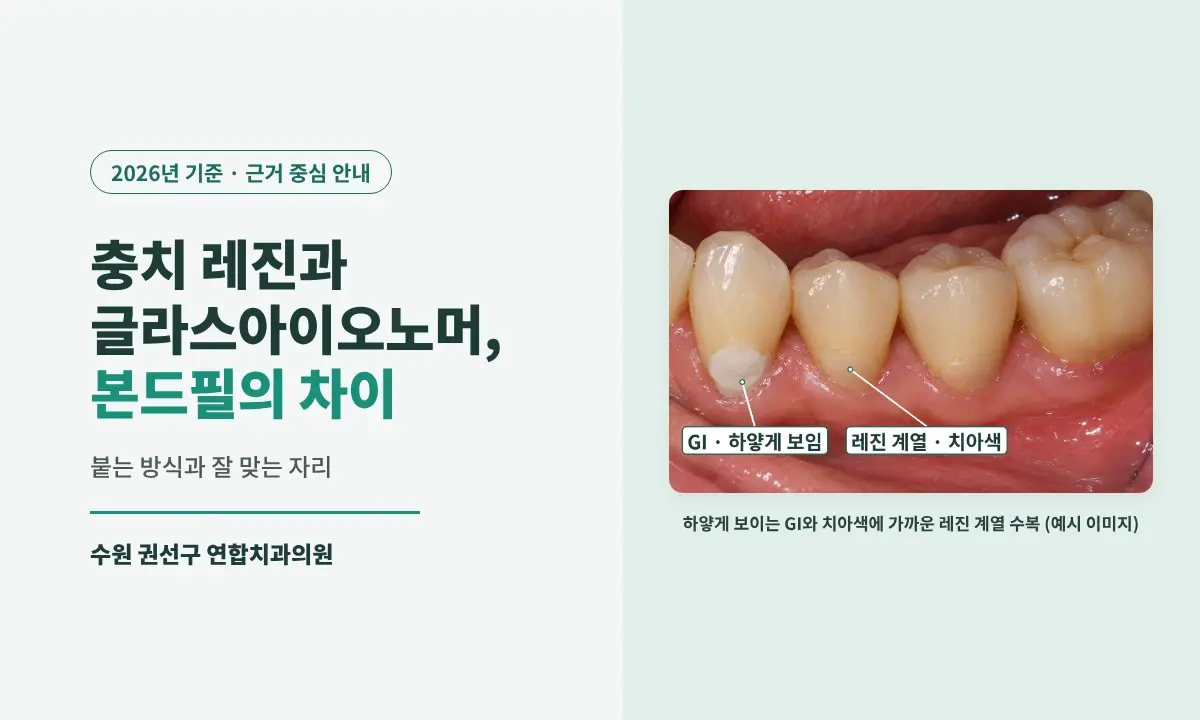
Composite resin, GI, and Bondfill bond in different ways and suit different sites. When restoring cavities and worn teeth, Yeonhap Dental Clinic chooses the material by looking at location, moisture control, and chewing force.
How do composite resin, glass ionomer (GI), and Bondfill differ?
To fill a tooth directly after it has been damaged by a cavity or worn away, we use materials such as ordinary light-cured composite resin, GI (glass ionomer), and Bondfill. Even the same material suits different sites depending on location, moisture control, and chewing force.
[Key Answer]
The three materials are not ranked from good to bad; they differ in how they bond to the tooth and where they fit best. Yeonhap Dental Clinic in Gwonseon-gu, Suwon chooses a material by looking at where the cavity or wear is, whether moisture can be controlled, and whether chewing force is applied, and also takes into account the patient's preferences on cost and color.
[4-Line Summary]
· Ordinary light-cured composite resin is hardened with light, is close to tooth color so it is less noticeable, and is suited to sites where moisture can be controlled.
· GI (glass ionomer) bonds by exchanging ions with the tooth and releases fluoride, but it tends to look white and noticeable, and there are limits on choosing it for sites that continuously bear strong chewing force and wear.
· Bondfill DUAL is a dual-cure adhesive resin that sets on its own and also with light, and our clinic mainly uses it for cervical abrasion, where the neck of the tooth is worn away.
· Yeonhap Dental Clinic first looks at location, moisture control, and chewing force, and if you prioritize cost or color, we take that choice into account as well.
Written by: Dr. Ahn Seong-jin, Chief Director, Yeonhap Dental Clinic
[Table of Contents]
· How do composite resin, glass ionomer (GI), and Bondfill differ?
· How do composite resin, glass ionomer (GI), and Bondfill bond to the tooth?
· How does Yeonhap Dental Clinic choose a restorative material?
· Why do we mainly use Bondfill for cervical abrasion, where the neck of the tooth is worn away?
This article covers the choice of material when directly filling not only cavities but also cervical abrasion, narrow dimples on the chewing surface, and incisal edge wear. Bondfill is also a resin-based material, so we explain ordinary light-cured composite resin, GI, and Bondfill separately, and the criteria for deciding the extent of treatment among resin, inlay, and crown are covered in a separate article.
Comparison of 3 direct filling materials
| Material | Characteristics | Situations mainly considered | Limit |
|---|---|---|---|
| Ordinary light-cured composite resin | Hardened with light, close to tooth color | Cavities at sites where moisture can be controlled | The bonding process is sensitive to moisture, and the material shrinks as it hardens |
| GI (glass ionomer) | Sets on its own, bonds by ion exchange, releases fluoride | Cervical and root cavities where moisture control is difficult, primary teeth | Tends to look white and noticeable; limited at sites that continuously bear strong chewing force and wear |
| Bondfill DUAL | Can be chemically cured or light-cured, close to tooth color, flexible after hardening | Cervical abrasion where the neck of the tooth is worn, narrow dimples on the chewing surface, incisal edge wear | Not used for restoring wide chewing surfaces |
How do composite resin, glass ionomer (GI), and Bondfill bond to the tooth?
All three materials bond to the tooth, but the way the surface is treated and the way they harden are different.
Ordinary light-cured composite resin forms a thin bonding layer (hybrid layer) on the tooth surface with an adhesive and is then hardened with light. Depending on the adhesive ingredients, part of it also bonds chemically to the tooth. However, this process weakens if saliva or blood gets on it, so keeping moisture out is important.
GI sets on its own without light, bonds by forming a layer that exchanges ions with the tooth, and releases fluoride (Sidhu 2016). Because it is a material applied to a surface that is moist rather than thoroughly dried, we consider it at sites where moisture control is difficult. That does not mean contamination with saliva or blood is acceptable; contamination should still be avoided.
Bondfill DUAL is applied after treating the surface by lightly dissolving it with a self-etching primer containing 4-META, and there are experimental results showing that ingredients of this type bond chemically to the calcium in the tooth's minerals (Nagakane 2006). Depending on the condition of the enamel, separate acid etching is applied (Hosoya 2014). It sets on its own and sets faster when exposed to light.
How does Yeonhap Dental Clinic choose a restorative material?
We first look at the site, moisture, and chewing force, and also take into account your choices about cost and color.
A cavity on the chewing surface of a molar (Class I) is usually filled with ordinary light-cured composite resin, and when it extends to the side surface (Class II), we usually go to an inlay. There are exceptions, and the criteria are summarized in Cavity Treatment Types: How to Choose Between Resin, Inlay, and Crown.
We mainly use GI for Class I cavities with sclerotic dentin, for cervical and root cavities where moisture is hard to control, and for primary teeth. Sclerotic dentin is dentin whose surface has hardened so that adhesive has difficulty soaking in; at such sites we look at the bonding conditions before choosing GI, and also check how much chewing force is applied and the extent of the restoration.
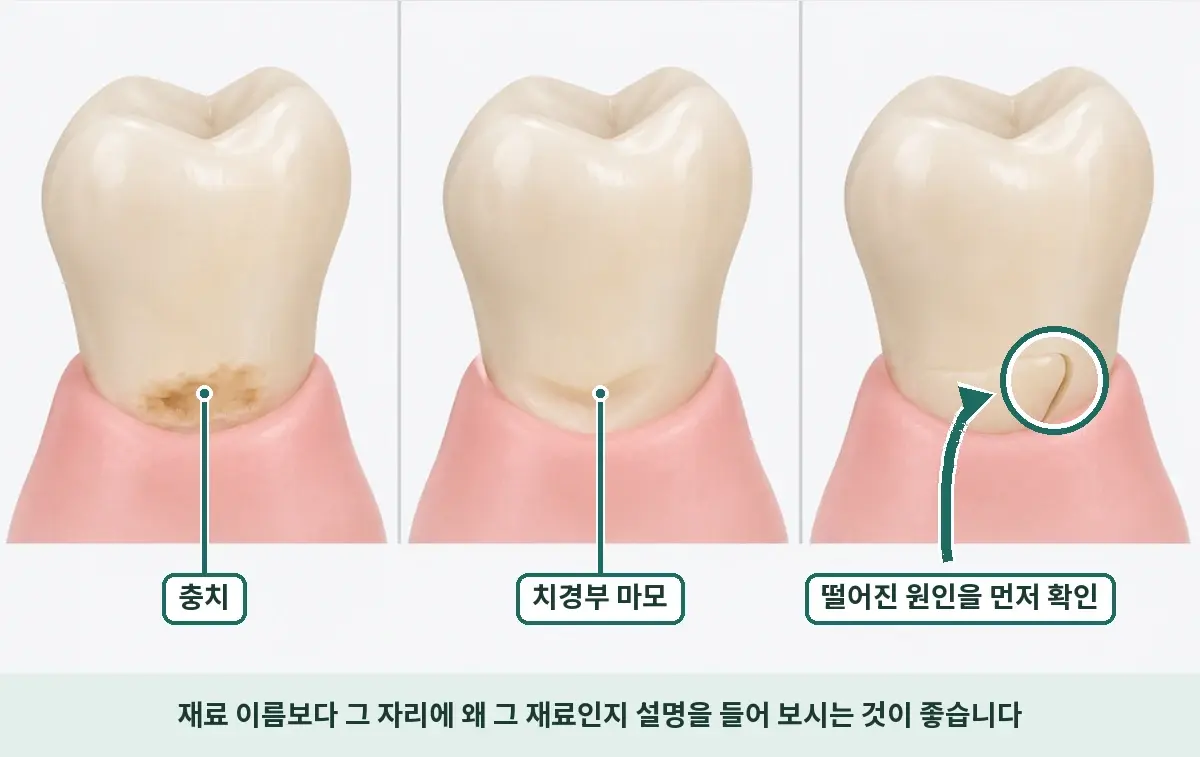
Cervical abrasion, where the neck of the tooth is worn away, is mostly filled with Bondfill, and for narrow worn pits on the chewing surface (dimples) and incisal edge wear where the front tooth tip is worn, we also use Bondfill depending on the condition and extent. For wide chewing-surface restorations, we choose other methods such as ordinary light-cured composite resin or an inlay. For cervical abrasion, if you prioritize cost or a natural color, you can choose ordinary light-cured composite resin.
Primary teeth will fall out as the child grows, so if the cost of resin is a burden, some guardians choose GI. That does not mean a lower-cost material is a worse fit for that site. Insurance coverage varies by age, tooth, and material, and we explain it at the consultation.
Why do we mainly use Bondfill for cervical abrasion, where the neck of the tooth is worn away?
Because the neck of the tooth is where the forces of the tooth flexing slightly during chewing concentrate, and we believe a material that stays flexible after hardening may help cushion that stress.
Bondfill-type materials were developed on the explanation that their low elastic modulus can cushion stress concentration at the cervical area. In an experiment testing Bondfill SB of the same type, extracted premolars had their cervical cavities filled and were artificially aged; Bondfill SB showed less separation of the bonding interface on the dentin side than the composite resin it was compared with, but the composite resin had better marginal adaptation at the enamel side (Zhang 2019). These are laboratory results and not a study confirming that it lasts longer in actual patients. The manufacturer's materials also present a lower flexural strength than ordinary composite resin, and our clinic chooses it for its flexible material properties rather than for high strength itself.
When to fill and when to watch is covered in Cervical Abrasion: When to Fill and When to Watch.
4 things to check when consulting about restorative materials in Gwonseon-gu and Tap-dong, Suwon
It is better to ask why that material was chosen for that site than to focus on the name of the material.
Yeonhap Dental Clinic, across from Suwon NongHyup Guun Branch (231 Geumho-ro), on the 5th floor at 230 Geumho-ro, Gwonseon-gu, Suwon, Gyeonggi-do (Tap-dong, Cham Clinic Building), has treated patients in the same place since 2002, and Dr. Ahn Seong-jin, Chief Director and Integrated Dentistry specialist, oversees treatment. If you are refilling the same site, please also read Why a Filling Keeps Coming Off the Same Spot.
· Whether they explain the difference between a cavity and wear in which the neck of the tooth has been worn away
· Whether the site is one where moisture can be controlled and whether chewing force is applied to it
· Whether there are other materials you can choose if you prioritize cost or color
· If you are refilling the same site, whether they first check why the filling came off
[Key Takeaways]
✓ Ordinary light-cured composite resin, GI, and Bondfill are not better or worse than each other; they bond differently and fit different sites.
✓ Yeonhap Dental Clinic usually uses resin for Class I molar cavities, mainly GI for hardened Class I cavities, cervical and root cavities where moisture is hard to control, and primary teeth, and mostly Bondfill for cervical abrasion.
✓ The evidence on Bondfill's flexible properties and bonding is at the laboratory-study level, and we do not treat it as evidence that it lasts longer in clinical use.
A Few Words from the Treatment Room About Tooth-Filling Materials
Patients who ask about materials usually want to know which one is best. I look first at what kind of site this is. The right material depends on whether heavy chewing force is applied, whether the site is close to the gum so moisture is hard to control, and whether it is a cavity or a worn-away pit. I have also had the experience in practice of switching a site that was being filled with resin to GI and finding that postoperative pain decreased. I think that choosing the material that fits the site matters more for long-term use than choosing an expensive material.
References
📋 Treatment Information
This post was written in compliance with the Korean Medical Service Act and the Ministry of Health and Welfare's medical advertising guidelines, and is intended to provide medical information. It does not guarantee or assert the result of any specific material. The materials that can be applied and the course of treatment differ from person to person depending on the condition and location of the tooth, so please be sure to consult fully with your dental team before deciding on treatment direction.
🦷 Cavity and prosthodontic treatment information: Yeonhap Dental Clinic Treatment Departments
📍 5th Floor, 230 Geumho-ro, Gwonseon-gu, Suwon, Gyeonggi-do (Tap-dong, Cham Clinic Building)
🚕 Across from Suwon NongHyup Guun Branch (231 Geumho-ro) / about 15 minutes by taxi from Suwon Station
🚗 Free parking available in the building
📞 031-293-2207
🌐 yeonhapdental.com
🟡 Opened in 2002 / Treatment overseen by Dr. Ahn Seong-jin, Chief Director and Integrated Dentistry specialist
🔗 Online booking and consultation
Composite Resin, Glass Ionomer (GI), and Bondfill: Frequently Asked Questions
- How do composite resin, glass ionomer (GI), and Bondfill differ?
- Ordinary light-cured composite resin is hardened with light and is a good material for matching tooth color naturally. GI (glass ionomer) sets on its own, bonds to the tooth by ion exchange, and releases fluoride, but it has limits in color and load-bearing. Bondfill DUAL is also resin-based, with dual-cure setting and flexible properties, and our clinic uses it for cervical abrasion and similar cases.
- Is GI (glass ionomer) a worse material than resin?
- Not so. GI is a material with sites that suit it, such as cavities at the neck or root area of the tooth where moisture is hard to control, and primary teeth. However, there are limits on choosing it for sites that continuously bear strong chewing force and wear.
- What kind of material is Bondfill, and where is it used?
- Bondfill DUAL is an adhesive resin of the 4-META/MMA-TBB type that sets on its own and sets faster with light (dual-cure). It stays flexible after hardening, so Yeonhap Dental Clinic mainly uses it for cervical abrasion where the neck of the tooth is worn away.
- What material is used to fill cervical abrasion where the neck of the tooth is worn away?
- Yeonhap Dental Clinic fills most cervical abrasion with Bondfill, and if cost is a concern or you would like a more natural color match, you can choose ordinary light-cured composite resin. For cavities at sites where moisture is hard to control, we may also use GI (glass ionomer).
- What material is used to fill cavities in a child's primary teeth?
- Yeonhap Dental Clinic mainly uses GI (glass ionomer) for primary teeth, and if the cost of resin is a burden, some guardians choose GI. Insurance coverage varies by age, tooth, and material, and we explain it at the consultation.
- Where is Yeonhap Dental Clinic in Tap-dong and Guun-dong, Gwonseon-gu, Suwon?
- We are located on the 5th floor at 230 Geumho-ro, Gwonseon-gu, Suwon, Gyeonggi-do (Tap-dong, Cham Clinic Building), across from Suwon NongHyup Guun Branch (231 Geumho-ro). Free parking is available in the building, and we are about 15 minutes by taxi from Suwon Station.
치아를 채우는 재료에 대해 진료실에서 드리고 싶은 말씀
재료를 여쭤보시는 분들은 대개 어느 것이 제일 좋은지를 궁금해하십니다. 저는 그보다 이 자리가 어떤 자리인지를 먼저 봅니다. 씹는 힘이 크게 걸리는지, 잇몸 가까이라 습기를 막기 어려운지, 충치인지 닳아서 패인 것인지에 따라 맞는 재료가 달라지기 때문입니다. 레진으로 채우던 자리를 GI로 바꾼 뒤 술후 통증이 줄었던 경험도 진료에서 있었습니다. 비싼 재료를 고르는 것보다, 그 자리에 맞는 재료를 고르는 것이 오래 쓰는 데 더 중요하다고 생각합니다.
참고문헌
📋 진료 안내
본 게시글은 의료법 및 보건복지부 의료광고 가이드라인을 준수해 작성되었으며, 의학 정보 제공을 목적으로 합니다. 특정 재료의 결과를 보장하거나 단정하지 않으며, 치아 상태와 위치에 따라 적용 가능한 재료와 경과는 개인마다 다르므로 치료 방향은 반드시 의료진과 충분히 상담하신 뒤 결정하시기 바랍니다.
🦷 충치치료 안내: 충치치료 방법을 정하는 기준
📍 경기 수원시 권선구 금호로 230, 5층 (탑동, 참클리닉빌딩)
🚕 수원농협 구운지점(금호로 231) 맞은편 / 수원역 택시 약 15분
🚗 건물 내 무료주차 가능
📞 031-293-2207
🌐 yeonhapdental.com
🟡 2002년 개원 / 통합치의학과 전문의 안성진 대표원장 책임 진료
🔗 온라인 예약 및 상담
레진·글라스아이오노머(GI)·본드필 자주 묻는 질문
- 레진·글라스아이오노머(GI)·본드필은 무엇이 다른가요?
- 일반 광중합 복합레진은 빛으로 굳히며 치아색을 자연스럽게 맞추기 좋은 재료입니다. GI(글라스아이오노머)는 스스로 굳고 치아와 이온 교환으로 붙으며 불소를 방출하지만, 색과 하중 면에서 한계가 있습니다. 본드필 듀얼도 레진 계열로, 이원중합과 유연한 특성이 있어 본원에서는 치경부 마모 등에 사용합니다.
- GI(글라스아이오노머)는 레진보다 안 좋은 재료인가요?
- 그렇지 않습니다. GI는 습기를 막기 어려운 치아 목·뿌리 쪽 충치나 유치처럼 맞는 자리가 있는 재료입니다. 다만 강한 씹는 힘과 마모를 계속 받는 자리에서는 선택에 제한이 있습니다.
- 본드필은 어떤 재료이고 어디에 쓰나요?
- 본드필 듀얼은 4-META/MMA-TBB 계열의 접착 레진으로, 스스로 굳고 빛을 쬐면 더 빨리 굳는 이원중합형입니다. 굳은 뒤에도 유연한 특성이 있어 연합치과의원은 치아 목이 패인 치경부 마모에 주로 사용합니다.
- 치아 목이 패인 치경부 마모는 어떤 재료로 때우나요?
- 연합치과의원은 치경부 마모를 대부분 본드필로 채우고, 비용이 부담되시거나 색을 더 자연스럽게 맞추고 싶으시면 일반 광중합 복합레진을 선택하실 수 있습니다. 습기를 막기 어려운 자리의 충치는 GI(글라스아이오노머)를 쓰기도 합니다.
- 아이 유치 충치는 어떤 재료로 때우나요?
- 연합치과의원은 유치에 GI(글라스아이오노머)를 주로 사용하며, 레진 비용이 부담되면 보호자분이 GI를 선택하시는 경우도 있습니다. 보험 적용은 나이와 치아, 재료에 따라 달라 상담 때 안내드립니다.
- 수원 권선구 탑동·구운동에서 연합치과의원은 어디에 있나요?
- 경기 수원시 권선구 금호로 230, 5층(탑동, 참클리닉빌딩)으로, 수원농협 구운지점(금호로 231) 맞은편입니다. 건물 내 무료주차가 가능하고 수원역에서 택시로 약 15분 거리입니다.
Related pages
Before your visit
This article provides general information on oral health and dental care. Whether treatment is needed, and which method is appropriate, may change after an oral exam and any necessary diagnostic tests. If you have pain, a loose tooth, swelling, or discomfort with a prosthesis, please visit us for a consultation.