
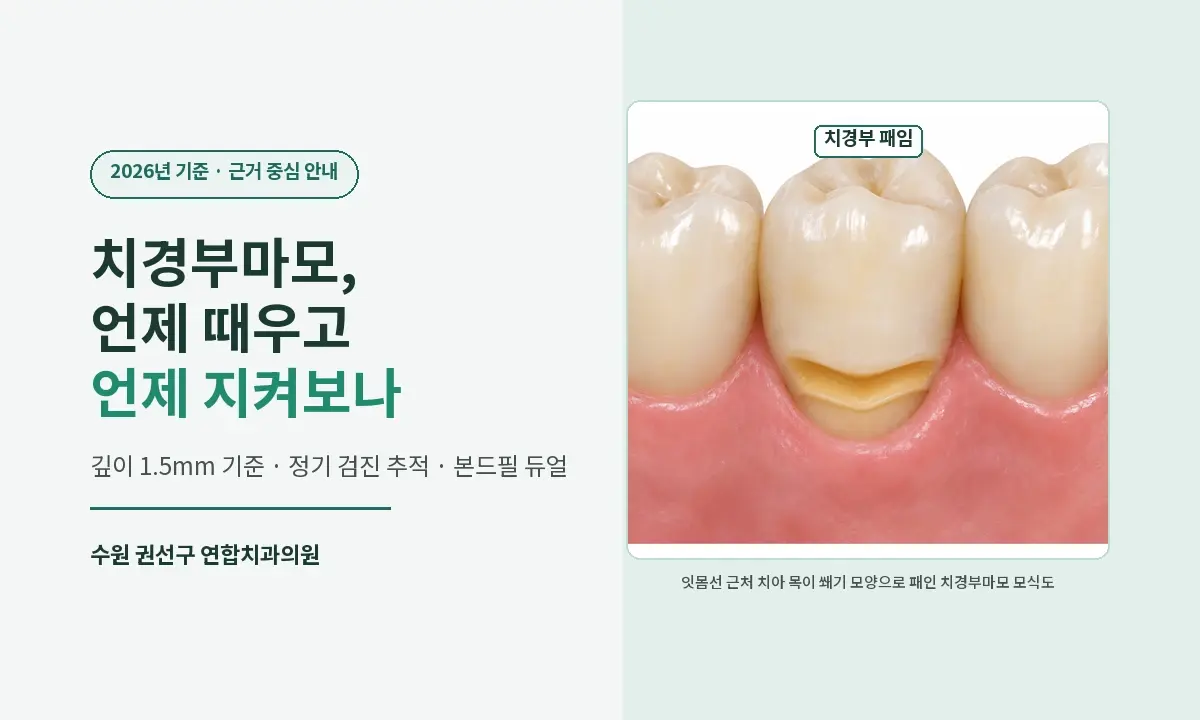
Once a notch forms at the neck of a tooth, it does not recover on its own and can only progress toward getting deeper. That said, we do not fill it the moment it is seen. At a very shallow stage there is not enough room for the restoration to be retained, and conversely, the deeper it gets, the greater the stress on the tooth. Yeonhap Dental Clinic uses an axial depth of about 1.5 mm as its threshold for intervention. In a study that loaded extracted premolars and measured deformation by depth, cervical deformation was reported to increase significantly at 1.5 mm (Du 2020), and Yeonhap Dental Clinic in Gwonseon-gu, Suwon, makes its judgment around that range and restores without delay.
Does a notch at the neck of the tooth (cervical wear) recover on its own?
A cervical notch does not recover and can only progress toward getting deeper.
Written by Dr. Ahn Seong-jin, Chief Director, Yeonhap Dental Clinic · Published Aug. 20, 2026 · Last updated Sept. 3, 2026
This article answers the six questions below in order. · Does a notch at the neck of the tooth (cervical wear) recover on its own? · Why is depth the criterion for judging cervical wear? · Why don't you fill shallow cervical wear? · How far can cervical wear progress if it is put off? · Isn't a bite adjustment also done for cervical wear? · If a cervical notch is not caused by decay, what is the cause?
A notch forming at the neck of a tooth near the gum line is called a non-carious cervical lesion. Because it is not decay, it is not the kind of problem that stops once bacteria are removed, and enamel and dentin that have been lost do not fill back in. The literature summarizes that these lesions become common after age 40 and progress with age (Goodacre 2023).
The shapes fall into two broad types. A gently dished, saucer-shaped lesion mainly widens in height, while a V-shaped lesion that bores in grows in both height and depth. The second shape is the reason Yeonhap Dental Clinic uses depth as the axis of judgment. How far in it has bored, more than the width visible on the surface, determines the strength of the tooth.
That said, we do not fill it the moment it is seen. As you will see in the next section, the timing of intervention has both a lower and an upper limit, and the range between them is the right time to restore.
· 때울 때는 씹을 때 휘는 자리에 맞는 본드필 듀얼을 주로 쓰고, 예방적 교합 조정은 기본으로 두지 않습니다.
작성: 연합치과의원 대표원장 안성진
거울을 보다가 잇몸선 근처 치아 목이 파인 것을 발견하고 걱정되셔서 오시는 경우가 많습니다.
[글의 목차]
· 치경부마모에서 깊이가 왜 판단 기준이 되나요?
· 치경부마모가 얕으면 왜 바로 때우지 않나요?
· 치경부마모를 때울 때는 무엇으로 채우나요?
· 치경부마모에 교합 조정은 함께 하지 않나요?
· 치경부 패임은 왜 생기나요?
치경부 병소는 충치가 아니므로 세균을 제거해 멈추는 종류의 문제가 아니고, 한번 사라진 법랑질과 상아질은 다시 채워지지 않습니다. 형태는 접시 모양으로 완만하게 파여 주로 높이 방향으로 넓어지는 것과, V자로 파고들어 높이와 깊이가 함께 늘어나는 것으로 나뉩니다(Goodacre 2023).
연합치과의원이 깊이를 판단의 축으로 삼는 이유는 두 번째 형태 때문입니다. 겉으로 보이는 폭보다 안쪽으로 얼마나 파고들었는지가 치아의 강도를 좌우합니다.
Why is depth the criterion for judging cervical wear?
It is reported that when the axial depth reaches 1.5 mm, the deformation applied to the cervical area increases significantly.
When chewing force is applied at an angle, the tooth repeatedly flexes and straightens very slightly, and that force gathers at the neck near the gum line. The deeper the notch, the thinner the remaining tooth structure, so the deformation at that spot grows even under the same force.
There is a study that measured this relationship. In an experiment on extracted premolars, a static load of 9 kg was applied at seven points, and deformation was measured with strain gauges while the lesion depth was changed to 0 mm (control), 0.5 mm, 1.0 mm, and 1.5 mm. Deformation of the cervical enamel and dentin increased significantly when the depth reached 1.5 mm, and this value is proposed as the threshold for conservative restoration (Du 2020).
A review gives the same criterion. It summarizes that restoration becomes indicated when the axial depth at the deepest point reaches at least 1.5 mm, and that tooth strength is threatened, particularly in single-rooted teeth (Goodacre 2023). In a wedge-shaped lesion, stress concentrates at the sharp tip, and an adhesive restoration lowers that stress by spreading it over a wider area.
This is the basis on which Yeonhap Dental Clinic sets about 1.5 mm as the threshold for intervention. We do not fill something just because it is visible; we look at whether it has reached the range that crosses the threshold in terms of stress.
Judgment by depth of cervical notch
| Depth range | Condition reported in the literature | Our clinic's judgment |
|---|---|---|
| Less than 0.5 mm | No clear increase in deformation | Watch: not enough room for the restoration to be retained |
| 0.5~1.0mm | Deformation begins to increase | Watch: check depth change at regular check-ups |
| About 1.5 mm | Cervical deformation increases significantly (Du 2020) | Right time to restore |
| More than 1.5 mm | Indicated for restoration (Goodacre 2023) | Restore without delay |
| Near the pulp, risk of fracture | Tooth strength threatened | A plan beyond restoration is needed (crown) |
Why don't you fill shallow cervical wear?
At a shallow stage, there is no room for the restoration to be retained in the first place.
It may seem safer to fill a notch as soon as it is seen, but in practice it is not. The neck of the tooth is where flexing force gathers with every bite, so restorations there tend to come off, and if the lesion is shallow, the material lacks the thickness and shape to be held. A thinly applied material cannot withstand flexing, lifts at the margin, and falls off. The same spot then has to be cut and filled again, over and over.
There is one more reason it is better to leave it alone. To place a restoration, the surface has to be prepared for bonding, and in that process some of the remaining tooth structure is lost. If the lesion has not yet crossed the stress threshold, there is no reason to accept that loss.
That is why Yeonhap Dental Clinic follows shallow lesions at regular check-ups. What we check is the change in depth. If there is no progression, we keep watching, and when it nears the threshold, we then discuss a restoration plan. However, if symptoms are pronounced, that is, if sensitivity to cold water interferes with daily life, we consider a response regardless of depth.
How far can cervical wear progress if it is put off?
As a cervical lesion deepens, it can start with sensitivity and lead to nearness to the pulp and cervical fracture.
The literature compiles cases showing what the end of this progression looks like. Reported cases include a deep V-shaped notch in an upper molar extending past secondary dentin to where the pulp had been, and a lower front tooth weakened by a cervical lesion that fractured (Goodacre 2023). The same literature also points out that plaque accumulates inside a deep notch, so restoration should begin before decay develops.
The problem comes after a fracture. When a tooth breaks at the neck, the edge of the remaining tooth structure drops below the gum line, and from then on it is no longer a matter of filling but of where to place the crown margin. Choices such as lowering the bone to expose the margin or raising the margin with resin become necessary, and even the crown-to-root ratio enters the calculation. How this judgment is made is covered in Crown Lengthening: How Much Bone Should Be Removed?.
If it progresses further and invades the pulp, root canal treatment is added. A single small notch at the neck becomes a path leading to a crown and root canal treatment, when it could have been handled with a single adhesive restoration at the threshold. This is why Yeonhap Dental Clinic does not put off lesions that have reached the criterion.
Progression path when a cervical lesion is left untreated
| Stage | Changes that appear | Treatment extent needed |
|---|---|---|
| Before the threshold | No clear symptoms | Monitor |
| Threshold reached (about 1.5 mm) | Stress concentration, sensitivity begins | Adhesive restoration |
| Deep progression | Plaque stagnation, decay may accompany | Larger restoration extent |
| Near the pulp | Persistent sensitivity and pain | Consider root canal treatment |
| Cervical fracture | Margin drops below the gum line | Crown lengthening or DME, then crown |
Isn't a bite adjustment also done for cervical wear?
Yeonhap Dental Clinic does not make preventive bite adjustment the default for cervical restorations.
Bite force is often cited as a cause of cervical lesions. I too believe that most lesions in clinical practice originate from chewing force. The natural next question is whether the bite should be adjusted, but Yeonhap Dental Clinic does not do that.
There are two reasons. First, the evidence is not established. Literature reviews also summarize that some studies see occlusal factors as involved in the development of cervical lesions while others see no relation (Goodacre 2023). Second, bite adjustment is an irreversible procedure. A cusp that has been ground away does not come back, so cutting healthy tooth structure on the basis of unestablished evidence is out of order.
The actual course also supports this judgment. Cases in which pain develops after a restoration and the bite has to be adjusted come to fewer than one a year. In such cases we identify the cause and adjust, but we do not cut in advance to prepare for something that does not happen. Not adding procedures that are not needed is a principle Yeonhap Dental Clinic keeps in other treatments as well.
If a cervical notch is not caused by decay, what is the cause?
A cervical lesion is a multifactorial lesion caused by toothbrushing, acid exposure, and bite force acting together.
The literature summarizes personal habits such as excessive horizontal toothbrushing and consumption of acidic foods and drinks as major factors (Goodacre 2023). In other words, it is not a matter of finding one cause and removing it; it is the result of several forces accumulating on the same spot.
There is one thing Yeonhap Dental Clinic checks here. If the pattern suggests acid damage, we ask about gastroesophageal reflux. When stomach acid repeatedly rises, tooth structure dissolves regardless of brushing or diet, and in this case the cause remains if only dental treatment is done. If it seems to apply, we also recommend a visit to a gastroenterology clinic.
You may be puzzled that a dental clinic brings up the stomach, but if restorations are repeated with the cause left in place, the next lesion will form again. I think it is better to tell you that some parts do not end with filling.
[Key Takeaways]
✓ A cervical notch does not recover and can only progress toward getting deeper, and cervical deformation is reported to increase significantly at an axial depth of about 1.5 mm (Du 2020).
✓ At stages shallower than that, there is not enough room for the restoration to be retained, so Yeonhap Dental Clinic tracks depth change at regular check-ups.
✓ If it is put off after crossing the threshold, it can lead to nearness to the pulp and cervical fracture, expanding into root canal treatment and crown margin problems, so we do not put off lesions that have reached the criterion.
✓ 치경부 패임은 저절로 돌아오지 않지만, 얕고 증상이 없으면 정기 검진으로 추적하며 시림이 일상에 지장을 주면 깊이와 별개로 대응을 검토합니다.
✓ 약 1.5mm에 이른 병소는 진행·증상·남은 치질을 함께 보고 수복을 판단하며, 연합치과의원은 휘는 자리에 맞는 본드필 듀얼을 주로 씁니다.
✓ 교합 조정은 예방 목적으로 미리 하지 않고, 산 노출이 의심되면 원인 확인을 함께 권합니다.
Criteria to check when consulting about a cervical lesion in Gwonseon-gu or Tap-dong, Suwon
The practical test of a consultation is whether the dentist can explain the criterion for filling or watching.
Yeonhap Dental Clinic, at 230 Geumho-ro, 5th Floor (Cham Clinic Building, Tap-dong), Gwonseon-gu, Suwon, across from Suwon NongHyup Guun Branch (231 Geumho-ro), has held the same location since 2002. Dr. Ahn Seong-jin, Chief Director and Integrated Dentistry specialist, is currently in charge, and you can see the restorative materials and process in General Dentistry Information.
[5 Things to Check Before a Cervical Lesion Consultation]
· Whether the reason to fill now is explained by depth or symptoms
· Whether cases that can be watched are also described
· Whether depth change is tracked at regular check-ups
· Whether preventive bite adjustment is not the default
· Whether a check for the cause is also recommended when acid exposure is suspected
Frequently Asked Questions
- If the neck of my tooth is notched but not sensitive, can I leave it?
- If it is shallow and has no symptoms, there are cases where we simply watch. However, a cervical notch does not recover on its own and can only progress toward getting deeper, so it is necessary to check the change in depth at regular check-ups.
- Why wait instead of filling cervical wear right away?
- At a shallow stage, the thickness and shape needed to retain the restoration are lacking, so it is likely to come off again, and preparing the surface for bonding reduces the remaining tooth structure. If it has not yet crossed the stress threshold, there is no reason to accept that loss.
- Where does the 1.5 mm criterion for restoring cervical wear come from?
- In a study that loaded extracted premolars and measured deformation while changing the lesion depth to 0, 0.5, 1.0, and 1.5 mm, cervical deformation was reported to increase significantly at 1.5 mm (Du 2020). A review also gives a minimum axial depth of 1.5 mm as the indication for restoration (Goodacre 2023).
- What happens if a cervical notch is left alone?
- Sensitivity can worsen, plaque can accumulate inside the notch and decay can accompany it, and with further progression it can approach the pulp or fracture at the neck. If it fractures, the margin drops below the gum line and the crown plan itself becomes complicated.
- Can bite adjustment prevent cervical wear from recurring?
- Studies disagree on the relationship between occlusal factors and cervical lesions. Because bite adjustment is an irreversible procedure, Yeonhap Dental Clinic does not do it in advance for prevention and considers it only when symptoms appear after a restoration.
- Why do you ask about reflux symptoms in a cervical notch consultation?
- When stomach acid repeatedly rises, tooth structure dissolves regardless of brushing or diet. In this case, repeating restorations alone leaves the cause in place, so if it seems to apply, we also recommend a visit to a gastroenterology clinic.
- If a filling at the neck of the tooth comes off again, did I take poor care of it?
- The neck of the tooth is where flexing force gathers with every bite, so restorations there tend to come off. The influence of the material and bonding is large enough that one report found 36-month retention rates differing at 92.3% and 56.4% depending on the adhesive system, and in many cases it is hard to see it as a matter of personal care.
- Where is Yeonhap Dental Clinic in Tap-dong and Guun-dong, Gwonseon-gu, Suwon?
- Yeonhap Dental Clinic is at 230 Geumho-ro, 5th Floor (Cham Clinic Building, Tap-dong), Gwonseon-gu, Suwon, Gyeonggi-do, across from Suwon NongHyup Guun Branch (231 Geumho-ro). Free parking is available in the building, and we are about 15 minutes by taxi from Suwon Station.
What I would like to tell you if you have found a notch at the neck of your tooth
A notch at the neck of a tooth is hard to notice until one day it starts showing in the mirror. People then split into two reactions: asking me to fill it right away, or saying it does not hurt so they will leave it. I tell both that we should decide by looking at the depth. If we rush to touch a spot that is still shallow, the material will not stay attached and the same thing repeats, and if we put off a spot that has crossed the threshold, it later will not end with a filling. Having seen in the treatment room how one small notch can lead to a crown and root canal treatment, I tend not to simply pass over this spot.
[References]
Du JK, Wu JH, Chen PH, Ho PS, Chen KK. Influence of cavity depth and restoration of non-carious cervical root lesions on strain distribution from various loading sites. BMC Oral Health. 2020;20(1):98. doi:10.1186/s12903-020-01083-w.
Goodacre CJ, Eugene Roberts W, Munoz CA. Noncarious cervical lesions: morphology and progression, prevalence, etiology, pathophysiology, and clinical guidelines for restoration. J Prosthodont. 2023;32(2):e1-e18. doi:10.1111/jopr.13585.
Restoration of non-carious cervical lesions: a brief review for clinicians. 2024. PMID 39503710.
Reis A, Loguercio AD. A 36-month clinical evaluation of ethanol/water and acetone-based etch-and-rinse adhesives in non-carious cervical lesions. Oper Dent. 2009;34(4):384-391. PMID 19678442.
🌐 yeonhapdental.com
🟡 2002년 개원 / 통합치의학과 전문의 안성진 대표원장 책임 진료
🔗 온라인 예약 및 상담
Clinic Information
This post was written in accordance with the Korean Medical Service Act and the Ministry of Health and Welfare's medical advertising guidelines, and is intended to provide medical information. It does not guarantee or assert the effect of any particular material or treatment. Judgments may vary depending on the depth, location, and symptoms of the lesion, so please decide whether to treat only after a thorough consultation with your dental team.
🦷 Restorative treatment information: Yeonhap Dental Clinic general dentistry
📍 230 Geumho-ro, 5th Floor (Cham Clinic Building, Tap-dong), Gwonseon-gu, Suwon, Gyeonggi-do
🚕 Across from Suwon NongHyup Guun Branch (231 Geumho-ro) / about 15 minutes by taxi from Suwon Station
🚗 Free parking available in the building
📞 031-293-2207
🌐 yeonhapdental.com
🟡 Open since 2002 / Treatment overseen by Dr. Ahn Seong-jin, Chief Director and Integrated Dentistry specialist
🔗 Online booking and consultation
Related pages
Before your visit
This article provides general information on oral health and dental care. Whether treatment is needed, and which method is appropriate, may change after an oral exam and any necessary diagnostic tests. If you have pain, a loose tooth, swelling, or discomfort with a prosthesis, please visit us for a consultation.