
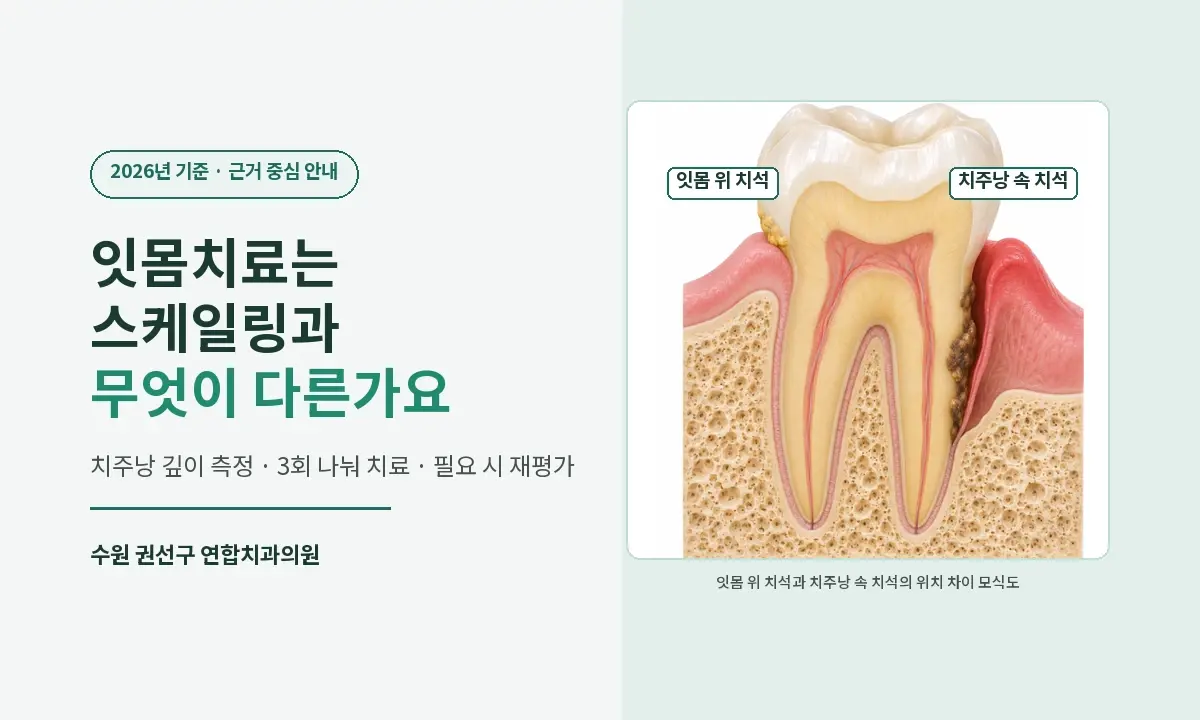
Scaling removes the tartar visible above the gum line, while gum treatment reaches inside the periodontal pocket under the gum. They are not two names for the same thing; they differ in the depth they reach. Cleaning the inside of the pocket is reported to reduce pocket depth by 1.7 mm on average and to close about 74% of pockets, and if any sites remain deeper than 4 mm, surgery is considered for those sites only. National Health Insurance applies one preventive scaling per year for patients aged 19 and older, and periodontal disease treatment is a separate item.
How are gum treatment and scaling different in Gwonseon-gu, Suwon?
We often hear patients ask, "I just had scaling, so why do I need more treatment?"
[Key Answer]
Scaling removes tartar exposed above the gum line, while gum treatment reaches inside the periodontal pocket under the gum. They are not the same treatment under different names; they reach different depths, and cleaning the inside of the pocket is reported to reduce pocket depth by 1.7 mm on average and close about 74% of pockets (Suvan 2020).
[4-Line Summary]
· Under international guidelines, gum treatment is divided into four steps. Step 1 covers the area above the gum line and habits, Step 2 the area below the gum line, Step 3 surgery for remaining sites, and Step 4 maintenance (Sanz 2020).
· After Step 2, we measure again; if pockets deeper than 4 mm still bleed, Step 3 is considered, and the criterion for ending treatment is no pockets of 5 mm or more with bleeding.
· Cleaning inside the pocket reduces depth by 1.7 mm on average, but the reduction differs by starting depth (1.6 mm for 4–6 mm sites, 2.6 mm for 7 mm or deeper), and about 26% of pockets do not close.
· National Health Insurance covers preventive scaling once per year, January 1 to December 31, for patients aged 19 and older, and periodontal disease treatment is a separate item.
Written by: Dr. Ahn Seong-jin, Chief Director, Yeonhap Dental Clinic · Published September 22, 2026 · Last updated September 22, 2026
[Table of Contents]
· How is gum treatment different from scaling?
· In what order is gum treatment carried out?
· How often is gum treatment covered by National Health Insurance?
· How does Yeonhap Dental Clinic in Gwonseon-gu, Suwon perform gum treatment?
· How do we decide between treating and monitoring?
A periodontal pocket is a gap that forms when the gum separates from the tooth. In healthy gums this gap is 1–3 mm, and the deeper it gets, the more areas a toothbrush cannot reach.
No matter how thoroughly the area above the gum line is cleaned by scaling, inflammation keeps progressing if what lies below is left in place. That is why Yeonhap Dental Clinic measures pocket depth at each site before treatment. This post was written as of September 2026.
Differences between scaling and gum treatment by item
| Item | Scaling (tartar removal) | Gum treatment (cleaning inside the periodontal pocket) |
|---|---|---|
| Depth reached | The exposed surface above the gum line | Inside the periodontal pocket, down to the root surface |
| Purpose | Remove deposits that cause inflammation | Reduce and close pockets that have already formed |
| Anesthesia | Usually not needed | Needed depending on the site |
| Number of visits | Usually once | Full-mouth scaling, then right and left sides in separate visits, three in total |
| Measurement before treatment | Not required | Pocket depth measurement at each site is a prerequisite |
| After treatment | Finished that day | Measure again after 6–8 weeks and reassess |
| National Health Insurance | Once a year for ages 19 and older (preventive) | Applied separately under a periodontal disease diagnosis |
How is gum treatment different from scaling?
They reach different depths, and so anesthesia and the number of visits differ.
Scaling removes tartar exposed outside the gum. Because it deals with surfaces you can see, it is usually done in one visit without anesthesia.
Gum treatment goes inside the periodontal pocket. It involves cleaning deposits on the root surface, which is covered by the gum and cannot be seen, by feel, so anesthesia is needed depending on the site and the work is divided over several visits rather than done all at once.
What has been reported
· About 6–8 months after cleaning the inside of the pocket, depth was reported to have decreased by 1.7 mm on average (Suvan 2020)
· In the same data, 4–6 mm sites decreased by 1.6 mm and sites of 7 mm or more by 2.6 mm, so results differed by starting depth
· The proportion of pockets that closed is estimated at about 74%
There is something I want to say plainly here. If 74% closed, then about 26% did not, and a site that was 6 mm still has 4.4 mm left even after a 1.6 mm reduction. This is why gum treatment is not a one-time procedure; it needs a step where we measure again and then decide.
Also, gum bone that has already been lost does not come back with treatment. The goal of gum treatment is not to regrow bone but to stop further loss. I mention this first because the gums can look as if they have receded after treatment. In fact, as the swollen gums settle down, their original position becomes visible; they did not recede because of the treatment.
In what order is gum treatment carried out?
It is divided into four steps, with a re-measurement between Steps 2 and 3.
The periodontitis treatment guideline compiled by the European Federation of Periodontology divides treatment into steps (Sanz 2020). Yeonhap Dental Clinic also builds its plans on this framework.
Step 1 — Above the gum line and daily habits
· Remove visible tartar and plaque
· You practice brushing and using floss or interdental brushes yourself during the visit
· Check factors that affect the gums, such as smoking and diabetes
If this step is skipped, the later steps do not last. No matter how well the inside of the pocket is cleaned, if the areas that are not reached every day stay the same, the same sites will deepen again.
Step 2 — Below the gum line
Tartar and biofilm inside the periodontal pocket are removed. This is done under anesthesia, one area at a time, and the root surface is cleaned by feel.
Reassessment — measuring again
Six to eight weeks after Step 2, we measure the depth at each site again. We look at two things.
· Whether pockets deeper than 4 mm still bleed on probing
· Whether deep sites of 6 mm or more remain
Step 3 — Remaining sites only
Sites that exceed the criteria at reassessment are reviewed. Depending on the case, the same area may be cleaned again, the gum may be opened to clean under direct view, or a regenerative procedure may be applied depending on the shape of the bone defect. Only the remaining sites are treated, not the whole mouth.
Step 4 — Maintenance
After treatment is finished, we check regularly. The guideline recommends setting the interval between 3 months and up to 12 months according to the patient's risk.
The criterion for ending treatment is no pockets of 5 mm or more with bleeding, and no deep sites of 6 mm or more.
Gum treatment steps and the criteria for moving to the next step
| Step | What we do | Criterion for moving to the next step |
|---|---|---|
| Step 1 | Remove tartar above the gum line, brushing instruction, check smoking and diabetes | Whether daily care that reaches the area is now possible |
| Step 2 | Under anesthesia, remove tartar and biofilm inside the periodontal pocket | Whether all planned areas have been completed |
| Reassessment | Re-measure pocket depth and bleeding at each site after 6–8 weeks | Whether pockets over 4 mm with bleeding, or sites of 6 mm or more, remain |
| Step 3 | Re-clean the remaining sites, open the gum to clean, regenerate if there is a bone defect | Whether the sites that exceeded the criteria are resolved |
| Step 4 | Periodic checks and re-measurement, re-check of brushing | Interval adjusted between 3 and 12 months according to risk |
| Criterion for ending treatment | No pockets of 5 mm or more with bleeding | No deep sites of 6 mm or more |
| Reported results | Average pocket depth reduction of 1.7 mm | About 74% closed, about 26% remain |
How often is gum treatment covered by National Health Insurance?
Preventive scaling and periodontal disease treatment are separate items.
This is the point patients misunderstand most often. Many people believe that "I used my scaling this year, so gum treatment isn't covered," but the two do not share the same limit.
Preventive tartar removal (scaling)
· Eligibility — National Health Insurance members aged 19 and older
· Frequency — once per year, from January 1 to December 31
· Nature — applied for prevention when gum disease is not severe
What matters is that the period is based on the calendar year, not 365 days from the treatment date. If you had it in December last year, it can be applied again in January after the year changes.
Periodontal disease treatment
If you are diagnosed with gum inflammation that needs treatment, the corresponding periodontal treatment is applied separately. Even if you have already used your one preventive scaling, if your condition requires treatment, that judgment comes first.
How often do we see you at Yeonhap Dental Clinic?
· Basic — you come for a regular check-up every 6 months, and periodontal treatment is done at the same visit
· If the periodontal condition is not good — we may recommend a 3-month interval
The European Federation of Periodontology guideline also recommends setting the maintenance interval between 3 months and up to 12 months according to risk (Sanz 2020). Six months is the interval that suits most cases within that range, and we shorten it for patients whose disease progresses quickly or who have deep remaining pockets.
At the consultation stage, Yeonhap Dental Clinic explains whether this treatment falls under preventive scaling or periodontal disease treatment. Coverage criteria may change with policy revisions, so we recheck whether they actually apply at the time of your visit.
How does Yeonhap Dental Clinic in Gwonseon-gu, Suwon perform gum treatment?
Our principle is not to treat before measuring, and to measure again after treatment.
Measurement comes first
We record pocket depth at each site and then make a plan. The depth in millimeters at each site determines how far Step 2 goes and where there is a possibility of moving to Step 3.
If bone loss is suspected, we check with 3D CT. A bone defect that looks overlapping on a flat image can look different in cross-section, and the method chosen at Step 3 depends on its shape.
Done in three visits
· Visit 1 — Full-mouth scaling. Tartar exposed above the gum line is cleaned first
· Visit 2 — Right side root planing (scraping off and smoothing deposits on the root surface) or periodontal curettage (also removing inflamed tissue inside the pocket)
· Visit 3 — Left side root planing or periodontal curettage
Because the right and left sides are done separately, you can eat on the side opposite the one that was numbed. If everything is done at once, both sides are uncomfortable on the day of treatment.
Whether to do root planing or periodontal curettage is decided by the pocket depth and degree of inflammation at that site. Even for the same person, it differs by site.
We do not skimp on anesthesia
Step 2 goes inside the gum, so pain is the most common reason treatment is interrupted. Yeonhap Dental Clinic uses three-step painless anesthesia: gargle anesthesia, topical ointment anesthesia, and the i-JECT automatic anesthesia device.
If you postpone your next appointment because of pain, treatment stops there. We believe that giving enough anesthesia is, in the end, how to finish as planned.
For loose teeth, we look at the bite as well
When chewing force is excessive on a tooth with reduced gum bone, the looseness gets worse. At Yeonhap Dental Clinic I personally check and adjust the final bite of every prosthesis, and in gum treatment I look at the bite from the same point of view.
Extraction is decided last
We do not extract a tooth just because it is loose. After Step 2 and the reassessment, we check whether it is still difficult to keep, and then decide. This does not mean every tooth can be saved; where the bone has already been lost extensively, preserving the tooth may be difficult, and we tell you that as well.
The schedule continues after treatment
It does not end with three visits. After that, you come for a regular check-up every 6 months, when we recheck your periodontal condition and continue any needed periodontal treatment. We recommend a 3-month interval for patients with poor periodontal condition.
How do we decide between treating and monitoring?
We decide by measurements, not by symptoms, because gum disease often progresses before it hurts.
5 things we check when deciding whether to treat
· Whether any site has a pocket deeper than 4 mm
· Whether that site bleeds when probed
· Whether the height of the gum bone is reduced on the X-ray
· Whether there are factors that speed progression, such as smoking or diabetes
· Whether your daily brushing actually reaches that area
The first three are values measured in the treatment room, and the last two are values that determine the maintenance interval after treatment.
[Key Takeaways]
✓ Scaling removes tartar exposed above the gum line, while gum treatment reaches inside the periodontal pocket. They are not different names; they reach different depths.
✓ Gum treatment is divided into four steps; 6–8 weeks after Step 2 we measure again, and if pockets deeper than 4 mm still bleed, Step 3 is considered (Sanz 2020).
✓ Cleaning inside the pocket reduces depth by 1.7 mm on average and closes about 74%, but about 26% do not close, and gum bone that has already been lost does not come back (Suvan 2020).
✓ National Health Insurance applies preventive tartar removal once per year, January 1 to December 31, for patients aged 19 and older, and periodontal disease treatment is a separate item.
✓ Yeonhap Dental Clinic does full-mouth scaling and then the right and left sides in three visits, and continues periodontal treatment at regular check-ups every 6 months afterward. For patients with poor periodontal condition, we recommend a 3-month interval.
If your gums are swollen or bleeding in Gwonseon-gu or Tap-dong, Suwon
Bleeding from the gums is a sign that inflammation is already present, so measuring comes first.
Yeonhap Dental Clinic, located across from Suwon NongHyup Guun Branch (231 Geumho-ro), on the 5th floor at 230 Geumho-ro, Gwonseon-gu, Suwon, Gyeonggi-do (Tap-dong, Cham Clinic Building), has stayed in the same place since opening in 2002. Today, Dr. Ahn Seong-jin, Chief Director and Integrated Dentistry specialist, oversees treatment, and you can see our range of services at Yeonhap Dental Clinic Treatment Information.
Helpful things to note before your visit
· When you last had scaling — this lets us check whether coverage remains for this year
· Whether the bleeding is in one place or throughout
· Whether you smoke and how much per day, and recent test values if you have diabetes
· If you have a loose tooth, since when
If you also have sensitivity from receding gums, whether to fill that site or just watch it is judged by different criteria. Those criteria are covered in Cervical Abrasion: When to Fill and When to Watch.
A Few Words from the Treatment Room About Gum Treatment
What we run into most often in gum treatment is not the technique but the timing.
By the time gum disease hurts, bone has often already been lost. But because there is no pain, people assume one scaling took care of it and move on. I have seen many cases where, by the time the patient comes in years later because a tooth is loose, the remaining options have narrowed.
That is why, when I recommend treatment, I tell you the millimeter numbers as they are. "The back of this molar is 6 mm" conveys much more accurately than "your gums are not good," and it leaves a value to compare against when we measure again after treatment.
That said, these numbers do not tell the whole story. Even at the same 5 mm, a site your toothbrush reaches and one it does not follow different courses, and smoking changes things as well. So I use the numbers as a standard while also looking at whether that site is one that is being cared for.
One more thing: in gum treatment, what you do at home affects the result more than what I do. That is why the guideline puts brushing and lifestyle first at Step 1. This is not modesty; it is really the case.
📞 031-293-2207
🌐 yeonhapdental.com
🟡 2002년 개원 / 통합치의학과 전문의 안성진 대표원장 책임 진료
🔗 온라인 예약 및 상담
References
📚 References
· Sanz M, Herrera D, Kebschull M, et al. Treatment of stage I-III periodontitis — The EFP S3 level clinical practice guideline. J Clin Periodontol. 2020;47(S22):4-60. doi:10.1111/jcpe.13290. PMID 32383274 — Four steps of periodontitis treatment, reassessment criteria (over 4 mm + bleeding / 6 mm or more), criterion for ending treatment (no sites of 5 mm or more with bleeding), maintenance at 3–12 months
· Suvan J, Leira Y, Moreno Sancho FM, Graziani F, Derks J, Tomasi C. Subgingival instrumentation for treatment of periodontitis. A systematic review. J Clin Periodontol. 2020;47(S22):155-175. doi:10.1111/jcpe.13245 — Average pocket depth reduction of 1.7 mm at 6–8 months (1.6 mm for 4–6 mm, 2.6 mm for 7 mm or more), pocket closure about 74%
· Lamont T, Worthington HV, Clarkson JE, Beirne PV. Routine scale and polish for periodontal health in adults. Cochrane Database Syst Rev. 2018;12:CD004625. PMID 30590875 — Evidence on the effect of routine scaling and polishing in healthy adults
· National Health Insurance Service — Coverage criteria for tartar removal (scaling): aged 19 and older, once per year from January 1 to December 31
· Ministry of Health and Welfare and Health Insurance Review & Assessment Service — Coverage criteria for benefits related to periodontal disease
Treatment Information
This post was written personally by Dr. Ahn Seong-jin, Chief Director, Yeonhap Dental Clinic. Published September 22, 2026 · Last updated September 22, 2026
This post was written in compliance with the Korean Medical Service Act and the Ministry of Health and Welfare's medical advertising guidelines, and is intended to provide medical information. It does not guarantee or assert the effect or outcome of any specific treatment. The treatment plan that can be applied and the course of treatment differ from person to person depending on gum condition and general health, so please be sure to consult fully with your dental team before deciding on diagnosis and treatment direction.
📋 Treatment Information
🦷 Gum treatment information: Yeonhap Dental Clinic Treatment Information
📍 5th Floor, 230 Geumho-ro, Gwonseon-gu, Suwon, Gyeonggi-do (Tap-dong, Cham Clinic Building)
🚕 Across from Suwon NongHyup Guun Branch (231 Geumho-ro) / about 15 minutes by taxi from Suwon Station
🚗 Free parking available in the building
📞 031-293-2207
🌐 yeonhapdental.com
🟡 Opened in 2002 / Treatment overseen by Dr. Ahn Seong-jin, Chief Director and Integrated Dentistry specialist
🔗 Online booking and consultation
Gum Treatment: Frequently Asked Questions
- How are gum treatment and scaling different?
- Scaling removes tartar exposed above the gum line, while gum treatment goes inside the periodontal pocket under the gum and cleans the root surface. Because the depth reached is different, gum treatment needs anesthesia depending on the site and is divided over several visits rather than finished at once.
- Will gum disease improve with scaling alone?
- Scaling alone has difficulty resolving gum disease once periodontal pockets have formed. Even if the area above the gum line is clean, the tartar and biofilm inside the pocket remain. If pocket depth exceeds 4 mm and the site bleeds on probing, we consider it a condition that needs treatment going below the gum line.
- In how many visits is gum treatment done?
- Yeonhap Dental Clinic divides gum treatment into three visits. At Visit 1, tartar above the gum line is cleaned with full-mouth scaling; at Visit 2 we do root planing or periodontal curettage on the right side, and at Visit 3 on the left side. Because the sides are done separately, you can eat on the side opposite the one that was numbed. After that, we recheck your periodontal condition at regular check-ups every 6 months, and we recommend a 3-month interval for patients with poor periodontal condition.
- Does gum bone grow back after gum treatment?
- Gum bone that has already been lost does not return to its original state with gum treatment. The goal of gum treatment is not to regrow bone but to stop progression so that no more is lost. Depending on the shape of the bone defect, a regenerative procedure may be applied at Step 3, but this does not apply in every case.
- My gums seem to have receded more after gum treatment. Why is that?
- In many cases, the gums that look as if they have receded after gum treatment are simply showing their original position as the swollen gum settles. The gum did not disappear because of treatment; the part that was puffed up by inflammation has shrunk.
- How many times is scaling covered by National Health Insurance?
- Preventive tartar removal is applied once a year, from January 1 to December 31, for National Health Insurance members aged 19 and older. It is based on the calendar year, so if you had it in December last year, it can be applied again in January after the year changes. Coverage criteria may change with policy revisions, so we recheck them at the time of your visit.
- I already had scaling this year. Is gum treatment also covered by National Health Insurance?
- Preventive scaling and periodontal disease treatment are separate items. Even if you have already used your one preventive tartar removal this year, if you are diagnosed with a gum condition that needs treatment, the corresponding periodontal treatment is applied separately. Yeonhap Dental Clinic explains at the consultation stage which category applies.
- Where do I go for a gum treatment consultation in Tap-dong, Gwonseon-gu, Suwon?
- Yeonhap Dental Clinic is located on the 5th floor at 230 Geumho-ro, Gwonseon-gu, Suwon, Gyeonggi-do (Tap-dong, Cham Clinic Building), across from Suwon NongHyup Guun Branch (231 Geumho-ro). We make a plan after measuring pocket depth at each site, free parking is available in the building, and we are about 15 minutes by taxi from Suwon Station.
Related pages
Before your visit
This article provides general information on oral health and dental care. Whether treatment is needed, and which method is appropriate, may change after an oral exam and any necessary diagnostic tests. If you have pain, a loose tooth, swelling, or discomfort with a prosthesis, please visit us for a consultation.