
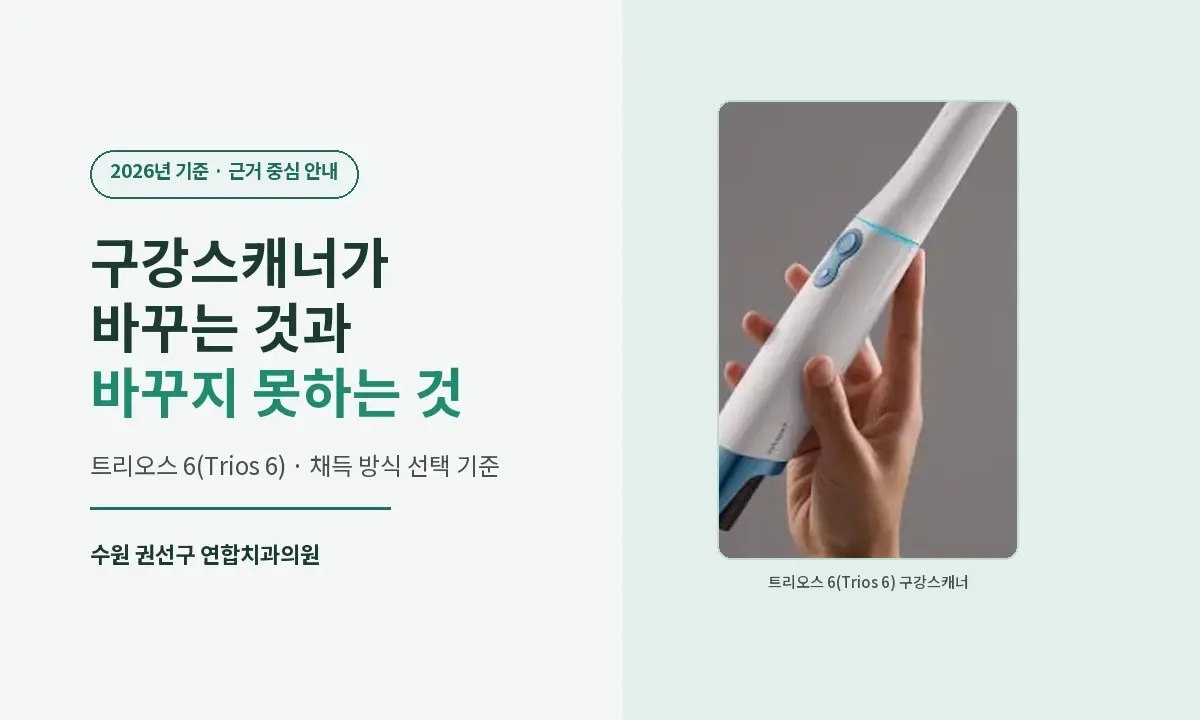
An intraoral scanner records the shape of your teeth by imaging, without putting impression material in your mouth. It is reported to be more comfortable than conventional impressions in terms of gagging and discomfort, and one study found a comfort score out of 10 of 9.14 versus 2.57. However, Yeonhap Dental Clinic does not scan complete dentures or partial dentures, that is, dentures; the director takes the impression by hand. The gum a denture rests on has to be recorded with movement and pressing separated, and current scanners cannot do that distinction in place of an impression.
What changes when impressions are taken with an intraoral scanner in Gwonseon-gu, Suwon?
If gagging came up every time an impression was taken and made it hard for you, the first thing to look at is whether the method itself can be changed.
[Key Answer]
An intraoral scanner is a device that records the shape of your teeth by imaging, without putting impression material in your mouth. It is reported to be more favorable than conventional impressions in terms of gagging and discomfort (comfort score 9.14 versus 2.57), but when the movable gum that a denture rests on has to be recorded, as with complete dentures or partial dentures, scanning cannot replace a conventional impression.
[Summary in 4 Lines]
· An intraoral scanner uses no impression material or tray, so it is reported to be favorable for gagging and nausea, and one study found a comfort score out of 10 of 9.14 versus 2.57 (Ramos-Morro 2026).
· The two methods do not differ in which is more accurate; they differ in where errors arise. For full-arch scans a mean deviation of 152.46 μm is reported, and for implants placed in parallel, conventional impressions are reported to have a slight advantage of 13.62 μm (Pesce 2024).
· A scan can be supplemented by re-imaging only the misaligned area, and the captured data remains as a file that can be reused if the prosthesis has to be remade.
· Yeonhap Dental Clinic does not scan dentures (complete dentures or partial dentures); the director takes the impression by hand. This is because current scanners are reported to be unable to record movable mucosa and border molding (Achmadi 2025).
Written by Dr. Ahn Seong-jin, Chief Director, Yeonhap Dental Clinic · Published 2026.09.13 · Last updated 2026.09.13
[Contents]
· Is gagging reduced when impressions are taken with an intraoral scanner?
· How do the points where errors arise differ between an intraoral scanner and impression material?
· When a prosthesis does not fit, is an intraoral scanner better for correcting it?
· Why aren't dentures taken with an intraoral scanner?
· How does Yeonhap Dental Clinic in Gwonseon-gu, Suwon decide the impression method?
Taking an impression is the process of obtaining a model, by transferring the shape of the teeth and gums as they are, from which a prosthesis can be made. Yeonhap Dental Clinic uses the Trios 6 intraoral scanner for this process, and in one study the time taken was in fact reported as 5 minutes 49 seconds versus 22 minutes 6 seconds.
However, what we want to tell you is not the fact that we have the equipment, but when we use it and when we do not. This article compares the two methods along four axes and then deals separately, at the end, with the cases where we do not scan.
Differences between an intraoral scanner and a conventional impression by item
| Item | Conventional impression | Trios 6 scan |
|---|---|---|
| Gagging and foreign-body sensation | Severe | Mild |
| Waiting for setting | You have to bite on it until the material sets | No waiting for it to set |
| Reported time taken | 22 min 6 s (per the Sfondrini study) | 5 min 49 s (same study) |
| Where errors arise | Material deformation, air bubbles, expansion of the stone model | Accumulation of image stitching errors, moisture, metal reflection |
| How to correct | Take it again from the start | Re-scan only the misaligned area |
| Data storage | The stone model is kept as a physical object | Kept as a file and reused when remaking |
| Cases where it is hard to apply | When the gag reflex is strong | When movable mucosa has to be recorded, such as dentures (complete or partial) |
Is gagging reduced when impressions are taken with an intraoral scanner?
It is reported to be reduced. However, this does not mean there is none at all.
The reason gagging occurs is the volume filling the mouth rather than the impression material itself. This is because the tray is pushed toward the throat and has to stay there until the material sets.
An intraoral scanner has neither of these. The scanner tip sweeps over the tooth surfaces, so it does not fill the mouth, and there is no need to wait for anything to set.
What has been reported
· Comfort score (out of 10): digital 9.14 versus conventional 2.57, and in another study 9.02 versus 6.5 (Ramos-Morro 2026)
· Time taken: one study reported 5 minutes 49 seconds versus 22 minutes 6 seconds
· More positive responses to the digital method for gagging, nausea, smell, and taste (Christopoulou 2022)
However, the same systematic review reports that patients' perception of time was mixed across studies and that there was no difference in anxiety level between the two methods. It is more accurate to read this as meaning that scanning does not remove all discomfort.
At Yeonhap Dental Clinic as well, for people with a strong gag reflex, we divide the scan into sections and proceed with rests. Apart from changing the equipment, not trying to finish in one go is the part that actually helps.
How do the points where errors arise differ between an intraoral scanner and impression material?
The difference is not which is more accurate, but where it goes off.
In conventional impressions, errors arise from the material and the model. The impression material deforms as it comes off the tray, air bubbles get in, or expansion occurs in the process of pouring stone to make the model.
The errors of an intraoral scanner come from elsewhere. A scanner stitches multiple images together into one shape, and the longer the stitched span, the more small misalignments accumulate. Saliva, moisture, and reflection from metal prostheses also have an effect.
What the literature says
· In a meta-analysis comparing full-arch (whole dentition) scans with conventional impressions, the pooled mean difference in three-dimensional deviation is reported as 152.46 μm (Pesce 2024)
· For tilted implants, digital is reported to be favorable by 99.29 μm
· Conversely, for implants placed in parallel, conventional impressions are reported to have a slight advantage of 13.62 μm
The last line is important. A scan is not always ahead, and depending on conditions it can be the other way around.
So Yeonhap Dental Clinic judges by range. When the stitched span is short, as with one or two inlays or crowns, a scan is favorable, and when it extends to the full arch, we take the accumulated error into account.
There is one more problem that comes up before error. A scanner records only the surfaces it can see, so if the margin (the boundary where the crown ends) lies deep below the gum, it cannot read that line. In such cases, before choosing the impression method we first consider a procedure to raise the margin above the gum, and the criteria for that judgment are covered in Crown Lengthening: How Much Bone to Remove.
When a prosthesis does not fit, is an intraoral scanner better for correcting it?
Only the misaligned area needs to be imaged again, so the extent of correction is smaller.
With the conventional method the model is a single piece, so if one place is inaccurate, there are cases where you have to take the whole impression again. The process of retaking it is itself something that makes you go through the same discomfort once more.
A scan allows partial correction. The method is to delete only the misaligned section, image that spot again, and stitch it in.
The nature of the data that remains is different too.
· A stone model is a physical object, so it needs storage space and wears over time
· Scan data remains as a file and is reused as is when the prosthesis has to be remade
· Because the shape before treatment is recorded, you can compare how the bite has changed
The last item is actually the one used most often. Unlike natural teeth, an implant prosthesis has no periodontal ligament to cushion chewing force, so the bite changes as the surrounding teeth wear over time. At 6-month check-ups, if the original data remains, we can compare what has changed and by how much.
However, the data remaining does not mean the prosthesis will last longer. That maintenance and regular check-ups are needed separately is the same regardless of the method.
Why aren't dentures taken with an intraoral scanner?
A denture, whether a complete denture or a partial denture, rests on movable gum, so that movement and pressing must be recorded, and imaging does not leave that behind.
When teeth remain, a scanner stitches images together by looking at firm reference points. When there are no teeth at all, those reference points disappear.
Three limitations of edentulous scanning are reported (Achmadi 2025).
· Movable mucosa: under the tongue and in the deep areas inside the cheeks, the surface is smooth and covered with saliva, and the deviation is greatest there
· Lack of reference points: a gum ridge without teeth has few landmarks for stitching, so accuracy drops
· No border molding: the edge shape formed as the muscles move is reported to be something current scanners cannot record
The third is decisive for dentures. Border molding is the process of imprinting into the impression material the boundary that the muscles form when the patient moves the lips and tongue, and that boundary becomes the edge that keeps the denture from floating and holds it in place.
The same applies to partial dentures. The remaining teeth are recorded accurately by scanning, but the area where the gum portion of the denture rests is the same movable mucosa as for a complete denture, so the movement and pressing of the muscles have to be recorded. That is why Yeonhap Dental Clinic does not scan partial dentures either and takes the impression directly.
Why Yeonhap Dental Clinic takes the impression by hand
For a denture, the gum has areas that can be pressed and areas that must not be pressed, and these differ from spot to spot. If the whole area is pressed with the same force, the areas that must not be pressed are recorded in a pressed state, and a denture made in that shape presses on those areas every time you chew.
That is why I take the complete denture impression myself, in two stages, with a custom tray.
· Stage 1: tissue conditioner is placed and the impression and border molding are done at the same time. We first capture the shape the muscles create, close to an unpressed state
· Stage 2: a thin layer of silicone light body is spread, force is applied once or twice on both sides at the sites of teeth no. 5 and 6, and then border molding is done. This is the stage that records how much the tissue is pressed during actual chewing
This method of adjusting pressure by area is called a selective pressure impression.
Evidence and limits
· In a randomized controlled trial on lower complete dentures, 33 of 66 people (50%) preferred the denture made with selective pressure, compared with 19 (29%) for the conventional pressure-relief method and 14 (21%) for the control (Hyde 2010)
· When a relief space was provided in the custom tray, the microstrain of the gum ridge measured 597.36 versus 897.07, and the pressure on the ridge is reported to have decreased by an average of 22.03% (Dadarwal 2022)
However, in the study above, half of the people chose selective pressure, and the other half chose another method. It is more accurate to read this as meaning it is not a method that produces the same result for everyone, and that judgments can differ depending on the condition of the gum.
Why lower dentures are especially uncomfortable and the two-stage impression process are covered in detail in Why Lower Dentures Are Especially Uncomfortable and How to Overcome It.
Impression method by case and the reason for choosing it
| Case | Impression method | Reason for choosing it |
|---|---|---|
| Inlay or single crown | Scan | The stitched span is short, so accumulated error is small |
| 3 to 4 unit connected prosthesis | Scan | Favorable if the span is short and the margin is above the gum |
| Single implant prosthesis | Scan | Position and direction recorded with a scan body |
| Connected implant prosthesis with several implants | Judged case by case | Conventional impression reported to have a slight advantage when placed in parallel |
| When the margin lies below the gum | Judge again after treatment | A scanner cannot record surfaces it cannot see |
| Partial denture (RPD) | Direct impression | The movable mucosa on which the denture rests, together with the remaining teeth, must be recorded |
| Complete denture | Direct impression | Pressureless and pressed areas must be recorded separately |
How does Yeonhap Dental Clinic in Gwonseon-gu, Suwon decide the impression method?
We decide not by the equipment but by what that prosthesis needs to record.
5 things we check when deciding the impression method
· How long the span to be stitched is: the shorter, the more favorable a scan is
· Whether the margin is above or below the gum: if it lies below, we look at treatment before the scan
· Whether the surface to be recorded includes movable mucosa: if so, it goes to an impression
· Whether areas to be pressed and areas not to be pressed need to be distinguished: if the distinction is needed, it is an impression
· How strong the gag reflex is: if it is severe, we consider a scan first and proceed in sections
The first four are decided by the prosthesis, and the last by the patient's condition. When these five conflict, accuracy takes priority, because a prosthesis that is comfortable to make but does not fit eventually has to be remade.
[Key Takeaways]
✓ An intraoral scanner is a device that records shape by imaging without impression material, and it is reported to be favorable for gagging and discomfort (comfort score 9.14 versus 2.57, time taken 5 minutes 49 seconds versus 22 minutes 6 seconds).
✓ The two methods do not differ in which is more accurate but in where errors arise. A deviation of 152.46 μm is reported for full-arch scans, and a slight advantage of 13.62 μm for conventional impressions with implants placed in parallel.
✓ A scan needs only the misaligned area re-imaged, and the data remains as a file that can be reused for remaking and for comparing bite changes.
✓ Yeonhap Dental Clinic does not scan dentures (complete or partial) and takes the impression directly, and for complete dentures it is taken in two stages with a custom tray. The gum has areas that can be pressed and areas that cannot, spot by spot, and there is a report that 50% preferred the lower denture made with selective pressure (Hyde 2010).
If you are about to have prosthetic treatment in Tap-dong, Gwonseon-gu, Suwon
It is better to hear why that method was chosen than which method is used to take the impression.
Yeonhap Dental Clinic, across from the Suwon NongHyup Guun Branch (231 Geumho-ro) at 230 Geumho-ro, 5th Floor (Tap-dong, Cham Clinic Building), Gwonseon-gu, Suwon, Gyeonggi-do, has kept the same location since opening in 2002. Treatment is currently led by Dr. Ahn Seong-jin, Chief Director and Integrated Dentistry specialist, and the prosthesis making process is available at Prosthodontics and CAD Treatment.
What to tell us in advance if impressions have been hard for you
· If you let us know first that your gag reflex is strong, we will proceed in sections
· If you have stopped an impression partway before, tell us at which stage it was hard
· If you have a prosthesis or denture you have been using, please bring it, as it is useful for reference
And the final step is the same regardless of the method. At Yeonhap Dental Clinic, I personally check and adjust the final bite of every prosthesis, including implant prostheses. Whether it was made from a scan or from a direct impression, we adjust the bite once more before it goes into your mouth.
A few words from the treatment room about intraoral scanners
What led me to bring in an intraoral scanner was a patient's second impression. In the first impression, the patient pulled out the tray partway because of gagging, and when I said we would try again, I saw the patient's expression stiffen. The problem was not the material but making them go through that process once more.
That is why I started using the Trios 6. However, what became clearer after bringing in the equipment was the other side. The boundary between the sections that a scan resolves and those it does not became sharper.
Dentures are that boundary. Whether complete or partial, I still take the denture impression with my own hands, and complete dentures in two stages. Areas of the gum that can be pressed and areas that must not be pressed have to be distinguished and recorded, and this is information that is not left by imaging but by the direction and strength of the force applied.
When the comfortable method and the method that fits are the same, there is no reason to agonize, and when they differ, I choose the one that fits. However, this judgment is not a single right answer, and I should also say that it is an area where clinicians may see it differently.
🚗 건물 내 무료주차 가능
📞 031-293-2207
🌐 yeonhapdental.com
🟡 2002년 개원 / 통합치의학과 전문의 안성진 대표원장 책임 진료
🔗 온라인 예약 및 상담
References
📚 References
· Ramos-Morro OD, Mareque-Ameijeiras S, Giovannini G, et al. Evaluation of the patient's perception, reliability and reproducibility, and chairside time with intraoral scanners in adult population — a systematic review. Front Oral Health. 2026;7:1733387 — comfort 9.14 vs. 2.57, 9.02 vs. 6.5, time taken 5 min 49 s vs. 22 min 6 s
· Christopoulou I, Kaklamanos EG, Makrygiannakis MA, Bitsanis I, Tsolakis AI. Patient-reported experiences and preferences with intraoral scanners: a systematic review. Eur J Orthod. 2022;44(1):56-65. doi:10.1093/ejo/cjab027 — digital preferred for gagging, nausea, smell, and taste; perception of time conflicting across studies; no difference in anxiety level
· Pesce P, Nicolini P, Caponio VCA, et al. Accuracy of Full-Arch Intraoral Scans Versus Conventional Impression: A Systematic Review with a Meta-Analysis. J Clin Med. 2024;14(1):71. doi:10.3390/jcm14010071 — pooled mean difference in 3D deviation 152.46 μm; digital advantage of 99.29 μm for non-parallel implants; conventional impression advantage of 13.62 μm for parallel implants
· Achmadi AA, Rikmasari R, Oscandar F, Novianti VMP. The accuracy of edentulous arch impression between intraoral scanner and laboratory scanner: a scoping review. BDJ Open. 2025;11(1):13. doi:10.1038/s41405-025-00300-4 — in edentulous arches, movable mucosa, lack of reference points, and inability to border mold; for completely edentulous arches conventional impressions are still needed
· Hyde TP, Craddock HL, Blance A, Brunton PA. A cross-over Randomised Controlled Trial of selective pressure impressions for lower complete dentures. J Dent. 2010;38(11):853-8. PMID 20637826 — of 66 people, selective pressure 33 (50%), conventional pressure relief 19 (29%), control 14 (21%) preferred
· Dadarwal A, Paliwal J, Sharma V, et al. Microstrain Analysis of Selective Pressure Techniques for Mandibular Complete Denture Impression: An In Vivo Study. Cureus. 2022;14(3):e23673. doi:10.7759/cureus.23673 — ridge microstrain 597.36 vs. 897.07 with relief space, pressure reduced by an average of 22.03%
Clinic Information
This article was written in line with the Medical Service Act and the Ministry of Health and Welfare's medical advertising guidelines, and is intended to provide medical information. It does not guarantee or assert the effect of any particular equipment or treatment. The impression method that can be used and the course of treatment vary from person to person depending on the oral condition and gum conditions, so please decide on diagnosis and treatment direction only after a thorough consultation with your dental team.
📋 Clinic Information
🦷 Prosthodontic treatment information: Yeonhap Dental Clinic Prosthodontics and CAD Treatment
📍 230 Geumho-ro, 5th Floor (Tap-dong, Cham Clinic Building), Gwonseon-gu, Suwon, Gyeonggi-do
🚕 Across from the Suwon NongHyup Guun Branch (231 Geumho-ro) / about 15 minutes by taxi from Suwon Station
🚗 Free parking available in the building
📞 031-293-2207
🌐 yeonhapdental.com
🟡 Open since 2002 / Treatment led by Dr. Ahn Seong-jin, Chief Director and Integrated Dentistry specialist
🔗 Online booking and consultation
Intraoral Scanner: Frequently Asked Questions
- Is gagging reduced when impressions are taken with an intraoral scanner?
- An intraoral scanner does not put impression material or a tray in your mouth, so it is reported to be favorable for gagging and nausea. One study found a comfort score out of 10 of 9.14 for digital and 2.57 for the conventional method (Ramos-Morro 2026). However, this does not mean there is no gagging at all, and when the reflex is strong, Yeonhap Dental Clinic divides the scan into sections.
- Is an intraoral scanner more accurate than conventional impression material?
- An intraoral scanner and a conventional impression do not differ in which is more accurate but in where errors arise. In the conventional method, errors come from material deformation and stone model expansion, and in scanning, errors accumulate when the stitched span gets long. A deviation of 152.46 μm is reported for full-arch scans, and a slight advantage of 13.62 μm for conventional impressions with implants placed in parallel (Pesce 2024).
- How long does it take to take an impression with an intraoral scanner?
- In one study, intraoral scanner time was reported as 5 minutes 49 seconds, shorter than the 22 minutes 6 seconds for conventional impressions in the same study. However, in the systematic review, patients' perceived time was reported as mixed across studies (Christopoulou 2022), so it can take longer if the area is wide or the gag reflex is strong.
- Can dentures also be taken with an intraoral scanner?
- Yeonhap Dental Clinic does not use an intraoral scanner for either complete dentures or partial dentures, and the director takes the impression directly. This is because the gum a denture rests on is movable mucosa, and its movement and pressing have to be recorded. In edentulous scanning it is reported that deviation is large in the movable mucosa under the tongue and inside the cheeks, there are not enough reference points to stitch images because there are no teeth, and current scanners cannot record border molding, which shapes the edges with muscle movement (Achmadi 2025).
- Why is a denture impression taken in two separate stages?
- The gum has areas that can be pressed and areas that must not be pressed, spot by spot, so a complete denture impression records them separately. In stage 1, Yeonhap Dental Clinic places tissue conditioner and does the impression and border molding together, and in stage 2 spreads a thin layer of silicone light body, applies force at the sites of teeth no. 5 and 6, and then does border molding. In a randomized controlled trial, 33 of 66 people (50%) preferred the lower denture made this way (Hyde 2010).
- If a prosthesis made with an intraoral scanner doesn't fit, do I have to have the impression retaken?
- With an intraoral scanner, only the misaligned area can be imaged again to correct it, so in many cases you do not have to retake the whole thing. With the conventional method, the model is a single piece, so if one place is inaccurate, there are cases where you have to take the impression again from the start.
- Can the data taken with an intraoral scanner be reused later?
- Intraoral scanner data remains as a file that can be reused when the prosthesis has to be remade, and because the shape before treatment is recorded, it is used to compare how the bite has changed. However, the data remaining does not guarantee the lifespan of the prosthesis, and regular check-ups are needed regardless of the impression method.
- Where do I go for a prosthetic consultation using an intraoral scanner in Tap-dong, Gwonseon-gu, Suwon?
- Yeonhap Dental Clinic is at 230 Geumho-ro, 5th Floor (Tap-dong, Cham Clinic Building), Gwonseon-gu, Suwon, Gyeonggi-do, across from the Suwon NongHyup Guun Branch (231 Geumho-ro). We use the Trios 6 intraoral scanner, free parking is available in the building, and the clinic is about 15 minutes from Suwon Station by taxi.
Related pages
Before your visit
This article provides general information on oral health and dental care. Whether treatment is needed, and which method is appropriate, may change after an oral exam and any necessary diagnostic tests. If you have pain, a loose tooth, swelling, or discomfort with a prosthesis, please visit us for a consultation.