
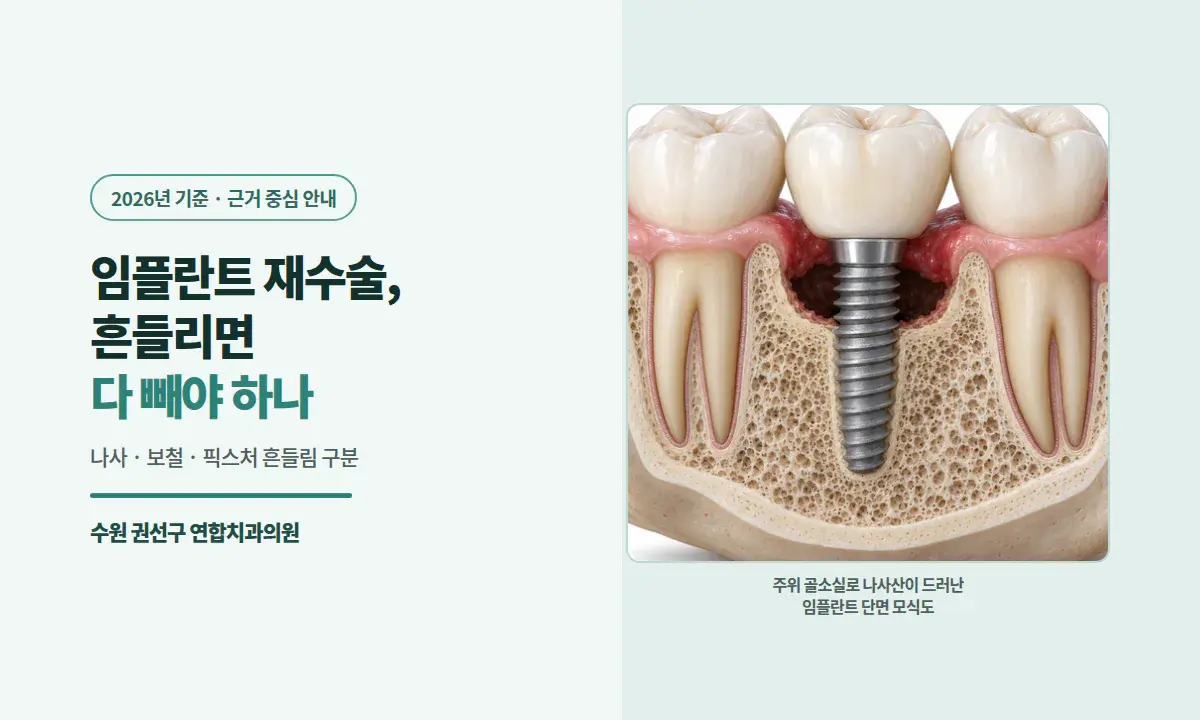
Not every loose implant is removed. The response is completely different depending on whether a screw has loosened, the prosthesis has come off, or the implant body itself is moving. Yeonhap Dental Clinic in Gwonseon-gu, Suwon first checks what is loose, and when peri-implantitis is present, decides on removal by looking together at the degree of bone loss, changes in ISQ (a value showing how firmly the implant is held in the bone), and the response to inflammation treatment.
If an implant is loose, does it all have to come out?
Among people who come in saying their implant is loose, many have a problem not with the implant body but with the part on top of it. An implant consists of three parts: the body placed in the bone, the abutment connected above it (the post linking the body and the prosthesis), and the prosthesis at the very top, so the response is completely different depending on which layer is loose.
[Key Answer]
Not every loose implant is removed. If a screw has loosened or the prosthesis has come off, it can be tightened or remade; if the implant body is moving, its bond with the bone has been lost and it usually proceeds to removal. Even when the body is not loose, Yeonhap Dental Clinic in Gwonseon-gu, Suwon decides on removal for an implant with peri-implantitis (inflammation of the gum and bone around the implant) by looking together at bone loss, changes in ISQ (a value showing how firmly the implant is held in the bone), and the response to inflammation treatment.
[Summary in 4 Lines]
· Looseness falls into three types: a loosened screw, a prosthesis that has come off, and a moving implant body; the first two are not grounds for removal.
· The diagnostic criteria for peri-implantitis are not removal criteria (Berglundh 2018). Yeonhap Dental Clinic decides on removal by looking together at the degree of bone loss, ISQ changes, and the treatment response.
· The 1-year survival rate of an implant re-placed in the site of a removed implant is reported as 96.7%, but it is lower than for a first-time implant (Gareb 2025).
· In a Korean study, the factors that significantly increased the risk of failure of a re-placed implant were age and smoking, and the authors considered the effect of patient factors to be greater than implant factors (Park 2022).
Written by Dr. Ahn Seong-jin, Chief Director, Yeonhap Dental Clinic
[Contents]
· If an implant is loose, does it all have to come out?
· What exactly is loose when an implant feels loose?
· When does an implant need to be removed?
· What do you look at to decide on removing an implant with peri-implantitis?
· How is the ISQ value of an older implant read?
· Can an implant be placed again in the site of a removed implant?
Implant reoperation is considered not only for peri-implantitis but also for fracture of the implant body or aesthetic problems of front teeth. This article focuses on distinguishing the causes of looseness and on the process of deciding whether to keep or remove an implant with peri-implantitis.
Implant reoperation refers to the process of removing an existing implant, letting the site heal, and placing an implant again. The 1-year survival rate of re-placed implants is reported as 96.7%, but the same meta-analysis concludes that this value is lower than for first-time implants and lower still when an implant is placed a second time in the same site (Gareb 2025).
This is why Yeonhap Dental Clinic in Gwonseon-gu, Suwon judges removal carefully and checks the cause of failure before placing again.
What exactly is loose when an implant feels loose?
Looseness can arise in any layer, the body, abutment, or prosthesis, and the response differs for each layer.
The most common is a loosened screw. This is when the screw holding the abutment and body has loosened under chewing force, and tightening it solves the problem. But if it loosens repeatedly, it is a sign that the bite (how the upper and lower teeth meet) is concentrated on one side, and that needs to be looked at as well.
Next is a prosthesis that has come off. This is when the crown has come off the abutment, and it can be reattached or remade. If the screw or abutment has fractured, the broken part is removed and replaced, or the prosthesis is remade. However, whether the implant can be kept depends on whether the fractured part can be removed and whether the connection of the body has been damaged.
The problem is the third. If the implant body itself moves, its bond with the bone has been lost, and it is not a stage that can be reversed by tightening. There is no option of waiting for the bone to reattach, and it usually proceeds to removal and clearing the site.
That is why, when I hear the word loose, I first take the prosthesis off. Only by checking directly whether the body moves with the prosthesis removed can we tell what is loose. It cannot be distinguished while it is still attached in the mouth.
Types of implant looseness and the response
| What is loose | What the patient feels | Response |
|---|---|---|
| Loosened abutment screw | Moves slightly and makes a sound when chewing | Resolved by tightening; if it recurs, check the bite as well |
| Prosthesis come off | The crown comes off whole or lifts | Reattachment or remaking |
| Abutment or screw fracture | Feels loose or as if the prosthesis has come off | Remove the broken part and replace it, remake the prosthesis if needed |
| Implant body mobility | Moves when pressed by hand, sometimes with pain | Bond with the bone is lost; usually removed |
| Mobility of an adjacent natural tooth | Feels as if the implant is loose | Gum treatment or treatment of that tooth |
| How to tell them apart | Remove the prosthesis and directly check body mobility | Cannot be distinguished while attached in the mouth |
| Presence of pain | May be absent even with body mobility | Absence of pain is not grounds for reassurance |
| X-ray findings | Bone around the body appears dark and lost | Read together with the mobility check |
When does an implant need to be removed?
The diagnostic criteria for peri-implantitis are not removal criteria. Yeonhap Dental Clinic decides on removal by looking together at the degree of bone loss, ISQ changes, and the treatment response.
There are international criteria for how to diagnose peri-implantitis. The 2017 World Workshop consensus defines it, when there are no previous records, as bleeding or pus with a probing depth (the depth measured by inserting a thin instrument into the gum pocket) of 6 mm or more and bone height 3 mm or more below the most coronal point of the intraosseous part of the implant (Berglundh 2018).
However, this only defines a diagnosis; it does not say to remove an implant once a certain line is crossed. A review that summarized peri-implantitis in the same year also gives no removal criteria (Schwarz 2018). The decision to remove is still within the clinician's judgment.
That is why I think it is better to make my own criteria public.
What do you look at to decide on removing an implant with peri-implantitis?
For an implant with peri-implantitis, Yeonhap Dental Clinic looks together at the degree of bone loss, ISQ changes, and the response to inflammation treatment.
1. Has more than half of the bone surrounding the implant been lost? For a 10 mm implant, we use 5 mm of lost bone as the reference.
2. Has the ISQ fallen compared with the previous value or the time elapsed? This is explained separately in the next section.
3. Has it failed to recover despite three rounds of peri-implantitis treatment? That is, bleeding and depth stay the same or get worse.
These three are not figures taken from the literature but the clinical criteria I use. Other clinicians may judge differently, and meeting just one of them does not lead straight to removal. What eats away at an implant's lifespan is covered separately in Implant Lifespan: What Chips Away at the 96% 10-Year Figure?.
The three things we look at when judging removal of an implant with peri-implantitis
| Item | Criterion | Nature |
|---|---|---|
| Bone loss | Half or more of the bone surrounding the implant (5 mm of 10 mm) | Our clinic's clinical criterion |
| ISQ change | In the 60s in an implant used for several years (in the 80s is usually observed when stable) | Our clinic's clinical experience |
| Response to peri-implantitis treatment | No improvement in bleeding or depth after three rounds of treatment | Our clinic's clinical criterion |
| For reference: ISQ at prosthesis connection | 75 or more for a single implant, 65 or more for multiple | Our clinic's criterion for connecting the prosthesis |
| For reference: general ISQ range | Usually 55 to 80 in clinical practice, 70 or more means high stability | Manufacturer's guidance (Osstell) |
| For reference: diagnostic criteria for peri-implantitis | Probing 6 mm or more + bone height loss of 3 mm or more + bleeding or pus | International diagnostic criteria (Berglundh 2018) |
| For reference: judging removal in peri-implantitis | Not decided by diagnostic criteria alone | Judged by combining our clinic's clinical criteria |
| Method of judgment | Look at the three together; do not decide by any one alone | Our clinic's principle |
How is the ISQ value of an older implant read?
The ISQ of an older implant is read not as a single number but as a change from the previous value.
ISQ is shown as a value from 1 to 99. According to the manufacturer's guidance, the range seen in clinical practice is usually between 55 and 80, with 70 or more regarded as high stability, 60 to 69 as medium, and below 60 as low stability (Osstell). It is a scale showing the degree of stability rather than an absolute boundary between normal and abnormal.
When connecting the prosthesis, Yeonhap Dental Clinic proceeds with a standard of 75 or more for a single implant and 65 or more for multiple implants. This is to confirm by number that the bond with the bone has settled sufficiently before moving on.
The same manufacturer's guidance explains that even if the initial value is low, it should rise as the healing period passes, that a fall may be a sign of failure, and that a large drop should be taken as a warning sign (Osstell).
At our clinic, when we re-measure an implant that has been used stably since the prosthesis was connected, we usually observe ISQ in the 80s. So if an implant used for several years reads in the 60s, we check it carefully. At our clinic we read this as a sign that the bone that surrounded the implant has been reduced.
However, we do not decide on removal from this number alone; we look together at the change from previous measurements, bone loss on X-rays, bleeding, body mobility, and the response to peri-implantitis treatment. This is a judgment based on our clinic's clinical experience, and it is not an official standard that an older implant must be in the 80s.
The overall flow of judging removal, including ISQ, is outlined from the patient's perspective in Implant Reoperation.
Can an implant be placed again in the site of a removed implant?
An implant can be placed again in the site of a removed implant. In a meta-analysis pooling 24 studies, the 1-year survival rate of re-placed implants was reported as 96.7% (Gareb 2025).
However, the same paper concluded that the survival rate of re-placement is lower than for first-time implants and reports that placing a second time in the same site was lower still than the first re-placement. That is why I do not take a second attempt lightly.
Let us also look at a Korean study. In a study that followed 69 re-placed implants, the survival rate of first-time implants was 96.3% and the 1-year survival rate of re-placed implants was 89.4%. Age and smoking significantly increased the risk of re-failure, and the authors concluded that the earlier failure did not affect the success of the next attempt and that patient factors had a greater effect than implant factors (Park 2022). However, the same paper noted that the analysis was limited because information on the site, such as bone quality and quantity, was lacking.
So I read this result not as “the site does not matter” but as meaning that the cause that produced the first failure has to be checked before placing again. Smoking is a factor reported for first-time implants as well, with a failure risk ratio of 2.23 (Chrcanovic 2015; the authors noted that confounding factors in the included studies were not controlled and caution is needed in interpretation), and if that condition remains, the same risk continues in re-placement.
In the same Korean study, all 8 that failed again failed early, that is, during the period when bone bonds to the implant before the prosthesis is connected. This reads as meaning that the period after re-placement when the bone bonds is the critical point.
Let me also talk about timing. The literature holds that immediate re-placement is also possible if enough bone remains, with no significant difference in survival between immediate and delayed, and recommends first filling the bone and placing later if bone is lacking (Gareb 2025). Yeonhap Dental Clinic does not do immediate re-placement; we place after a 2 to 3 month healing period, and for the re-placed implant we wait 3 months before attaching the prosthesis. We think it is better to allow time for the inflammation and gum at the failed site to settle and for the bone to bond, and this is my choice, not because the literature prohibits otherwise. The overall process of reoperation is available at Implant Care.
5 things to check when you ask about implant reoperation in Tap-dong, Gwonseon-gu, Suwon
The starting point of a consultation is not deciding on reoperation from the word loose alone.
Yeonhap Dental Clinic, across from the Suwon NongHyup Guun Branch (231 Geumho-ro) at 230 Geumho-ro, 5th Floor (Tap-dong, Cham Clinic Building), Gwonseon-gu, Suwon, Gyeonggi-do, has been treating patients at the same location since 2002. Treatment is led by Dr. Ahn Seong-jin, Chief Director and Integrated Dentistry specialist.
· Whether they took off the prosthesis and directly checked what is loose
· Whether they show bone loss on an X-ray and explain how much has been lost
· Whether they explain ISQ not as a single value but by comparison with previous values or the time elapsed
· Whether they check the cause of the first failure (smoking, inflammation, bite, etc.) before placing again
· Whether they explain the timing of re-placement and the period before the prosthesis is attached
[Key Takeaways]
✓ For a loosened screw, a prosthesis that has come off, or a fractured part, we first look for a way to resolve it while keeping the body. If the body is loose or bone loss and inflammation are severe, we judge whether to remove it.
✓ The diagnostic criteria for peri-implantitis are not removal criteria, and for an implant with peri-implantitis, Yeonhap Dental Clinic looks together at three things: loss of half the bone, ISQ changes, and the response to peri-implantitis treatment.
✓ The 1-year survival rate of re-placement is reported as 96.7% but is lower than for first-time implants, so Yeonhap Dental Clinic checks the cause of failure first and places again after 2 to 3 months of healing.
A few words from the treatment room about implant reoperation
The first thing I hear at a reoperation consultation is “do you have no choice but to take this out?” Before answering, I take the prosthesis off. This is because the conversation is completely different depending on whether what moves when pressed is the body or the part above it. If the body is not loose, I look together at bone loss, ISQ, and the response to peri-implantitis treatment, and in my practice I have seen cases where an implant whose ISQ had fallen into the 60s held on without coming out but kept discharging pus repeatedly and stayed in an uncomfortable state. I look at re-placement more carefully still. I once had a case where the prosthesis should have been attached to a re-placed implant after 3 months, but under pressure to get things done quickly for the patient I tried to attach it at 2 months and it failed again. Since then I have not shortened the waiting period at a re-placed site, and I check the cause of the first failure before placing again. This is why I consider reoperation a matter of conditions before it is a matter of technique.
References
📋 Clinic Information
This article was written in line with the Medical Service Act and the Ministry of Health and Welfare's medical advertising guidelines, and is intended to provide medical information. It does not guarantee or assert the effect of any particular treatment. The procedures that can be used and the course of treatment vary depending on each person's oral condition and general health, so please decide on diagnosis and treatment direction only after a thorough consultation with your dental team.
🦷 Implant reoperation treatment information: Implant Reoperation in Suwon
📍 230 Geumho-ro, 5th Floor (Tap-dong, Cham Clinic Building), Gwonseon-gu, Suwon, Gyeonggi-do
🚕 Across from the Suwon NongHyup Guun Branch (231 Geumho-ro) / about 15 minutes by taxi from Suwon Station
🚗 Free parking available in the building
📞 031-293-2207
🌐 yeonhapdental.com
🟡 Open since 2002 / Treatment led by Dr. Ahn Seong-jin, Chief Director and Integrated Dentistry specialist
🔗 Online booking and consultation
Implant Reoperation: Frequently Asked Questions
- If an implant is loose, does it absolutely have to come out?
- A loose implant is not automatically removed. If the screw of the abutment (the post linking the body and the prosthesis) has loosened or the prosthesis has come off, it can be tightened or remade. If the implant body moves, its bond with the bone has been lost and it usually proceeds to removal, and even when it is not loose, if bone loss and inflammation are severe, we judge removal separately.
- Are there separate criteria for when an implant must be removed?
- The diagnostic criteria for peri-implantitis (inflammation of the gum and bone around the implant) are in the 2017 World Workshop consensus (Berglundh 2018), but diagnostic criteria are not removal criteria. For an implant with peri-implantitis, Yeonhap Dental Clinic judges by looking together at the degree of bone loss, ISQ changes, and the response to peri-implantitis treatment.
- If my implant's ISQ is 60, is there a problem?
- An ISQ of 60 (a value showing how firmly the implant is held in the bone) corresponds to medium stability according to the manufacturer's guidance (Osstell). At our clinic, implants used stably for a long time usually read in the 80s, so if an implant that is several years old reads in the 60s, we check it carefully, but we do not remove it on this number alone and look together at the change from the previous value, bone loss, and the response to peri-implantitis treatment.
- Can an implant be placed again in the site of a removed implant?
- An implant can be placed again in the site of a removed implant. In a meta-analysis pooling 24 studies, the 1-year survival rate of re-placed implants was reported as 96.7% (Gareb 2025). However, it was lower than for first-time implants and lower still when placed a second time in the same site, and Yeonhap Dental Clinic places after a 2 to 3 month healing period instead of immediate re-placement.
- Is the chance of failure higher in an implant reoperation than the first time?
- The survival rate of re-placed implants is reported as lower than that of first-time implants (Gareb 2025). In a Korean study, age and smoking significantly increased the risk of re-failure and the authors considered patient factors to have a greater effect, but information on the placement site was not sufficiently analyzed (Park 2022). That is why Yeonhap Dental Clinic checks the cause of the first failure before placing again.
- How is implant reoperation carried out in Gwonseon-gu, Suwon?
- For the looseness and peri-implantitis covered in this article, we first check what is loose, and evaluate bone loss, ISQ changes, and the response to inflammation treatment together. Yeonhap Dental Clinic is at 230 Geumho-ro, 5th Floor (Tap-dong, Cham Clinic Building), Gwonseon-gu, Suwon, Gyeonggi-do, and the phone number is 031-293-2207.
Related pages
Before your visit
This article provides general information on oral health and dental care. Whether treatment is needed, and which method is appropriate, may change after an oral exam and any necessary diagnostic tests. If you have pain, a loose tooth, swelling, or discomfort with a prosthesis, please visit us for a consultation.