
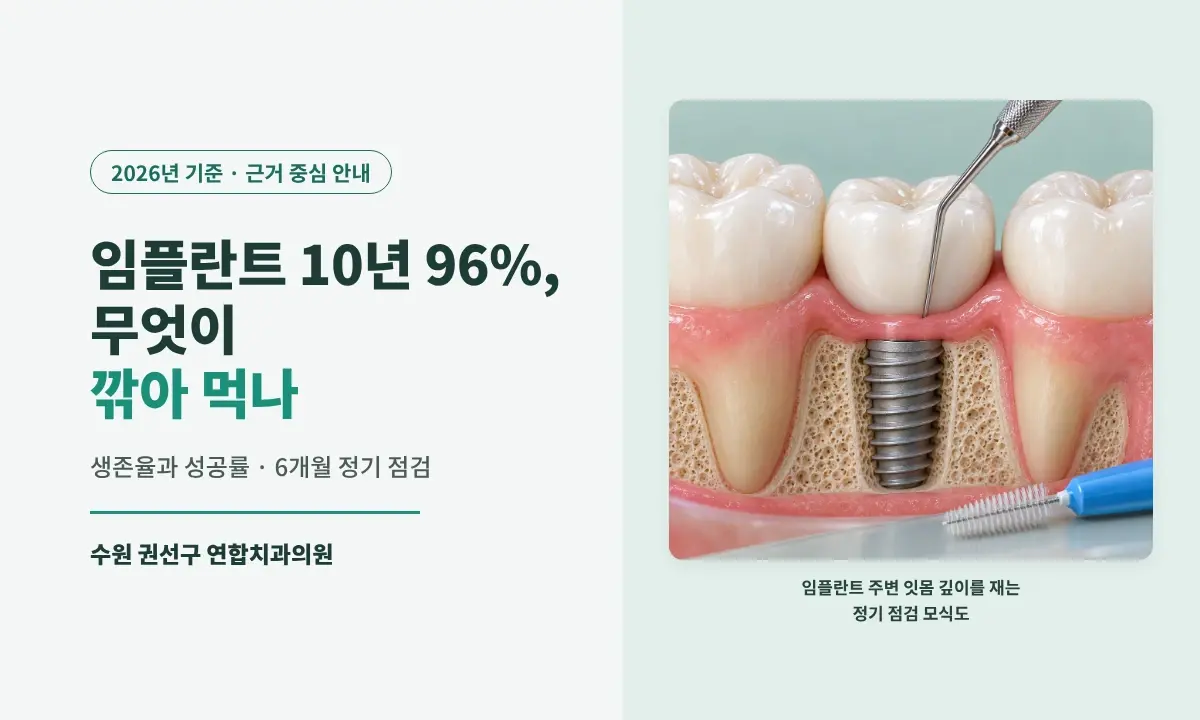
A 96% 10-year implant survival rate is only the share still remaining; it does not mean they are healthy. Yeonhap Dental Clinic checks the gums, bone, and prosthesis at 6-month check-ups.
How many years can an implant last?
The question we hear most at implant consultations is “how many years will it last?” A dental implant is an artificial tooth root placed in the jawbone where a tooth was lost, and the figure “96% 10-year survival rate” is often quoted, but what that number counts is rarely explained.
[Key Answer]
The 10-year survival rate of implants is reported as about 96%, but this figure is only the share of implants that have not been removed; it does not mean the gums and bone are free of problems. At 6-month check-ups, Yeonhap Dental Clinic compares changes in the gums, bone, and prosthesis with previous records and manages the remaining implants so they can be used in good health.
[Summary in 4 Lines]
· The 10-year implant survival rate is reported as 96.4%, and a sensitivity analysis that accounted for assumed loss to follow-up estimated it at 93.2% (Howe 2019).
· The survival rate is the share of implants that have not been removed, so in statistics that judge survival by whether the implant was removed, an implant can be counted as surviving even while inflammation of the surrounding gum and bone (peri-implantitis) is progressing, as long as it remains.
· In a 5-year follow-up study of patients who had peri-implant mucositis (a stage with inflammation in the gum only) from the start, peri-implantitis developed in 18% of the maintenance group and 43.9% of the non-maintenance group (Costa 2012).
· Yeonhap Dental Clinic in Gwonseon-gu, Suwon uses a 6-month check as the standard, and shortens the interval if there is a history of smoking, diabetes, teeth grinding, or gum disease.
Written by Dr. Ahn Seong-jin, Chief Director, Yeonhap Dental Clinic
[Contents]
· How many years can an implant last?
· What does the 96% 10-year implant survival rate mean?
· What affects implant lifespan?
· What does Yeonhap Dental Clinic check after placing an implant?
· How far can implant lifespan figures be trusted?
The implant survival rate refers to the share of placed implants that have not been removed and remain in the mouth. This article explains what that number does and does not mean, and which factors are related to using the remaining implants in good health.
What does the 96% 10-year implant survival rate mean?
It is the share of implants that have not been removed, and it is a different number from the success rate, which applies health and function criteria.
In a systematic review that pooled studies with follow-up of 10 years or more, the 10-year implant survival rate was reported as 96.4% (95% confidence interval 95.2 to 97.5%) (Howe 2019). The commonly quoted 96% is this number.
In the same review, a sensitivity analysis that accounted for assumed outcomes of subjects who dropped out of follow-up estimated the 10-year survival rate at 93.2% (Howe 2019). This is not a value that adds up additional failures actually confirmed, but an analysis of how loss to follow-up could affect the results. Neither figure represents an individual's probability of survival or the upper or lower limit of the actual survival rate.
The more important distinction is between survival rate and success rate. The survival rate is the share of implants that have not been removed. The success rate is the share that met criteria set by the study, such as health and function, and the specific criteria differ from study to study. In statistics that judge survival by whether the implant was removed, an implant can be counted as surviving even while peri-implantitis is progressing, as long as it remains.
What we look at to decide on removal when bone loss makes an implant start to loosen is covered in Implant Reoperation: Not Every Loose Implant Has to Come Out.
Reported figures related to implant lifespan
| Item | Reported figure | Source and conditions |
|---|---|---|
| 10-year survival rate | 96.4% (confidence interval 95.2 to 97.5%) | Review pooling studies with follow-up of 10 years or more (Howe 2019) |
| 10-year survival rate, sensitivity analysis | 93.2% | Analysis that accounted for assumed outcomes of those lost to follow-up (Howe 2019) |
| Peri-implantitis prevalence (patient level) | 21% | AO/AAP systematic review (Galarraga-Vinueza 2025) |
| Peri-implantitis prevalence (patient and implant level) | 19.53%·12.53% | Another meta-analysis (Diaz 2022) |
| Peri-implantitis development: maintenance group vs. non-maintenance group | 18% vs. 43.9% | 80 patients with existing mucositis followed for 5 years (Costa 2012) |
| Failure rate: smokers vs. non-smokers | 6.35% vs. 3.18% (risk ratio 2.23) | 104 studies with different follow-up periods pooled (Chrcanovic 2015) |
What affects implant lifespan?
Several factors are related to using an implant for a long time, including peri-implantitis, smoking, and whether maintenance is done.
Peri-implantitis is a disease in which the gum around an implant becomes inflamed and the supporting bone is lost. In the AO/AAP systematic review, the patient-level prevalence was reported as 21% (Galarraga-Vinueza 2025). The implant itself does not get cavities, but the surrounding gum and bone can become inflamed. Peri-implantitis can progress without obvious pain, so we do not judge an implant to be healthy just because it does not hurt. How peri-implantitis connects to the design at the time of placement is covered in How Placement Depth Affects Peri-implantitis.
For smoking, a meta-analysis pooling 104 studies found failure rates of 6.35% in smokers and 3.18% in non-smokers, a risk ratio of 2.23, and marginal bone loss (loss of the bone surrounding the neck of the implant) was 0.32 mm greater on average (Chrcanovic 2015). These rates come from pooling studies with different follow-up periods and do not represent a smoker's 10-year failure rate. The authors also noted that uncontrolled factors differ between studies and the results should be interpreted with caution. Yeonhap Dental Clinic recommends that smokers stop for one month after surgery; this is our clinic's recommendation, not a period verified in the literature.
Regarding maintenance (regular visits to check and clean the gums and bone), in a 5-year follow-up study of patients who had peri-implant mucositis from the start, peri-implantitis developed in 18% of the group that received maintenance and 43.9% of the group that did not (Costa 2012). This is an observation in a specific group of patients, and the same rate does not apply to every patient. The maintenance literature suggests return visits at 5 to 6 month intervals, adjusted to individual risk (Monje 2016).
What does Yeonhap Dental Clinic check after placing an implant?
With a 6-month check-up as the standard, we compare changes in the gums, bone, and prosthesis with previous records, and set a shorter interval if there is a history of smoking, diabetes, teeth grinding, or gum disease.
At 6-month check-ups, Yeonhap Dental Clinic compares gum bleeding, pus, and probing depth, bone height on the panoramic X-ray, and screw loosening, crown damage, and bite interference with previous records, and provides gum treatment. A panoramic X-ray is taken at every 6-month check-up. If you have repeated swelling, bleeding, pus, or looseness, please let us know without waiting for the next check-up.
Over time, wear of natural teeth and prosthetics and changes in tooth position and bite can occur, so we also check whether force is concentrating on the implant.
At home, in addition to daily brushing, clean the gum border under the crown with an interdental brush or floss that suits the shape of the prosthesis. Yeonhap Dental Clinic shows you the tools and where to clean. The check criteria and process can also be found in Implant Lifespan: Three Key Points for Long-Term Use.
Implant check intervals and items checked (Yeonhap Dental Clinic)
| Condition or item | Yeonhap Dental Clinic standard | Reason and what is checked |
|---|---|---|
| No particular risk factors | Check-up every 6 months | Return interval of 5 to 6 months suggested in the maintenance literature (Monje 2016) |
| Smoking | Shorter interval | Reported to carry a higher risk of failure |
| Diabetes | Shorter interval | Adjusted according to blood sugar control |
| Teeth grinding or clenching | Shorter interval | More emphasis on bite checks |
| Teeth lost to gum disease | Shorter interval | The same risk factors remain |
| Every check-up: gums | Bleeding, pus, probing depth | Compared with previous records |
| 6-month check-up: bone | Panoramic X-ray | Compare bone height changes against previous images |
| Every check-up: prosthesis and bite | Screw loosening, crown damage, bite | Check changes and interference in the bite and wear or damage of the prosthesis |
How far can implant lifespan figures be trusted?
Survival rates and prevalence vary with subjects, diagnostic criteria, and follow-up periods, so a single number cannot be carried over directly to an individual's lifespan.
Survival rates vary with the study subjects, the type of implant, the follow-up period, and the dropout rate. The analysis of loss to follow-up in Howe 2019 looked at how assumptions about the outcomes of those who dropped out affect the overall estimate, and it is not a result that directly compares the effect of maintenance. The relationship between maintenance and peri-implantitis has to be explained through separate studies such as Costa 2012.
In Diaz 2022, the patient-level prevalence of peri-implantitis was 19.53% and the implant-level prevalence was 12.53%. In the group of studies that included probing depth in the diagnostic criteria it was 24.69% at the patient level, and in the group that did not it was 17.56%, but the difference between the two groups was not statistically significant. This means that subjects and diagnostic criteria differ, so the numbers are hard to compare directly.
So we do not state flatly that “an implant lasts this many years.” Instead, we explain the reported range, the factors related to it, and which of those can be managed.
5 things to check before a regular implant check-up in Tap-dong, Gwonseon-gu, Suwon
If you bring the information so that we can compare with previous records, we can see changes in the gums and bone more accurately.
Yeonhap Dental Clinic, across from the Suwon NongHyup Guun Branch (231 Geumho-ro) at 230 Geumho-ro, 5th Floor (Tap-dong, Cham Clinic Building), Gwonseon-gu, Suwon, Gyeonggi-do, has been treating patients at the same location since 2002. Treatment is led by Dr. Ahn Seong-jin, Chief Director and Integrated Dentistry specialist. If you have diabetes or take medication, you may also want to read How Implants Differ With Diabetes, Aspirin, or Osteoporosis Injections.
· If the implant was placed at another dental clinic, when it was placed and whether you have earlier check-up records
· Whether you have told us about any history of smoking, diabetes, teeth grinding, or gum disease
· Whether you have recently had repeated swelling, bleeding, pus, or looseness
· Whether the interdental brush or floss you use at home suits the shape of the prosthesis
· Whether you have set the date of your next check-up
[Key Takeaways]
✓ The 10-year implant survival rate is reported as 96.4%, and a sensitivity analysis that accounted for assumed loss to follow-up estimated 93.2%. The two values are not the upper and lower limits of the actual survival rate.
✓ In statistics that judge survival by whether the implant was removed, an implant can be counted as surviving even while peri-implantitis is progressing, and peri-implantitis can progress without pain.
✓ At 6-month check-ups, Yeonhap Dental Clinic compares the gums, bone, and prosthesis with previous records, and shortens the interval if there is a history of smoking, diabetes, teeth grinding, or gum disease.
A few words from the treatment room about implant lifespan
At regular check-ups, before asking whether the implant is loose, I first compare gum bleeding and pus, probing depth, and bone height on the panoramic X-ray with previous records. If there is a history of smoking, diabetes, teeth grinding, or gum disease, I shorten the check interval, and if there is repeated swelling or pus, I check right away without waiting for the next check-up. I have actually seen cases where an implant that was several years old had not fallen out and remained in place but kept discharging pus and stayed in an uncomfortable state. In survival statistics that judge by whether the implant was removed, that implant is also counted as surviving. That is why I tell patients that an implant remaining in place is different from using it in good health. The day of placement is not the end; I believe the follow-up checks afterward are how we work toward using the implant for a long time.
References
📋 Clinic Information
This article was written in line with the Medical Service Act and the Ministry of Health and Welfare's medical advertising guidelines, and is intended to provide medical information. It does not guarantee or assert the effect of any particular treatment. The procedures that can be used and the course of treatment vary depending on each person's oral condition and general health, so please decide on diagnosis and treatment direction only after a thorough consultation with your dental team.
🦷 Implant aftercare information: Implant Lifespan in Suwon: Three Key Points for Long-Term Use
📍 230 Geumho-ro, 5th Floor (Tap-dong, Cham Clinic Building), Gwonseon-gu, Suwon, Gyeonggi-do
🚕 Across from the Suwon NongHyup Guun Branch (231 Geumho-ro) / about 15 minutes by taxi from Suwon Station
🚗 Free parking available in the building
📞 031-293-2207
🌐 yeonhapdental.com
🟡 Open since 2002 / Treatment led by Dr. Ahn Seong-jin, Chief Director and Integrated Dentistry specialist
🔗 Online booking and consultation
Implant Lifespan: Frequently Asked Questions
- How many years can an implant last?
- In a review pooling studies with follow-up of 10 years or more, the 10-year implant survival rate was reported as 96.4%, and an analysis that accounted for assumed loss to follow-up estimated it at 93.2% (Howe 2019). However, this value does not predict an individual's lifespan, and because it is the share remaining, it does not show the health of the gums and bone.
- How do implant survival rate and success rate differ?
- The survival rate is the share of implants that have not been removed and remain in the mouth. The success rate is the share that met criteria set by the study, such as health and function, and the specific criteria differ from study to study. In statistics that judge survival by whether the implant was removed, an implant can be counted as surviving even while peri-implantitis (inflammation of the gum and bone around the implant) is progressing, as long as it remains.
- How common is peri-implantitis?
- The AO/AAP systematic review reported 21% at the patient level (Galarraga-Vinueza 2025), and another meta-analysis found 19.53% at the patient level and 12.53% at the implant level (Diaz 2022). The numbers differ because the subjects and diagnostic criteria differ.
- How often should I have a regular implant check-up?
- The maintenance literature suggests return visits at 5 to 6 month intervals, adjusted to individual risk (Monje 2016). Yeonhap Dental Clinic uses 6 months as the standard and shortens the interval if there is a history of smoking, diabetes, teeth grinding, or gum disease.
- Do implants fail sooner if you smoke?
- In a meta-analysis pooling 104 studies, failure rates were 6.35% in smokers and 3.18% in non-smokers, a risk ratio of 2.23 (Chrcanovic 2015). It pools studies with different follow-up periods, so it is not a 10-year failure rate, and Yeonhap Dental Clinic gives a one-month smoking pause after surgery as our clinic's recommendation.
- How do I take care of an implant at home?
- In addition to daily brushing, clean the gum border under the crown with an interdental brush or floss that suits the shape of the prosthesis. Yeonhap Dental Clinic shows you the tools and where to clean at your check-up.
- If an implant does not hurt, is it fine?
- Not necessarily. The implant itself does not get cavities, but the surrounding gum and bone can become inflamed, and peri-implantitis can progress without obvious pain. If you have repeated swelling, bleeding, pus, or looseness, please let us know without waiting for the next check-up.
- Where is Yeonhap Dental Clinic in Tap-dong and Guun-dong, Gwonseon-gu, Suwon?
- It is at 230 Geumho-ro, 5th Floor (Tap-dong, Cham Clinic Building), Gwonseon-gu, Suwon, Gyeonggi-do, across from the Suwon NongHyup Guun Branch (231 Geumho-ro). Free parking is available in the building, and the clinic is about 15 minutes from Suwon Station by taxi.
Related pages
Before your visit
This article provides general information on oral health and dental care. Whether treatment is needed, and which method is appropriate, may change after an oral exam and any necessary diagnostic tests. If you have pain, a loose tooth, swelling, or discomfort with a prosthesis, please visit us for a consultation.