
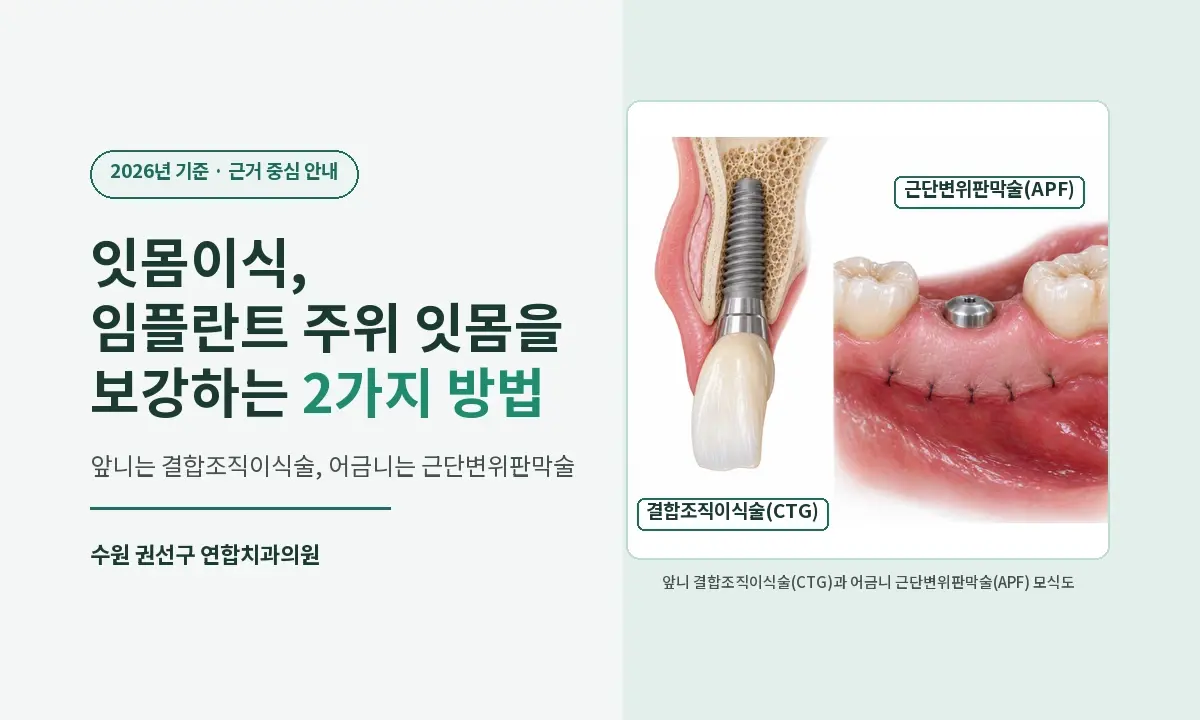
Around implants, the gumline of front teeth is reinforced with a connective tissue graft (CTG) and a procedure that moves the gum toward the crown, and the width of firm gum around back teeth is reinforced with an apically positioned flap (APF). This article outlines Yeonhap Dental Clinic's criteria, timing, recovery period, and fees.
When is gum grafting needed for a dental implant?
Many people worry when they hear at an implant consultation that “gum grafting may be needed.” Gum grafting is a surgery that mainly uses tissue taken from the palate to reinforce an area where gum is lacking.
[Key Answer]
Reinforcing the gum around an implant is not done for every implant; it is needed when the gumline of a front tooth has dropped and affects appearance, or when a back tooth lacks the firm gum that the toothbrush touches. Yeonhap Dental Clinic uses two methods: for front teeth, a connective tissue graft (CTG, a surgery in which connective tissue from inside the palate is placed under the gum) together with a procedure that moves the gum toward the crown; and for back teeth, an apically positioned flap (APF, a surgery that moves the existing gum toward the root and fixes it in place) at the second-stage surgery (the day the covered implant is uncovered again).
[Summary in 4 Lines]
· For front teeth we look at the height of the gumline, and for back teeth the width of firm gum (keratinized mucosa, gum that does not shift when touched by a toothbrush), to decide whether to reinforce.
· For a newly placed front-tooth implant whose gumline has dropped, on the same day as placement we perform a connective tissue graft (CTG) together with pulling the gum toward the crown (the top of the tooth) and suturing it.
· For back teeth, we look at whether the keratinized mucosa is 2 mm or wider, and at movement and discomfort when brushing; if it is lacking, we widen it as needed with an apically positioned flap (APF) at the second-stage surgery.
· A connective tissue graft is KRW 500,000 per site (not covered by NHI), and an apically positioned flap is included in the second-stage surgery at no additional charge.
Written by Dr. Ahn Seong-jin, Chief Director, Yeonhap Dental Clinic
[Contents]
· How do a connective tissue graft (CTG) and an apically positioned flap (APF) differ?
· If the gum around a front-tooth implant has receded, can it be raised with a connective tissue graft?
· Why is firm gum (keratinized mucosa) needed around a back-tooth implant?
· When is implant gum grafting done, and how long is recovery?
· How much does implant gum grafting cost?
Gum reinforcement is part of the placement plan, and the standard of first checking the placement position and 2 mm of bone on the cheek side so that the front-tooth gum does not recede is outlined in Six Checks to Reduce the Risk of Implant Complications.
How do a connective tissue graft (CTG) and an apically positioned flap (APF) differ?
A connective tissue graft thickens the gum with palatal tissue, while an apically positioned flap moves the existing gum without taking tissue to widen the firm gum.
A connective tissue graft takes only the connective tissue from inside the palate, so it is used in areas that show like front teeth, and an apically positioned flap is strictly speaking not a graft, so it leaves no wound on the palate. The sequence of raising the gum on front teeth and creating firm gum on back teeth is also covered in Four Things to Check Before Placing a Complex Implant.
Comparing connective tissue graft (CTG) and apically positioned flap (APF) (Yeonhap Dental Clinic)
| Item | Connective tissue graft (CTG) | Apically positioned flap (APF) |
|---|---|---|
| Where Yeonhap Dental Clinic uses it | Front teeth | Back teeth |
| What is done | Connective tissue is placed under the gum and the gum is pulled toward the crown and sutured | The existing gum is moved toward the root and fixed in place |
| Palatal tissue harvest | Yes | No |
| 시점 | 새로 심는 앞니는 식립과 같은 날 | 부족하면 필요에 따라 2차 수술 때 |
| 입천장 조직 채취 | 있음 | 없음 |
| 비용 | 비급여(비급여 수가표 참고) | 2차 수술에 포함, 별도 비용 없음 |
If the gum around a front-tooth implant has receded, can it be raised with a connective tissue graft?
If the implant position is right and only the gum has receded, the gumline can be improved by combining a connective tissue graft (CTG), a procedure that moves the gum toward the crown, and adjustment of the prosthesis.
When placing a new front-tooth implant, if the gumline has dropped below the neighboring tooth and affects appearance, Yeonhap Dental Clinic places connective tissue and pulls the gum toward the crown and sutures it on the same day as placement. Adding connective tissue alone does not raise the gumline by itself, so moving the gum and adjusting the shape of the prosthesis go together, and if there is no 2 mm of bone on the cheek side, a bone graft is added.
For a front tooth that already has a prosthesis, if the position is right we keep it with a connective tissue graft and remake the prosthesis, and if the gum has receded a lot or the position or angle is off, we consider removal and re-placement (Implant Reoperation Guide). In a systematic review of single front-tooth implants as well, the combination of a connective tissue graft and a procedure that moves the gum toward the crown was the most effective in the medium to long term at covering gum recession on the cheek side (Moussa 2024).
Why is firm gum (keratinized mucosa) needed around a back-tooth implant?
With enough firm gum, the gum shifts less during brushing and there is less discomfort, making it easier to keep the area around the implant clean.
Around back-tooth implants, Yeonhap Dental Clinic checks whether the keratinized mucosa is 2 mm or wider, how much the gum moves, and whether brushing is uncomfortable, and if it is lacking, we widen it as needed with an apically positioned flap (APF) at the second-stage surgery (5 Criteria Checked Before Surgery and Key Planning). More plaque, gum inflammation, and gum recession were observed around implants with insufficient keratinized mucosa, but many studies compared a single point in time, so a cause-and-effect relationship has not been established (Lin 2013).
연합치과의원은 일반 식립에서 잇몸 표면(연조직 탑)에서 아래로 4mm 지점에 임플란트 플랫폼이 오도록 계획하되 잇몸이 두꺼우면 더 깊게 심으며, 뎁스게이지와 3D CT로 잇몸 두께와 뼈 위치를 확인해 깊이에 반영합니다. 수직 연조직 2mm 이하 환자를 대상으로 한 무작위 연구에서는 골정 아래 1.5mm에 심은 쪽이 골정 높이에 심고 잇몸을 두껍게 만든 쪽보다 2년 변연골 소실이 적었습니다(Linkevicius 2020). 깊이 기준은 임플란트 주위염과 식립 깊이에 정리했습니다.
When is implant gum grafting done, and how long is recovery?
The gum of a newly placed front tooth is reinforced on the same day as placement, the firm gum of back teeth at the second-stage surgery, and a connective tissue graft requires time for the palate to heal.
A second-stage surgery usually takes 5 to 10 minutes per implant, but if an apically positioned flap is added on the same day, the incision and suturing make it take about 20 to 30 minutes, and you need to come back once more to have the stitches removed.
Palatal anesthesia is done as four-step anesthesia that adds a pressure step, and Yeonhap Dental Clinic tells patients that the palatal harvest site takes about 2 weeks to heal. In the literature, there is a small study in which a palatal wound created by taking connective tissue through a single incision was completely covered on the surface again (complete epithelialization) by week 3 (Del Pizzo 2002).
Criteria for reinforcing the gum around implants (Yeonhap Dental Clinic)
| Site | What is checked | Yeonhap Dental Clinic's treatment and timing |
|---|---|---|
| Newly placed front tooth | Whether the gumline has dropped below the neighboring tooth and affects appearance | Connective tissue graft (CTG) and moving the gum toward the crown on the same day as placement |
| Back teeth | Whether the keratinized mucosa is 2 mm or wider, movement, and brushing discomfort | If lacking, an apically positioned flap (APF) at the second-stage surgery as needed |
How much does implant gum grafting cost?
Yeonhap Dental Clinic's 2026 non-covered fee is KRW 500,000 per site for a connective tissue graft (CTG), and the apically positioned flap (APF) on back teeth is included in the second-stage surgery at no additional charge.
The connective tissue graft fee includes palatal tissue harvest and treatment materials. The fee schedule lists a connective tissue graft (CTG) at KRW 500,000 per site and a free gingival graft (FGG) at KRW 500,000 per site, and Yeonhap Dental Clinic mainly uses a connective tissue graft to reinforce the area around front-tooth implants.
· 입천장에서 조직을 떼는 수술인지, 별도 비용이 드는지
[핵심 정리]
✓ 임플란트 주위 잇몸 보강은 앞니의 내려간 잇몸선, 어금니의 부족한 각화점막처럼 목적이 있을 때 합니다.
✓ 이미 보철을 올린 앞니는 위치와 주변 조직 조건이 적절하면 결합조직이식술(CTG)·잇몸의 치관 쪽 이동·보철 재제작으로 개선할 수 있고, 잇몸이 많이 꺼졌거나 위치·각도가 벗어났으면 제거·재식립을 검토합니다.
✓ 어금니는 각화점막 폭 2mm와 움직임·칫솔질 불편을 함께 보고, 부족하면 필요에 따라 2차 수술 때 근단변위판막술(APF)로 넓히며 별도 비용은 없습니다.
3 things to check when you ask about implant gum grafting in Tap-dong, Gwonseon-gu, Suwon
· Whether the purpose of gum reinforcement is to raise the gumline or to create a width of firm gum
· Whether it is on the same day as placement or at the second-stage surgery, and whether the prosthesis has to be remade
· Whether it involves surgery to take tissue from the palate, and whether there is a separate fee
[Key Takeaways]
✓ Reinforcing the gum around an implant is done when there is a purpose, such as a receded front-tooth gumline or insufficient keratinized mucosa on a back tooth.
✓ Yeonhap Dental Clinic reinforces a newly placed front tooth with a connective tissue graft (CTG) and moving the gum toward the crown on the same day as placement, and back teeth with an apically positioned flap (APF) at the second-stage surgery.
✓ A connective tissue graft is KRW 500,000 per site (not covered by NHI) and the palate takes about 2 weeks to heal; an apically positioned flap has no separate fee.
A few words from the treatment room about implant gum grafting
At an implant consultation, I do not look only at the bone; for a front tooth I also look at whether the gumline has dropped below the neighboring tooth, and for a back tooth whether there is firm gum for the toothbrush to touch. On a front tooth, if there is no 2 mm of bone on the cheek side, the gum recedes over time, so I plan a bone graft on the same day as well. For a front tooth that already has a prosthesis, I first check whether the implant position is right. Patients who come expecting a back-tooth second-stage surgery to be over in 5 minutes are caught off guard when it takes 30, so I tell them in advance whether gum surgery will be included that day. For that reason, rather than deciding gum reinforcement separately, I decide the timing and method together within the placement plan.
References
🚕 수원농협 구운지점(금호로 231) 맞은편 / 수원역 택시 약 15분
🚗 건물 내 무료주차 가능
📞 031-293-2207
🌐 yeonhapdental.com
🟡 2002년 개원 / 통합치의학과 전문의 안성진 대표원장 책임 진료
🔗 온라인 예약 및 상담
📋 Clinic Information
This article was written in line with the Medical Service Act and the Ministry of Health and Welfare's medical advertising guidelines, and is intended to provide medical information. It does not guarantee or assert the effect of any particular treatment. Whether gum reinforcement is needed and the recovery period vary from person to person depending on gum thickness, bone condition, implant position, and smoking, so please decide on a treatment direction only after a thorough consultation with your dental team.
🦷 Implant treatment information: Complex Implants in Suwon: Four Things to Check Before Placement
📍 230 Geumho-ro, 5th Floor (Tap-dong, Cham Clinic Building), Gwonseon-gu, Suwon, Gyeonggi-do
🚕 Across from the Suwon NongHyup Guun Branch (231 Geumho-ro) / about 15 minutes by taxi from Suwon Station
🚗 Free parking available in the building
📞 031-293-2207
🌐 yeonhapdental.com
🟡 Open since 2002 / Treatment led by Dr. Ahn Seong-jin, Chief Director and Integrated Dentistry specialist
🔗 Online booking and consultation
Gum Grafting for Dental Implants: Frequently Asked Questions
- If I have an implant, do I have to have a gum graft?
- It is not a surgery that is always done. We consider it when the gumline of a front tooth has dropped and affects appearance, or when a back tooth lacks firm gum (keratinized mucosa) and brushing is uncomfortable.
- In reinforcing the gum around an implant, how do a connective tissue graft (CTG) and an apically positioned flap (APF) differ?
- A connective tissue graft takes connective tissue from inside the palate and places it under the gum to reinforce the gum in areas that show like front teeth, while an apically positioned flap moves the existing gum toward the root without taking tissue to widen the firm gum of back teeth. Yeonhap Dental Clinic uses a connective tissue graft on front teeth and an apically positioned flap on back teeth.
- If the gum around a front-tooth implant has receded and the metal shows through, does it have to be re-placed?
- It is not re-placed right away. If the implant position is right, it can be improved with a connective tissue graft (CTG, a surgery that places connective tissue from inside the palate under the gum), a procedure that moves the gum toward the crown, and remaking the prosthesis; if the gum has receded a lot or the position or angle is off, we consider removal and re-placement.
- How long does the palate take to heal after implant gum grafting?
- Healing time varies from person to person and can be slower if you smoke. Yeonhap Dental Clinic tells patients that the site where tissue was taken from the palate for a connective tissue graft (CTG) takes about 2 weeks to heal, and palatal anesthesia is done as four-step anesthesia that adds a pressure step.
- How much does implant gum grafting cost?
- Yeonhap Dental Clinic's 2026 non-covered fee is KRW 500,000 per site for a connective tissue graft (CTG), which includes palatal tissue harvest and treatment materials. The apically positioned flap (APF, a surgery that moves the existing gum toward the root) done at the back-tooth second-stage surgery has no separate fee.
- Yes, it takes longer. A second-stage surgery (the day the covered implant is uncovered again) usually takes 5 to 10 minutes per implant, but when an apically positioned flap (APF) is added, the incision and suturing make it take about 20 to 30 minutes, and you need to come back once more to have the stitches removed.
- Does gum surgery at the implant second-stage surgery take more time?
Related pages
Before your visit
This article provides general information on oral health and dental care. Whether treatment is needed, and which method is appropriate, may change after an oral exam and any necessary diagnostic tests. If you have pain, a loose tooth, swelling, or discomfort with a prosthesis, please visit us for a consultation.