
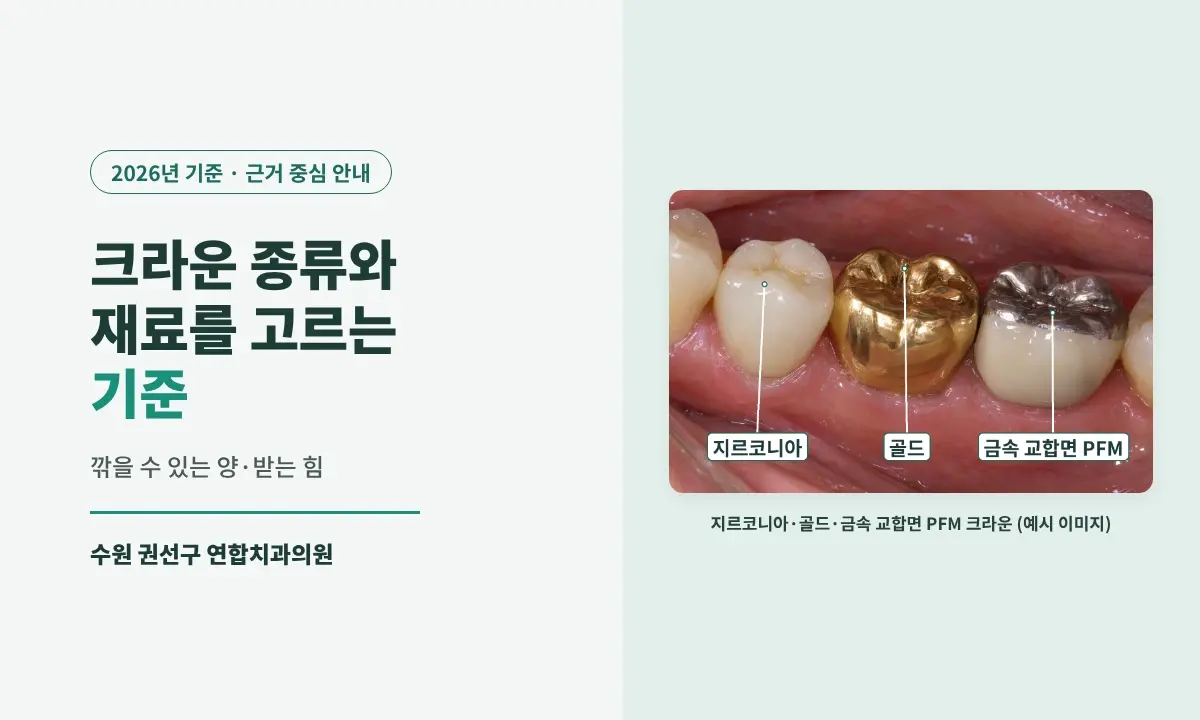
The crown material is chosen according to how much tooth can be removed and the forces it will bear. Yeonhap Dental Clinic uses zirconia for most crowns and turns to other materials only when conditions do not fit.
How do crown materials differ by type?
A crown is a prosthesis that covers an entire weakened tooth. Once a crown is decided on, the next step is the material, and each material differs in strength, color, and the thickness it needs.
[Key Answer]
The crown material is chosen not by which is "better" but by how much of that tooth can be removed and what forces that site bears. At Yeonhap Dental Clinic in Gwonseon-gu, Suwon, we use monolithic zirconia for most crowns, and turn to PFM with a metal chewing surface or a metal crown (a crown made entirely of base metal) only when conditions do not fit.
[Summary in 4 Lines]
· Yeonhap Dental Clinic uses monolithic zirconia for most crowns, which has no porcelain layer on the outside that could chip off.
· Teeth that need less reduction get a metal chewing surface (by our clinic's standard, prosthesis thickness of 0.7 mm for zirconia and 0.3 mm for metal).
· For a tooth that carries a partial denture clasp, we choose PFM (porcelain-fused-to-metal); gold is chosen when the tooth conditions fit and you accept the color and cost.
· For zirconia crowns, we check height, lateral interference, and re-polishing after adjustment, and recheck the bite every 6 months.
Written by Dr. Ahn Seong-jin, Chief Director, Yeonhap Dental Clinic
[Table of Contents]
· How do crown materials differ by type?
· Why is a crown with a metal chewing surface used for teeth that need less reduction?
· Why is the crown for a tooth that carries a partial denture clasp made of porcelain-fused-to-metal (PFM)?
· What are the advantages and limits of a gold crown?
· Doesn't a zirconia crown wear down the opposing tooth?
· What do you do if the tooth is short or the crown margin goes below the gum line?
This article covers the choice of crown material. The criteria for deciding the extent of treatment among resin, inlay, and crown are covered in Cavity Treatment Types: How Do You Choose Between Resin, Inlay, and Crown?.
PFZ (porcelain-layered zirconia) and PFM have porcelain layered over a hard core and look natural, but that porcelain can chip. A systematic review pooling 6,370 natural tooth-supported restorations also found that porcelain-layered zirconia had more failures and complications than monolithic zirconia, with a large difference in porcelain chipping (Shihabi 2023, crowns and bridges combined).
For front teeth, we make zirconia the default and choose PFZ or PFM with a metal lingual surface depending on color matching and lingual space and bite. Our clinic does not use PFZ if there is grinding or a deep bite, and there is also a study in which more chipping of layered porcelain was observed in patients who grind (Heller 2022). The detailed criteria are explained in Front Tooth Crown Types: What Should You Choose?.
Comparison of 5 crown materials
| Material | Advantages | Limits | When Yeonhap Dental Clinic uses it |
|---|---|---|---|
| Zirconia | No outer porcelain layer to chip off; a reasonable tooth color | Requires a certain thickness | Most crowns (default) |
| PFZ (porcelain-layered zirconia) | Most natural color and translucency | The outer porcelain can chip | Front teeth where color is especially important (excluding grinding or deep bite) |
| PFM (porcelain-fused-to-metal) | A metal chewing surface holds up even when thin | Metal may show through, and the porcelain surface can chip | When less reduction is needed, teeth that carry a partial denture |
| Metal crown (base metal) | Holds up even when thin | Metal color shows; beware of nickel allergy | Hard-to-see molars where less reduction is needed |
| Gold | Holds up even when thin; the margins can be fitted precisely | Gold color shows; higher material cost | Chosen when the tooth conditions fit and you accept the color and cost |
Why is a crown with a metal chewing surface used for teeth that need less reduction?
Because porcelain-type materials need thickness to hold up, while metal holds up even when thin.
Our clinic secures a prosthesis thickness of at least 0.7 mm for zirconia and 0.3 mm for a metal chewing surface. This is a different number from the amount of tooth cut away. In laboratory research, monolithic zirconia showed fracture resistance even at 0.5 mm but lower than at 1.0 mm (Tekin 2020), so we allow a margin. Cutting a tooth with a nearby nerve canal deeply to fit porcelain thickness can lead to root canal treatment, so we use PFM, with porcelain on the visible surface and metal on the chewing surface, or a metal crown for molars that are hard to see.
Why is the crown for a tooth that carries a partial denture clasp made of porcelain-fused-to-metal (PFM)?
To make the surfaces where the denture's rest and clasp sit precise, and to adjust and re-polish those spots.
In the crown for a tooth that carries a partial denture (a surveyed crown), a groove for the denture rest and a surface for the clasp to pass over are built in, and force falls on those spots each time the denture is inserted and removed. Our clinic chooses PFM with a metal surface, taking into account adjustment and re-polishing of the rest seat and clasp surface.
What are the advantages and limits of a gold crown?
It holds up even when thin and the margins can be fitted precisely, but the gold color shows and the material cost is high.
Gold is an alloy with a high gold content that stretches rather than breaks, so it holds up even when made thin and the margins can be fitted precisely. Its composition differs from a metal crown (base metal); nickel is reported to be a metal that readily causes allergies, so for people sensitive to metals we check the alloy composition (Geurtsen 2002). Our clinic chooses it when the tooth conditions fit and you accept the color and cost, and recently not many patients choose it.
Doesn't a zirconia crown wear down the opposing tooth?
Wear of the opposing tooth depends more on the crown's surface condition and the bite than on how hard the material is.
In a review pooling laboratory studies, well-polished monolithic zirconia wore opposing enamel less than a glazed-only surface (Aljomard 2022). That is why our clinic sets the height precisely, checks whether it catches when the jaw moves side to side (lateral interference), and always re-polishes any adjusted spot. Interference that did not exist can arise even after the crown is placed, so we recheck the bite every 6 months.
What do you do if the tooth is short or the crown margin goes below the gum line?
Where possible we secure tooth length first to raise the margin, and if the margin still has to go below the gum line, we consider zirconia first.
For a crown to stay on, the tooth post it sits on must be high enough, so where possible our clinic first secures length with gingivectomy or crown lengthening (Crown Lengthening, Ferrule and Crown-to-Root Ratio). When the margin has to go below the gum line, we consider zirconia first, but a design that does not invade the gum tissue comes before the material.
Most crowns are cemented with glass ionomer-type cement, and if the shape is made first, cementation alone holds well enough. When length cannot be secured, the tooth and the inside of the crown are each treated and then bonded with adhesive cement.
4 things to check when consulting about crown materials in Gwonseon-gu or Tap-dong, Suwon
It helps to hear why that material is right for that tooth, rather than just the name of the material.
Yeonhap Dental Clinic, at 230 Geumho-ro, 5th Floor (Cham Clinic Building, Tap-dong), Gwonseon-gu, Suwon, across from Suwon NongHyup Guun Branch (231 Geumho-ro), has been treating patients in the same location since 2002, with Dr. Ahn Seong-jin, Chief Director and Integrated Dentistry specialist, in charge.
· How much of that tooth can be removed, and whether the nerve canal is close
· What forces that site bears, and whether there is grinding or a deep bite
· Whether the crown margin has to go below the gum line
· How the bite and surface are managed after the crown is placed
[Key Takeaways]
✓ The crown material is chosen by the amount of tooth that can be removed, the forces borne, and whether the margin goes below the gum; Yeonhap Dental Clinic uses monolithic zirconia for most crowns.
✓ For teeth that need less reduction, we use PFM with a metal chewing surface or a metal crown; for teeth that carry a partial denture, PFM; and gold is chosen when the tooth conditions fit and you accept the color and cost.
✓ For zirconia crowns, we check height, lateral interference, and re-polishing, and recheck the bite every 6 months.
What I would like to tell you about crown materials from the treatment room
When I am asked about crown materials, I usually start by talking about the tooth: how much remains, how close the nerve canal is, what forces it bears when biting, and how the bone is. Once those are settled, the material almost follows. For front teeth too, where force falls on them, we give up a little naturalness and go with monolithic zirconia, and in my practice the majority of patients were satisfied even so. And even after the material is chosen, I think work remains: setting the height, removing any catch points, finishing the surface, and checking again over time for anything that has changed.
References
📋 Clinic Information
This post was written in accordance with the Korean Medical Service Act and the Ministry of Health and Welfare's medical advertising guidelines, and is intended to provide medical information. It does not guarantee or assert the result of any particular material. The choice of material and the course differ from person to person depending on the remaining tooth, the bite, and periodontal conditions, so please decide on a treatment direction only after a thorough consultation with your dental team.
🦷 Crown and prosthodontic information: Yeonhap Dental Clinic prosthodontic treatment
📍 230 Geumho-ro, 5th Floor (Cham Clinic Building, Tap-dong), Gwonseon-gu, Suwon, Gyeonggi-do
🚕 Across from Suwon NongHyup Guun Branch (231 Geumho-ro) / about 15 minutes by taxi from Suwon Station
🚗 Free parking available in the building
📞 031-293-2207
🌐 yeonhapdental.com
🟡 Open since 2002 / Treatment overseen by Dr. Ahn Seong-jin, Chief Director and Integrated Dentistry specialist
🔗 Online booking and consultation
Frequently asked questions about crown types
- Which crown material is the best?
- Each material suits different sites, so it is hard to say that any one is always better. Yeonhap Dental Clinic uses monolithic zirconia for most crowns, and chooses PFM with a metal chewing surface (porcelain-fused-to-metal) or a metal crown when conditions do not fit, such as for teeth that need less reduction or teeth that carry a partial denture.
- Does a zirconia crown require removing a lot of tooth?
- Our clinic secures a prosthesis thickness of at least 0.7 mm for zirconia and 0.3 mm for a metal chewing surface. This is a different number from the amount of tooth cut away, which is why we use a metal chewing surface for teeth with little room to cut.
- Why is a crown with a metal chewing surface used for teeth with a nearby nerve canal?
- Porcelain-type materials require deep cutting to reach the needed thickness, and if the nerve canal is close, the nerve can be irritated in the process, which can lead to root canal treatment. Metal can be made thin, so the amount cut can be reduced.
- Are gold crowns still done these days?
- Yes. Gold is a material that holds up even when thin and whose margins can be fitted precisely. However, the gold color shows and the material cost is high, so at Yeonhap Dental Clinic it is chosen when the tooth conditions fit and you accept the color and cost, and recently not many patients choose it.
- Won't a zirconia crown wear down the opposing tooth?
- Wear of the opposing tooth depends more on the surface condition and the bite than on the hardness of the material. Yeonhap Dental Clinic sets the crown height, checks whether it catches when the jaw moves side to side, re-polishes any adjusted spot, and rechecks the bite every 6 months.
- Where is Yeonhap Dental Clinic in Tap-dong and Guun-dong, Gwonseon-gu, Suwon?
- We are at 230 Geumho-ro, 5th Floor (Cham Clinic Building, Tap-dong), Gwonseon-gu, Suwon, Gyeonggi-do, across from Suwon NongHyup Guun Branch (231 Geumho-ro). Free parking is available in the building, and we are about 15 minutes by taxi from Suwon Station.
Related pages
Before your visit
This article provides general information on oral health and dental care. Whether treatment is needed, and which method is appropriate, may change after an oral exam and any necessary diagnostic tests. If you have pain, a loose tooth, swelling, or discomfort with a prosthesis, please visit us for a consultation.