
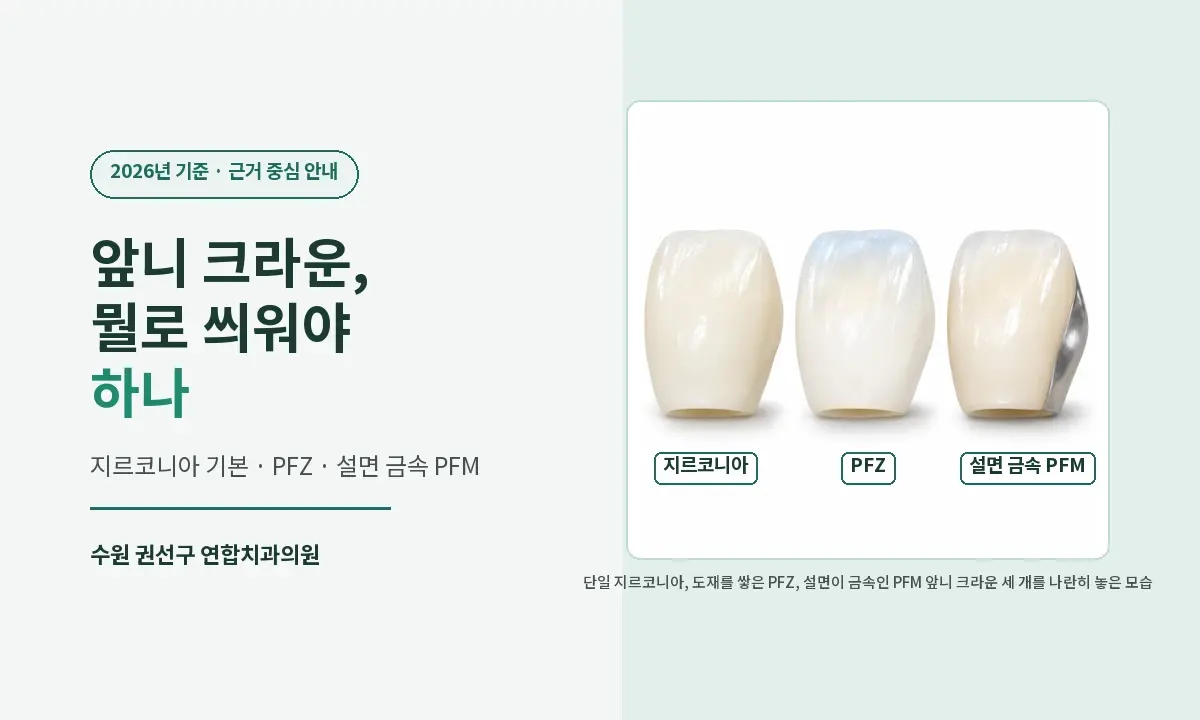
At Yeonhap Dental Clinic in Gwonseon-gu, Suwon, most front tooth crowns are made of zirconia, and PFZ is used when color matching is especially important. PFM, with a metal lingual surface, is chosen only when the conditions are clear, such as an abutment for a partial denture, a need to reduce tooth preparation, or a site under strong bite force. The material is not chosen first and the tooth fitted to it; the condition of the tooth narrows down the material.
Front tooth crowns: let's start by sorting out the material names
When you are told a front tooth needs a crown, the first thing you hear is a material name. Zirconia, PFZ, PFM, all-ceramic: there are many names, but little explanation of which one suits you.
[Key Answer]
At Yeonhap Dental Clinic in Gwonseon-gu, Suwon, most front tooth crowns are made of zirconia, and PFZ is used when color matching is especially important. PFM, with a metal lingual surface, is chosen only when the conditions are clear, such as an abutment for a partial denture, a need to reduce tooth preparation, or a site under strong bite force.
[Summary in 4 Lines]
· At Yeonhap Dental Clinic in Gwonseon-gu, Suwon, most front tooth crowns are made of zirconia.
· PFZ is used only where color matching is especially important.
· PFM is used with a metal lingual surface only in three situations: a surveyed crown, a case where tooth reduction must be minimized, and a deep bite.
· In a fatigue test on front teeth, the reported fracture loads were 9,369 N for metal-ceramic with a metal lingual surface, 2,782 N for porcelain-layered zirconia, and 1,650 N for lithium disilicate (Amir Rad 2015).
Written by Dr. Ahn Seong-jin, Chief Director, Yeonhap Dental Clinic · Published Sept. 29, 2026 · Last updated Sept. 29, 2026
[Table of Contents]
· How do zirconia, PFZ, and PFM differ for front tooth crowns?
· What is a front tooth crown usually made of?
· When is PFM used for a front tooth crown?
· Why doesn't Yeonhap Dental Clinic in Gwonseon-gu, Suwon, make all-ceramic front tooth crowns?
· What determines how long a front tooth crown lasts?
· Which front tooth crown should I choose for my tooth?
A front tooth crown is a fixed prosthesis (one the patient does not remove and reinsert) that covers the whole tooth. In an experiment on front teeth, the fracture load varied more than fivefold between materials (Amir Rad 2015). Yeonhap Dental Clinic in Gwonseon-gu, Suwon, does not read this gap as a ranking; we first look at the force that actually falls on that tooth and the space that remains.
How do zirconia, PFZ, and PFM differ for front tooth crowns?
Front tooth crowns are distinguished by what the core is made of and whether porcelain is layered on the outside.
There are only two points of difference: what the framework is made of, and whether color-giving porcelain is layered on top separately.
A zirconia crown is milled from a single block of zirconia, with no porcelain layered on the outside. With no outer porcelain, the failure route of porcelain breaking off does not exist.
A PFZ is a crown in which porcelain is hand-layered over a zirconia framework. Because it is built up layer by layer by a person, it offers the highest reproduction of color and translucency.
A PFM is a crown with porcelain layered over a metal framework. When Yeonhap Dental Clinic uses PFM on a front tooth, porcelain is applied only to the visible labial surface, and the lingual surface that the tongue touches is left as metal.
All-ceramic usually refers to a restoration made only of glass-based ceramic such as e.max (lithium disilicate).
What is a front tooth crown usually made of?
At Yeonhap Dental Clinic, front tooth crowns are made of zirconia by default, and we turn to PFZ when color matching matters.
I make most front tooth crowns from zirconia. The most common way a prosthesis fails is chipping of the layered outer porcelain, and when no porcelain is layered, that route does not exist at all.
There is also room in terms of thickness. In an experiment that fractured crowns of varying occlusal thickness, zirconia showed clinically usable strength even at 0.5 mm (Tekin 2020). This means the tooth may not need to be reduced as much.
For patients for whom color matching is especially important, I recommend PFZ. A natural tooth is opaque near the root and becomes more translucent toward the tip, and this gradation is hard to capture with surface staining alone on a milled crown. A typical example is a single front tooth being crowned while the neighboring teeth remain natural.
In return, PFZ comes with the condition that its layered porcelain can chip. So I first look at whether color or strength is more pressing at that site.
Structure and reported strength of front tooth crown materials
| Material / condition | Reported value | Test conditions |
|---|---|---|
| PFM (metal lingual surface) | Fracture load 9,369 ± 734 N | Front teeth, 1,000 thermocycles + 50,000 fatigue loading cycles (Amir Rad 2015) |
| PFZ (porcelain-layered zirconia) | Fracture load 2,782 ± 283 N | Same conditions, p=.0001 compared with metal-ceramic (Amir Rad 2015) |
| All-ceramic (lithium disilicate) | Fracture load 1,650 ± 945 N | Same conditions, the widest variation (Amir Rad 2015) |
| Zirconia, 0.5 mm thick | Fracture load about 1,400 N | Comparison by occlusal thickness (Tekin 2020) |
| Zirconia, 1.0 mm thick | Equivalent to 1.5 mm metal-ceramic | Same test (Tekin 2020) |
| Zirconia, 1.5 mm thick | Above 10,000 N, did not fracture | Same test (Tekin 2020) |
| Zirconia, translucent incisal layer | Flexural strength 571.97 to 1036.87 MPa | Measured layer by layer on a multilayer block (Lohbauer 2026) |
| Zirconia, opaque dentin layer | Flexural strength 686 to 1142.73 MPa | Same measurement; lower as translucency increases (Lohbauer 2026) |
When is PFM used for a front tooth crown?
Yeonhap Dental Clinic uses PFM on front teeth, with a metal lingual surface, in only three situations.
PFM is not our default choice for front tooth prostheses. We use it only when one of the three conditions below applies.
First, a surveyed crown. This is a crown placed on an abutment tooth of a patient who also wears a partial denture, with the spot where the denture clasp will hook and the rest seat where the denture will sit built into the crown in advance. A surveyed crown requires those areas to be precisely milled and polished and is often adjusted after delivery; metal can be reshaped and re-polished in the mouth, but grinding the surface of zirconia is unfavorable for both strength and wear on the opposing tooth.
Second, when tooth reduction must be minimized. If only a little of the tooth can be removed, the remaining space becomes thin, and a metal lingual surface provides the required strength even at that thin thickness.
Third, sites under strong bite force, such as a deep bite. When the lower front teeth bite deeply into the lingual surface of the upper front teeth, force concentrates at one spot on that surface. In an experiment that subjected front teeth to thermocycling and fatigue loading and then fractured them, metal-ceramic with a metal lingual surface withstood the highest load, and the authors concluded that metal-ceramic is still the standard (Amir Rad 2015).
However, these values were obtained by fracturing specimens in a laboratory, so they are not numbers that carry over directly to the mouth. I also do not use PFM outside these three conditions.
Why doesn't Yeonhap Dental Clinic in Gwonseon-gu, Suwon, make all-ceramic front tooth crowns?
It is not that all-ceramic is a poor material; the conditions do not fit when a front tooth is fully covered.
For crowns that fully cover a front tooth, we do not use all-ceramic (glass-ceramic). There are two reasons, and both concern not the performance of the material but the conditions under which that performance is achieved.
First, a dark abutment cannot be masked. A front tooth that needs a crown has often had a root canal treatment or a post and has darkened, and because glass-ceramic lets light pass through, that color shows through. Why a root canal-treated front tooth is structurally at a disadvantage is covered in Why a Rubber Dam Matters in Root Canal Treatment.
Second, bonding becomes less favorable when the margin sits below the gum line. Glass-ceramic reaches its full strength only when chemically bonded to resin cement, and that bonding assumes a dry environment free of saliva and gingival fluid. The margin of a front tooth crown is often placed below the gum line for aesthetics, which makes that environment hard to secure.
In short, it is not that we do not use e.max; we use it in different places. For inlays and onlays, where enough enamel remains to secure a bonding environment, we use e.max ceramic as a rule. This is not an area with a single correct answer, though; different dentists may judge differently depending on how they secure the bonding environment.
What determines how long a front tooth crown lasts?
The lifespan of a front tooth crown depends more on where and how force reaches it than on the strength of the material.
The fracture loads in the table are values from applying force straight in one direction. In the actual mouth, the direction keeps changing, and when force concentrates on one point, problems can occur at much lower loads.
Front teeth are especially demanding in this respect. When the lower jaw moves forward or to the side, the front teeth touch first and lift the back molars apart, and if this contact is even slightly off, force concentrates on one point of the crown. A prosthesis that looked well-fitted with the mouth closed and then starts breaking from the edge a few months later is an example.
That is why at Yeonhap Dental Clinic the director personally adjusts the final bite of every prosthesis. Including implant prostheses, our principle is not to delegate this step to anyone else. We check not only the central bite but also contacts when the lower jaw moves forward and side to side before bonding the crown. How much ferrule, the tooth structure the crown grips, is secured is covered separately in Crown Lengthening: How Much Bone Should Be Removed?.
Wear on the opposing tooth is managed at the same point. Strong wear marks exceeding 350 µm on teeth opposing zirconia crowns were observed about twice as often as with lithium disilicate, and there were none in the control group of natural teeth biting against each other (Rosentritt 2020). The authors of that study attached accurate occlusal adjustment and regular follow-up as conditions to their conclusion. This means zirconia's advantages cannot be taken on their own, so we finish by polishing the occlusal surface thoroughly and check wear together at regular follow-ups.
Which front tooth crown should I choose for my tooth?
The front tooth crown material is decided by four things: whether you wear a partial denture, the remaining space, the abutment color, and how important color matching is.
In the treatment room, I do not bring up material names first. I check the four points below first, and the results decide the material.
1. Do you also wear a partial denture? That abutment becomes a surveyed crown, and we go with PFM with a metal lingual surface.
2. How much space remains? If only a little of the tooth can be removed, or space on the lingual surface is insufficient because of a deep bite, we consider PFM with a metal lingual surface.
3. Is the abutment dark? If so, glass-ceramic is ruled out and we go with a zirconia-based crown.
4. How important is color matching at that site? For a single front tooth that sits next to natural teeth, PFZ; otherwise, zirconia.
Once these four points are checked, the options usually narrow to one. The overall process for front tooth prostheses continues in Aesthetic Dentistry Information.
[Key Takeaways]
✓ For front tooth crowns, zirconia is the default, and PFZ is used only where color matching is especially important.
✓ PFM, with a metal lingual surface only, is used in three situations: a surveyed crown, limited tooth reduction, and a deep bite.
✓ We do not use all-ceramic for full coverage of front teeth because it cannot mask a dark abutment and bonding is less favorable at margins below the gum line.
Yeonhap Dental Clinic is at 230 Geumho-ro, 5th Floor (Cham Clinic Building, Tap-dong), Gwonseon-gu, Suwon, Gyeonggi-do, across from Suwon NongHyup Guun Branch (231 Geumho-ro).
Criteria for choosing a front tooth crown material, by condition
| Tooth condition | Yeonhap Dental Clinic's choice | Reason |
|---|---|---|
| Most front tooth crowns | Zirconia | With no outer porcelain, there is no chipping route |
| A single front tooth that sits next to natural teeth | PFZ | The outer surface must be layered to reproduce changes in translucency |
| Abutment for a partial denture (surveyed crown) | PFM with a metal lingual surface | Rest seats and guide planes must be milled and re-polished |
| When only a little of the tooth can be removed | PFM with a metal lingual surface | Provides the required strength even at a thin thickness |
| Sites under strong bite force, such as a deep bite | PFM with a metal lingual surface | Showed the highest fracture load in the front tooth fatigue test |
| Abutment darkened by root canal treatment | Zirconia-based | Glass-ceramic lets the color beneath show through |
| When the margin sits below the gum line | Zirconia-based or PFM | Glass-ceramic needs a dry environment for bonding |
| When enamel remains and full coverage is not needed | e.max inlay or onlay | A site where a bonding environment can be secured |
A word from the Gwonseon-gu, Suwon treatment room for those facing a front tooth prosthesis
The phrase I hear most often in front tooth consultations is, "Please use the best one." At that point, I show you the condition of the tooth first instead of a material name. That is because, even among front teeth, a tooth darkened by root canal treatment and a tooth with living color are entirely different conditions.
I give the experimental numbers as they are for a similar reason. The differences in fracture load do exist, but if you decide on those numbers alone, you get the same answer every time. In reality, what comes first is whether that much force acts on that tooth and whether that much space remains.
So I see the moment a prosthesis arrives from the dental lab not as the end but as the beginning. Before placing it in the mouth, I adjust the bite once more and move the lower jaw forward, back, and side to side to check that contact does not concentrate on a single point. No material is better than a natural tooth, so if a tooth can hold up without a crown, I consider not crowning it first.
References
Amir Rad FA, Succaria FG, Morgano SM. Fracture resistance of porcelain veneered zirconia crowns with exposed lingual zirconia for anterior teeth after thermal cycling: An in vitro study. Saudi Dent J. 2015;27(2):63-69. doi:10.1016/j.sdentj.2014.11.005.
Tekin YH, Hayran Y. Fracture resistance and marginal fit of the zirconia crowns with varied occlusal thickness. J Adv Prosthodont. 2020;12(5):283-290. doi:10.4047/jap.2020.12.5.283.
Rosentritt M, Schumann F, Krifka S, Preis V. Influence of zirconia and lithium disilicate tooth- or implant-supported crowns on wear of antagonistic and adjacent teeth. J Adv Prosthodont. 2020;12(1):1-8. doi:10.4047/jap.2020.12.1.1.
Lohbauer U, Schwarz M, Belli R. Flexural Strength and Clinical Classification of Different Layers in 4/5Y-PSZ Zirconia Materials. J Funct Biomater. 2026;17(6):300. doi:10.3390/jfb17060300.
Sailer I, Makarov NA, Thoma DS, Zwahlen M, Pjetursson BE. All-ceramic or metal-ceramic tooth-supported fixed dental prostheses (FDPs)? A systematic review of the survival and complication rates. Part I: Single crowns (SCs). Dent Mater. 2015;31(6):603-623. PMID 25842099.
Pjetursson BE, Valente NA, Strasding M, Zwahlen M, Liu S, Sailer I. A systematic review of the survival and complication rates of zirconia-ceramic and metal-ceramic single crowns. Clin Oral Implants Res. 2018;29(Suppl 16):199-214. doi:10.1111/clr.13306.
Poggio CE, Ercoli C, Rispoli L, Maiorana C, Esposito M. Metal-free materials for fixed prosthodontic restorations. Cochrane Database Syst Rev. 2017;12:CD009606. doi:10.1002/14651858.CD009606.pub2.
This post was written as of September 2026.
🔗 온라인 예약 및 상담
📋 Clinic Information
This article was written by Dr. Ahn Seong-jin, Chief Director of Yeonhap Dental Clinic. Published Sept. 29, 2026 · Last updated Sept. 29, 2026
This post was written in accordance with the Korean Medical Service Act and the Ministry of Health and Welfare's medical advertising guidelines, and is intended to provide medical information. It does not guarantee or assert the effect of any particular treatment. The applicable techniques and course of treatment may vary depending on each person's oral condition and general health, so please decide on a diagnosis and treatment direction only after a thorough consultation with your dental team.
🦷 Front tooth crown information: Aesthetic Dentistry Information
📍 230 Geumho-ro, 5th Floor (Cham Clinic Building, Tap-dong), Gwonseon-gu, Suwon, Gyeonggi-do
🚕 Across from Suwon NongHyup Guun Branch (231 Geumho-ro) / about 15 minutes by taxi from Suwon Station
🚗 Free parking available in the building
📞 031-293-2207
🌐 yeonhapdental.com
🟡 Open since 2002 / Treatment overseen by Dr. Ahn Seong-jin, Chief Director and Integrated Dentistry specialist
🔗 Online booking and consultation
Frequently Asked Questions
- What material is a front tooth crown usually made of?
- At Yeonhap Dental Clinic, most front tooth crowns are made of zirconia. Because no porcelain is layered on the outside, outer porcelain chipping, the most common prosthesis failure, does not occur.
- How do PFZ and zirconia differ for front tooth crowns?
- A PFZ is a crown in which porcelain is hand-layered over a zirconia framework, while a zirconia crown is milled in one piece with no porcelain layered on the outside. PFZ can reproduce the gradation of translucency in a natural tooth, but it comes with the condition that its layered porcelain can chip.
- When is PFM used for a front tooth crown?
- PFM is used for front tooth crowns in three situations: an abutment for a partial denture (surveyed crown), when only a little of the tooth can be removed, and when bite force is strong, as in a deep bite. Even then, porcelain is applied only to the visible labial surface, and the lingual surface that the tongue touches is left as metal.
- What is a surveyed crown?
- A surveyed crown is a crown placed on an abutment tooth of a patient who also wears a partial denture, with the spot where the denture clasp will hook and the rest seat where the denture will sit built into the crown in advance. These areas are often adjusted after delivery, so metal, which can be reshaped and re-polished in the mouth, is advantageous.
- Are there dental clinics that do not make front tooth crowns from all-ceramic?
- Some dental clinics do not use all-ceramic for crowns that fully cover a front tooth, and Yeonhap Dental Clinic is one of them. When an abutment has darkened from root canal treatment, glass-ceramic cannot mask that color, and when the margin sits below the gum line, it is hard to secure the dry environment needed for bonding.
- How is the front tooth crown material decided in Gwonseon-gu, Suwon?
- At Yeonhap Dental Clinic in Gwonseon-gu, Suwon, we choose the front tooth crown material after checking four things: whether you wear a partial denture, the remaining space, the abutment color, and how important color matching is. Yeonhap Dental Clinic is at 230 Geumho-ro, 5th Floor (Cham Clinic Building, Tap-dong), Gwonseon-gu, Suwon, Gyeonggi-do, and the phone number is 031-293-2207.
Related pages
Before your visit
This article provides general information on oral health and dental care. Whether treatment is needed, and which method is appropriate, may change after an oral exam and any necessary diagnostic tests. If you have pain, a loose tooth, swelling, or discomfort with a prosthesis, please visit us for a consultation.