
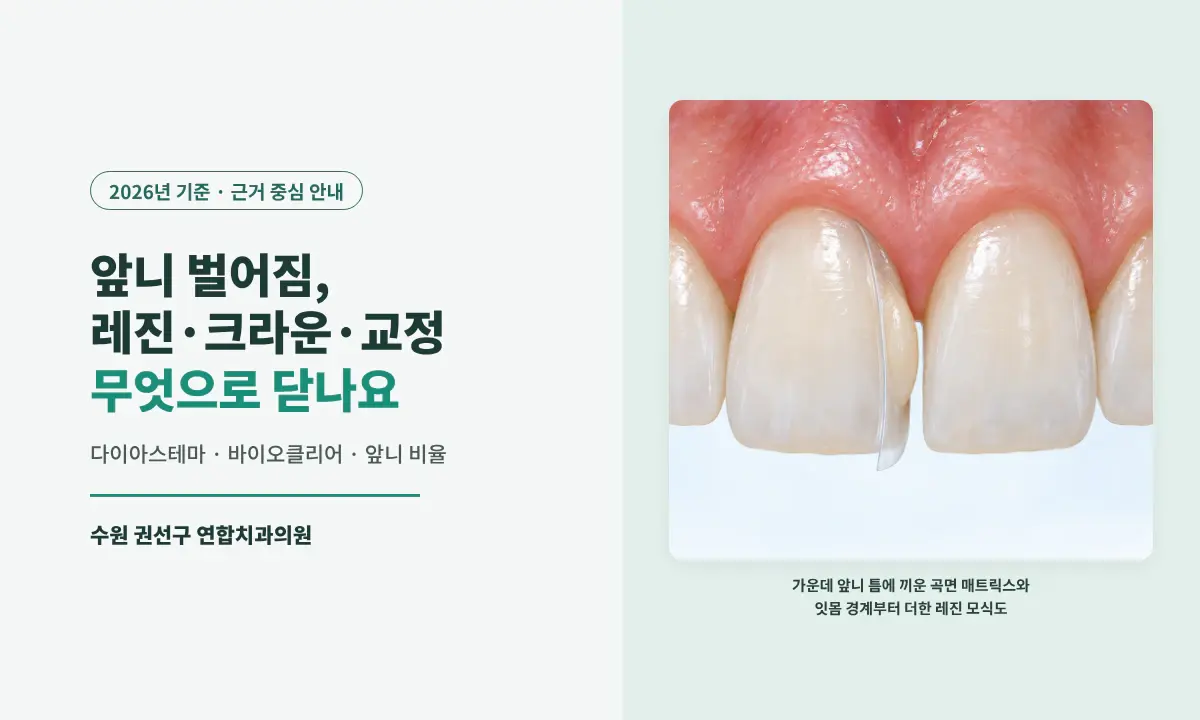
A gap between the front teeth (diastema) is handled with resin, a crown, or orthodontics depending on the proportion of the front teeth once the gap is closed, the depth of the bite, and the condition of the tooth surface to be bonded. At Yeonhap Dental Clinic in Gwonseon-gu, Suwon, if all three conditions fit, we bond resin using a BioClear matrix; if the length also has to be extended, we consider a crown; and if the teeth need to be moved, we refer you to an orthodontist.
In Gwonseon-gu, Suwon, is a front tooth gap (diastema) treated with resin, a crown, or orthodontics?
When you consult about a gap between the front teeth, some clinics suggest filling it with resin, others a crown, and others orthodontics, which makes things more confusing.
[Key Answer]
A front tooth gap (diastema) is handled with resin, a crown, or orthodontics depending on whether the front tooth proportions look natural even after the gap is closed, whether the lower front teeth touch when you bite, and whether the tooth surface to be bonded is healthy. At Yeonhap Dental Clinic in Gwonseon-gu, Suwon, if all three conditions fit, we bond resin using a BioClear matrix, and if closing the gap would make the front teeth look too wide and the length also has to be extended, we consider a crown that extends the length as well.
[Summary in 4 Lines]
· Direct resin restoration, including closing a front tooth gap and reshaping, is reported at a 5-year survival of 84.6% (Frese 2013) and a 4-year survival of 90.3% (Korkut 2021), and most restorations that developed problems were repaired by adding material.
· Yeonhap Dental Clinic fills the BioClear matrix in two parts, the gum-side 1/3 and the upper 2/3, with different resins chosen for the flow and physical properties each area needs.
· When closing the gap would make the front teeth too wide and the length also has to be extended, we consider a crown that extends the length as well, and front tooth crown preparation is reported to remove 63 to 72% of the crown (by weight) (Edelhoff 2002, model tooth experiment).
· A report that followed 30 people for an average of 5.6 years after retainers ended found that 60% had the central gap reopen after orthodontic closure (Morais 2014), so retention care matters even after orthodontics, and when orthodontics is needed, Yeonhap Dental Clinic refers you to an orthodontist.
Written by Dr. Ahn Seong-jin, Chief Director, Yeonhap Dental Clinic
[Table of Contents]
· What do you check first to decide how to treat a front tooth gap?
· How long does a front tooth gap last when closed with resin?
· How does BioClear resin differ from ordinary front tooth resin?
· When is a crown used for a front tooth gap?
· Does a front tooth gap reopen after orthodontic closure?
The three methods differ even in the principle by which the gap is removed. Resin and crowns widen the tooth to fill the gap, while orthodontics moves the teeth to close it.
So rather than which method is better, we first need to look at which method can hold up in the current state of your front teeth. This article lays out that order of judgment and the evidence for each method.
What do you check first to decide how to treat a front tooth gap?
Treatment of a front tooth gap is decided by three things: the proportion of the front teeth after closing, the depth of the bite, and the condition of the tooth surface.
However, when needed, for example if the gap appeared recently or is gradually widening, we first check the gum (periodontal) condition. This is because in some cases the front teeth drift apart as periodontitis reduces the bone around them.
First, the proportion. Because the width increases by as much as the gap is filled, if the existing length is left as is, the larger the gap, the wider and shorter the front tooth looks. In a study measuring white adults, the width-to-length ratio of the upper central incisor was reported at an average of 0.85 to 0.86 (Sterrett 1999). Because this may differ by ethnicity, Yeonhap Dental Clinic does not use this ratio as a fixed standard for every patient, and instead judges by whether the tooth would look too wide once filled.
Second, the depth of the bite. If the bite is deep (deep bite) and the tips of the lower front teeth hit where the resin would sit, force falls repeatedly on that spot with every bite.
Third, the tooth surface to be bonded. If the existing tooth is heavily chipped or has exposed sclerotic dentin (dentin that has hardened after long wear and bonds poorly), the resin is at a disadvantage in staying on. Aesthetic treatment in general, such as whitening and veneers, is summarized in Aesthetic Dentistry.
Criteria for choosing front tooth gap treatment (Yeonhap Dental Clinic)
| Condition checked | Our clinic's choice | Reason |
|---|---|---|
| Gap appeared recently or is gradually widening | If needed, check the gum (periodontal) condition first | Teeth may drift apart because of periodontitis |
| Front tooth width-to-length proportion looks natural even after filling | BioClear resin | Fills the gap in a single visit without cutting the tooth |
| Filling makes the front teeth too wide, so the length must be extended as well | Crown that also extends the length (zirconia; PFZ if aesthetics matter) | Depending on how far the incisal edge is extended and the bite, the fracture burden may rise, so our clinic considers a crown |
| Deep bite, with the lower front teeth touching the resin site | Consider a crown first | Force falls repeatedly on the resin with every bite |
| Existing tooth is heavily chipped or has sclerotic dentin | Consider a crown | Bonding is at a disadvantage and the resin comes off easily |
| The tooth position itself is gapped | Refer to an orthodontist | Moving the teeth is more suitable than filling |
| A crown is needed but you do not want the tooth cut | Refer to an orthodontist | A way to reduce the gap without cutting |
| Thick labial frenum (the band inside the upper lip) | We do not routinely excise the frenum when filling with resin | Our clinic's judgment is that resin is a method that does not move teeth |
How long does a front tooth gap last when closed with resin?
Front tooth gap resin is reported to have remained problem-free in the 80 to 90% range at 4 to 5 years of follow-up.
A study that followed 176 front tooth reshaping and gap-closing restorations performed at a university hospital found a 5-year survival of 84.6%, and all 30 that developed problems such as chipping were repaired and returned to use, with none lost completely (Frese 2013). A study of 216 restorations in 53 people (199 of them gap closures) found a 4-year survival of 90.3% and an annual failure rate of 0.9 to 3.4%, and 100% when repaired ones were included (Korkut 2021).
The form of failure is closer to "chipping and discoloration" than to "falling off." In a study that followed 163 restorations, including front tooth fracture restorations, for an average of 7.2 years, the annual failure rate was 1.43%, and the causes of failure were restoration fracture and shade mismatch. Chipping was more frequent in the first year, and beverage intake was related to discoloration (Lempel 2017).
All three studies come from different institutions, and none separately reported the results of restorations using a BioClear matrix.
How does BioClear resin differ from ordinary front tooth resin?
BioClear is not a resin but a transparent matrix that wraps along the curve of the tooth to the gum margin to shape the resin.
When filling between the front teeth, the most noticeable area is the margin at the gum side. If a step forms or it is underfilled here, a black triangle remains and food tends to get caught, making the gum prone to swelling. A curved matrix works by filling within a set shape, and Yeonhap Dental Clinic uses this method to get a consistent shape every time.
Yeonhap Dental Clinic fills this matrix in two parts with two resins, considering the flow and physical properties each area needs. For the narrow, sharply curved gum-side 1/3, we use the highly flowable T Com Flow (Nexobio Transcen LV, a flowable nanohybrid resin), so that it fills even the narrow curved corners. For the upper 2/3, where the visible area is large and chewing force acts, we use Estelite Flow Quick, from the same flowable family, chosen for aesthetics, stain resistance, and fracture strength.
The basis for splitting them is the two causes of failure reported in the studies above, namely chipping and discoloration. However, within the scope reviewed for this article, we did not find a clinical study comparing the long-term results of the BioClear method with other methods, and the material choice above is our clinic's reasoning, not a comparison of product performance.
When is a crown used for a front tooth gap?
A crown is used for a front tooth gap when filling would make the front teeth too wide and the length also has to be extended, or when the bite and tooth surface make it hard for resin to hold.
Resin can also be used to extend the incisal edge and match the length, but depending on the amount of extension and the bite force, the burden of chipping can rise, so in such cases Yeonhap Dental Clinic readjusts the front tooth proportions with a crown that extends the length as well. Crowns are zirconia by default, and for those for whom aesthetics are especially important, we use PFZ.
In exchange, a crown removes a lot of tooth. In a study measured on model teeth, front tooth crown preparation removed 63 to 72% of the crown (by weight) (Edelhoff 2002). This was an experiment on resin models rather than real teeth, but it is the reason we do not recommend a crown where resin will do. The differences between front tooth crown materials are covered in What Should a Front Tooth Be Crowned With?.
Does a front tooth gap reopen after orthodontic closure?
It is reported not infrequently that the central gap reopens after a front tooth gap is closed with orthodontics.
In a study that followed 30 people whose central gap was 0.5 mm or more for an average of 5.6 years after they stopped wearing a removable retainer (worn for an average of 1.44 years), 60% had the central gap reopen, with an average relapse of 0.49 mm across all participants (0.78 mm among those whose gap reopened). The wider the initial gap, the greater the tendency to reopen, and gaps between the lateral incisors and neighboring teeth were stable (Morais 2014). In a study that observed 96 people 4 to 9 years after treatment, relapse was 49%, and that study counted not only reopened gaps but also retreatment and continued retainer use as relapse (Shashua 1999).
The role of the labial frenum differs from study to study. One report found a clearly stronger tendency to relapse when the frenum was abnormal (Edwards 1977), while another found no association between frenum abnormality and relapse (Shashua 1999).
Yeonhap Dental Clinic does not perform orthodontics itself, and refers you to an orthodontist when the tooth positions themselves are gapped, or when a crown is needed but you do not want the tooth cut. Because resin is not a method that moves teeth, Yeonhap Dental Clinic does not routinely excise the labial frenum when filling with resin.
Study results by front tooth gap treatment method
| Treatment method | Reported result | Study conditions |
|---|---|---|
| Resin restoration (Frese 2013) | 5-year survival 84.6%, all 30 with problems repaired | 176 restorations at a university hospital, reshaping and gap closing |
| Resin restoration (Korkut 2021) | 4-year survival 90.3%, annual failure rate 0.9 to 3.4% | 199 gap closures among 216 restorations in 53 people, retrospective study |
| Resin restoration (Lempel 2017) | Annual failure rate 1.43%, causes of failure fracture and shade mismatch | 163 restorations in 65 people, including fracture restorations, average 7.2 years |
| Crown preparation (Edelhoff 2002) | 63 to 72% of the crown removed (by weight) | Resin model tooth experiment |
| Central gap after orthodontics (Morais 2014) | Reopened in 60%, overall average 0.49 mm | 30 people, average 5.6 years after retainer ended |
| Central gap after orthodontics (Shashua 1999) | Relapse 49%; initial gap size and family history were risk factors | 96 people, 4 to 9 years; continued retainer use also counted as relapse |
| Frenum and relapse after orthodontics | Strong association (Edwards 1977) / no association (Shashua 1999) | Results differ from study to study |
5 things to check when consulting about a front tooth gap in Gwonseon-gu or Tap-dong, Suwon
In a front tooth gap consultation, the test is whether the dentist explains why a method was chosen, rather than the name of the method.
· Whether the dentist explains if the front teeth would look too wide once the gap is fully closed
· Whether they checked where the lower front teeth touch the restoration site when you bite
· Whether they looked at conditions that interfere with bonding, such as chipped areas or sclerotic dentin
· If a crown, whether they explain how the length will be matched as well
· If orthodontics, whether you were also told about the possibility of the gap reopening
[Key Takeaways]
✓ Yeonhap Dental Clinic chooses among resin, crown, and orthodontics for a front tooth gap based on three things: the proportion after closing, the depth of the bite, and the condition of the tooth surface.
✓ For resin, we fill the BioClear matrix in two parts, the gum-side 1/3 and the upper 2/3, with resins suited to each area. A separate direct resin restoration study reported a 4-year survival of 90.3% (Korkut 2021).
✓ If the length also has to be extended, we consider a crown, and if the teeth need to be moved, we refer you to an orthodontist. A report found that 60% had the central gap reopen after retainers ended (Morais 2014), so retention care matters even after orthodontics.
What I would like to tell you about front tooth gap treatment from the treatment room
When someone comes in with a gap between the front teeth, I first look at what shape the front teeth would take once the gap is fully closed, where the lower front teeth touch when you bite, and whether the tooth surface to be bonded has any chipped or hardened areas. If the proportion looks natural even after filling and the bite and tooth surface are fine, I bond resin with BioClear; if it looks like the teeth would become too wide, I use a crown that extends the length as well; and if the teeth need to be moved, I refer you to an orthodontist. In the past, because resin had to get into the narrow part between the teeth, I filled with a single highly flowable resin, but it came off fairly often, and I attributed that to fracture strength. So now I fill the gum side and the upper side with different resins, and since then there have been few major problems. Even after changing to the current method, however, there have been patients with a deep bite, heavily chipped existing teeth, and sclerotic dentin, for whom bonding was at a disadvantage from the start, and no matter how careful we were, the resin came off after a little over a year and we switched to a crown. This is why I look at these three things first in a consultation.
References
Clinic Information
This post was written in accordance with the Korean Medical Service Act and the Ministry of Health and Welfare's medical advertising guidelines, and is intended to provide medical information. It does not guarantee or assert the result of any particular treatment. The applicable methods and how long they last differ from person to person depending on gap size, front tooth proportions, bite depth, and the condition of the tooth surface, so please decide on a diagnosis and treatment direction only after a thorough consultation with your dental team.
📋 Clinic Information
🦷 Front tooth gap information: Aesthetic Dentistry
📍 230 Geumho-ro, 5th Floor (Cham Clinic Building, Tap-dong), Gwonseon-gu, Suwon, Gyeonggi-do
🚕 Across from Suwon NongHyup Guun Branch (231 Geumho-ro) / about 15 minutes by taxi from Suwon Station
🚗 Free parking available in the building
📞 031-293-2207
🌐 yeonhapdental.com
🟡 Open since 2002 / Treatment overseen by Dr. Ahn Seong-jin, Chief Director and Integrated Dentistry specialist
🔗 Online booking and consultation
Frequently asked questions about front tooth gap treatment
- If front tooth gap resin chips or comes off, can it be redone?
- In many cases, front tooth gap resin can be repaired by smoothing only the chipped part and adding material. In a 5-year follow-up study, all 30 resin restorations that developed problems were repaired and returned to use (Frese 2013).
- How much tooth is cut away if a front tooth gap is treated with a crown?
- Front tooth crowns are reported to remove 63 to 72% of the crown (by weight) in a resin model tooth experiment (Edelhoff 2002). That is why Yeonhap Dental Clinic considers a crown for a front tooth gap only when the length also has to be extended, the bite is deep, or the tooth surface is at a disadvantage for bonding.
- Is BioClear, used for front tooth gaps, the name of a resin?
- BioClear is not a resin but a transparent matrix that wraps along the curve of the tooth to the gum margin to shape the resin. Yeonhap Dental Clinic fills it in two parts, the gum side and the upper part, with different resins.
- If the front tooth gap is wide, how does it look when filled with resin?
- The wider the gap, the more the width increases as it is filled, and the front teeth can look wide and short. When the length also has to be extended, the burden of the resin chipping can rise depending on the amount of extension and the bite force, so Yeonhap Dental Clinic considers a crown that extends the length as well to match the proportions.
- If the labial frenum is thick, will a front tooth gap reopen even if filled with resin?
- Resin fills the gap without moving teeth, so Yeonhap Dental Clinic does not routinely excise the labial frenum (the band inside the upper lip) when closing a front tooth gap with resin. Whether the frenum is involved in relapse also gives mixed results in studies of gaps closed with orthodontics.
- Can a front tooth gap reopen after orthodontic closure?
- A report found that after retainers ended, the central front tooth gap closed with orthodontics reopened in 60% of 30 people followed for an average of 5.6 years, with an overall average relapse of 0.49 mm (Morais 2014). That is why retention care matters even after orthodontics.
- If I whiten after front tooth gap resin, will the resin also get lighter?
- Whitening agents cannot change the color of resin, so after whitening, the front tooth gap resin alone may remain at its previous shade. If you plan to whiten, the usual order is to whiten first and then do the resin to match that color.
- What should I check when consulting about a front tooth gap in Gwonseon-gu, Suwon?
- In a front tooth gap consultation, check whether the dentist explains why they chose one of resin, a crown, or orthodontics. Yeonhap Dental Clinic, at 230 Geumho-ro, Gwonseon-gu, Suwon, looks at the proportion of the front teeth after closing, the depth of the bite, and the condition of the tooth surface together before telling you the method and the reason.
Related pages
Before your visit
This article provides general information on oral health and dental care. Whether treatment is needed, and which method is appropriate, may change after an oral exam and any necessary diagnostic tests. If you have pain, a loose tooth, swelling, or discomfort with a prosthesis, please visit us for a consultation.