
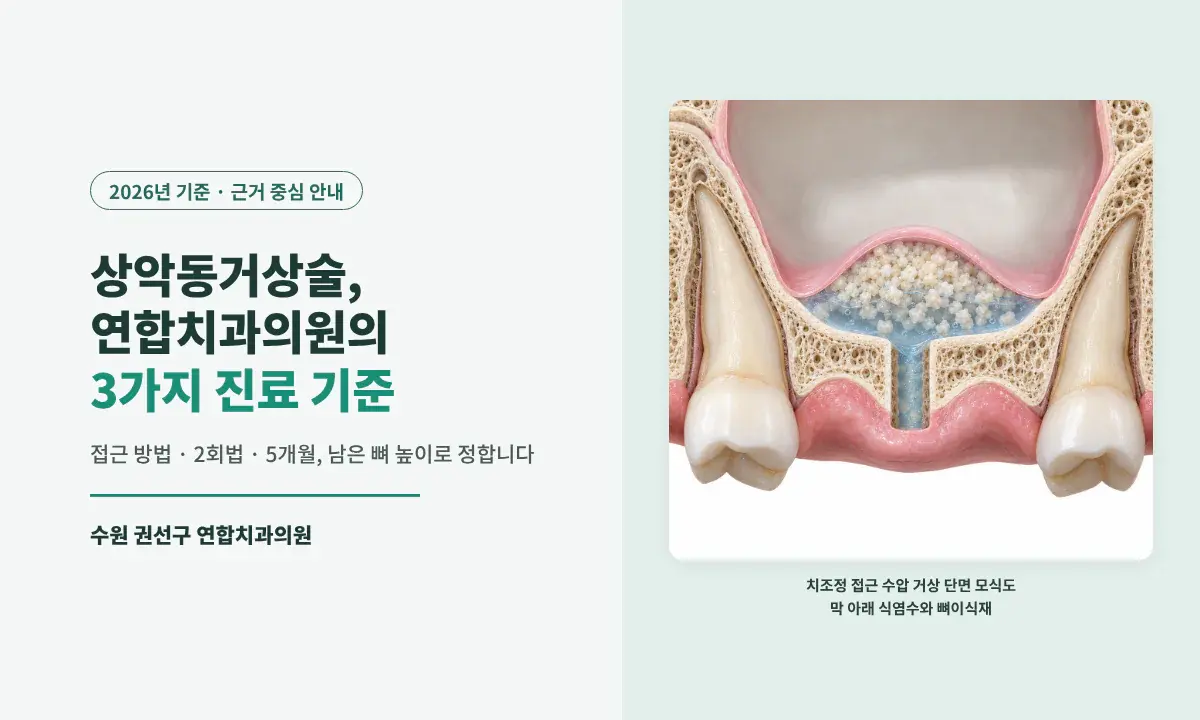
A sinus lift is surgery that raises the floor membrane of the maxillary sinus above the upper molars to create bone height for an implant. Yeonhap Dental Clinic in Gwonseon-gu, Suwon considers it when less than 7 mm of bone remains, and proceeds according to three criteria: approach, number of surgeries, and healing period. The estimated 3-year survival of implants at lifted sites is reported as 92.8% for the crestal approach and 90.1% for the lateral approach (Tan 2008, Pjetursson 2008).
A sinus lift is surgery that solves the bone height problem for upper molar implants
In an upper molar implant consultation, hearing that your bone is as thin as a sheet of paper makes you think of major surgery. But which method is used, how many stages it is divided into, and how long you wait are decided not by the size of the surgery but by the remaining bone height and the condition of the sinus membrane.
[Key Answer]
A sinus lift is surgery that raises the floor membrane of the maxillary sinus, the empty space above the upper molars, and places bone graft material there to create height for an implant, and depending on the remaining bone height, either the crestal approach or the lateral approach is chosen. Yeonhap Dental Clinic decides three things, the approach, the number of surgeries, and the waiting period, from 3D CT measurements.
[4-Line Summary]
· If remaining bone height is less than 7 mm, we consider a sinus lift, and if the membrane is healthy and primary stability is achieved, we place the implant on the same day by the crestal approach (hydraulic lift). The 7 mm figure is not a value from the literature but Yeonhap Dental Clinic's clinical criterion.
· The estimated 3-year survival of implants at lifted sites is reported as 92.8% for the crestal approach and 90.1% for the lateral approach (Tan 2008, Pjetursson 2008). These two figures are estimates calculated by pooling different studies, so they are not values for a direct comparison of the crestal and lateral approaches. In the crestal approach, lower survival was reported in the group with less than 5 mm of remaining bone (Del Fabbro 2012).
· As a rule we use the two-stage method, in which the implant is covered. In the experimental literature, the threshold of micromotion that interferes with osseointegration is reported to be in the range of about 50–150 µm (Szmukler-Moncler 1998).
· The second-stage surgery is based on roughly 5 months, adjusted according to the condition. In a meta-analysis of biopsies at lifted sites, the proportion of new bone was significantly higher in the group whose healing exceeded 4.5 months, and our criterion refers to this and adds our clinic's experience (Danesh-Sani 2017).
Written by: Dr. Ahn Seong-jin, Chief Director, Yeonhap Dental Clinic
[Table of Contents]
· When is a sinus lift needed, and how do we choose between crestal and lateral?
· Why is the two-stage method, in which the implant is covered, our standard in a sinus lift?
· What is the basis for waiting 5 months after a sinus lift?
· Does the lifted bone remain after several years?
· Why are one month of provisional teeth and the bite managed separately?
· What can go wrong in a sinus lift, and how do we prepare?
A sinus lift is surgery done when, after an upper molar has been extracted, the maxillary sinus has expanded downward and the remaining bone has shrunk to a few millimeters, to raise the floor membrane and create the height for an implant. In a systematic review pooling 48 studies and 12,020 implants, the estimated 3-year survival of implants at lateral-approach lifted sites was 90.1%, and up to 98.3% was reported for rough-surface implants with the window covered by a membrane (Pjetursson 2008). Yeonhap Dental Clinic in Gwonseon-gu, Suwon regards this surgery not as a question of how large it is but of the criteria by which the approach, the number of surgeries, and the waiting period are decided, and discloses those criteria in order in this article. The overall framework of our implant care is in Yeonhap Dental Clinic Implant Information.
When does Yeonhap Dental Clinic in Tap-dong, Suwon do a sinus lift, and how do we choose between crestal and lateral?
A sinus lift is considered when the remaining bone height falls short of the implant length.
At Yeonhap Dental Clinic, if less than 7 mm of bone remains up to the floor of the sinus on 3D CT, we consider a sinus lift, and if it is 7 mm or more, we place the implant without a lift. This 7 mm is not a value set by the literature but a clinical criterion used by Yeonhap Dental Clinic. The literature often reports results divided at 5 mm of remaining bone.
There are two methods. The crestal approach is a closed technique that raises the membrane through the hole where the implant will go, and the lateral approach is an open technique that makes a small window in the cheek-side bone and raises the membrane while looking at it directly. In a meta-analysis comparing the two methods with 6 mm or less of remaining bone, there was no significant difference in implant survival, membrane perforation, or marginal bone loss, and for the crestal approach survival of 1 year or more was reported as 96.5% and membrane perforation as 5.4% (Shi 2023).
So I do not decide the direction first; I look at the conditions first. If the sinus membrane is healthy and the site is one where the implant gets grip in the bone at the moment of placement (primary stability), we go crestal, but instead of tapping with an instrument, we spread the force across the whole membrane with hydraulic pressure. If the membrane is thin or inflamed, we go lateral from the start. Where the crestal approach becomes risky and what a hydraulic lift changes are covered separately in Sinus Lift: Limits of the Crestal Approach and How to Overcome Them.
Choice of sinus lift approach according to remaining bone height and membrane condition
| Condition | Yeonhap Dental Clinic's choice | Nature and source |
|---|---|---|
| Remaining bone 7 mm or more | Place the implant without a lift | Clinic clinical criterion |
| Remaining bone under 7 mm, healthy membrane, primary stability secured | Crestal approach (hydraulic lift) with same-day placement | Clinic clinical criterion |
| Remaining bone under 7 mm, thin membrane or sinusitis | Lateral approach; treat the inflammation first | Clinic clinical criterion |
| Perforation suspected during the crestal approach | Switch to the lateral approach on the same day | Clinic clinical criterion |
| Remaining bone 6 mm or less, crestal vs. lateral | No significant difference in survival, perforation, or marginal bone loss | Literature value (Shi 2023, meta-analysis) |
| Crestal approach, remaining bone under 5 mm vs. 5 mm or more | Survival 92.7% vs. 96.9% | Literature value (Del Fabbro 2012) |
| Lateral approach overall | Estimated 3-year survival 90.1%; 98.3% for rough-surface implants with the window covered by a membrane | Literature value (Pjetursson 2008) |
| Crestal approach overall | Estimated 3-year survival 92.8%, similar to non-lifted sites | Literature value (Tan 2008) |
Why is the two-stage method, in which the implant is covered, our standard in a sinus lift?
The two-stage method covers the implant under the gum and reopens it a few months later.
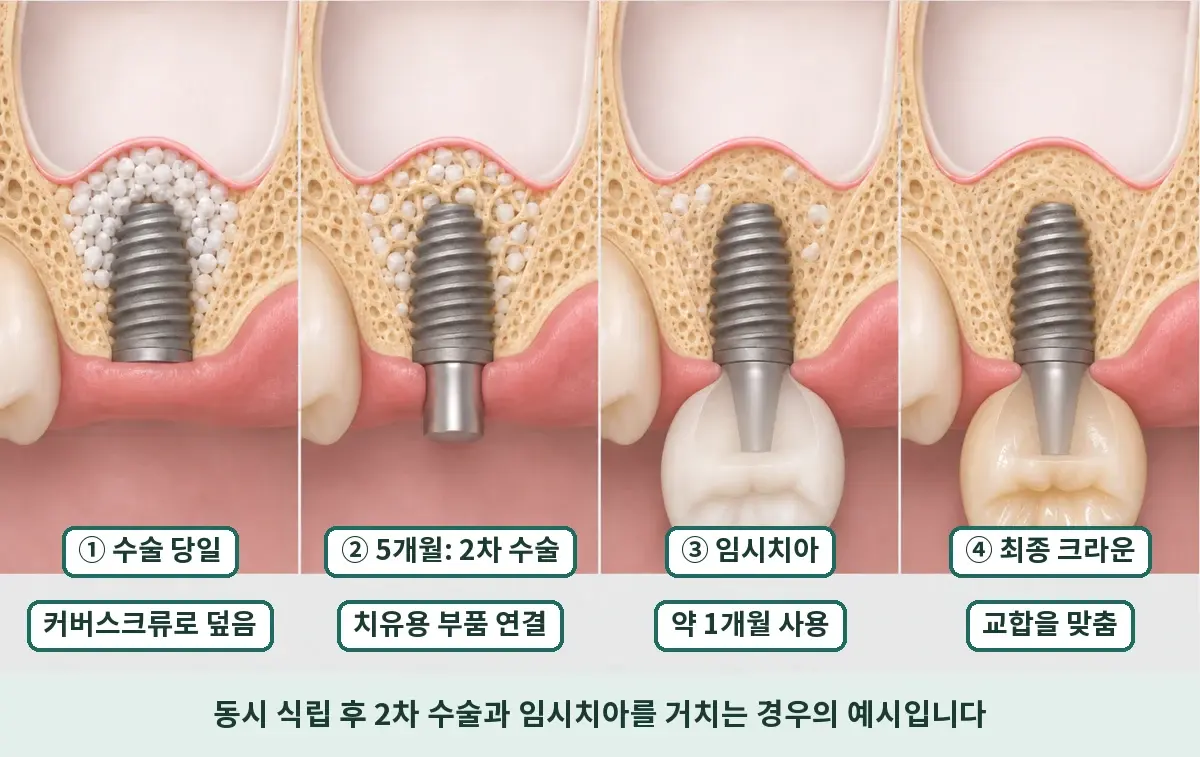
Yeonhap Dental Clinic covers an implant placed on the same day as the lift with a cover screw. There is one reason. During the osseointegration period, when the implant bonds to the bone, if a part that protrudes upward is touched by the tongue, food, or a temporary denture, tiny movements occur, and once that movement exceeds a certain line, fibrous tissue forms instead of bone and the implant fails. A review pooling experimental literature reports that line as between 50 and 150 µm, and notes that it is not zero and that only excessive movement is the direct cause of fibrous attachment (Szmukler-Moncler 1998). At a lifted site, fresh graft material lies beneath, so we are more conservative. We use a cover screw 2 mm longer so it is easy to find at the second-stage surgery.
To be honest, a Cochrane review of 5 randomized studies (239 patients) comparing one-stage and two-stage placement found no significant difference in prosthesis and implant failure at the patient level. However, the same review concluded that the two-stage method is indicated when primary stability is insufficient, when a barrier membrane is used, or when a temporary denture can transmit force (Esposito 2009). Lifted sites often meet these conditions, so I make the two-stage method the default.
There is only one case in which we use the one-stage method: when a tooth is extracted, the implant is placed on the same day, and a lift is also done. The extraction site has a large empty space, and we think it is better to fill that space to some extent by attaching a healing abutment. At all other lifted sites we keep to the two-stage method without exception.
What is the basis for Yeonhap Dental Clinic in Tap-dong, Suwon waiting 5 months after a sinus lift?
Five months is the healing period our clinic normally applies at sites with little remaining bone.
The graft material placed in a lift is not bone itself but a framework into which new bone grows. A meta-analysis pooling 136 biopsy studies at lifted sites reported that the proportion of new bone was significantly higher in the group whose healing exceeded 4.5 months, and that for most materials there was no significant difference between 4.5–9 months (average 6.2 months) and 9–13.5 months (average 10.4 months) (Danesh-Sani 2017). In other words, the group beyond 4.5 months had a higher proportion of new bone, and the effect of waiting longer than that varies by material (only allograft increased further).
Yeonhap Dental Clinic refers to this result and adds our clinic's experience to set 5 months as the standard. Even at difficult sites with only 1–2 mm of remaining bone, 5 months was enough to take an impression after the second-stage surgery and use provisional teeth. When the remaining bone is a comfortable 4–5 mm, we sometimes do the second-stage surgery at 4 months. We still record the standard as 5 months to stay on the safe side even for difficult sites. This period is not a value from the literature but Yeonhap Dental Clinic's clinical criterion.
At sites with very little remaining bone, we must look carefully not only at the time of surgery but also at the long-term course. In a study that followed 123 implants placed simultaneously with lateral lifts at sites with 3 mm or less of remaining bone for up to 12 years, the 6-year cumulative survival was 95.7%, but for 2 mm or less of remaining bone the 10-year survival was 53.3% (with a wide confidence interval of 27.5–100%), lower than for more than 2 mm (92.9%), and smoking also raised the risk (Wang 2023). This study did not compare healing periods, so the basis for deciding the period is the biopsy result in the previous paragraph, and this result is evidence that the care that follows matters. If inflammation remains in the sinus, this 5-month calculation does not even begin; the sequence when inflammation does not settle after an extraction is in When Sinusitis Won't Settle Before an Implant.
Does the lifted bone remain after several years?
The lifted bone height decreases over time, and in the Hatano study it reached about the height of the implant tip after 2–3 years and then stayed relatively stable.
Let me state the unfavorable figures first. In a study that followed 20 patients lifted with autogenous bone and beta-TCP for 4.5 years or more, the lifted height decreased significantly regardless of material, and the rate of decrease slowed over time (Zijderveld 2009). In a study that followed 191 patients, lifted with a 2:1 mixture of autogenous bone and xenograft with simultaneous implant placement, for up to about 10 years, the lifted floor came down to the same height as the implant tip or slightly below it after 2–3 years, then that relationship was maintained, implant survival was 94.2%, and all failures occurred within 3 years (Hatano 2004).
So I set the goal of a sinus lift not as creating a lot of height but as the implant staying covered by bone beyond 3 years. In that study the first 3 years were the critical period, and afterward the bone around the implant was maintained even as the lifted height came down slightly. However, some studies have reported late failures, so at regular check-ups after the lift we continue to monitor the height on panoramic images.
Why are one month of provisional teeth and the bite managed separately?
When gradual adaptation to load is needed, chewing force is applied in stages with provisional teeth.
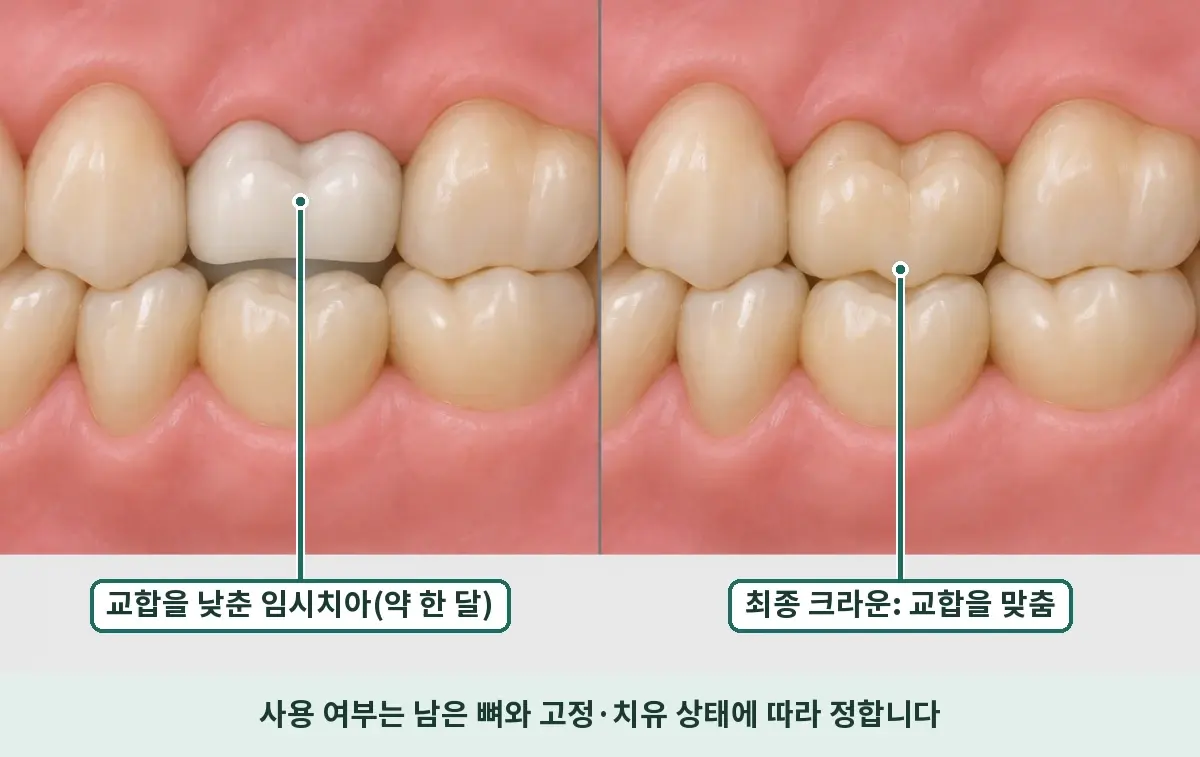
When bone formation and gradual adaptation to load are needed, we usually do the second-stage surgery after 5 months, and after the impression and fabrication, use provisional teeth with a lowered bite for about one month. If the remaining bone and the stability and healing are good, we sometimes finish the final prosthesis in about 4–5 months without going through provisional teeth.
We note that the level of evidence is low. In a small randomized study that divided 20 single implants in upper molars into progressive loading and conventional loading, marginal bone loss at 12 months was 0.11 mm with progressive loading and 0.36 mm with conventional loading, less with progressive loading, but the difference in bone density was not significant (Ghoveizi 2013). That study's design changed the provisional prosthesis at 2, 4, and 6 months and connected the final prosthesis at 8 months, so its timing differs from Yeonhap Dental Clinic's one month of provisional teeth, and as a study of 10 patients it is not a figure on which a conclusion can be drawn. I present this method not as a standard the literature has proven but as a sequence we have kept to in practice.
Whether it is a provisional tooth or the final prosthesis, I personally check and adjust the bite. If force is skewed to one side on an implant at a lifted site, the new bone beneath is affected first, so I regard the moment the prosthesis comes back from the dental laboratory as the beginning, not the end. For one or two implants, we do not do immediate loading, where you chew on them the day they are placed. Why a sinus lift is counted as a separate item in cost and NHI coverage at age 65 are summarized in Sinus Lift Implants in Tap-dong.
Timeline after a sinus lift, and Yeonhap Dental Clinic's sequence by remaining bone height
| Timing | What we do | Nature and source |
|---|---|---|
| Day of surgery | Sinus lift and implant placement, covered with a cover screw (two-stage method) | Clinic clinical criterion |
| Day of surgery, when done together with extraction | Healing abutment attached only when extraction, lift, and placement are done together (one-stage method) | Clinic clinical criterion |
| 2 weeks after surgery | Avoid blowing your nose hard, using straws, and air travel, and do not chew on the grafted site | Clinic clinical criterion |
| 4 months | Second-stage surgery possible for sites that had 4–5 mm of remaining bone | Clinic clinical criterion |
| 5 months | Second-stage surgery even for sites with 1–2 mm of remaining bone (reference value) | Clinic clinical criterion |
| 1 week after second-stage surgery | Impression | Clinic clinical criterion |
| 1 week after the impression | If needed, fit provisional teeth with a lowered bite, used for about 1 month | Clinic clinical criterion |
| 1 month after provisional teeth | Final crown, bite adjusted (adjusted personally by the director) | Clinic clinical criterion |
| 2–3 years | The period when the lifted floor comes down to the height of the implant tip (in the Hatano study, all failures occurred within 3 years) | Literature value (Hatano 2004) |
What can go wrong with a sinus lift in Gwonseon-gu and Tap-dong, Suwon, and what to check
The most common complications are membrane perforation during surgery and sinusitis before or after surgery.
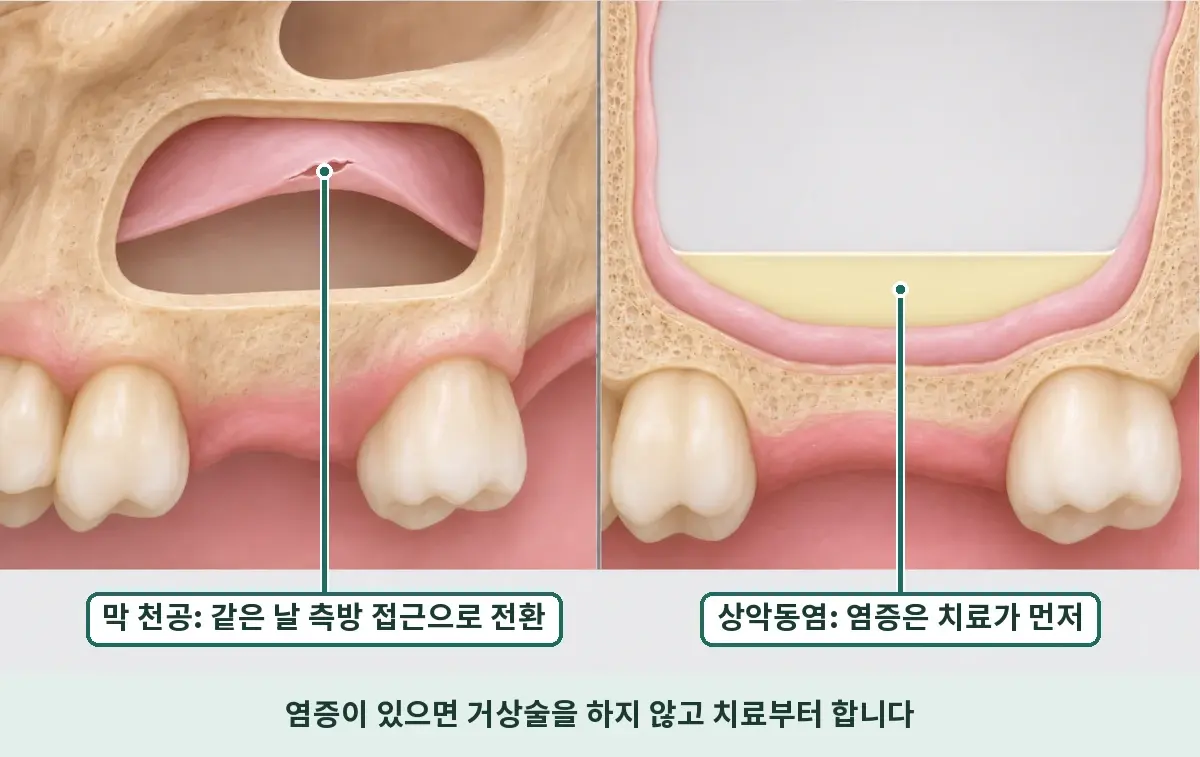
Membrane perforation is the most common complication in both approaches, and sinusitis, if present before surgery, causes the lift itself to be postponed. Yeonhap Dental Clinic checks for perforation in four ways. If perforation is confirmed, we switch to the lateral approach on the same day, and if primary stability is secured, we complete the bone graft and placement. If it is not secured, we do the sinus lift first. If there is inflammation, we do not lift and treat it first. What happens in each case is summarized in Sinus Lift Implants in Gwonseon-gu.
[Key Takeaways]
✓ If less than 7 mm of bone remains, we consider a lift, and choose between crestal (hydraulic lift) and lateral according to membrane condition and primary stability. The 7 mm figure is Yeonhap Dental Clinic's clinical criterion.
✓ We use the two-stage method as the default for implants at lifted sites, with roughly 5 months as the standard and the timing of the second-stage surgery set according to the condition. The basis is the micromotion threshold reported in the experimental literature (range of about 50–150 µm) and the higher proportion of new bone in the group whose healing exceeded 4.5 months (Szmukler-Moncler 1998, Danesh-Sani 2017).
✓ The lifted bone height decreases over time, and in the Hatano study it reached about the height of the implant tip after 2–3 years and then stayed relatively stable, with all failures occurring within 3 years. Long-term follow-up is still needed afterward (Hatano 2004, Wang 2023).
[5 Things to Check in a Sinus Lift Consultation]
· How many millimeters of bone remain up to the sinus floor on 3D CT
· Whether the sinus membrane is healthy, and whether there is inflammation or clouding
· Whether they go crestal or lateral, and why
· Whether the implant is covered (two-stage method), and how many months until the second-stage surgery
· How long the provisional teeth period is, and who adjusts the bite of the final prosthesis
Yeonhap Dental Clinic is located across from Suwon NongHyup Guun Branch (231 Geumho-ro), on the 5th floor at 230 Geumho-ro, Gwonseon-gu, Suwon, Gyeonggi-do (Tap-dong, Cham Clinic Building).
What I Always Add for Patients Who Have Come After Hearing a Sinus Lift Explained
To patients who come to a consultation startled by the words "major surgery," I show three numbers before the size of the surgery: how many millimeters of bone remain, how many months you will wait, and how many weeks you will use provisional teeth. Once these numbers are set, the method follows, and whether it is crestal or lateral, when both can be done on the same day, I first choose the one that makes your recovery easier. The two-stage method and the usual 5 months are our clinic's basic principles applied at difficult sites with little remaining bone. What we check on CT at the first consultation and how to book are summarized in Sinus Lift Implants in Suwon.
References
This post was written as of October 2026.
📋 Treatment Information
This post was written in compliance with the Korean Medical Service Act and the Ministry of Health and Welfare's medical advertising guidelines, and is intended to provide medical information. It does not guarantee or assert the effect of any specific treatment. The technique that can be applied and the course of treatment differ from person to person depending on remaining bone height, the condition of the sinus, and general health, so please be sure to consult fully with your dental team before deciding on diagnosis and treatment direction.
🦷 Sinus lift implant information: Sinus Lift Implants in Suwon
📍 5th Floor, 230 Geumho-ro, Gwonseon-gu, Suwon, Gyeonggi-do (Tap-dong, Cham Clinic Building)
🚕 Across from Suwon NongHyup Guun Branch (231 Geumho-ro) / about 15 minutes by taxi from Suwon Station
🚗 Free parking available in the building
📞 031-293-2207
🌐 yeonhapdental.com
🟡 Opened in 2002 / Treatment overseen by Dr. Ahn Seong-jin, Chief Director and Integrated Dentistry specialist
🔗 Online booking and consultation
Frequently Asked Questions
- At how many millimeters of remaining bone is a sinus lift done?
- At Yeonhap Dental Clinic, if less than 7 mm of bone remains up to the floor of the sinus on 3D CT, we consider a sinus lift, and if it is 7 mm or more, we place the implant without a lift. This 7 mm is not a literature value but our clinic's clinical criterion, and the literature often reports results divided at 5 mm of remaining bone (Del Fabbro 2012).
- Can the sinus lift and implant placement be done on the same day?
- If the sinus membrane is healthy and the implant gets grip in the bone at the moment of placement (primary stability), the sinus lift and implant placement are done on the same day. If perforation is confirmed during the crestal approach, we switch to the lateral approach on the same day, and if primary stability is secured, we complete the bone graft and placement. If it is not secured, we do the sinus lift first.
- Why is the implant covered after a sinus lift (two-stage method)?
- In the experimental literature, the threshold of micromotion that interferes with osseointegration is reported to be in the range of about 50–150 µm (Szmukler-Moncler 1998), so Yeonhap Dental Clinic uses the two-stage method, covering implants at sinus lift sites with a cover screw, as the default. The one-stage method, with a healing abutment attached, is used only when extraction, lift, and placement are done on the same day.
- Why 5 months until the second-stage surgery after a sinus lift?
- The proportion of new bone in sinus lift graft material was reported to be significantly higher in the group whose healing exceeded 4.5 months (Danesh-Sani 2017), and Yeonhap Dental Clinic refers to this and adds our clinic's experience, taking into account sites with 1–2 mm of remaining bone, to set roughly 5 months as the standard. If the remaining bone is 4–5 mm, we sometimes do the second-stage surgery at 4 months.
- Does the bone created by a sinus lift disappear later?
- The height raised by a sinus lift decreases over time and approaches the height of the implant tip after 2–3 years, but afterward it was maintained and implant survival of 94.2% was reported (Hatano 2004). In that study all failures occurred within 3 years, but some studies have reported late failures, so regular check-ups are needed afterward as well.
- Why are provisional teeth used for a month after a sinus lift?
- When gradual adaptation to load is needed, we use provisional teeth with a lowered bite for about one month and then adjust the bite of the final crown. Whether to use them is decided according to the remaining bone and the stability and healing. There is a small study on progressive loading (Ghoveizi 2013), but the level of evidence is low, so we present it as our clinic's clinical sequence.
- Where can I get a sinus lift consultation in Gwonseon-gu, Suwon?
- Yeonhap Dental Clinic is located on the 5th floor at 230 Geumho-ro, Gwonseon-gu, Suwon, Gyeonggi-do (Tap-dong, Cham Clinic Building), across from Suwon NongHyup Guun Branch, and at the first consultation we check the remaining bone height and sinus membrane condition on 3D CT and explain the sinus lift method and timeline.
상악동거상술 뒤 시간표, 남은 뼈 높이에 따른 연합치과의원 진행 순서
| 시점 | 하는 것 | 성격·출처 |
|---|---|---|
| 수술 당일 | 상악동거상술과 임플란트 식립, 커버스크류로 덮음(2회법) | 본원 임상 기준 |
| 수술 당일, 발치와 동시일 때 | 발치·거상술·식립을 같이 할 때만 치유용 부품 연결(1회법) | 본원 임상 기준 |
| 수술 뒤 2주 | 코 세게 풀기·빨대·비행기 탑승을 피하고 이식 부위로 씹지 않음 | 본원 임상 기준 |
| 4개월 | 남은 뼈가 4~5mm였던 자리는 2차 수술 가능 | 본원 임상 기준 |
| 5개월 | 남은 뼈 1~2mm 자리까지 2차 수술(기준값) | 본원 임상 기준 |
| 2차 수술 1주 뒤 | 본뜨기 | 본원 임상 기준 |
| 본뜬 1주 뒤 | 필요한 경우 교합을 낮춘 임시치아 장착, 약 1개월 사용 | 본원 임상 기준 |
| 임시치아 1개월 뒤 | 최종 크라운, 교합을 맞춤(원장 직접 조정) | 본원 임상 기준 |
| 2~3년 | 거상한 바닥이 임플란트 끝 높이로 내려오는 시기(Hatano 연구에서는 모든 실패가 3년 안에 발생) | 문헌값(Hatano 2004) |
수원 권선구·탑동에서 상악동거상술을 받을 때 잘못될 수 있는 것과 확인할 기준
가장 흔한 합병증은 수술 중 막 천공과 수술 전후의 상악동염입니다.
막 천공은 두 접근 모두에서 가장 흔한 합병증이고, 상악동염은 수술 전에 있으면 거상술 자체를 미루게 합니다. 연합치과의원은 천공을 네 가지 방법으로 확인합니다. 천공이 확인되면 같은 날 측방 접근으로 전환하며, 초기 고정이 확보되면 골이식과 식립을 마칩니다. 확보되지 않으면 상악동거상술을 먼저 합니다. 염증이 있으면 거상술을 하지 않고 치료부터 합니다. 각각 생기면 어떻게 되는지는 권선구 상악동거상술 임플란트에 정리했습니다.
[핵심 정리]
✓ 남은 뼈 7mm 미만이면 거상술을 검토하고, 막 상태와 초기 고정에 따라 치조정(수압 거상)과 측방을 고릅니다. 7mm는 연합치과의원 임상 기준입니다.
✓ 거상술 부위 임플란트는 2회법을 기본으로 하며, 통상 5개월을 기준으로 상태에 따라 2차 수술 시점을 정합니다. 실험 문헌에서 보고된 미세움직임 역치(약 50~150µm 범위)와 치유 4.5개월을 넘긴 군의 새 뼈 비율 증가가 그 근거입니다(Szmukler-Moncler 1998, Danesh-Sani 2017).
✓ 거상한 뼈 높이는 시간이 지나며 줄고, Hatano 연구에서는 2~3년 뒤 임플란트 끝 높이 부근에 이른 후 비교적 안정적으로 유지됐으며 모든 실패가 3년 안에 있었습니다. 이후에도 장기 검진은 필요합니다(Hatano 2004, Wang 2023).
[상악동거상술 상담에서 확인할 다섯 가지]
· 3D CT에서 상악동 바닥까지 남은 뼈 높이가 몇 mm인지
· 상악동 막이 건강한지, 염증이나 혼탁이 있는지
· 치조정과 측방 중 무엇으로 가는지, 그 이유가 무엇인지
· 임플란트를 덮어 두는지(2회법), 2차 수술까지 몇 개월인지
· 임시치아 기간과 최종 보철 교합을 누가 조정하는지
연합치과의원은 수원농협 구운지점(금호로 231) 맞은편, 경기 수원시 권선구 금호로 230, 5층(탑동, 참클리닉빌딩)에 있습니다.
상악동거상술 설명을 듣고 오신 분께 제가 꼭 덧붙이는 말
상담에서 큰 수술이라는 말에 놀라 오신 분께 저는 수술의 크기보다 세 숫자를 먼저 보여 드립니다. 남은 뼈가 몇 mm인지, 몇 개월을 기다릴지, 임시치아를 몇 주 쓸지입니다. 이 숫자들이 정해지면 방법은 따라오고, 그 방법이 치조정이든 측방이든 둘 다 같은 날 할 수 있는 상태에서 환자분 회복이 편한 쪽을 먼저 고릅니다. 2회법과 통상 5개월은 남은 뼈가 적은 어려운 자리에서 적용하는 본원의 기본 원칙입니다. 첫 상담에서 CT로 무엇을 확인하는지와 예약은 수원 상악동거상술 임플란트에 정리해 두었습니다.
참고문헌
📋 진료 안내
본 게시글은 의료법 및 보건복지부 의료광고 가이드라인을 준수해 작성되었으며, 의학 정보 제공을 목적으로 합니다. 특정 치료의 효과를 보장하거나 단정하지 않으며, 남은 뼈 높이와 상악동 상태, 전신 건강에 따라 적용 가능한 술식과 경과는 사람마다 달라지므로 진단과 치료 방향은 반드시 의료진과 충분히 상담하신 뒤 결정하시기 바랍니다.
🦷 상악동거상술 임플란트 진료 안내: 수원 상악동거상술 임플란트
📍 경기 수원시 권선구 금호로 230, 5층 (탑동, 참클리닉빌딩)
🚕 수원농협 구운지점(금호로 231) 맞은편 / 수원역 택시 약 15분
🚗 건물 내 무료주차 가능
📞 031-293-2207
🌐 yeonhapdental.com
🟡 2002년 개원 / 통합치의학과 전문의 안성진 대표원장 책임 진료
🔗 온라인 예약 및 상담
자주 묻는 질문
- 상악동거상술은 남은 뼈가 몇 mm일 때 하나요?
- 연합치과의원은 3D CT에서 상악동 바닥까지 남은 뼈가 7mm 미만이면 상악동거상술을 검토하고, 7mm 이상이면 거상술 없이 심습니다. 이 7mm는 문헌값이 아니라 본원 임상 기준이며, 문헌은 남은 뼈 5mm를 경계로 성적을 나눠 보고하는 경우가 많습니다(Del Fabbro 2012).
- 상악동거상술과 임플란트 식립을 같은 날 할 수 있나요?
- 상악동 막이 건강하고 임플란트가 심는 순간 뼈에 물리는 힘(초기 고정)이 나오면 상악동거상술과 식립을 같은 날 합니다. 치조정 접근 도중 천공이 확인되면 같은 날 측방 접근으로 전환하며, 초기 고정이 확보되면 골이식과 식립을 마칩니다. 확보되지 않으면 상악동거상술을 먼저 합니다.
- 상악동거상술 뒤 임플란트를 왜 덮어 두나요(2회법)?
- 실험 문헌에서는 골유착을 방해하는 미세움직임의 역치가 약 50~150µm 범위로 보고되어(Szmukler-Moncler 1998), 연합치과의원은 상악동거상술 부위 임플란트를 커버스크류로 덮어 두는 2회법을 기본으로 합니다. 발치·거상술·식립을 같은 날 할 때만 치유용 부품을 올리는 1회법을 씁니다.
- 상악동거상술 뒤 2차 수술까지 왜 5개월인가요?
- 상악동거상술 이식재의 새 뼈 비율은 치유 4.5개월을 넘긴 군에서 유의하게 높았다고 보고되어(Danesh-Sani 2017), 연합치과의원은 이를 참고하고 본원 경험을 더해 남은 뼈 1~2mm인 자리도 고려해 통상 5개월을 기준으로 둡니다. 남은 뼈가 4~5mm면 4개월에 2차 수술을 하기도 합니다.
- 상악동거상술로 만든 뼈는 나중에 없어지나요?
- 상악동거상술로 올린 높이는 시간이 지나며 줄어 2~3년 뒤 임플란트 끝 높이에 가까워지지만, 그 뒤로는 그 상태가 유지되고 임플란트 생존율 94.2%가 보고되었습니다(Hatano 2004). 그 연구에서는 실패가 모두 3년 안에 생겼지만 후기 실패를 보고한 연구도 있어 그 뒤에도 정기 검진이 필요합니다.
- 상악동거상술 뒤 임시치아는 왜 한 달 쓰나요?
- 단계적 하중 적응이 필요한 경우, 임시치아의 교합을 낮춰 약 한 달 사용한 뒤 최종 크라운의 교합을 맞춥니다. 사용 여부는 남은 뼈와 고정·치유 상태에 따라 정합니다. 점진 부하 관련 소규모 연구가 있지만(Ghoveizi 2013), 근거 등급은 낮아 본원 임상 순서로 안내합니다.
- 수원 권선구에서 상악동거상술 상담은 어디서 받나요?
- 연합치과의원은 경기 수원시 권선구 금호로 230, 5층(탑동, 참클리닉빌딩), 수원농협 구운지점 맞은편에 있으며, 첫 상담에서 3D CT로 남은 뼈 높이와 상악동 막 상태를 확인해 상악동거상술 방법과 기간을 안내합니다.
Related pages
Before your visit
This article provides general information on oral health and dental care. Whether treatment is needed, and which method is appropriate, may change after an oral exam and any necessary diagnostic tests. If you have pain, a loose tooth, swelling, or discomfort with a prosthesis, please visit us for a consultation.