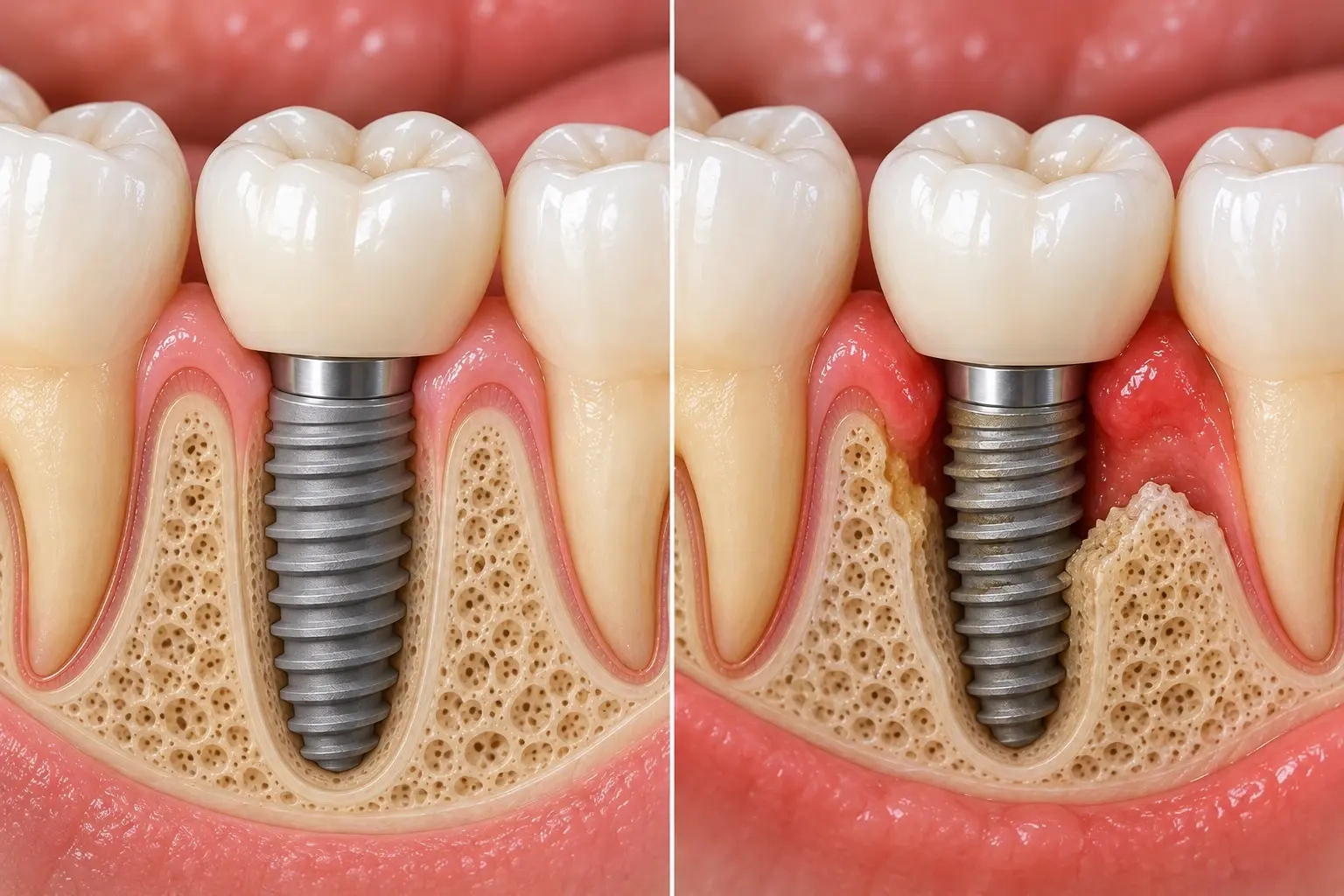
Cross-section diagram comparing an implant whose body is healthily surrounded by bone with peri-implantitis, in which half the surrounding bone has dissolved, threads are exposed, and the gum is swollen

SUWON IMPLANT REVISION

Implant Reoperation: Three Key Things That Decide It

Judgment on implant reoperation differs by what kind of problem it is. We first look at whether it can be solved while keeping the implant body, and not every loose implant is removed.

Why Diagnosis Matters

Implant reoperation: judgment differs by what kind of problem it is

The causes for considering implant reoperation fall into peri-implantitis, fracture and looseness, and front-tooth esthetics and position problems, and each takes a different path. Yeonhap Dental Clinic first identifies what kind of problem it is, looks at whether it can be solved while keeping the implant body, and only then considers removal, and a removed site waits 2–3 months before placing again.

Consultation Checklist

What we check at your first consultation

At the first consultation, we sort out the three points below with an X-ray, stability value (ISQ) measurement, loosening the prosthesis, and checking the front-tooth gum line. Earlier CBCT or panoramic records are not required.

  • Whether swelling and pus keep recurring, and how bone loss, a drop in stability value (ISQ), and the response to 3 treatments look
  • Whether what is loose or fractured is a component such as the screw, abutment, or crown, or the implant body itself
  • For a front tooth, whether the gum has receded and the metal shows, and whether the position or angle deviates from the line of the neighboring teeth

Treatment Options

Whether to keep it or remove it depends on what kind of problem it is

Peri-implantitis, fracture and looseness, and front-tooth esthetics and position problems. We look at them in three branches.

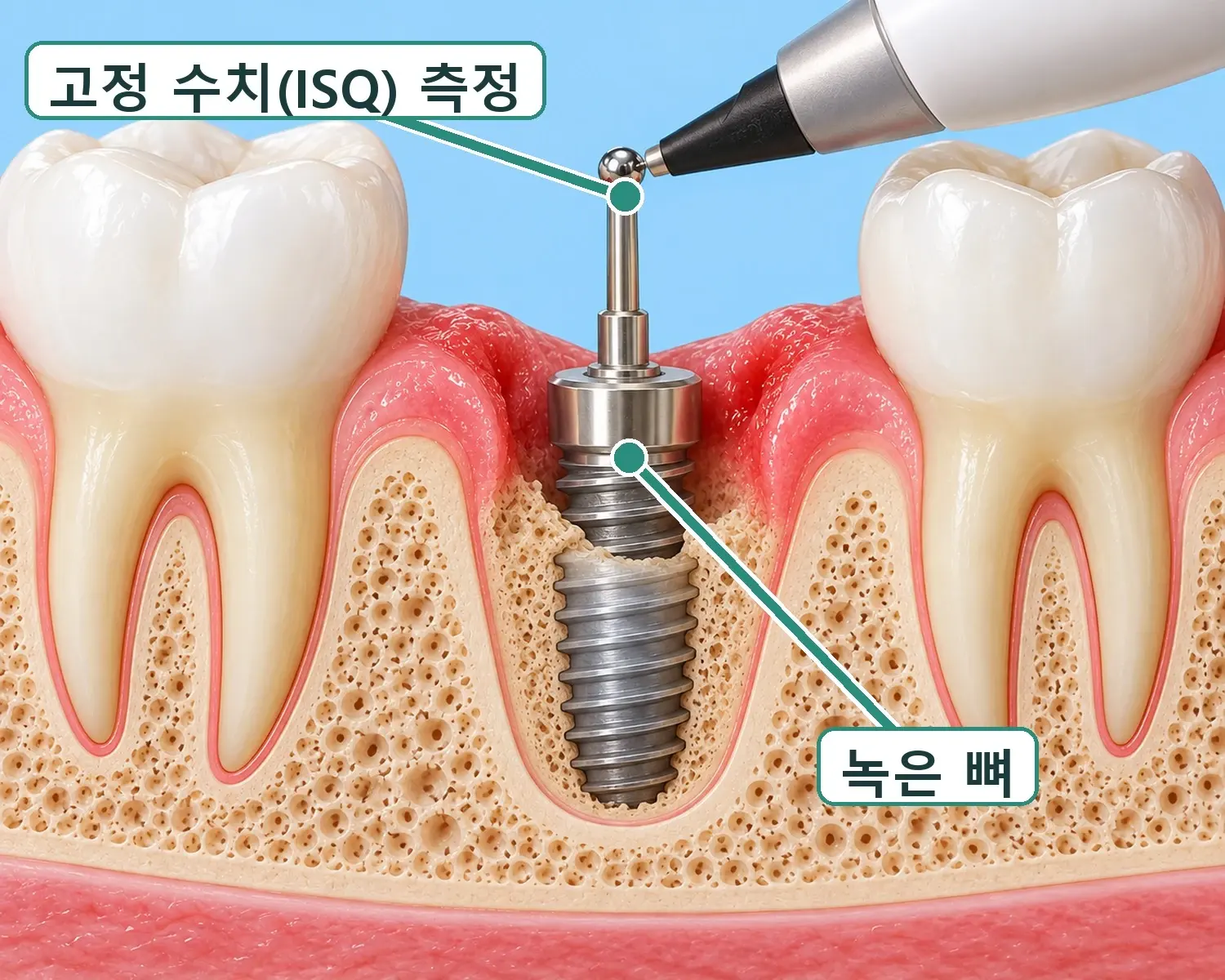
Cross-section diagram of an implant with the crown removed, an ISQ measuring pin attached, and a device measuring stability, with part of the surrounding bone dissolved

Peri-implantitis: keep it with treatment, or remove it

If swelling and pus keep recurring, we look at whether more than half the bone has dissolved, whether the stability value (ISQ) has dropped from before, and whether there was a response to 3 peri-implantitis treatments. The diagnostic criteria for peri-implantitis are not removal criteria; Yeonhap Dental Clinic decides by looking at the three together, and does not remove based on any one alone.

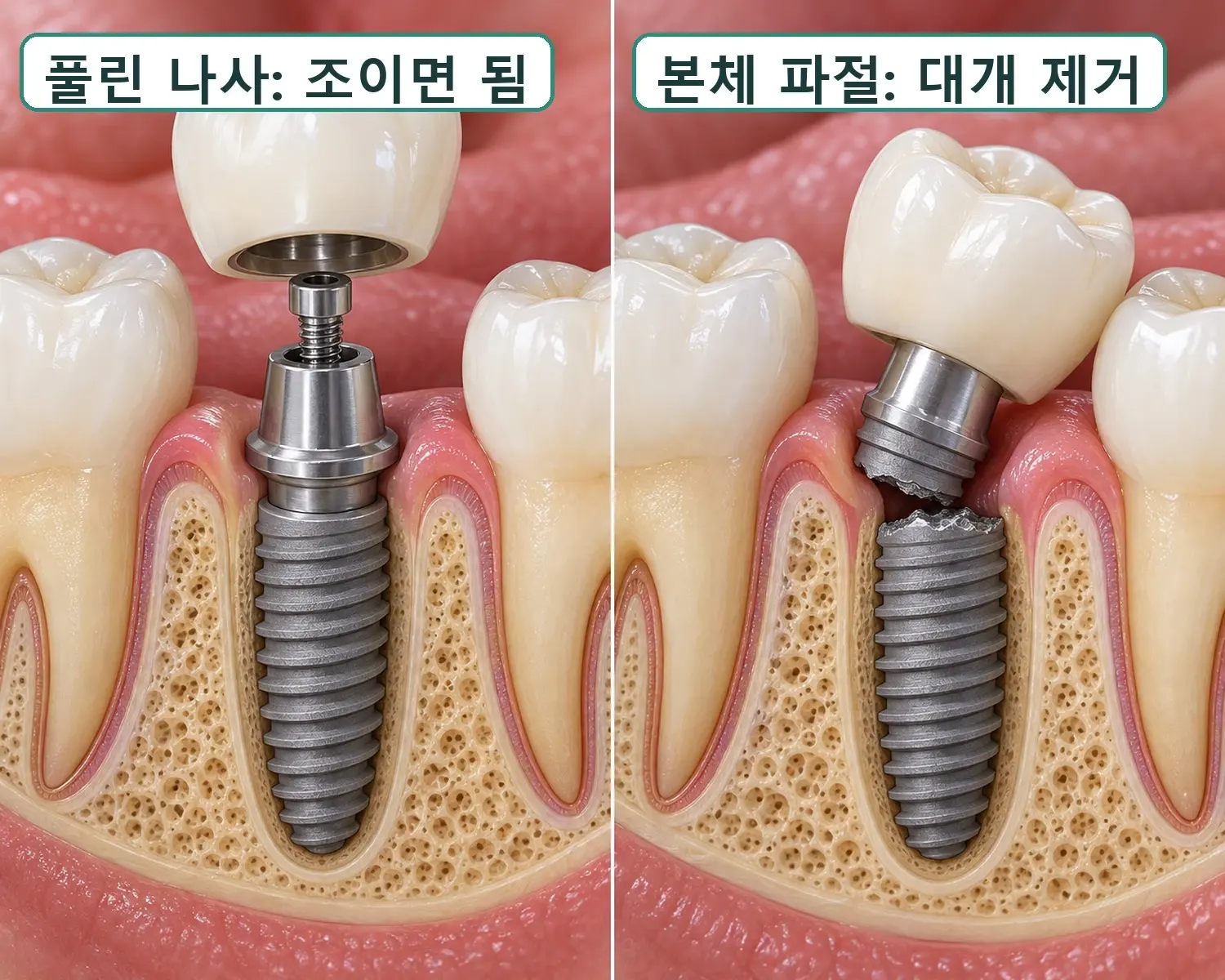
Cross-section diagram comparing an implant whose abutment screw has loosened and lifted the crown with an implant whose body has fractured near the gum

Fracture and looseness: a component problem, or an implant body problem

First we loosen the prosthesis to identify what is moving. For a loosened screw or a crown that came off, we tighten or recement it, and for a fractured component, we look at whether it can be removed and remade. If the implant body has fractured or the body itself moves, we usually remove it.

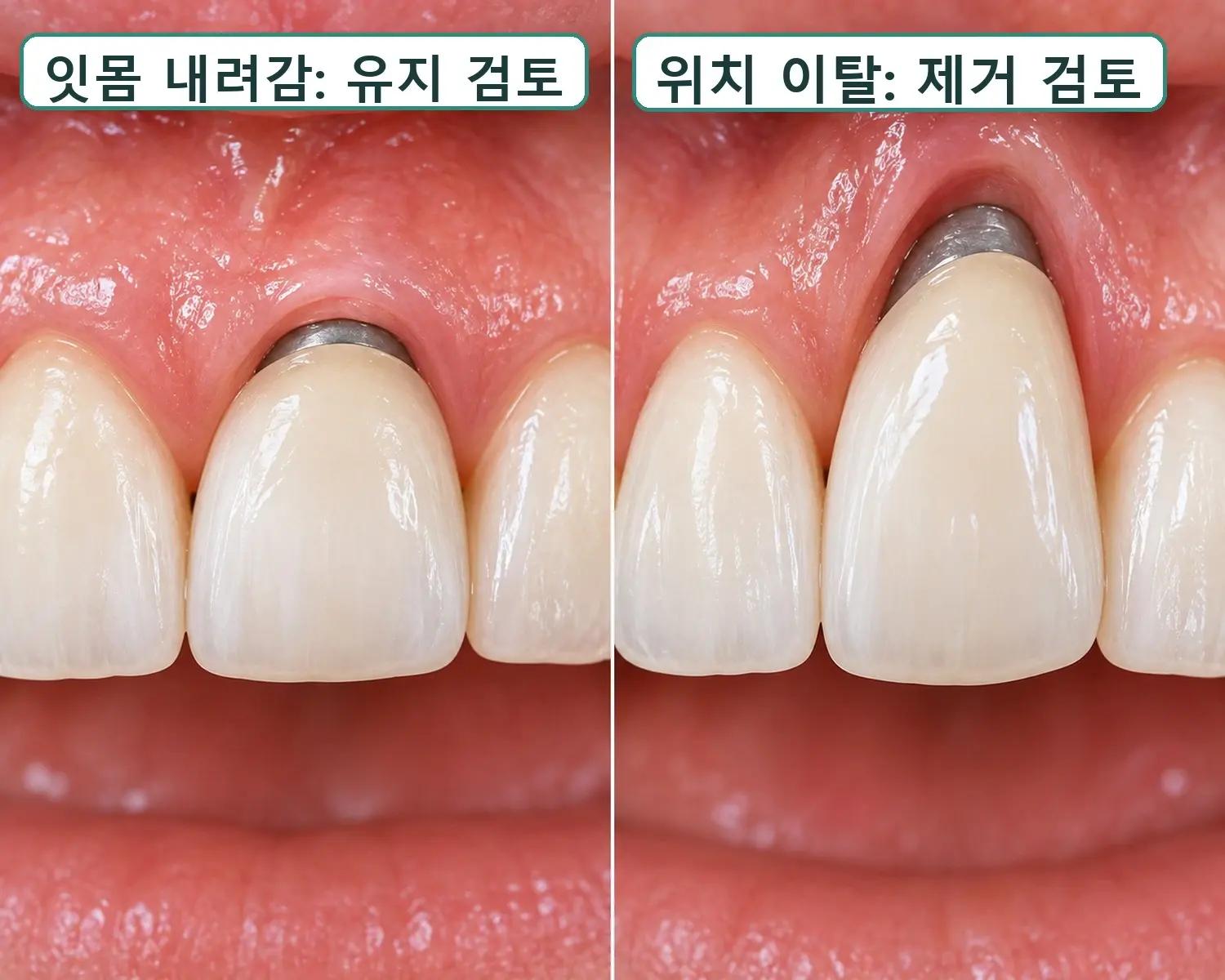
Diagram comparing a front-tooth implant where the gum has receded and the metal margin shows with an implant placed deviating toward the lip

Front-tooth esthetics and position: improve with gum treatment, or re-place

If the position is right but only the gum has receded and the metal shows, it can be improved with a gum graft and prosthesis adjustment. If the gum has receded a lot or the position or angle deviates from the line of the neighboring teeth, we consider removal and re-placement. If there is pus, we also judge based on the degree of bone loss, the change in ISQ, and the response to infection treatment.

Planning Points

2–3 Months After Removal, and What We Change When Placing Again

We do not re-place on the same day. A site that has failed once has a reason, so we address the cause first and proceed safely.

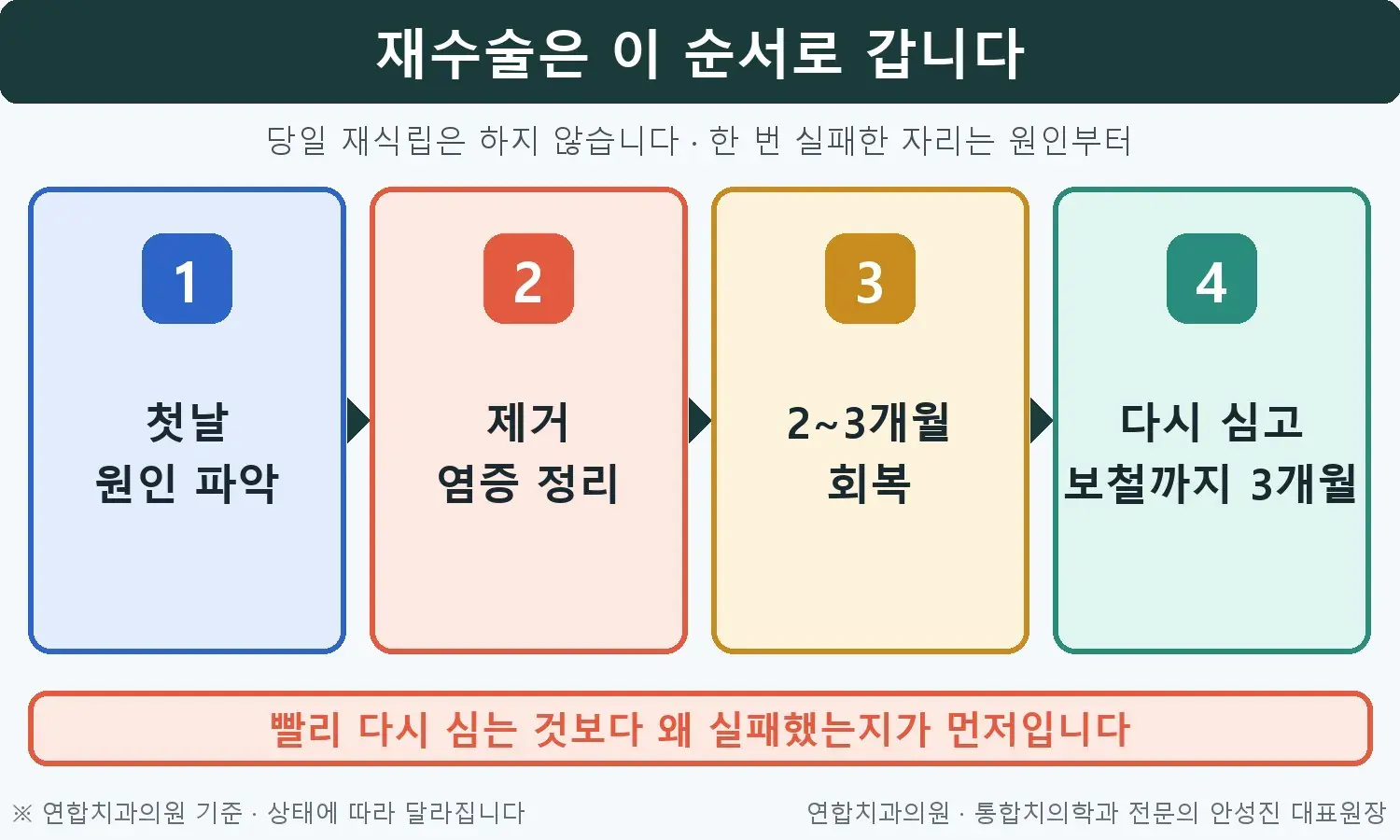
Infographic of the reoperation sequence: identify the cause on day one, removal and inflammation control, 2–3 months of recovery, re-placement and 3 months to the prosthesis

Identify the cause → removal → 2–3 months → re-placement → 3 months to the prosthesis

The site where an implant had to be removed had reasons such as thin gum, thin bone, or difficulty with care. So we do not place on the day of removal, and first address the cause during 2–3 months of recovery. Before placing again, we check conditions that may have contributed to the first failure, such as gum and bone condition, smoking, remaining inflammation, and bite problems, and for the re-placed implant, we wait 3 months before the prosthesis.

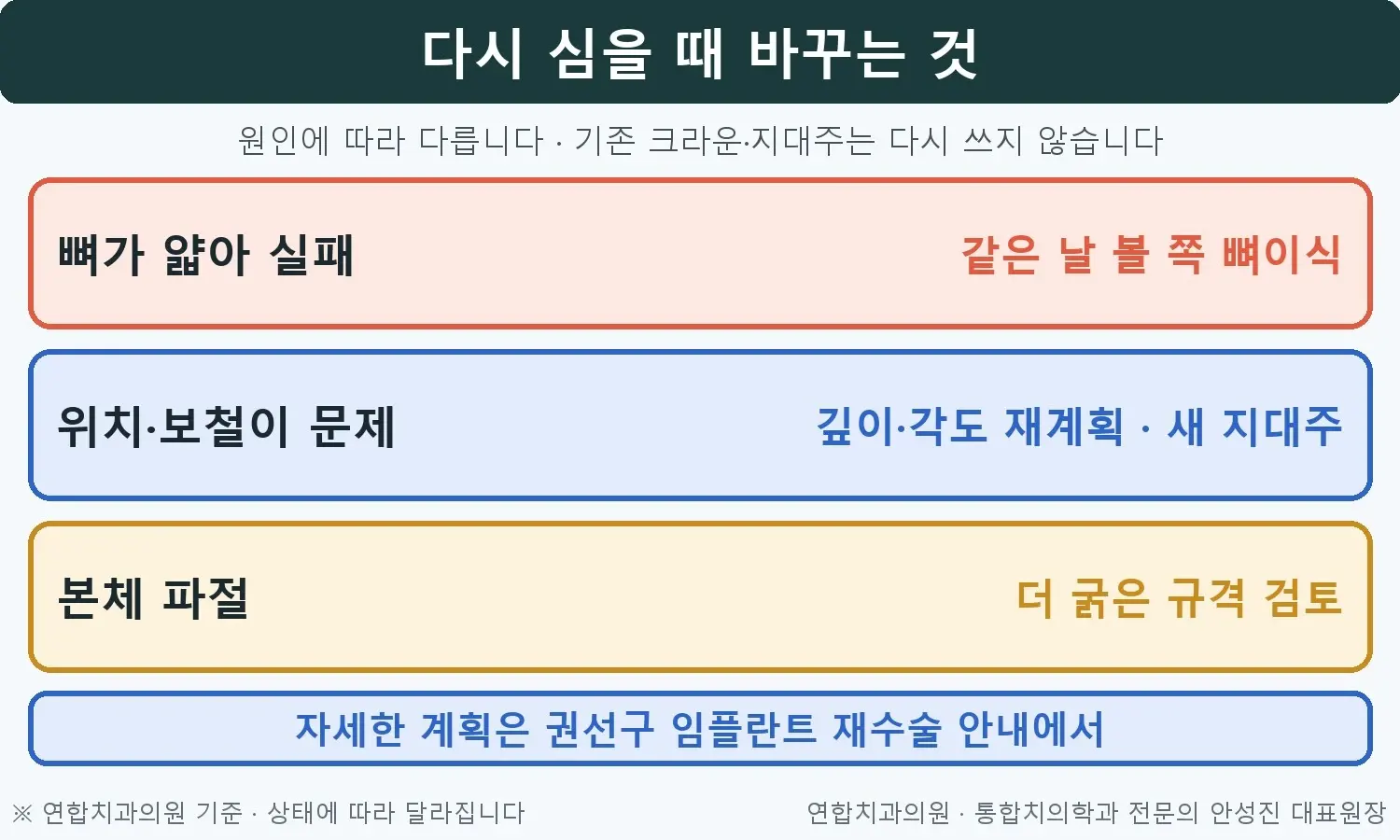
Infographic of what changes when placing again by cause: for lack of bone, a cheek-side bone graft on the same day; for position or prosthesis problems, re-planned depth and angle with a new abutment; for body fracture, a thicker size; see the Gwonseon-gu implant reoperation guide for the detailed plan

What changes when placing again depends on the cause

For a site that failed because the bone was thin, we do a cheek-side bone graft on the same day as placement; for a site where depth, angle, or prosthetic shape was the problem, we re-plan, place, and use a new abutment; and for a site where the body fractured, we consider a thicker size. In any case, we do not reuse the existing crown and abutment, and the detailed plan is explained in our Gwonseon-gu implant reoperation guide.

Before Visit

Helpful details before your visit

If you organize the points below and bring them, at the first consultation we can tell you what kind of problem it is and whether the implant body can be kept. Earlier CBCT or panoramic records are not required.

  • When the swelling, pus, or odor started and how many times it has recurred
  • How long ago the implant was placed, and since when it has been loose, fractured, or the gum has receded
  • How many times you have had gum treatment or taken antibiotics
  • Whether you take diabetes or osteoporosis medication, aspirin, Plavix, or similar drugs, and whether you smoke

Implant Reoperation Criteria: Yeonhap Dental Clinic

Peri-implantitis: We look together at whether more than half the bone has dissolved (5 mm of 10 mm), whether the stability value (ISQ) has dropped from before, and whether there was a response to 3 treatments, and consider removal. From our clinic's observation, a stable implant is usually in the ISQ 80s, and if it is in the 60s after several years, we look at the earlier values, images, and signs of inflammation together. Fracture and looseness: We loosen the prosthesis to identify what is moving; for a loosened screw or a crown that came off, we tighten or recement it, and for a fractured component, we look at whether it can be refabricated. A fractured or mobile implant body is usually removed. Front-tooth esthetics and position: If the position and tissue conditions are suitable, we improve it with a connective tissue graft (CTG), coronal movement of the gum, and prosthesis adjustment; if the gum has receded a lot or the position or angle deviates, we consider removal and re-placement. Pus is judged by the peri-implantitis criteria. Timing of re-placement: We do not place on the day of removal but 2–3 months later, and wait 3 months before the prosthesis. Replacing with a different one is covered in our Gwonseon-gu reoperation guide.

Implant Reoperation: The Evidence and Its Limits

The diagnostic criteria for peri-implantitis are not removal criteria (Berglundh 2018). For gingival dehiscence of a front tooth, in 19 patients treated with crown removal, abutment adjustment, connective tissue graft, coronal movement, and a new prosthesis together, mean coverage at 5 years was 99.2% (Zucchelli 2018), while the estimate of complete coverage in a review was 71%, so coverage rate differs from success rate (Nart 2025). The 1-year survival rate of re-placed implants is 96.7% but lower than the first time (Gareb 2025), and of 69 re-placed implants in Korea, all 8 that failed again were early failures (Park 2022). For this reason, Yeonhap Dental Clinic first identifies what kind of problem it is, looks at whether it can be solved while keeping the implant body, and only then considers removal; we do not remove based on a single number. In a reoperation, knowing why it failed comes before placing again quickly. References: Berglundh 2018, consensus report on classification of peri-implant diseases · Zucchelli 2018, 5-year study of combined soft tissue dehiscence treatment · Nart 2025, systematic review of soft tissue dehiscence treatment · Gareb 2025, meta-analysis of re-placed implants · Park 2022, follow-up of 69 re-placed implants in Korea Treatment results may vary by individual oral condition.

Last updated:

Schedule a consultation by phone or Naver Booking

Leave a few details on our consultation page and we'll get back to you promptly.

Frequently Asked Questions

Q. The gum around my implant keeps swelling. Do I need reoperation?
If swelling keeps recurring, peri-implantitis may be progressing, so we first check the height of the surrounding bone on an X-ray. We look together at whether more than half the bone has dissolved, whether the stability value (ISQ) has dropped from before, and whether there has been no recovery after 3 treatments, and consider removal; if it is at an earlier stage, treatment and care may allow us to keep watching.
Q. If my implant is loose, does it always have to come out?
No. For a loosened screw or a crown that has come off, we tighten it or recement it, and for a fractured component, we look at whether it can be solved by replacement or refabrication. Whether the implant can be kept depends on whether the fractured part can be removed and on damage to the connection of the implant body. Yeonhap Dental Clinic loosens the prosthesis to check what is moving, and if the implant body itself moves, the bond with the bone has been lost, so we usually remove it.
Q. Can an implant be placed again right after it is removed?
Yeonhap Dental Clinic does not re-place an implant on the same day. The site where an implant had to be removed had reasons such as thin gum or bone or difficulty with care, so we first address the cause during 2–3 months of recovery and then place again. Before placing again, we check conditions that may have contributed to the first failure, such as gum and bone condition, smoking, remaining inflammation, and bite problems, and for the re-placed implant, we wait 3 months before the prosthesis. The principle is not to force a site that has failed once.
Q. The gum around my front-tooth implant has receded and the metal shows. Do I need to place it again?
It is not placed again right away. If the implant position and surrounding tissue conditions are suitable, we can improve a receded gum line with a connective tissue graft (CTG), a procedure that moves the gum coronally, and prosthesis adjustment together. If the gum has receded a lot or the position and angle deviate from the line of the neighboring teeth, we consider removal and re-placement. If there is pus, we also judge based on the degree of bone loss, the change in ISQ, and the response to infection treatment. The improvement that can be expected from grafting alone is limited, so at the first consultation Yeonhap Dental Clinic looks at the conditions of that tooth and tells you how far it is possible.
Q. Can I get a consultation about an implant placed long ago without any records?
Yes. Earlier CBCT or panoramic X-rays are not required, and at the first consultation we take new X-rays and ISQ measurements. However, we do ask how long you have used it and since when it has bothered you. The cost of reoperation has the same structure as ordinary placement, and if a bone graft or sinus lift is needed, only that item is added.