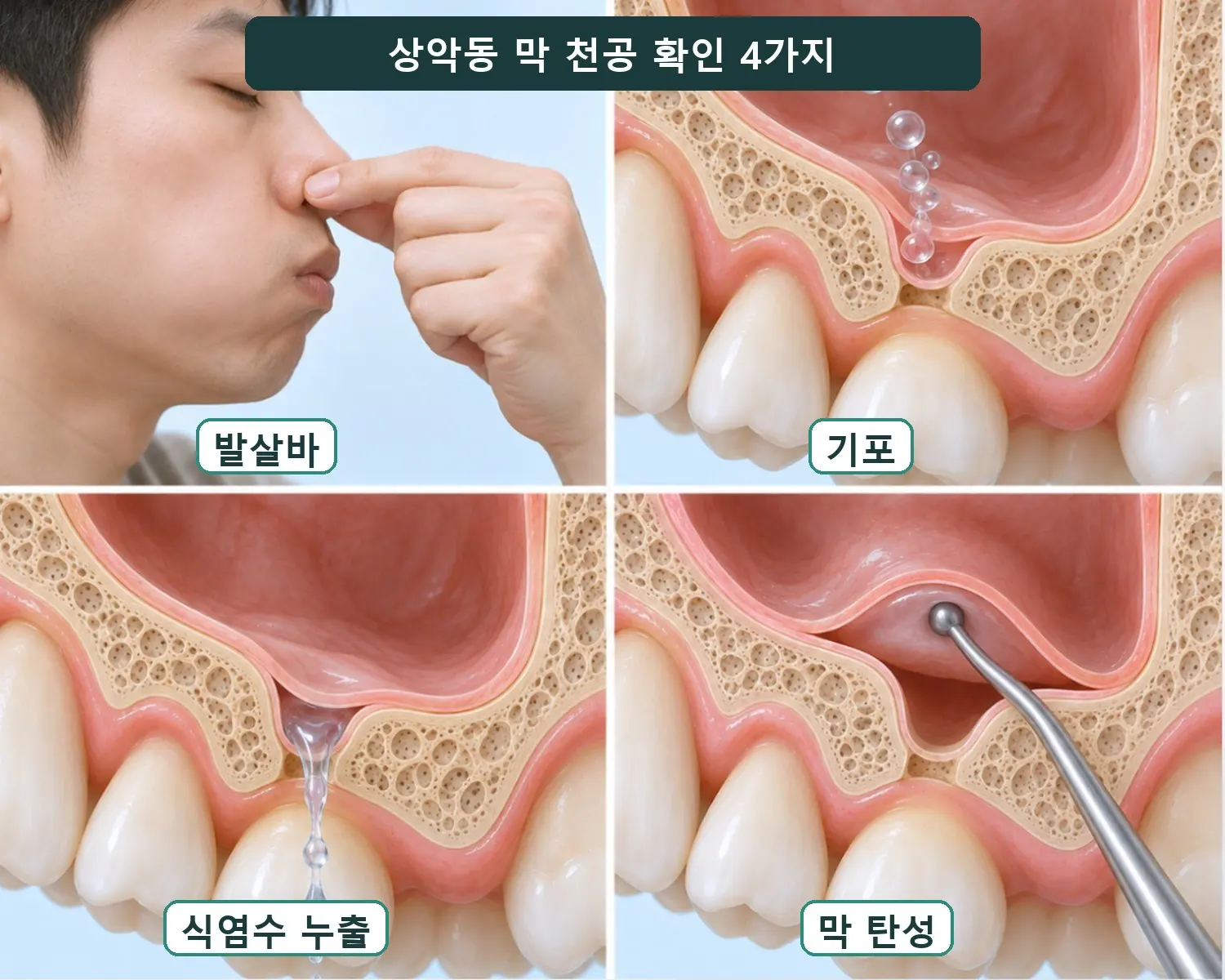
Four perforation checks
We check all four: Valsalva (pinching the nose and exhaling), bubbles, saline leakage, and membrane elasticity. If even one is ambiguous, we treat it as a perforation and move on to the next step.

GWONSEON SINUS LIFT
The two things people worry about most in a sinus lift are membrane perforation and sinusitis. We first tell you what is done if they occur.
Why Diagnosis Matters
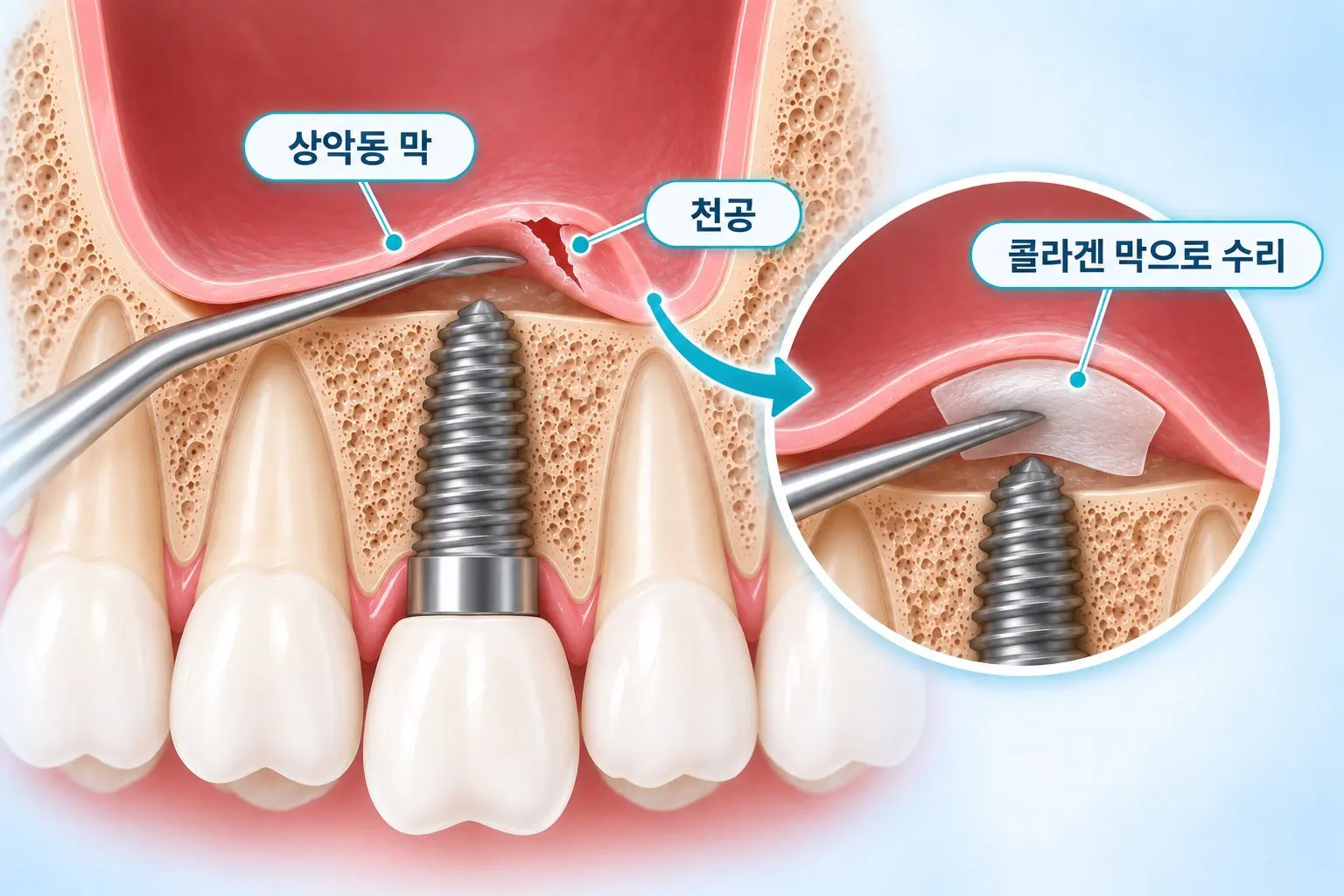
The representative complications of a sinus lift are perforation, in which the sinus membrane tears during surgery, and sinusitis before and after surgery. Membrane perforation is not uncommon, so what decides the result is not whether it is avoided but whether it is caught and repaired. At Yeonhap Dental Clinic, we check for perforation with four methods (Valsalva, bubbles, saline leakage, membrane elasticity), and if the judgment is ambiguous, we treat it as a perforation and switch to the lateral approach on the same day. If sinusitis is present, we postpone the sinus lift, re-check with CBCT 3 months after extraction, and then proceed.
Consultation Checklist
At the first consultation, we use 3D CT to look at the five items below and estimate the risks of perforation and sinusitis in advance.
Treatment Options
In the crestal approach, instead of tapping with instruments, we spread the force across the whole membrane with water pressure to reduce perforation. Perforation can still occur, so we carry out all four checks without exception, and if one is confirmed, we cover it on the spot with a collagen membrane and switch to the lateral approach to repair it.
We check all four: Valsalva (pinching the nose and exhaling), bubbles, saline leakage, and membrane elasticity. If even one is ambiguous, we treat it as a perforation and move on to the next step.
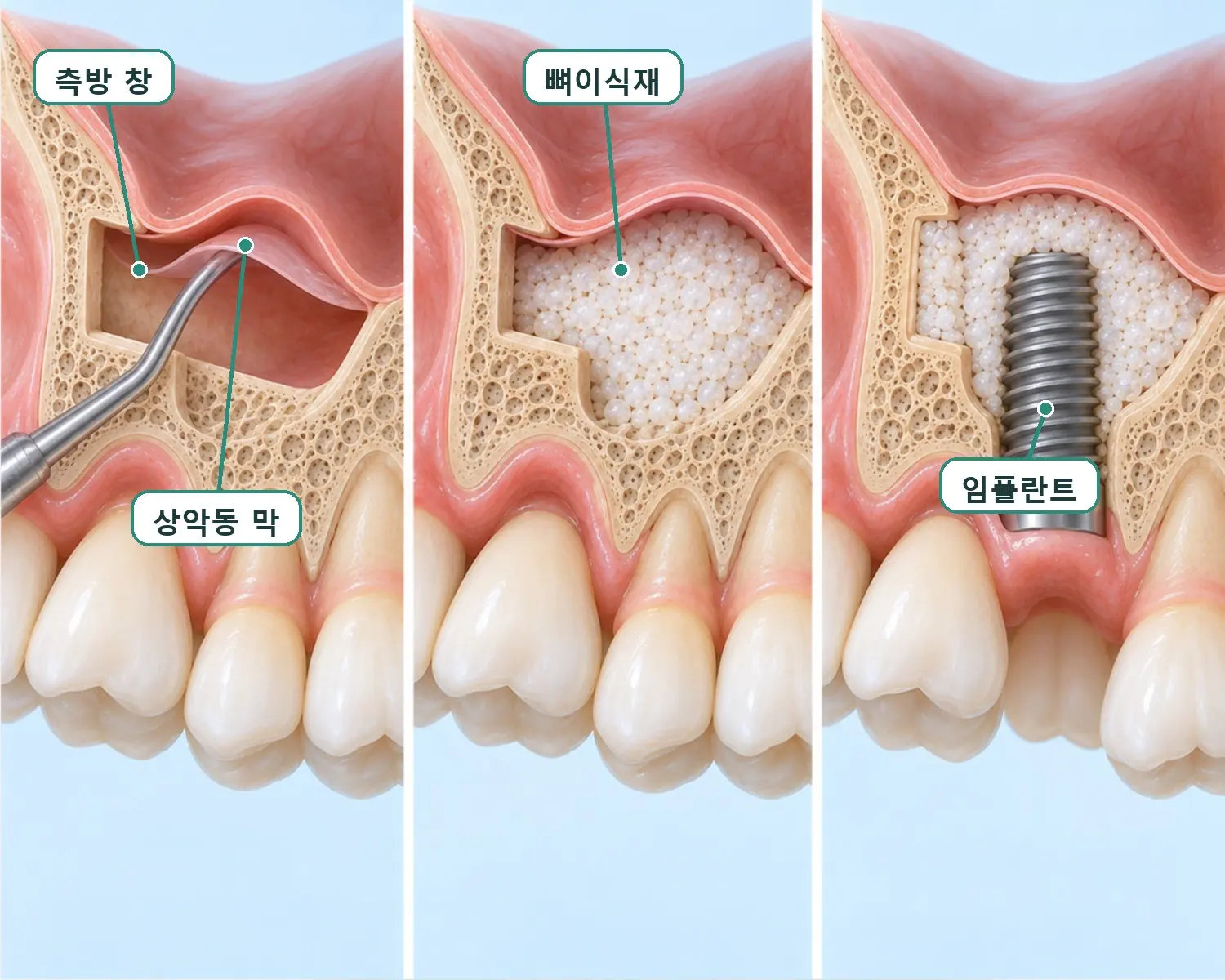
If a perforation is confirmed, we make a window in the cheek-side bone, cover the membrane with a collagen membrane while looking at it directly, and if initial stability is secured, complete the bone graft and placement on the same day. If it is not secured, we do the sinus lift first.
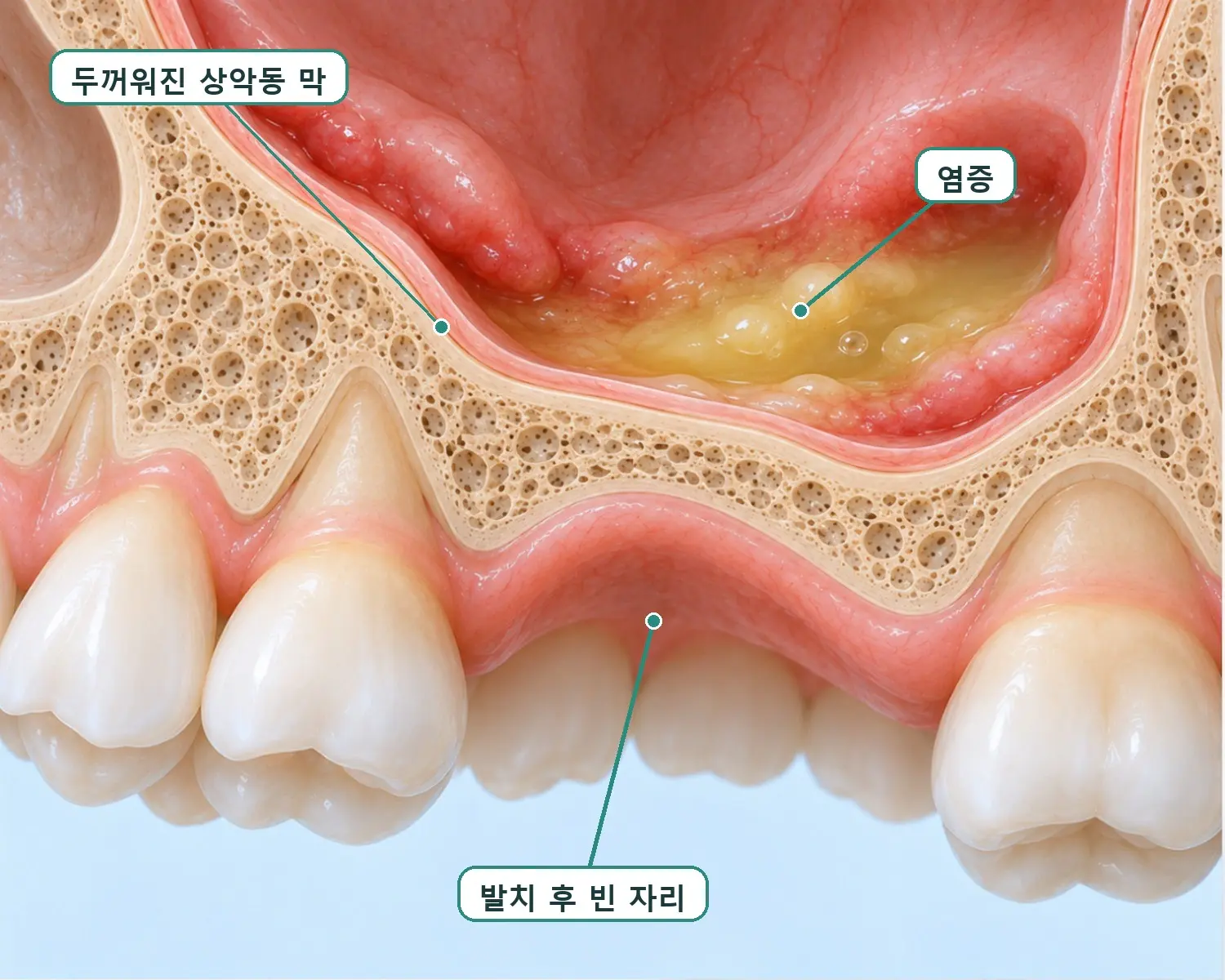
We do not perform a sinus lift while infection is present. We re-check with CBCT 3 months after extraction; if it is still present, we re-evaluate after 1 week of antibiotics; if there is no improvement, we irrigate the inflamed area through a lateral approach, check the remaining inflammation and the condition of the membrane, and if we can proceed, continue directly with the sinus lift.
Planning Points
The time until the final prosthesis is expected to be about 4-5 months or 6-7 months, depending on the remaining bone and the condition of fixation and healing. We do not decide the timeline based only on whether a perforation was repaired, and if sinusitis is present, we begin with the re-evaluation 3 months after extraction.
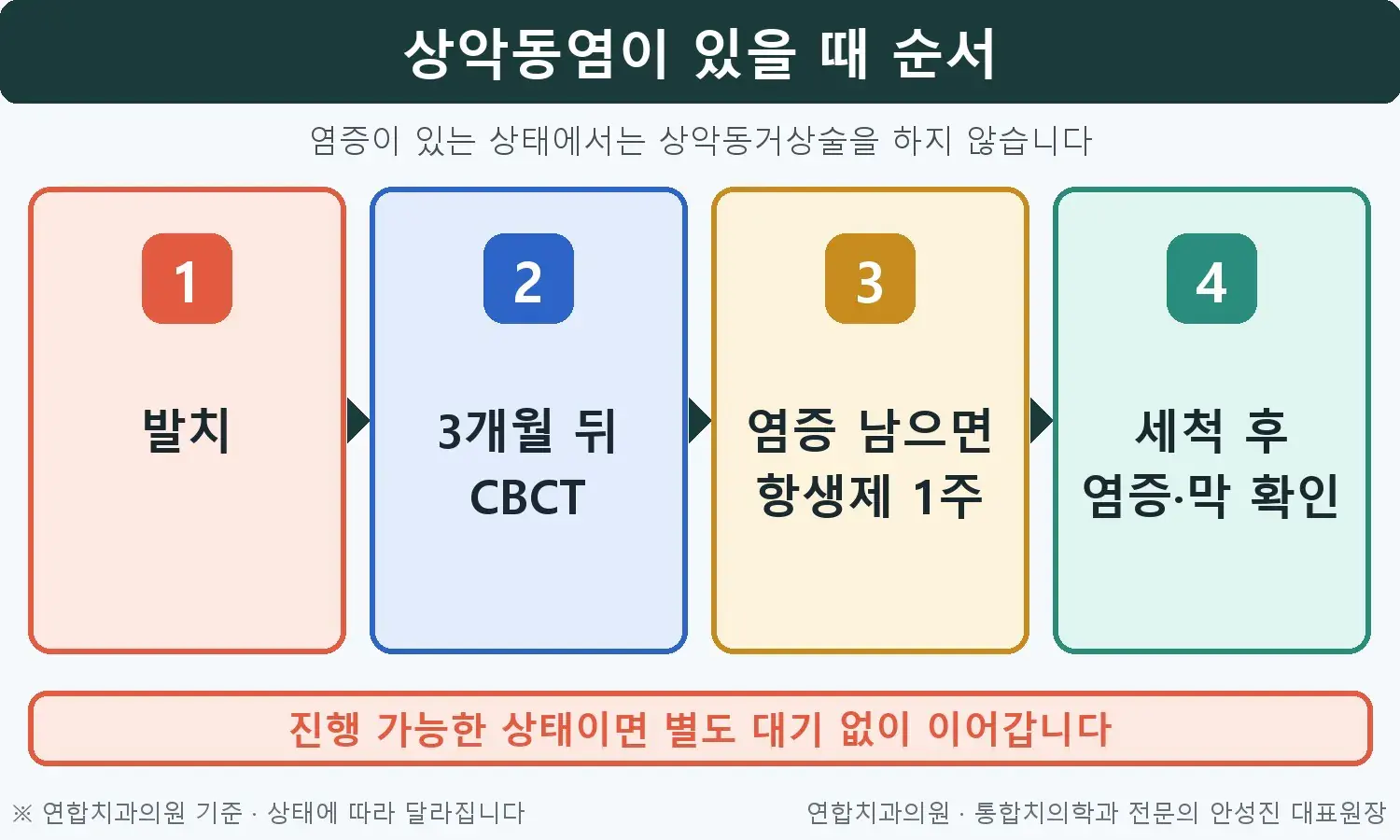
If inflammation remains on CBCT 3 months after extraction, we re-evaluate after 1 week of antibiotics. If there is no improvement, we irrigate the inflamed area through a lateral approach, check the remaining inflammation and the condition of the membrane, and if we can proceed, continue directly with the sinus lift.
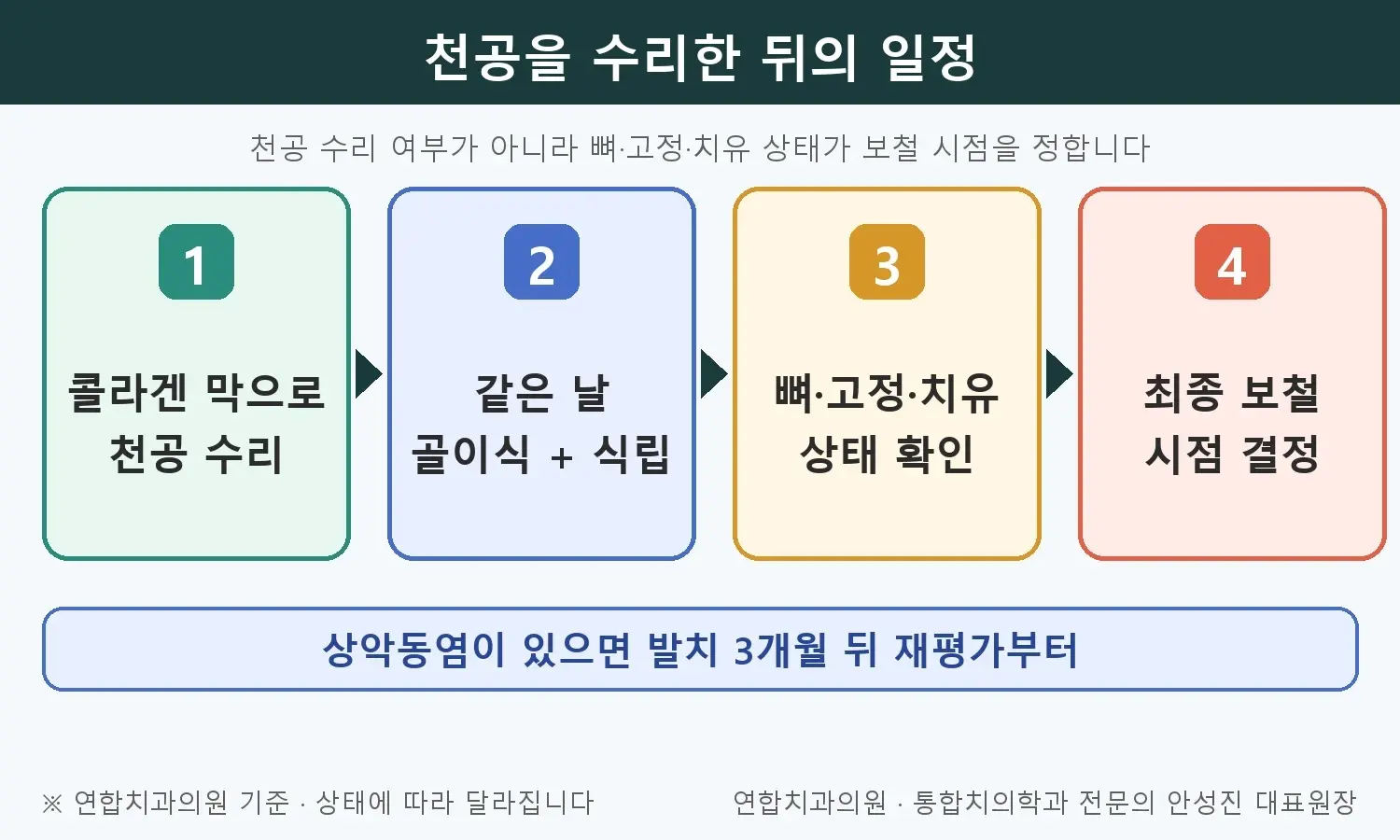
If it was repaired with a collagen membrane and the bone graft and placement were completed on the same day, the perforation does not necessarily lengthen the timeline. The timing of the final prosthesis is decided according to the remaining bone and the condition of fixation and healing.
Before Visit
If you know the items below before you come, we can tell you the perforation and sinusitis risks and the schedule at the first consultation.
Sinus membrane perforation is the most common complication of sinus lift and is reported in 7-56% of cases in the literature. In the lateral approach, the survival rate of implants placed after a perforation was repaired with a collagen membrane was 97.68%, and no significant difference was observed compared with 98.88% when the membrane was intact (7 studies, 3,604 implants, Díaz-Olivares 2021). In another meta-analysis that also pooled lateral approach studies, no significant difference was observed between repaired perforation sites at 97.1% and sites without perforation at 97.7% (7 studies, Schiavo-Di Flaviano 2024). Septa and smoking were associated with a greater likelihood of perforation (odds ratios of 3.56 and 2.57, respectively; meta-analysis, Liu 2026). For this reason, Yeonhap Dental Clinic's standard for perforation is not “never cause one” but “never miss one.” The real problem is when bone graft material is placed without knowing about a perforation and flows into the sinus. At Yeonhap Dental Clinic, if even one of the four checks (Valsalva, bubbles, saline leakage, membrane elasticity) is ambiguous, we treat it as a perforation, cover it with a collagen membrane on the spot, switch to the lateral approach to repair it, and if initial stability is secured, complete the placement the same day. If it is not secured, we do the sinus lift first. References: Díaz-Olivares 2021, implant survival after repair of membrane perforation in lateral approach sinus lift of 97.68% versus 98.88% with an intact membrane, no significant difference observed; 7 studies, 3,604 implants · Schiavo-Di Flaviano 2024, meta-analysis of the effect of membrane perforation on implant survival in the lateral approach (97.1% after repair versus 97.7%; no significant difference observed) · Liu 2026, meta-analysis of the incidence of membrane perforation in sinus lift and related factors (septum and smoking, odds ratios 3.56 and 2.57) Treatment results may vary depending on each person's oral condition.
Sinus Lift Implants in Suwon: Three Key Points
Last updated:
Leave a few details on our consultation page and we'll get back to you promptly.