
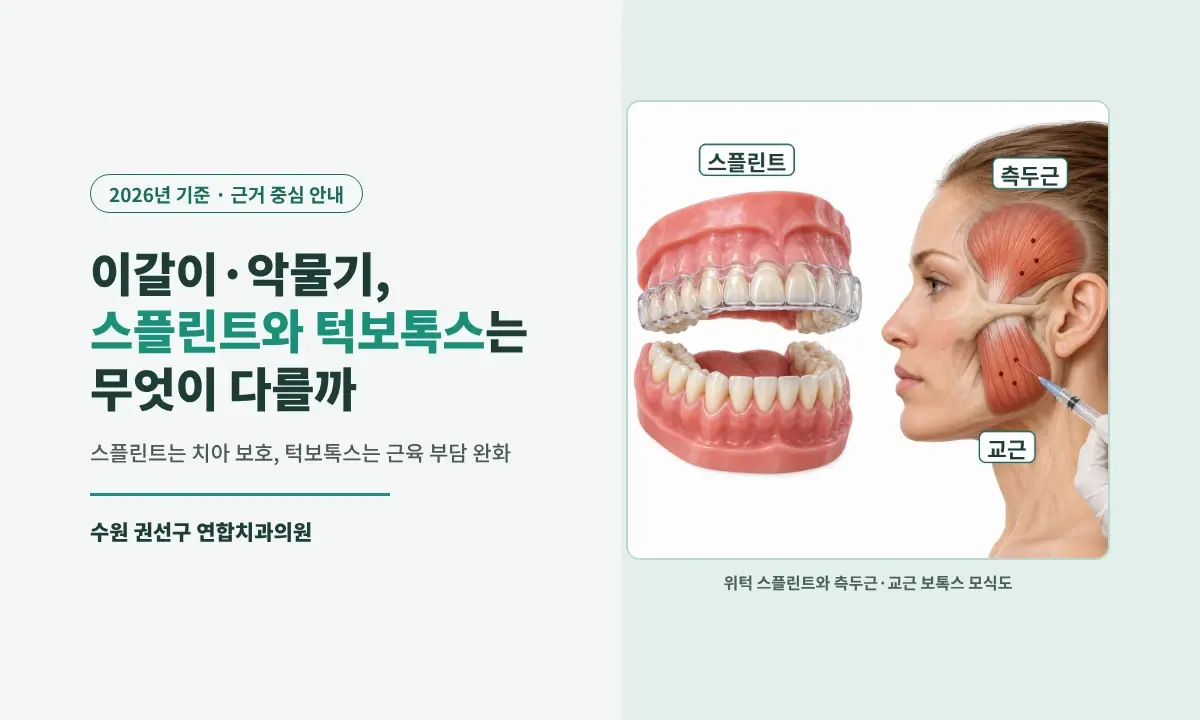
A splint (bruxism mouthguard) protects teeth and prostheses, while jaw Botox reduces the load on the chewing muscles. Here is how Yeonhap Dental Clinic chooses between soft and hard splints, our criteria for temporalis and masseter injections, the order we use, and the limits of each.
What do a splint and jaw Botox each do for teeth grinding?
Many people wake up with a stiff jaw or are told by a partner that they grind their teeth. Bruxism, grinding or clenching, is chewing muscle activity in which the teeth are ground or clamped, and it can occur both during sleep and while awake. The international consensus also divides it into sleep and awake forms.
[Key Answer]
A splint (bruxism mouthguard or appliance) keeps the upper and lower teeth from grinding directly against each other, protecting teeth and prostheses, while jaw Botox (botulinum toxin injection) reduces the force of the chewing muscles to ease muscle strain. At Yeonhap Dental Clinic, if grinding is your main concern, we consider Botox first, and if tooth protection is still needed afterward and you wish, we consider a splint.
[Summary in 4 Lines]
· A splint aims to protect teeth and prostheses, while jaw Botox aims to ease muscle strain; their purposes differ.
· At Yeonhap Dental Clinic, if grinding is your main concern we inject both the temporalis and masseter muscles; if it is mild or there is also a cosmetic goal, we may inject the masseter only.
· At Yeonhap Dental Clinic, we check your condition 3 months after the first jaw Botox treatment and every 6 months afterward, and advise on repeat treatment.
· Splints at Yeonhap Dental Clinic are made for the upper jaw and worn at night only, with a check after 1 week and then every 6 months.
Written by Dr. Ahn Seong-jin, Chief Director, Yeonhap Dental Clinic
[Table of Contents]
· What does a bruxism splint protect, and how do you choose between soft and hard?
· Which muscles does jaw Botox target, and how often is it repeated?
· Which does Yeonhap Dental Clinic do first for teeth grinding, a splint or jaw Botox?
· Will a splint or jaw Botox make the grinding go away?
What does a bruxism splint protect, and how do you choose between soft and hard?
A splint protects teeth and prostheses by keeping the teeth from grinding directly against each other during sleep. Yeonhap Dental Clinic makes a soft splint for first-time or short-term use, and a hard splint for heavy grinding or many prostheses.
A splint is made from an impression of the upper teeth and worn at night only. If it is uncomfortable at first, we check the splint's fit and bite and adjust how often you wear it. During the adjustment period, we may advise wearing it every other night if needed, and if pain is severe or persistent, we check it. One week after delivery we check the bite and any uncomfortable spots, and if there are no problems, we check every 6 months.
The main purpose of a splint is to protect teeth and prostheses, and changes in muscle activity after wearing it vary from person to person. Even in a small study, muscle activity responses differed by splint material (Okeson 1987).
Soft vs. hard bruxism splints (Yeonhap Dental Clinic)
| Item | Soft splint | Hard splint |
|---|---|---|
| Material | Soft material | Hard resin |
| When Yeonhap Dental Clinic uses it | First-time users, short-term use | Heavy grinders, patients with many prostheses |
| Wearing and check-ups | Night only; check after 1 week, then every 6 months | Night only; check after 1 week, then every 6 months |
Which muscles does jaw Botox target, and how often is it repeated?
Jaw Botox is an injection into the chewing muscles, the masseter (the muscle at the side of the jaw) and the temporalis (the muscle at the temple). Its effect can fade over time, so whether to repeat it is decided according to symptoms and muscle condition.
At Yeonhap Dental Clinic, if grinding is your main concern we inject both the temporalis and masseter, and if it is mild or a cosmetic goal is also considered, we inject the masseter only. We check symptoms and muscle condition 3 months after the first treatment and every 6 months afterward, and advise on repeat treatment.
A meta-analysis pooling studies of masseter Botox found reduced bite force and pain, but the effect faded over time (Chen 2023), and another systematic review based on electromyography and bite force judged that the evidence to confirm the effect is still insufficient (Ågren 2020).
Which does Yeonhap Dental Clinic do first for teeth grinding, a splint or jaw Botox?
At Yeonhap Dental Clinic, if grinding is your main concern, we consider Botox, which reduces the load on the chewing muscles, first, and if tooth protection is still needed afterward and you wish, we consider a splint.
For clenching while awake, we also practice noticing whether your upper and lower teeth are apart during the day.
Splint vs. jaw Botox (Yeonhap Dental Clinic)
| Item | Splint | Jaw Botox |
|---|---|---|
| Purpose | Protect teeth and prostheses | Ease strain on the chewing muscles |
| Method | Upper jaw splint worn at night only | Injection into the temporalis and masseter |
| Check-ups / interval | Check after 1 week, then every 6 months | Check condition 3 months after the first treatment, then every 6 months, and repeat as needed |
| Order used at Yeonhap Dental Clinic | When tooth protection is still needed after Botox and you wish | First, when grinding is the main concern |
Will a splint or jaw Botox make the grinding go away?
Neither a splint nor Botox has been confirmed as a treatment that eliminates grinding itself; they are best understood as management that reduces tooth damage and muscle strain.
In a systematic review of management methods for sleep bruxism in adults, splints tended to reduce the number of grinding episodes, and Botox reduced some measures but there were also reports of side effects, and the review concluded that larger long-term studies are needed (Minakuchi 2022). The international consensus also regards grinding in otherwise healthy people as a behavior rather than a disease in itself (Lobbezoo 2018). After Botox, chewing force may temporarily weaken or your expression when smiling may change, so we explain this before treatment and check your condition afterward. That is why even while using a splint or Botox, the condition of your teeth and prostheses and your muscle symptoms need to be rechecked regularly.
3 things to check when consulting about a splint or jaw Botox in Gwonseon-gu or Tap-dong, Suwon
· Whether the purposes are explained separately: splint for protecting teeth, Botox for easing muscle strain
· Whether the injection site, temporalis or masseter, is chosen according to the degree of grinding and any cosmetic goal
· Whether follow-up after wearing a splint and the Botox repeat interval are explained in advance
[Key Takeaways]
✓ A splint protects teeth and prostheses, and Botox reduces the load on the temporalis and masseter.
✓ At Yeonhap Dental Clinic, if grinding is your main concern we consider Botox first, and if tooth protection is still needed afterward, we consider a splint if you wish.
✓ For Botox we check your condition 3 months after the first treatment and every 6 months afterward and repeat as needed; for a splint we check after 1 week and then every 6 months.
What I would like to tell you about teeth grinding from the treatment room
In a grinding consultation, I first ask whether there are worn teeth or broken prostheses, whether the muscles at the temple and the side of the jaw feel stiff, and whether your concern is the grinding itself or the shape of your jaw. If only muscle stiffness is present, we first manage it with physical therapy and improved eating habits, and a broken prosthesis can be monitored if it is not severe and replaced if it is. For patients whose teeth are heavily worn or for whom the grinding itself is stressful, we consider a splint and Botox as appropriate to the situation; if grinding is the main concern, we consider Botox in the temporalis and masseter first, and if the grinding is not severe or there is also a cosmetic goal, we may inject the masseter only; and for patients who still grind after Botox and want an appliance, we also consider a splint. Because it happens during sleep, it is often a spouse who notices before the patient whether the grinding has decreased. Many people say their teeth hurt when they first wear a splint, so I first check the fit and bite and, if needed, suggest wearing it every other night until you adjust. That is why rather than finishing with one approach, I look at the muscles and teeth separately and decide the order.
References
📋 Clinic Information
This post was written in accordance with the Korean Medical Service Act and the Ministry of Health and Welfare's medical advertising guidelines, and is intended to provide medical information. It does not guarantee or assert the effect of any particular treatment. The effects and duration of splints and Botox differ from person to person depending on the degree of grinding and the condition of the muscles and teeth, so please decide on a treatment direction only after a thorough consultation with your dental team.
🦷 General dentistry: Yeonhap Dental Clinic general dentistry
📍 230 Geumho-ro, 5th Floor (Cham Clinic Building, Tap-dong), Gwonseon-gu, Suwon, Gyeonggi-do
🚕 Across from Suwon NongHyup Guun Branch (231 Geumho-ro) / about 15 minutes by taxi from Suwon Station
🚗 Free parking available in the building
📞 031-293-2207
🌐 yeonhapdental.com
🟡 Open since 2002 / Treatment overseen by Dr. Ahn Seong-jin, Chief Director and Integrated Dentistry specialist
🔗 Online booking and consultation
Frequently asked questions about bruxism splints and jaw Botox
- Which should I do first for teeth grinding, a splint or jaw Botox?
- At Yeonhap Dental Clinic, if grinding is your main concern we consider Botox first, and if tooth protection is still needed afterward and you wish, we consider a splint. This is because a splint protects teeth and prostheses while jaw Botox reduces the load on the chewing muscles, so their purposes differ.
- Should a splint be soft or hard?
- It depends on the purpose. A soft splint is made of soft material and a hard splint of hard resin. At Yeonhap Dental Clinic, we use a soft splint for first-time or short-term use and a hard splint for heavy grinding or many prostheses; both are made for the upper jaw and worn at night only.
- How often is jaw Botox repeated for teeth grinding?
- The effect of jaw Botox can fade over time, so whether to repeat it is decided according to symptoms and muscle condition. At Yeonhap Dental Clinic, we check symptoms and muscle condition 3 months after the first treatment and every 6 months afterward, and advise on repeat treatment.
- Do I have to wear an anti-grinding mouthguard every day?
- At Yeonhap Dental Clinic, we advise wearing an anti-grinding mouthguard (splint) every night as a rule. If it is uncomfortable at first, we check the fit and bite, and if needed during the adjustment period, we adjust to wearing it every other night.
- My teeth hurt when I first wear a splint. Is that okay?
- Your teeth may feel stiff or sore when you first wear it. We check the splint's fit and bite and, if needed during the adjustment period, adjust to wearing it every other night. If pain is severe or persistent, you should have it checked right away.
- Will a splint or jaw Botox make the grinding go away completely?
- Neither has been confirmed as a treatment that eliminates grinding itself. A splint protects teeth and prostheses and Botox reduces muscle strain, so we check the condition of your teeth and muscles regularly even while you use them.
- What do you check during a grinding consultation at Yeonhap Dental Clinic in Gwonseon-gu, Suwon?
- We check for worn teeth or broken prostheses, stiffness in the muscles at the temple and the side of the jaw, and whether your concern is mainly grinding or also the shape of your jaw. Based on the results, we explain the Botox sites, whether a splint is needed, and the follow-up interval.
Related pages
Before your visit
This article provides general information on oral health and dental care. Whether treatment is needed, and which method is appropriate, may change after an oral exam and any necessary diagnostic tests. If you have pain, a loose tooth, swelling, or discomfort with a prosthesis, please visit us for a consultation.