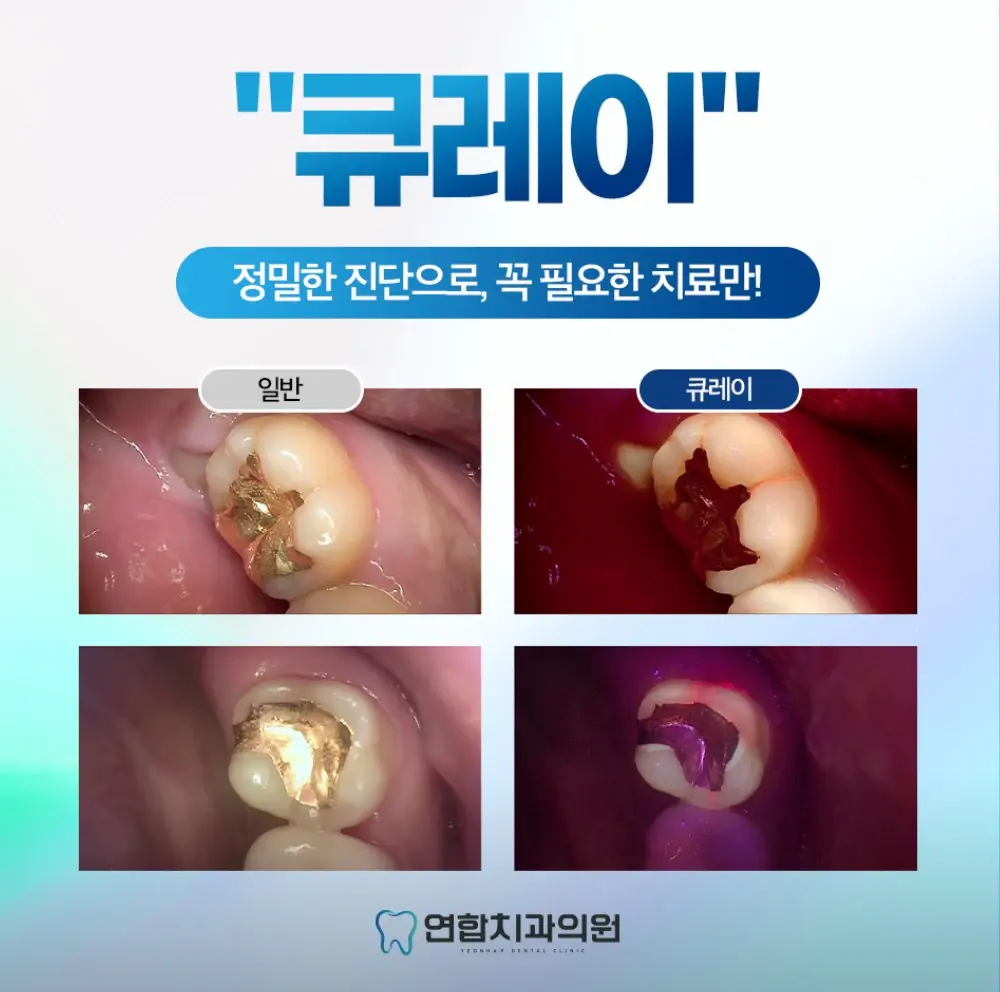
Yeonhap Dental Clinic precision diagnosis guide comparing a regular oral photo with a Q-ray fluorescence photo

SUWON IMPLANT CONSULTATION

Implant Consultation in Suwon We first check whether the tooth can be saved before extracting

Save, extract, place. The first consultation at Yeonhap Dental Clinic goes in this order.

Why Diagnosis Matters

In an implant consultation, we look at the tooth to save before the site to place

At Yeonhap Dental Clinic, an implant consultation does not start by looking at the site to place. It starts by looking at whether that tooth can be saved. We find cracks that cannot be seen by eye early with a Q-ray fluorescence photo to reduce the chance of later extraction, and for a tooth with poor gums, we first recommend periodontal treatment so that you can keep your natural tooth as long as possible. For teeth that cannot be saved, such as those with periodontitis that is too severe or a fracture that has reached the root, we decide on extraction after confirming with the Q-ray and 3D CBCT. Once extraction is decided, we again first look at whether there are procedures that do not have to be added to implant surgery: a bone graft, a sinus lift, and whether you really need to place as many implants as missing teeth.

Consultation Checklist

What we check at your first consultation

At the first consultation, we confirm the five points below with the Q-ray and 3D CBCT, then decide whether to save, extract, or, if placing, which procedures do not have to be added.

  • How far cracks and early cavities have progressed on the Q-ray fluorescence image. If before the root, the tooth is saved with a crown
  • Jawbone height and looseness. Whether the tooth can be maintained with periodontal treatment
  • Whether periodontitis is too severe or a fracture has reached the root. In such cases, extraction is decided
  • The cheek-side bone thickness at the site decided for extraction, and the height to the maxillary sinus and nerve canal. Whether a bone graft or sinus lift is needed
  • Whether you need to place as many implants as missing teeth. Whether the number can be reduced according to space and bone

Treatment Options

Save, Extract, Place: Three Directions

The conclusion of the consultation is one of these three. Either way, we look at the evidence together on the Q-ray and CBCT images.

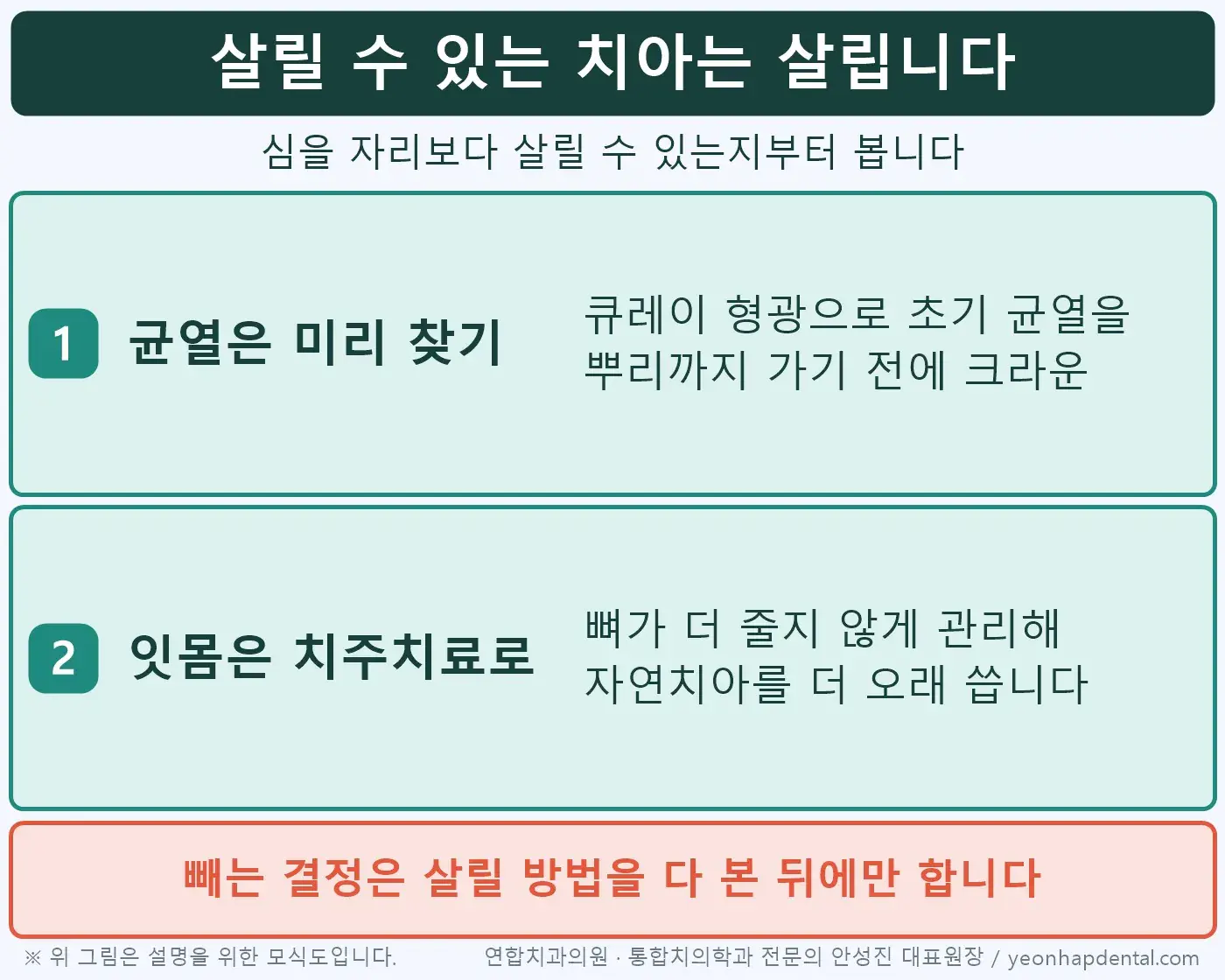
Infographic of two points on saving teeth that can be saved: early detection of cracks with the Q-ray, and maintenance with periodontal treatment

Save: early detection with the Q-ray, maintenance with periodontal treatment

The Q-ray uses fluorescence to find early cracks and cavities that cannot be seen by eye. If they are found at the enamel or dentin stage, the tooth is saved with a crown. For a tooth whose jawbone has receded, we do not extract right away but first recommend periodontal treatment, managing it so that the bone does not shrink further.

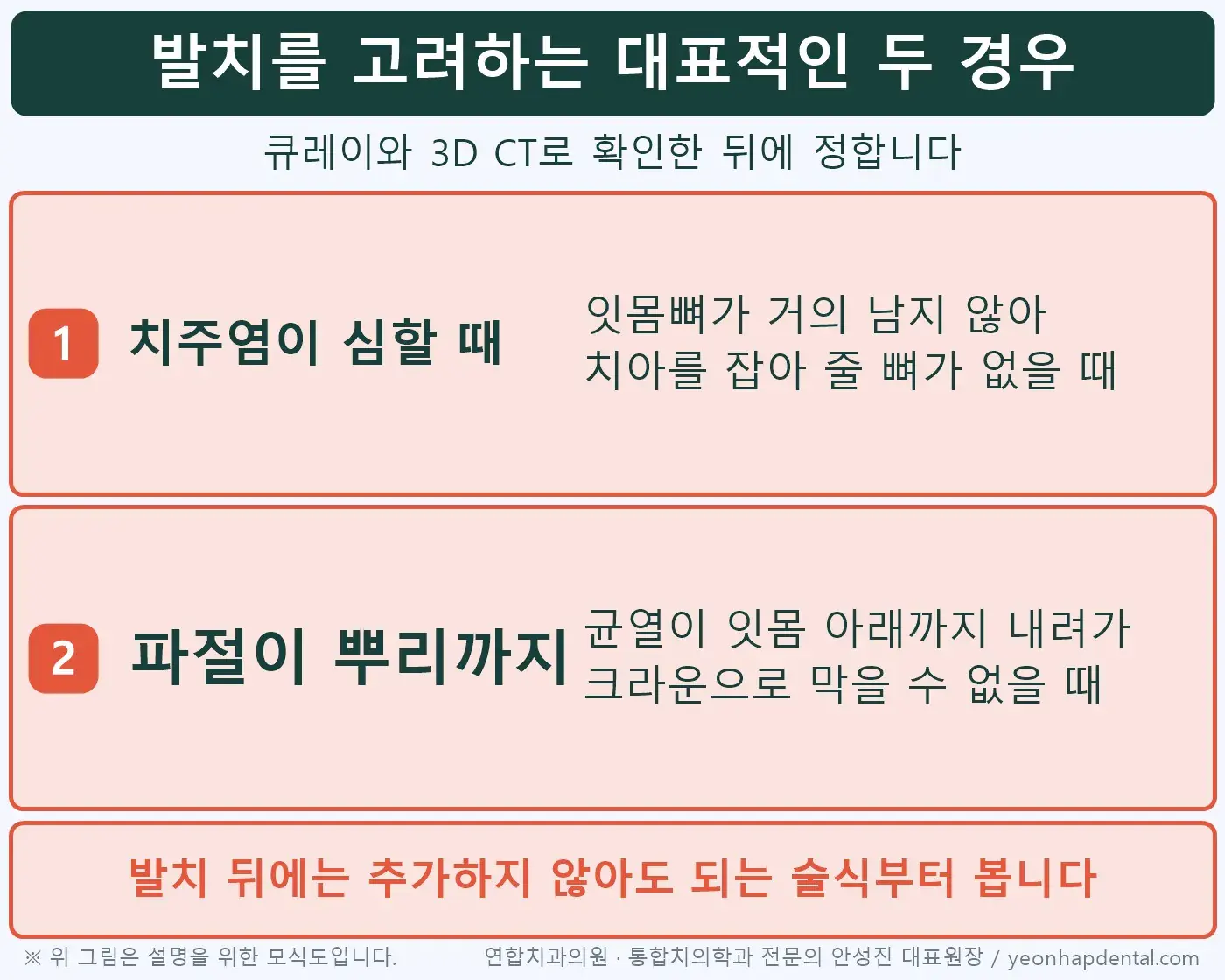
Infographic of two typical cases in which extraction is considered: when periodontitis is too severe, and when a fracture has reached the root

Extract: two typical cases

These are when almost no jawbone remains even after periodontal treatment, so there is no bone to hold the tooth, and when a crack runs down below the gum to the root and cannot be stopped even with a crown. We decide after confirming with the Q-ray and 3D CBCT, and other reasons are judged by the same standard.

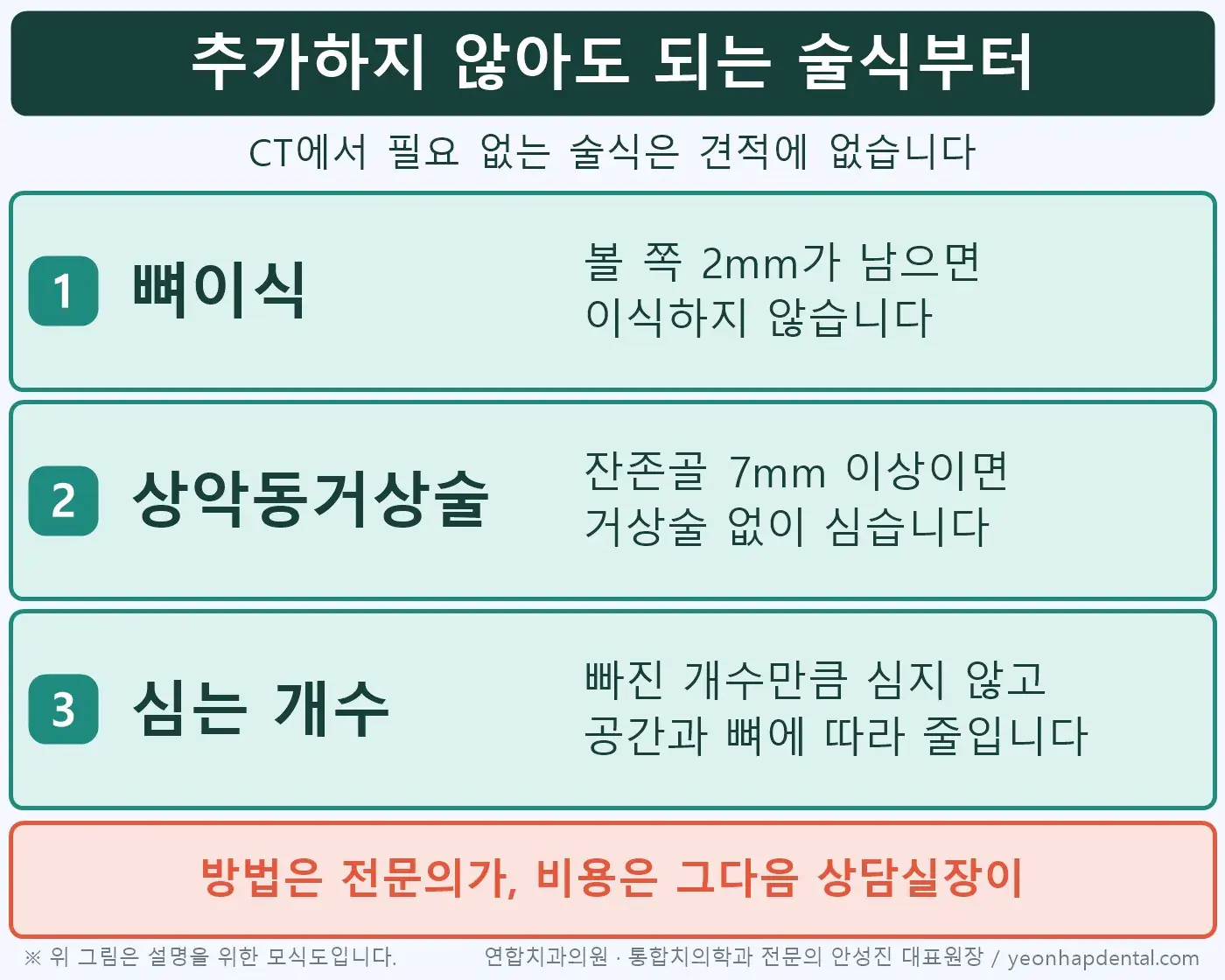
Infographic of three procedures that do not need to be added to implant surgery: bone graft, sinus lift, and the number of implants

Place: starting with procedures that do not have to be added

If a position leaving 2 mm of cheek-side bone and 1.5 mm of tongue-side bone can be found, we do not do a bone graft, and for an upper molar with 7 mm or more of remaining bone up to the maxillary sinus, we place the implant without a sinus lift. We do not place as many implants as missing teeth, but reduce the number according to the space and bone. Items not needed on the CBCT are not included in the estimate.

Planning Points

The Number of Implants and the Order of the Consultation

These are the standard for not placing as many implants as missing teeth, and the consultation order in which the method is decided first and the cost comes after.

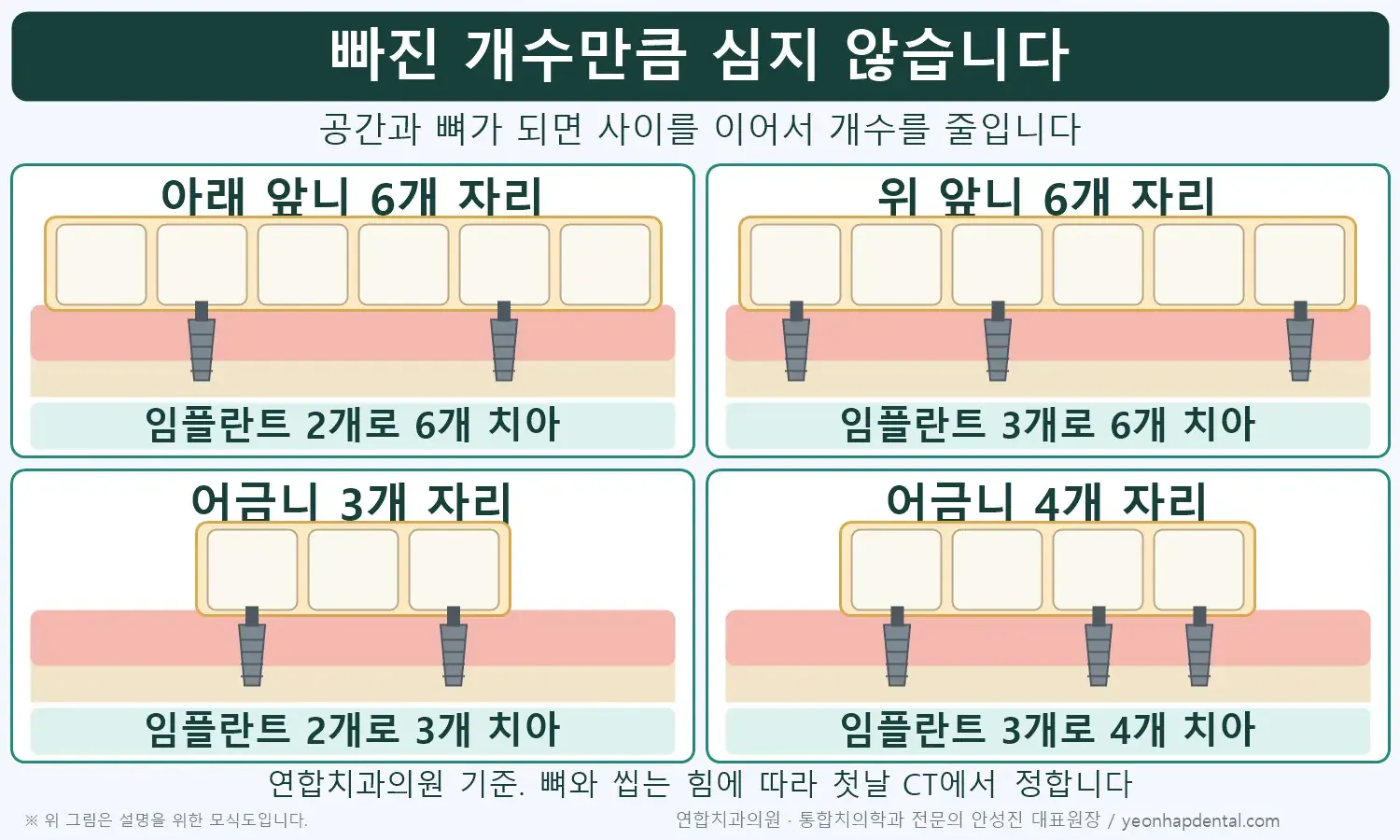
Diagram of the standard for not placing as many implants as missing teeth: 2 for 6 lower front tooth positions, 3 for 6 upper front tooth positions, 2 for 3 molar positions, and 3 for 4 positions

We do not place as many as the missing teeth

If the space and bone meet the conditions, we bridge between the implants and reduce the number. Yeonhap Dental Clinic's standard is 2 for 6 lower front tooth positions, 3 for 6 upper front tooth positions, 2–3 for 3 molar positions, and 3–4 for 4 positions. This varies with bone thickness and height and with chewing force, so it is decided on the CBCT on the first day.

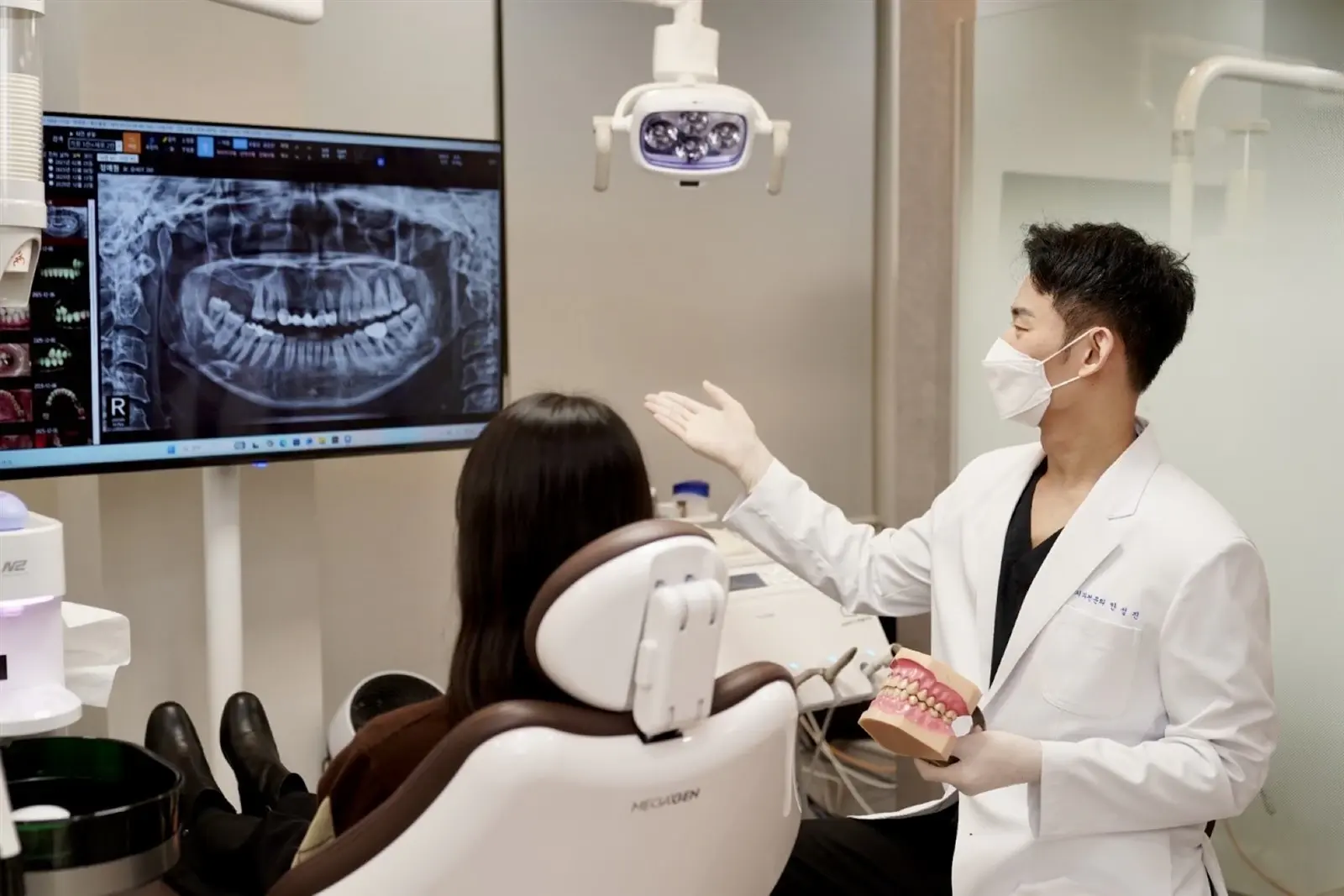
A director explaining the diagnosis to a patient using a panoramic X-ray on screen and a tooth model

The method comes from the specialist; the cost comes after

Whether to save or extract, and if placing, how many implants and how, is explained in person by an Integrated Dentistry specialist while looking at the Q-ray and CBCT images. After the method is decided, the consultation coordinator explains the cost item by item. We do not give an estimate with only a total.

Before Visit

Helpful details before your visit

If you organize the points below and bring them, at the first consultation we can tell you whether to save or extract and, if placing, which procedures do not have to be added.

  • The area that bothers you most now and your symptoms. Whether it hurts when chewing, is sensitive, or feels loose
  • When the tooth was extracted and any denture or bridge you use now
  • Whether you have had gum treatment or root canal treatment
  • Whether you take diabetes or osteoporosis medication, or aspirin, Plavix, or similar drugs

Whichever the conclusion, you see the evidence on screen

If the conclusion is to save the tooth, we look at how far the crack extends on the Q-ray fluorescence image and whether periodontal treatment can protect the bone. If the conclusion is to extract, we look on the CBCT at how much bone remains around the root and whether the crack has reached the root. If the conclusion is to place an implant, we look in numbers at how many millimeters of cheek-side bone remain, how many millimeters there are to the maxillary sinus, and how many implants need to be placed. At Yeonhap Dental Clinic, two Integrated Dentistry specialists decide among these three directions in person at the first consultation, and you can make your decision at home. Treatment results may vary by individual oral condition. How cracks are found with the Q-ray is covered in Q-ray precision diagnosis, the 2 mm standard for not adding a bone graft in Implant bone graft: when and how, and the principle of reducing unnecessary grafting in When an implant bone graft is needed: the minimization principle. References: Monje 2023, systematic review of the effect of buccal bone thickness on peri-implant tissue changes

Last updated:

Schedule a consultation by phone or Naver Booking

Leave a few details on our consultation page and we'll get back to you promptly.

Frequently Asked Questions

Q. If I have an implant consultation, will I definitely end up getting an implant?
No. At Yeonhap Dental Clinic, the first consultation ends in one of three directions: save, extract, or place an implant. If the Q-ray shows that a crack has not reached the root, or the bone can be protected with periodontal treatment, we plan to save the tooth, and we decide on extraction only for teeth that cannot be saved.
Q. I am missing 3 teeth. Do I need to place all 3 implants?
If the space and bone meet the conditions, two implants can bridge the gap to make three teeth. The standard is 2 implants for 6 lower front tooth positions, 3 for 6 upper front tooth positions, 2–3 for 3 molar positions, and 3–4 for 4 positions; this varies with bone thickness and height and with chewing force, and is decided on the CBCT on the first day.
Q. Is a bone graft always necessary for an implant?
If placing the implant leaves 2 mm on the cheek side and 1.5 mm on the tongue side, we do not graft. We add a graft only when such a position cannot be found even after moving the site, and insufficient height in an upper molar is a sinus lift item, not a bone graft. Items not needed on the CBCT are not included in the estimate.
Q. Who tells me the implant cost, and when?
Whether to save or extract, and how many implants to place and how, is first explained by the specialist while looking at the CBCT images. After the method is decided, the consultation coordinator explains the cost item by item. We do not give an estimate with only a total, and you can make your decision at home.