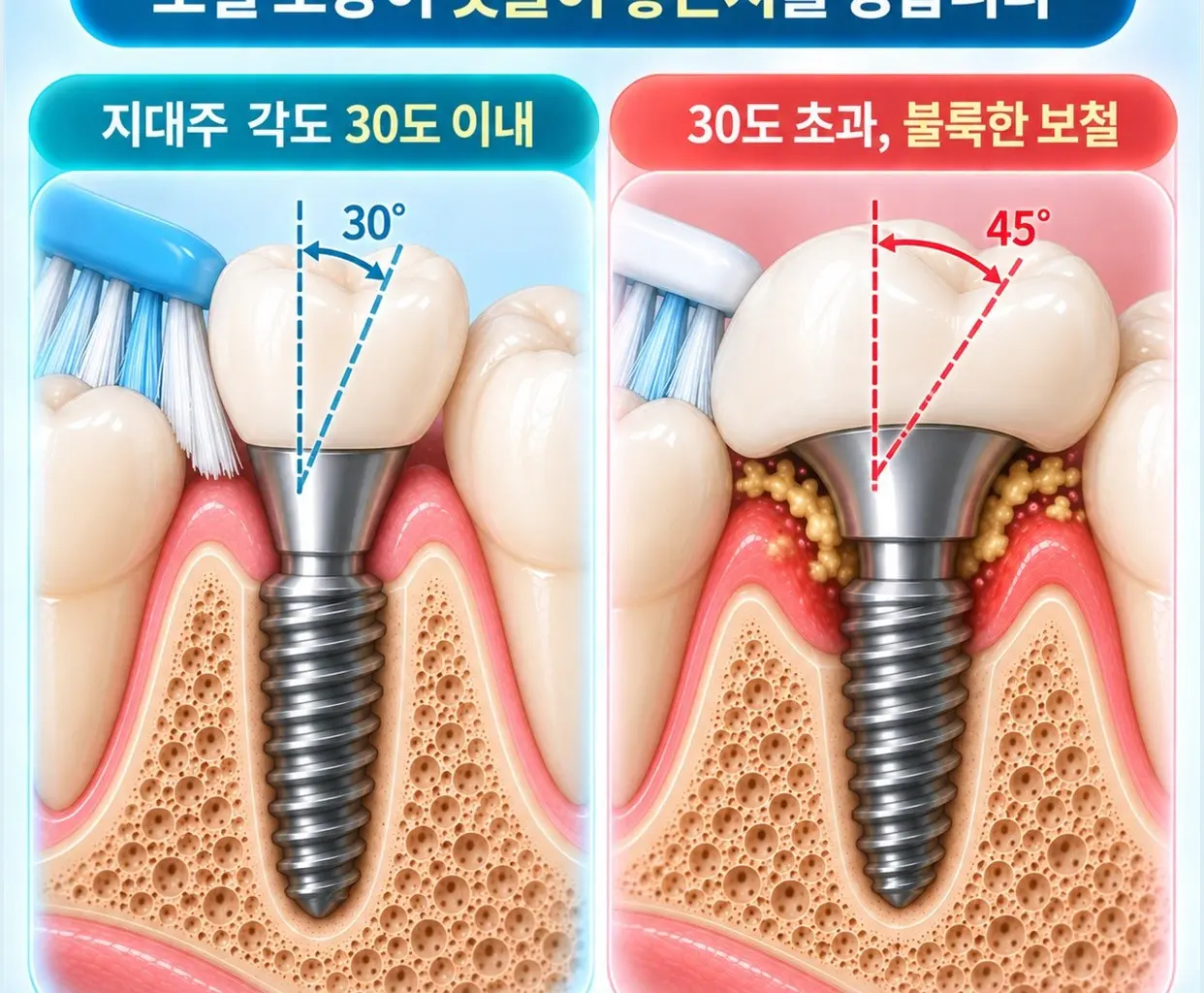
Diagram comparing an implant prosthesis with an emergence angle within 30 degrees that a toothbrush can reach and a prosthesis that has become convex beyond 30 degrees

IMPLANT COMPLICATIONS

Implant Side Effects Six Checks to Reduce Risk

We divide the main implant side effects into six, and explain what Yeonhap Dental Clinic checks to reduce risk, from pre-surgery planning through the prosthesis and recovery.

Why Diagnosis Matters

Implant side effects have different causes, so we prepare for each differently

For each implant side effect, the conditions related to risk differ, so what we check also differs. Yeonhap Dental Clinic divides the main side effects into six and checks together your condition before surgery, the placement and prosthetic conditions, and the loading and check-up plan during recovery.

Consultation Checklist

What we check at your first consultation

At the first consultation, we check the conditions related to implant side effects with the three points below.

  • On the 3D CBCT, bone thickness and height and the condition of the nerve canal and maxillary sinus; for front teeth, the cheek-side bone and gum condition (gum thickness is measured during surgery)
  • The opposing tooth and the space for the prosthesis, and whether a prosthetic shape that can be cleaned is achievable
  • Whether you take diabetes or osteoporosis medication or antiplatelet drugs, and whether you smoke

Treatment Options

Peri-implantitis, Altered Sensation, Sinusitis, and Front-Tooth Gum: What We Check First to Reduce Risk

For each implant side effect, the conditions to check and prepare for before surgery differ.

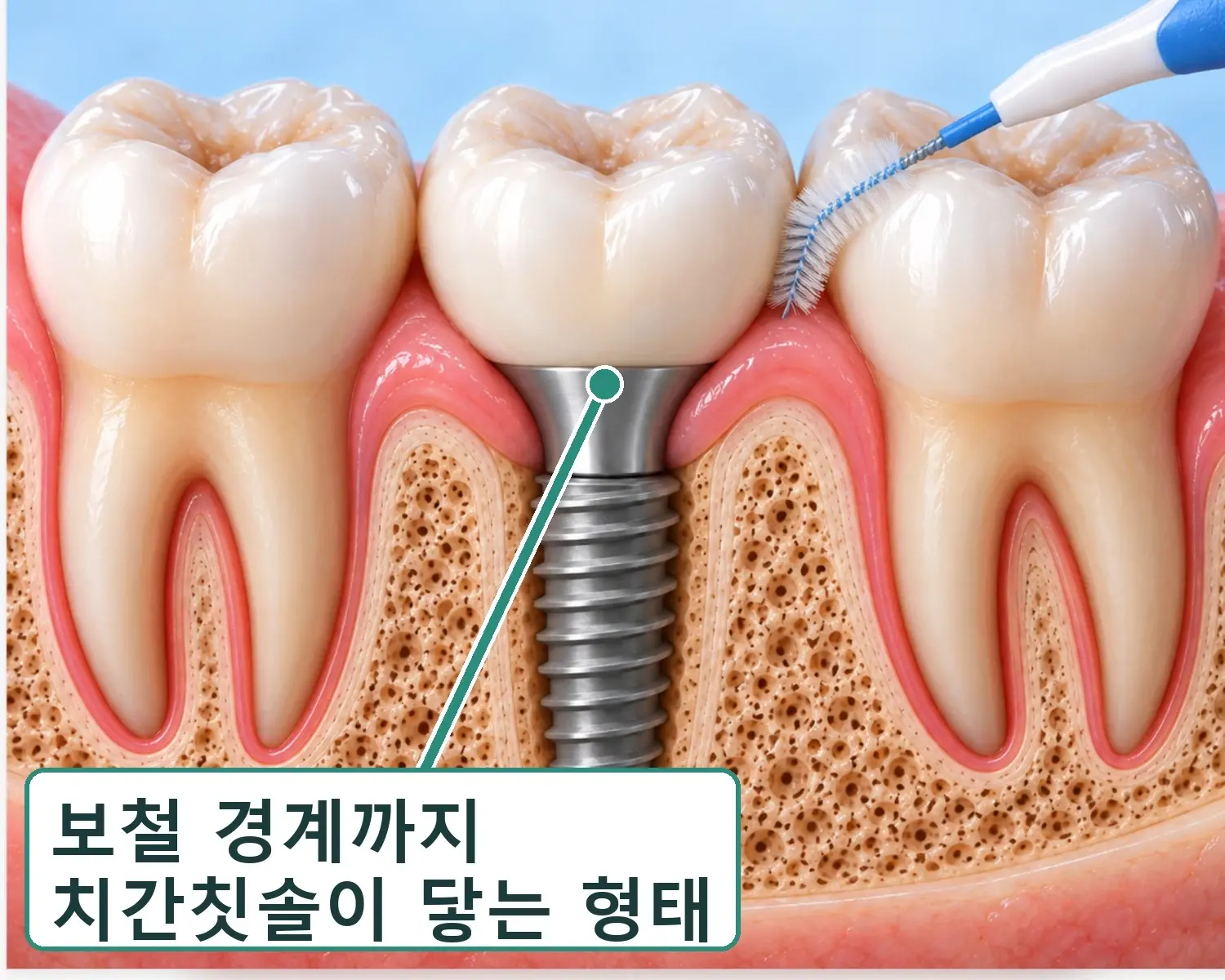
Cross-section diagram of a prosthetic shape in which an interdental brush reaches the margin between an implant crown and the gum

Peri-implantitis: we check for a prosthesis that can be cleaned and a check-up plan

This is a disease in which inflammation of the gum around the implant spreads to the bone, and the bone shrinks without pain. Yeonhap Dental Clinic places with a prosthetic shape a toothbrush can reach and sets a plan from the start to check the gums and bone every 6 months.

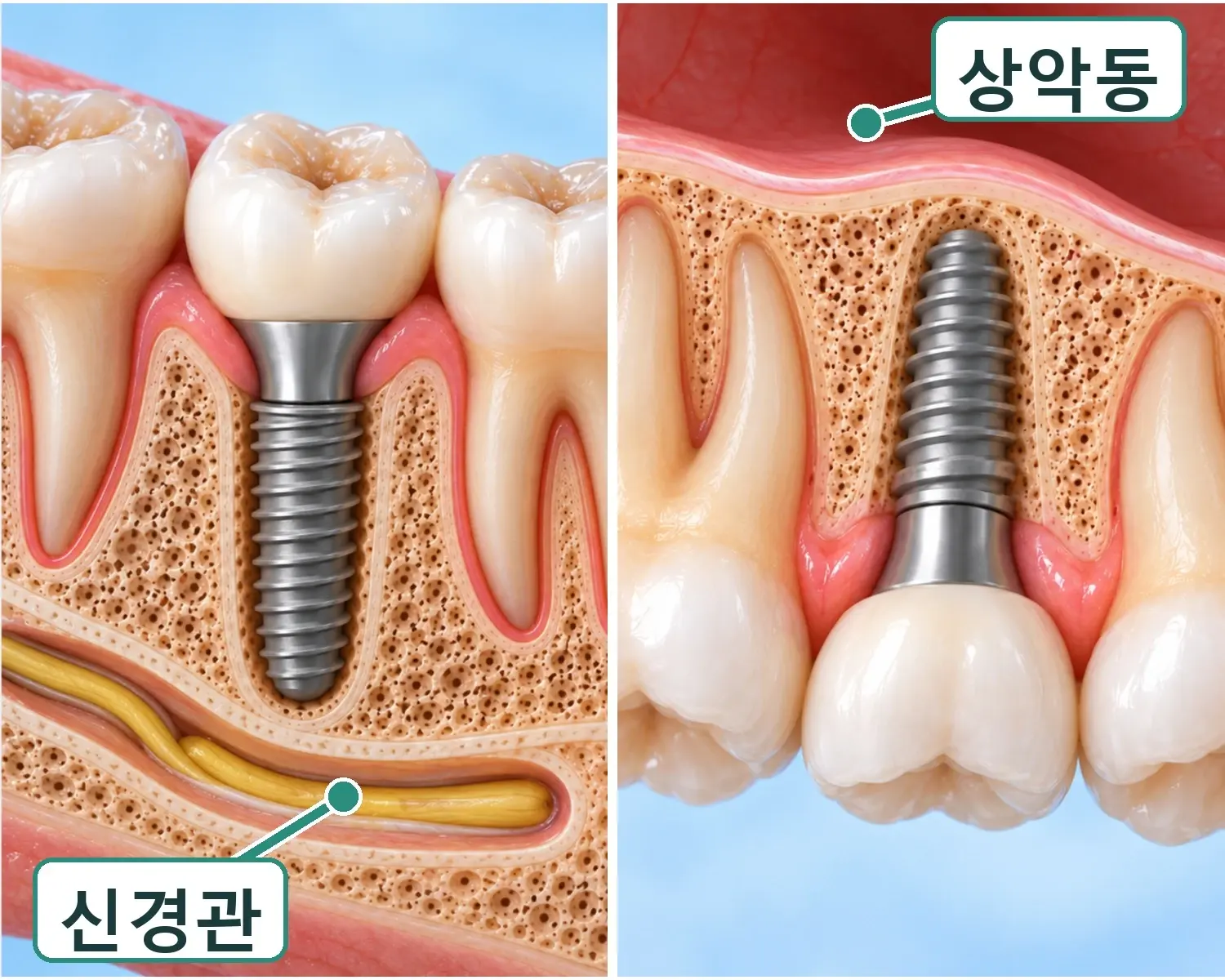
Cross-section diagram showing, side by side, the nerve canal below a lower molar implant and the maxillary sinus above an upper molar implant

Altered sensation and sinusitis: we first check the distance to the nerve canal and the condition of the sinus

For a lower molar, with a standard-length implant we leave 2 mm of clearance above the nerve canal, and with a short implant we advance the drill 1 mm at a time and check the depth. For an upper molar, we treat sinusitis first and judge whether to proceed from the remaining inflammation and the membrane condition.

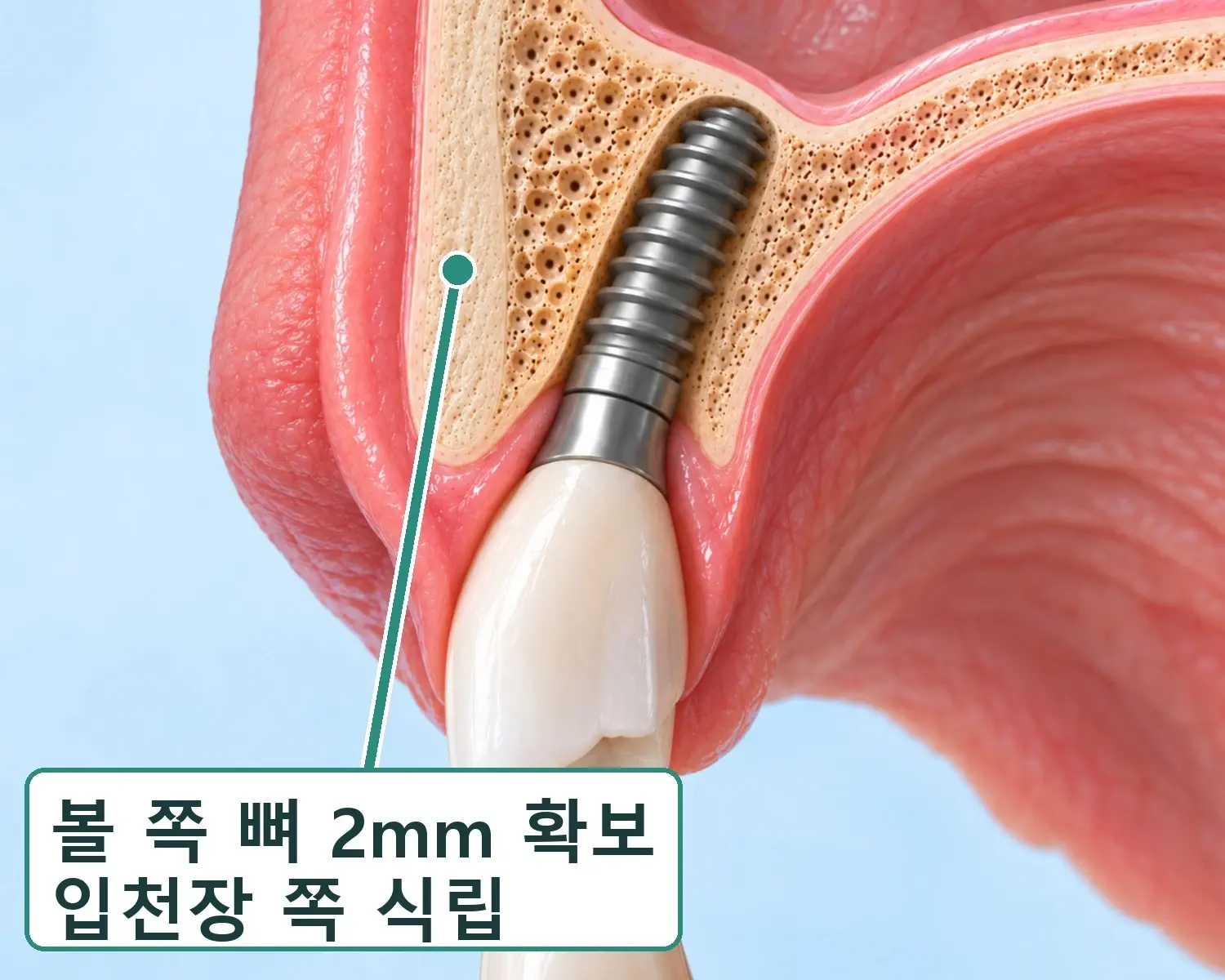
Cross-section diagram of a front-tooth implant placed toward the palate with thick cheek-side bone remaining

Front-tooth gum recession: we check the position and the bone and gum conditions

In front teeth, the cheek-side bone is thin, so if the position deviates or the bone and gum are thin, the gum may recede after a few years. Yeonhap Dental Clinic checks the placement position, whether 2 mm of cheek-side bone is secured, and the gum condition, and if necessary reinforces bone or soft tissue along with placement.

Planning Points

Prosthetic Problems and Early Failure: What We Check to Reduce Risk

We prepare for loosened screws and crown fractures by distinguishing causes and checking the bite, and for early failure by checking stability and loading.

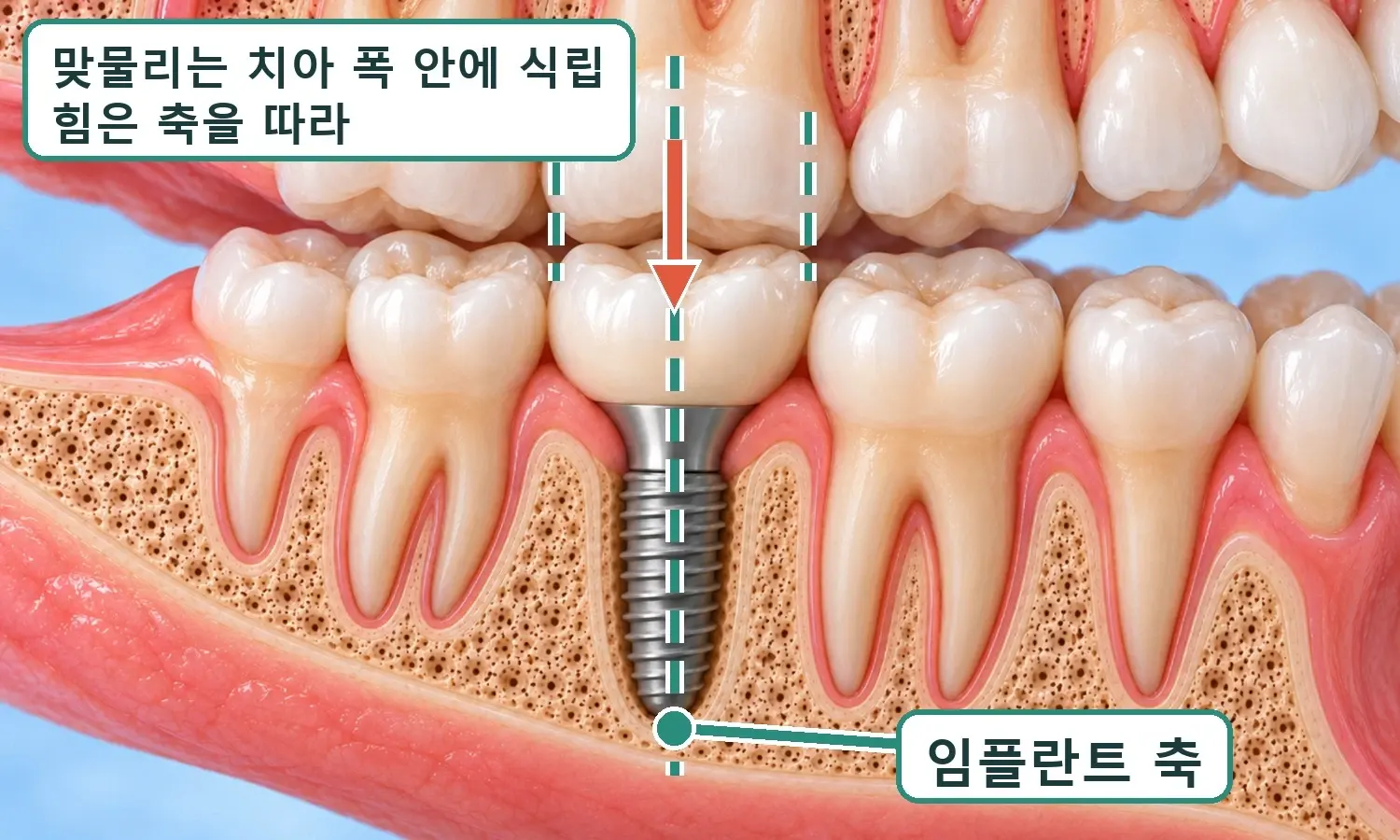
Cross-section diagram of a lower molar implant crown sitting directly beneath the upper molar it bites against

Loosened screws and crown fractures: we check the bite and the prosthesis

If chewing force is applied at an angle, the screw may loosen or the crown may break. Yeonhap Dental Clinic places within the width of the opposing tooth, adjusts the interference that catches when moving sideways, and checks the prosthesis at 6-month check-ups.

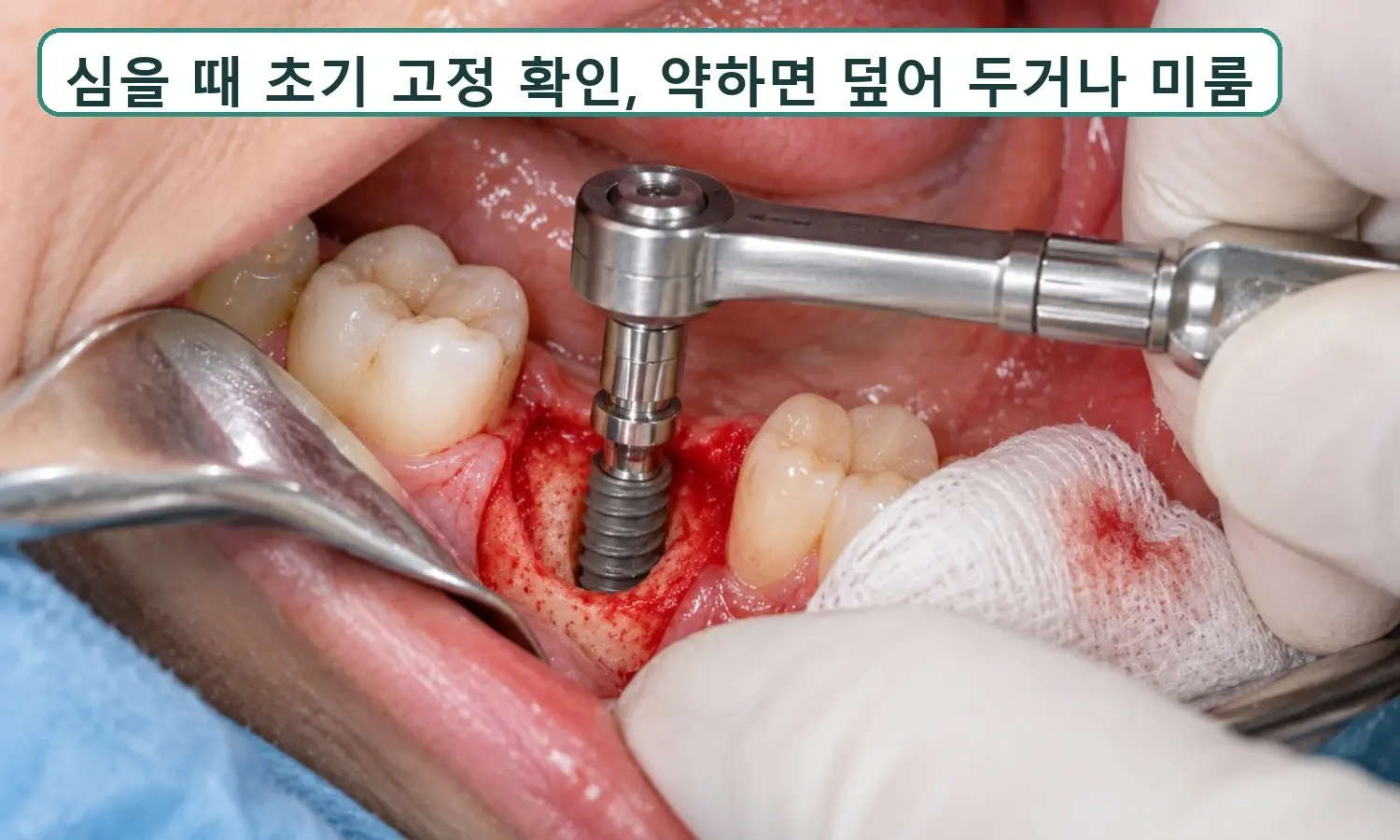
Checking the initial stability of an implant with a torque wrench during surgery

Early failure: we check initial stability and loading conditions

If stability is weak before bonding with the bone, or if force is applied, it may fail to bond. Yeonhap Dental Clinic checks stability at placement and, if it is weak, covers the implant or postpones, and also looks at smoking and diabetes control. For placement of some teeth where an immediate fixed temporary tooth is not attached, we advise chewing while avoiding the surgical site for about 6 weeks.

Before Visit

Helpful details before your visit

If you tell us the points below, at the first consultation we can decide which risks to look at first.

  • Whether you take diabetes or osteoporosis medication, or antiplatelet drugs or anticoagulants
  • Whether you smoke, and your history of gum disease treatment
  • Your history of sinusitis, and, if you have an earlier implant or bone graft, when it was done
  • If there is a problem with an existing implant, the symptoms (looseness, pus, numbness, nasal congestion) and when they began

Six Implant Side Effects: What Yeonhap Dental Clinic Checks

Peri-implantitis: We place with a prosthetic shape a toothbrush can reach and check the gums and bone every 6 months. Altered sensation: For standard length, 2 mm of clearance above the nerve canal; for short implants, we advance 1 mm at a time and check. Sinusitis: We treat it first, judge whether to proceed from the remaining inflammation and the membrane condition, and do simultaneous placement when initial stability is also secured. Front-tooth gum recession: We check the placement position, whether 2 mm of cheek-side bone is secured, and the gum condition, and if necessary reinforce bone or soft tissue along with placement. Loosened screws and crown fractures: We prepare with placement within the width of the opposing tooth, adjusting lateral interference, and 6-month check-ups. Early failure: We check stability at placement, the conditions for immediate loading, and control of smoking and diabetes. For placement of some teeth where an immediate fixed temporary tooth is not attached, we advise chewing while avoiding the surgical site for about 6 weeks.
Six Implant Side Effects: The Evidence and Its Limits

Peri-implantitis is reported in the literature at a patient-level prevalence of about 22% (Derks 2015), which is not a figure for our clinic's incidence or an individual's risk. In some studies of bone-level implants, an emergence angle over 30 degrees and a convex emergence profile were associated with peri-implantitis (Katafuchi 2018), and for single crowns and fixed prostheses, technical complications such as loosened screws and fractures are reported at a certain rate within 5 years (Jung 2012, Pjetursson 2012). Smoking is reported to raise the risk of implant failure (Chrcanovic 2015). Design and check-ups are conditions that reduce risk, not a guarantee that side effects will be eliminated. For this reason, Yeonhap Dental Clinic looks at the six separately and reduces each risk by combining pre-surgery checks, design, and check-ups after placement. References: Derks 2015, systematic review of the prevalence of peri-implant disease · Katafuchi 2018, prosthetic emergence angle and profile and peri-implantitis · Jung 2012, 5-year complications of implant single crowns · Pjetursson 2012, 5-year complications of implant fixed prostheses · Chrcanovic 2015, smoking and implant failure Treatment results may vary by individual oral condition.

Last updated:

Schedule a consultation by phone or Naver Booking

Leave a few details on our consultation page and we'll get back to you promptly.

Frequently Asked Questions

Q. What side effects can implants have?
On this page, we explain six: peri-implantitis, altered sensation in the lower lip and chin, sinusitis, gum recession at a front tooth, loosened screws and crown fractures, and early failure to bond with the bone. Because the causes differ, Yeonhap Dental Clinic checks different things for each to reduce risk.
Q. How is peri-implantitis prevented?
Both design and care are needed. Yeonhap Dental Clinic places implants with a prosthetic shape that is easy to clean (emergence angle within 30 degrees, not convex), and after placement checks the gums and bone loss every 6 months. At home, the core of care is cleaning right up to the margin around the implant with an interdental brush; the detailed design criteria and care methods are explained on each page.
Q. Why does the lower lip feel numb after an implant?
This is an altered sensation that can occur when a lower molar implant is close to the nerve canal. Yeonhap Dental Clinic plans a standard-length implant with 2 mm of clearance above the nerve canal, and for sites where a short implant must be used because of little bone, we reduce risk by advancing the drill 1 mm at a time and checking the depth. If a dull feeling continues after surgery, please tell us right away and have it checked.
Q. After implant surgery, when can I chew on that side?
For placement of some teeth where an immediate fixed temporary tooth is not attached, we advise you to chew while avoiding the surgical site for about 6 weeks after surgery. For bilateral placement or full-mouth implants, we advise separately depending on the temporary teeth and the surgical scope. This is a period to avoid early loading; the point at which the implant has bonded with the bone and the prosthesis is attached is decided separately (about 3 months for the lower jaw and 4–6 months for the upper jaw is the baseline, varying with condition).