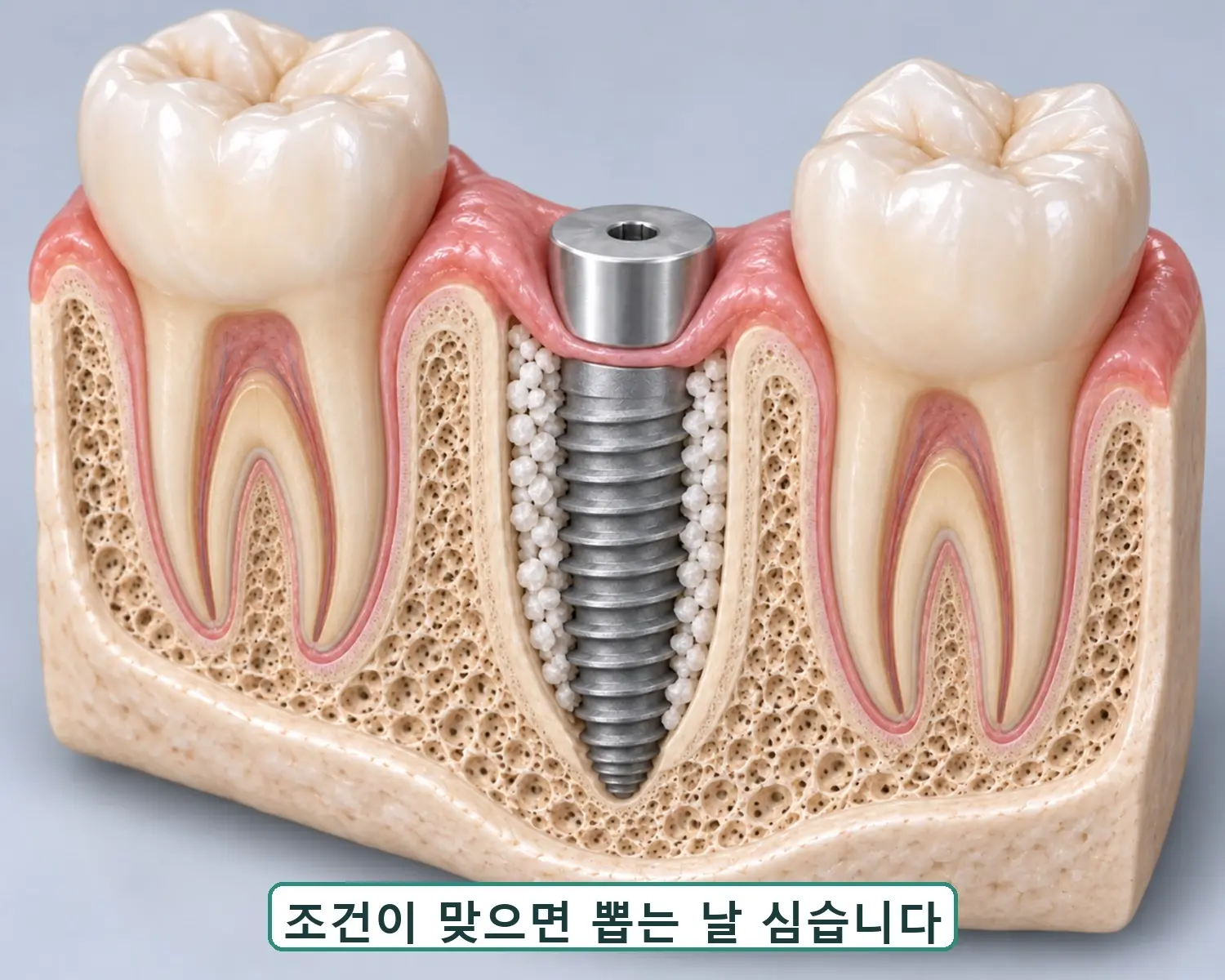
Jaw model showing an implant placed on the same day a molar was extracted, with bone graft material filling the gap and a healing abutment

IMMEDIATE IMPLANT

Immediate Implants After Extraction: Four Key Points

Whether to place the implant on the day of extraction or wait two to three months is decided by infection and the 2–3 mm of bone below the socket.

Same-Day Implant

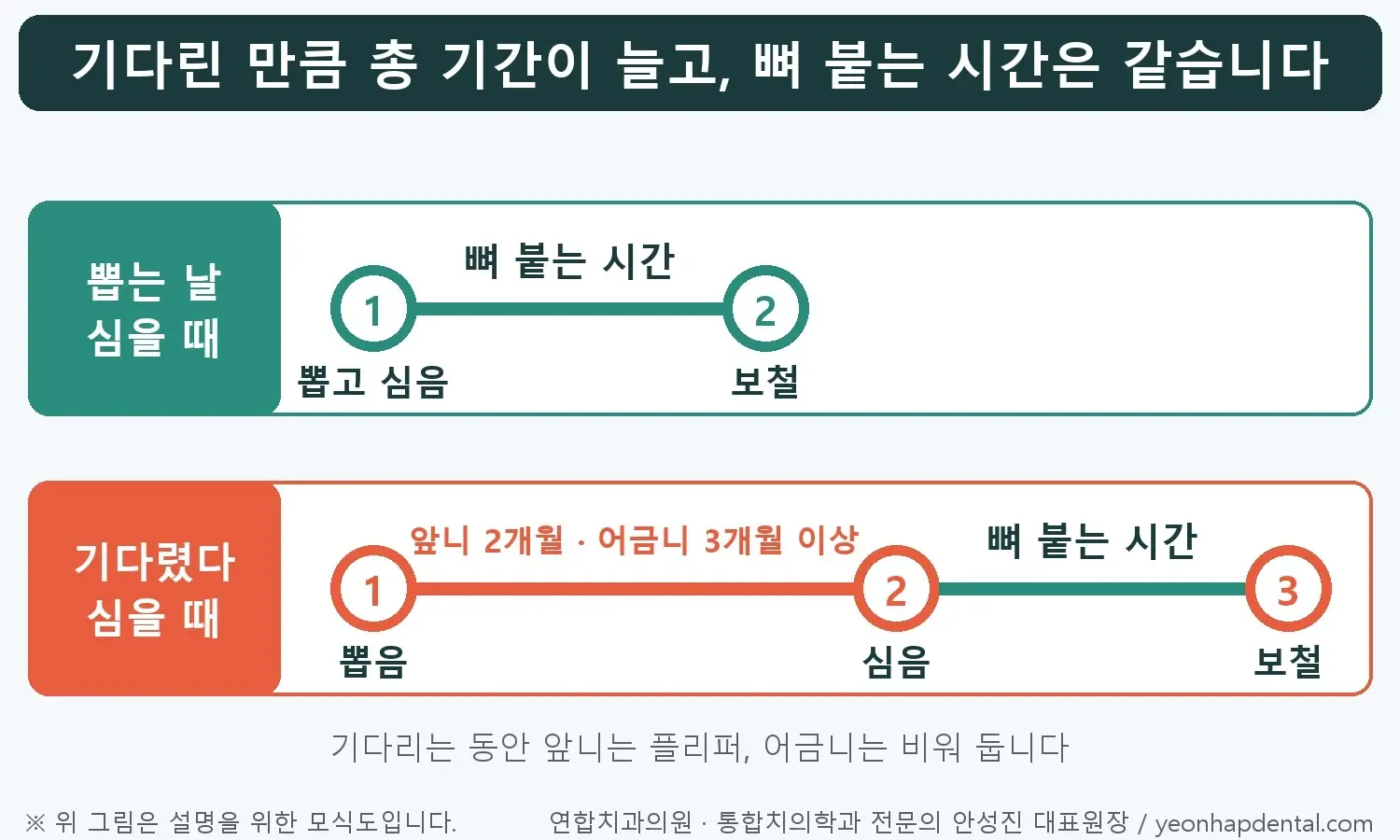
An immediate implant is a way to remove the waiting time

An immediate implant (immediate placement) is a method of placing the implant on the same day the tooth is extracted. What gets shorter is the wait after extraction; the 3–6 months for bone bonding stays the same. Yeonhap Dental Clinic decides between two options: place on the extraction day, or wait more than two months for front teeth and more than three months for molars before placing.

Go Or Wait

What we check at your first consultation

On the first day, we look at the three points below using a 3D CBCT and the condition of the socket to gauge whether to place on the extraction day. Stability is confirmed during surgery.

  • Whether there is pus, swelling, or a fistula, and whether it can all be curetted out
  • Whether there is original bone 2–3 mm below the socket floor, and whether the maxillary sinus or nerve canal reaches that depth
  • For front teeth, whether the gum has receded; for molars, whether there is bone between or at the root sites to achieve stability

How We Do It

Immediate Implants After Extraction: Three Things We Check First

These are whether the infection can be fully cleared, whether stability can be achieved in the bone below the socket, and what is attached after placement.

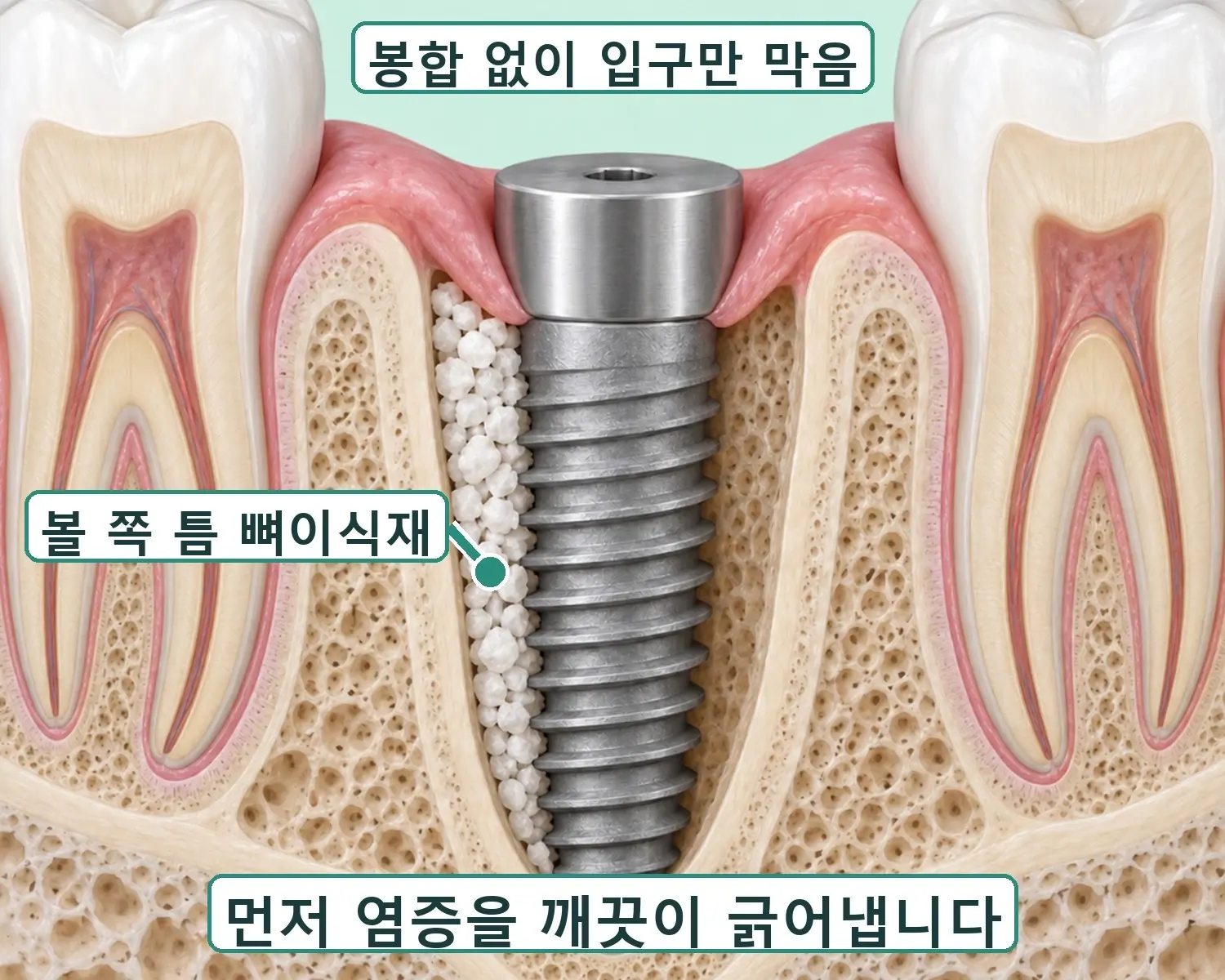
Cross-section diagram of an implant placed in a cleanly curetted socket after extraction without cutting the gum, with a healing abutment closing the opening and bone graft material filling the cheek-side gap

First, we check whether all the infection can be cleaned out

After extraction without cutting the gum, we thoroughly curette the infected tissue from the socket. Depending on the stability achieved, we only close the opening and add no sutures or membrane, so there is less swelling. If the infection is so severe that it would remain even after curettage, we do not place the implant that day.

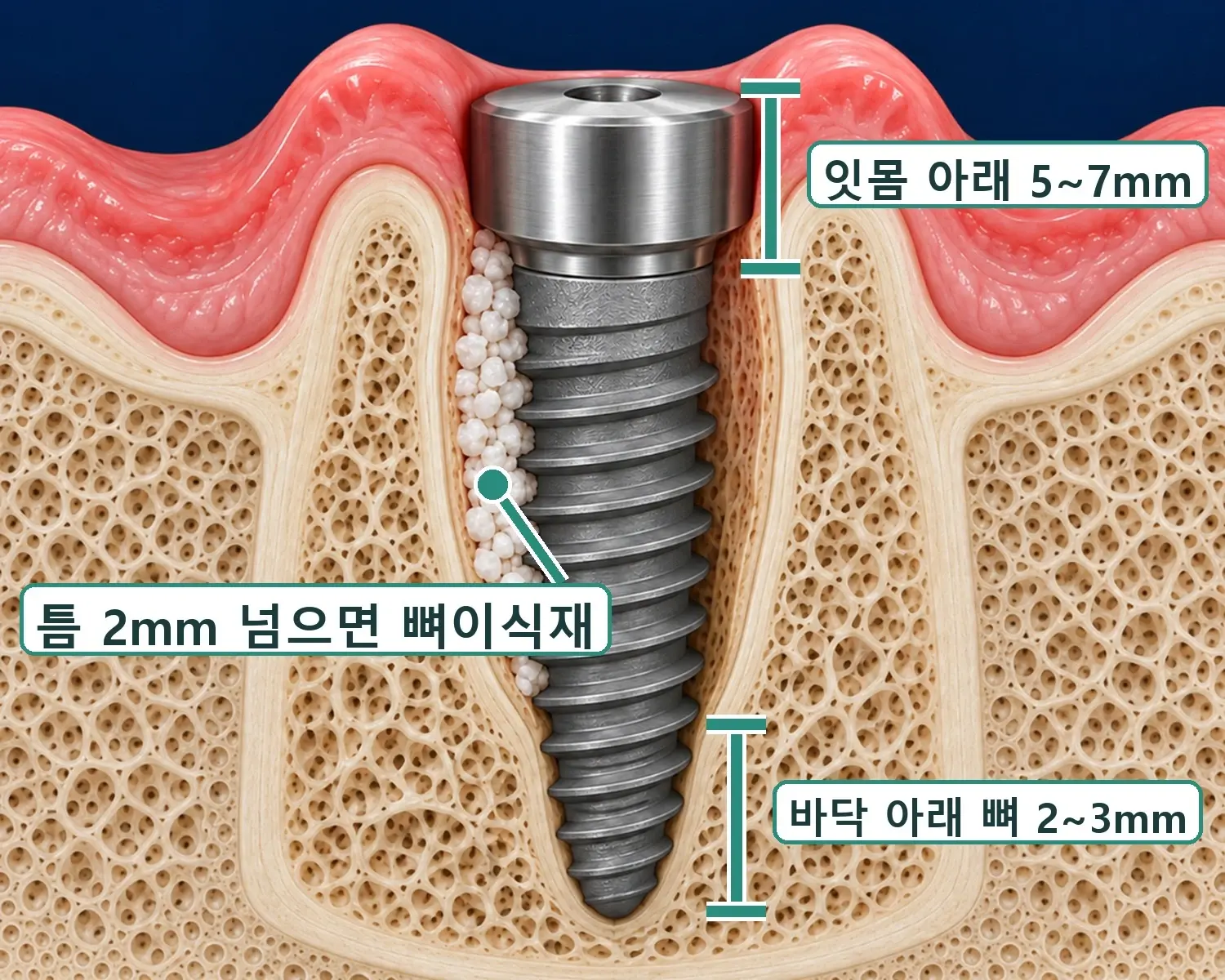
Cross-section diagram of an implant anchored in bone 2–3 mm below the floor of the socket, marking a depth of 5–7 mm below the gum and bone graft material filling a 2 mm gap

Stability must be achieved in the bone 2–3 mm below the socket floor

We aim for 30–35 Ncm by anchoring the implant in the original bone 2–3 mm below the socket floor. If it barely engages (10 Ncm or less), or if the maxillary sinus or nerve canal is at that depth, we wait. The implant is placed 5–7 mm below the gum, and if the gap exceeds 2 mm, it is filled with bone graft material.

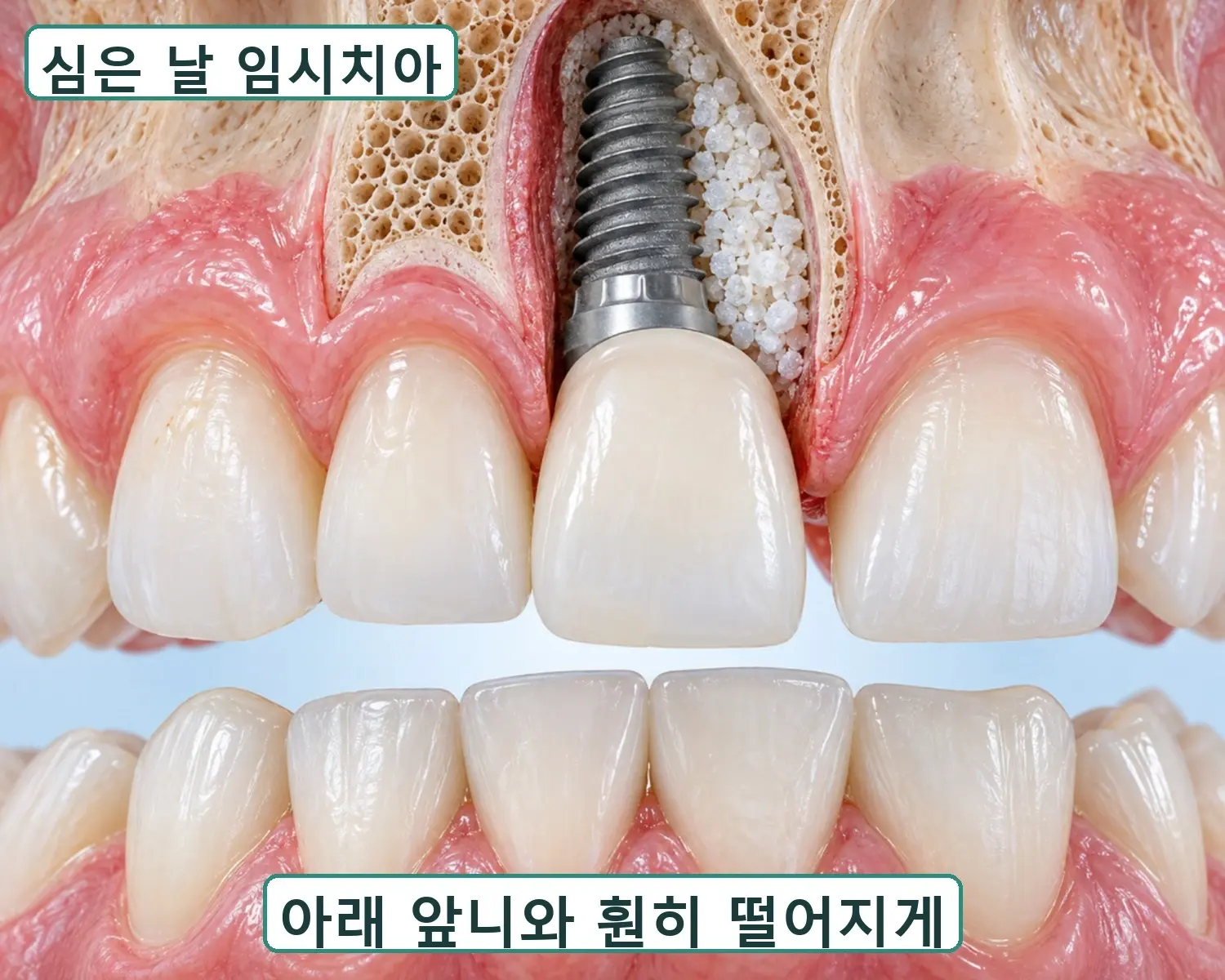
Cross-section diagram of an implant placed in an upper front tooth site right after extraction, with bone graft on the cheek side and a temporary tooth above it held clear of the lower front teeth

Front teeth: a temporary tooth on the day of placement if conditions allow; molars: a healing abutment

For front teeth, if stability of 30 Ncm or more is achieved and the bite is right, a temporary tooth is attached on the day of placement and made to sit visibly clear of the opposing teeth; otherwise a flipper is used. For molars, only a healing abutment is placed and you chew while avoiding the surgical site.

When We Wait

If we do not place that day: 2 months for front teeth, 3 months or more for molars

On the first day, we explain together the four cases in which we wait and how you manage in the meantime.

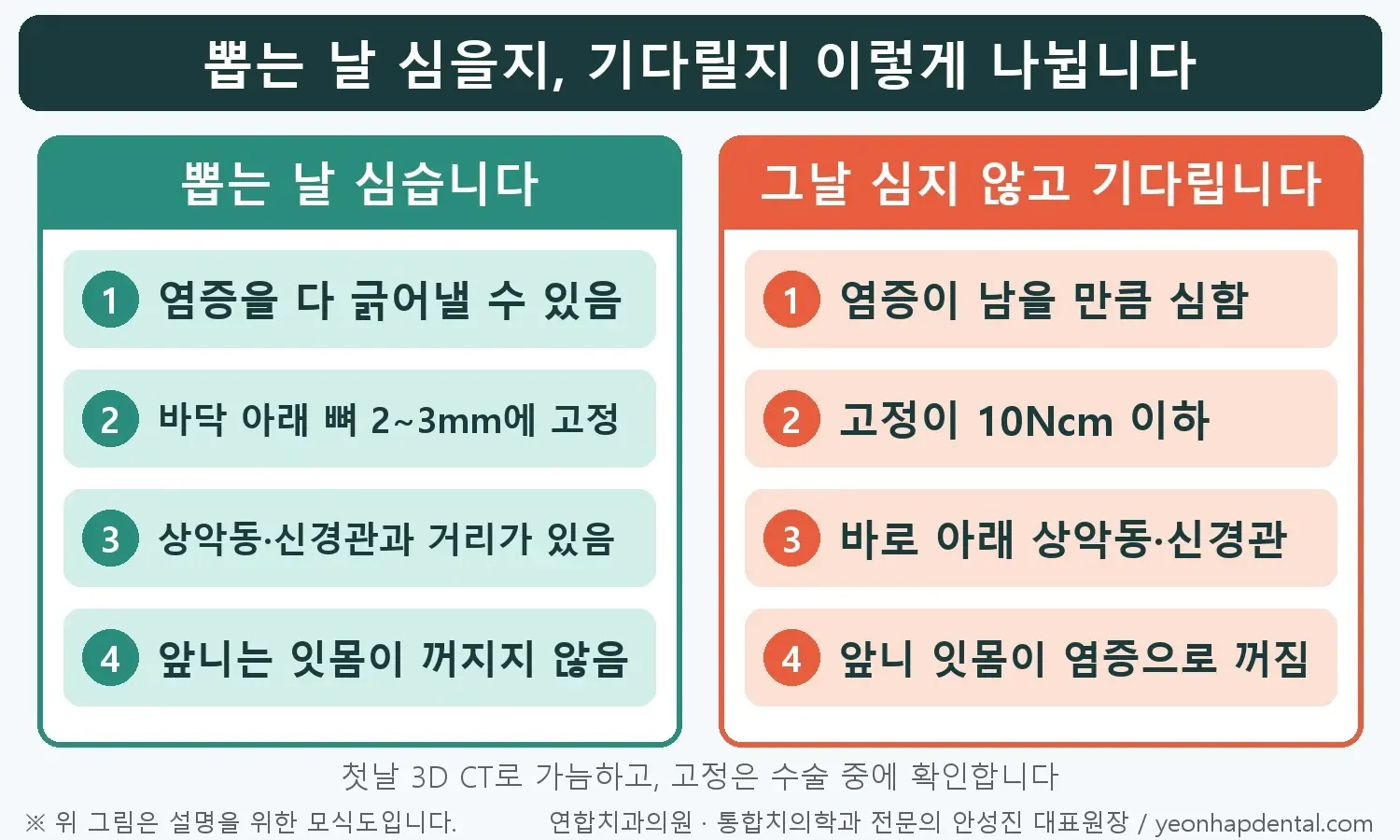
Diagram comparing, left and right, the conditions for placing on the day of extraction and four cases in which we wait

In these four cases, we do not place the implant that day

① When pus and swelling are so severe that the infection cannot be fully removed ② When the front tooth gum has receded due to infection ③ When there is barely any stability in the bone below the floor (10 Ncm or less) ④ When the maxillary sinus or nerve canal is at that depth. Infection that cannot be fully removed is better waited out.

Timeline comparing the schedule for placing on the extraction day versus waiting and placing later, with a wait of 2 months for front teeth and 3 months or more for molars

While you wait: a flipper for front teeth, and the molar space left empty

For front teeth, you manage for 2 months with a flipper (a removable temporary partial denture); for molars, the space is left empty for 3 months or more and you chew on the other side. For an upper molar with a history of sinusitis, we recheck the maxillary sinus with CT after three months. The total period extends by the length of the wait, and the time for bone bonding is the same.

Before Visit

Helpful details before your visit

If you let us know the points below, we can tell you on the first day whether immediate placement may be possible.

  • Whether the tooth to be extracted has ever swollen or drained pus, and whether it hurts now
  • For an upper molar, whether you have ever been treated for sinusitis
  • For a front tooth, whether your gums show when you smile and whether your front teeth bite deeply
  • Medications you take (osteoporosis drugs, anticoagulants, diabetes drugs) and whether you smoke

Immediate Implants After Extraction: Our Criteria at Yeonhap Dental Clinic

Initial stability: The implant engages the original bone 2–3 mm below the floor of the extraction socket, aiming for 30–35 Ncm and not tightening beyond that. At 10 Ncm or less, we do not place it that day. If it is above 10 Ncm but short of 30 Ncm, we place it but cover it with a low healing abutment or a cover screw so that no force is applied. Placement depth: 5–7 mm from the gum surface. It is placed deeper than a conventional placement (4 mm) so that the neck of the implant is not exposed even after the bone has receded. Gap: If it exceeds 2 mm, bone graft material is placed on the same day. For front teeth, the implant is placed against the palatal wall and the gap on the cheek side is filled, creating 2 mm of bone on the cheek side. Waiting period: 2 months for front teeth (with a flipper), 3 months or more for molars. The amount of graft may be reduced, but if the cheek-side bone shrinks during the wait, a bone graft may instead be needed.

Immediate Implants After Extraction: The Evidence Behind Our Criteria and Its Limits

The numbers above are not values from the literature but the clinical criteria of Yeonhap Dental Clinic. The estimated 2-year survival rate of immediate placement is reported as 98.4% in 46 prospective studies (Lang 2012), but in 8 studies that directly compared it with delayed placement (12–96 months of follow-up), it was 94.9% versus 98.9%, with more early failures in immediate placement (Cosyn 2019). The two reviews differ in composition and follow-up period, so their figures cannot be compared directly. The loss of cheek-side bone after extraction also does not stop just because the implant is placed immediately. For this reason, Yeonhap Dental Clinic reads the high survival rate as the result of carefully selecting sites, and if even one of the four conditions is not met, we do not place the implant that day. References: Lang 2012, systematic review of 46 prospective studies on immediate placement · Cosyn 2019, meta-analysis of immediate vs. delayed single-tooth implant placement Treatment results may vary by individual oral condition.

Last updated:

Schedule a consultation by phone or Naver Booking

Leave a few details on our consultation page and we'll get back to you promptly.

Frequently Asked Questions

Q. Can anyone have an immediate implant after extraction?
To place an implant on the day of extraction, we check three common conditions, and for front teeth we also look at the gum condition. The infection inside the extraction socket must be completely curettaged away; the implant must engage firm bone 2–3 mm below the floor of the socket to achieve stability (if it barely engages, at 10 Ncm or less, we do not place it that day); and there must be no maxillary sinus or nerve canal at that depth. For front teeth, placement is usually possible as long as the gum has not receded. For sites that do not qualify, Yeonhap Dental Clinic waits more than two months for front teeth and more than three months for molars before placing the implant.
Q. Does an immediate implant shorten the treatment period?
What gets shorter is the two to three months of waiting after the extraction. The time the implant needs to bond with the bone (about 3 months in the lower jaw, 4–6 months in the upper jaw) is not reduced by immediate placement. Yeonhap Dental Clinic tells you in advance that this time stays the same, and only at sites that meet the conditions do we place the implant on the extraction day to remove the waiting.
Q. Can an implant be placed on the day of extraction even in a tooth with infection?
Even with infection, if the socket can be cleaned out thoroughly, the implant can be placed on the day of extraction. However, if pus and swelling are severe and infection is likely to remain, Yeonhap Dental Clinic does not place the implant that day and places it after the area has healed.
Q. Can I use a temporary tooth right after an immediate implant?
For front teeth, if stability of 30 Ncm or more is achieved and the bite conditions are right, a temporary tooth can be attached on the day of placement, but it is made so that it does not touch the opposing teeth. If the front tooth bites deeply or 30 Ncm stability is not achieved, a flipper is used instead of a temporary tooth. For molars, only a healing abutment or cover screw is placed, and you eat while avoiding the surgical site until the bone has bonded. Yeonhap Dental Clinic explains in advance that the day of placement and the day you can chew are different.