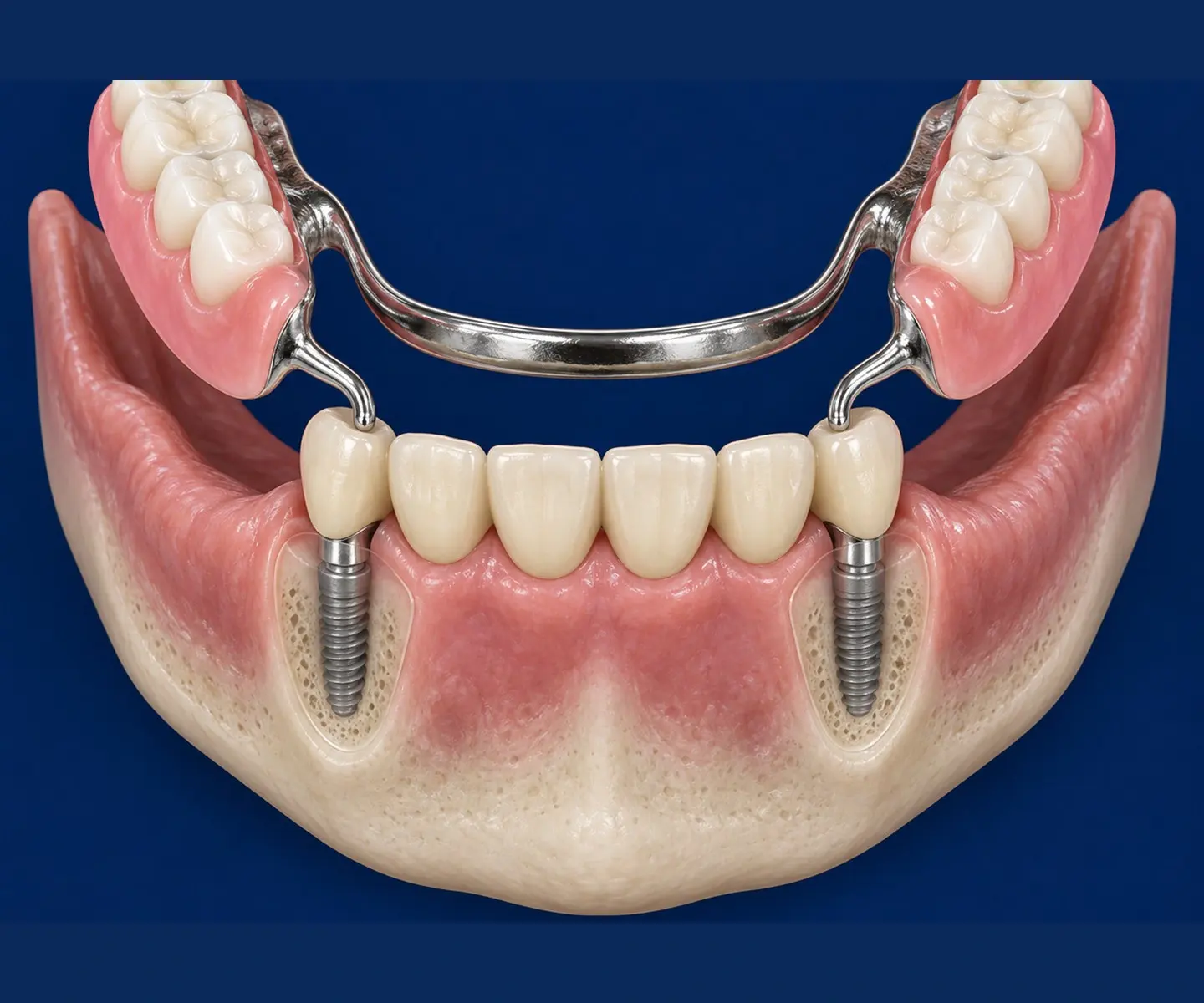
Diagram of an implant-supported denture showing the moment a partial denture is seated on a bridge over two implants

IMPLANT DENTURE

Implant-Supported Dentures, Three Key Points

It does not shake as a whole like a complete denture, and you do not need to place many implants as with All-on-X.

Between Denture and Fixed

An implant-supported denture is midway between a complete denture and All-on-X

An implant-supported denture (IARPD) is a treatment in which implants support a partial denture, and it sits between a complete denture and full-arch implants (All-on-X). Our clinic attaches a partial denture with clasps and rests to a bridge fixed on the implants, and the standard is two implants at the canine sites for a completely edentulous lower jaw and four for the upper jaw. If a complete denture or All-on-X is the better choice for you, we will tell you so.

Consultation Checklist

What we check at your first consultation

At the first consultation, we look at the three items below on 3D CT and decide whether an implant-supported denture is right for you.

  • Where the remaining teeth and the opposing molars are
  • Whether a 10 mm implant fits at the implant sites on CT, and whether four sites are available in the lower jaw
  • If you are 65 or older, your NHI-covered implant and denture history and what coverage remains

Three Things First

Implant-Supported Dentures: Three Things to Know First

What it attaches to, how many implants are placed and where, and how it changes if teeth remain.

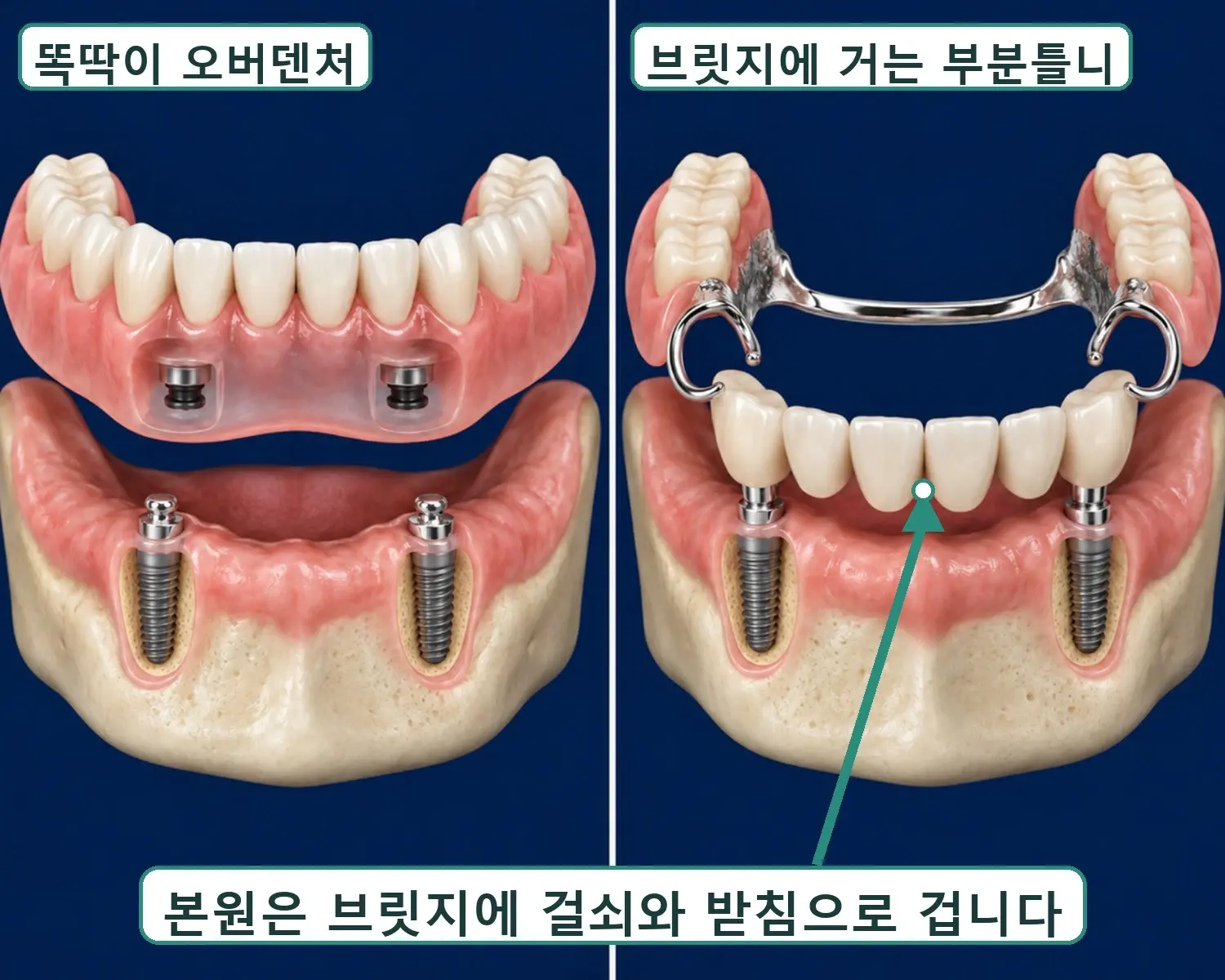
Realistic side-by-side diagram comparing a snap-on overdenture (rubber ring on a button) with a partial denture clasped onto an implant bridge

Our implant-supported denture is a partial denture that attaches to a bridge

A “snap-on” overdenture fits a rubber ring onto a button component on the implant, whereas we attach a partial denture with clasps and rests to a bridge fixed on the implants. It may be eligible for NHI coverage and there are no snap-on retention parts to replace, but relining the inside of the denture and adjusting the clasps are needed.

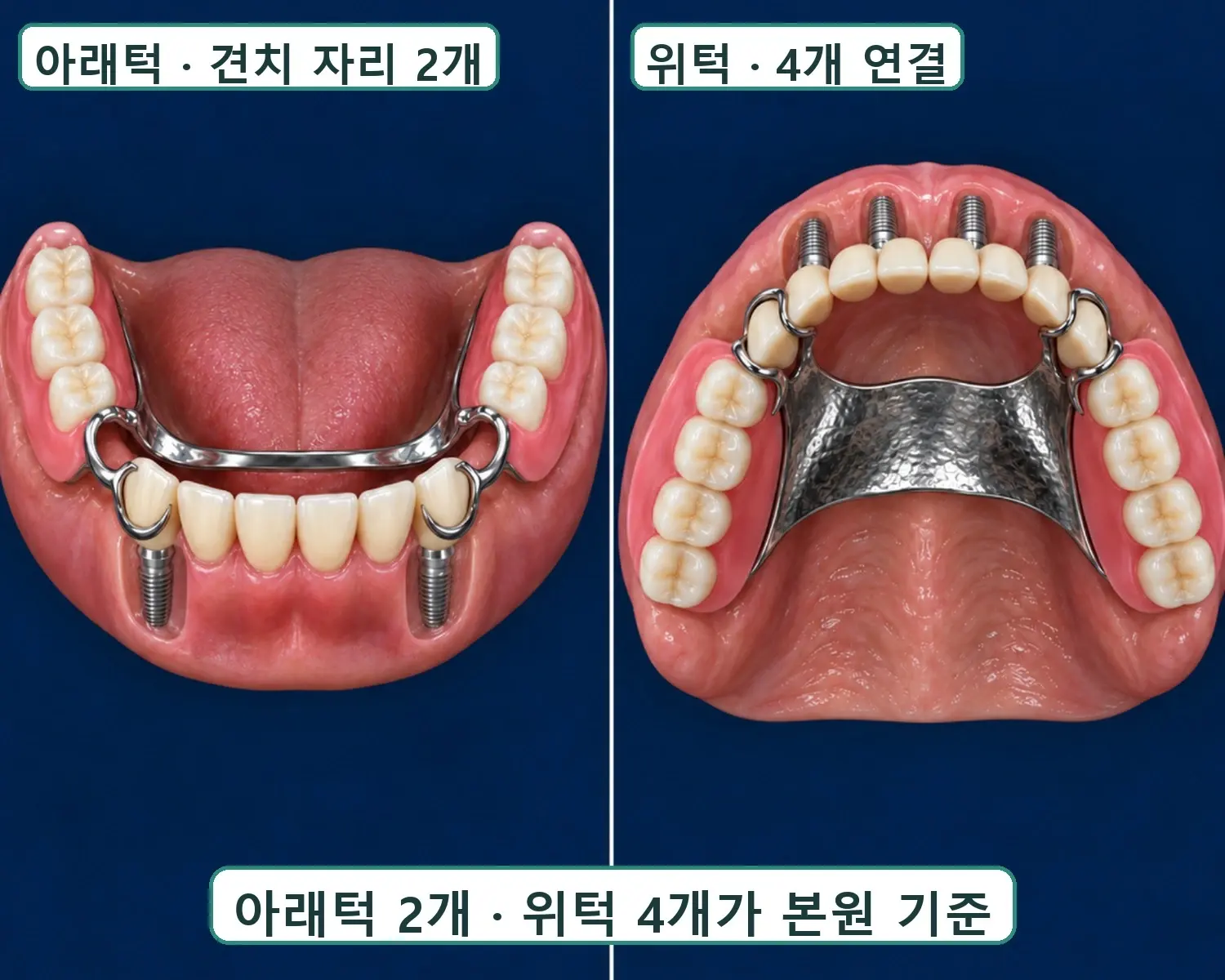
Realistic diagram of our basic design: a partial denture attached to a bridge over two implants at the lower canine sites, and a partial denture over four connected implants in the upper jaw

Two canine implants in the lower jaw, four in the upper jaw, are our standard

Our basic design is two implants at the canine sites with a 6-unit front-tooth bridge for a completely edentulous lower jaw, and four connected implants for a completely edentulous upper jaw. If four sites are available, we also consider All-on-4 (four implants), and for a completely edentulous upper jaw we first consider a complete denture or All-on-6 (six implants in the upper jaw).

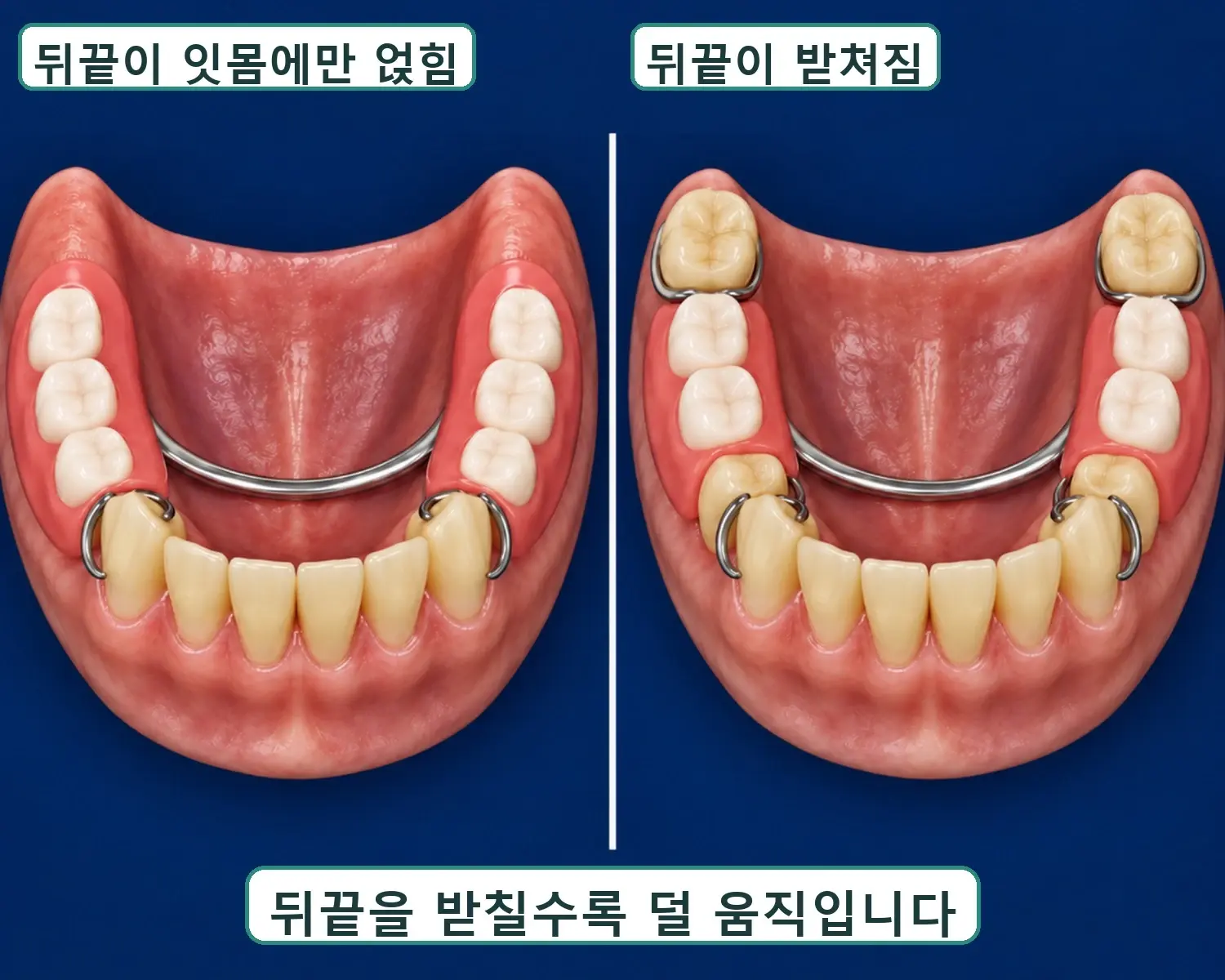
Realistic diagram of a partial denture comparing a rear end that rests only on the gums with a rear end supported by a tooth

If teeth remain, we place support where the rear end of the denture rests

A rear end resting only on the gums sinks when chewing and loosens the clasp tooth. We look at the remaining teeth and the opposing molars, and set a bridge where it supports that rear end to reduce movement. If only the front teeth remain, for example, it varies from case to case, such as placing support on the side with more opposing molars.

Coverage and Care

Decide after knowing the coverage and the timeline

We explain the coverage scope and the time involved on the first day of consultation.

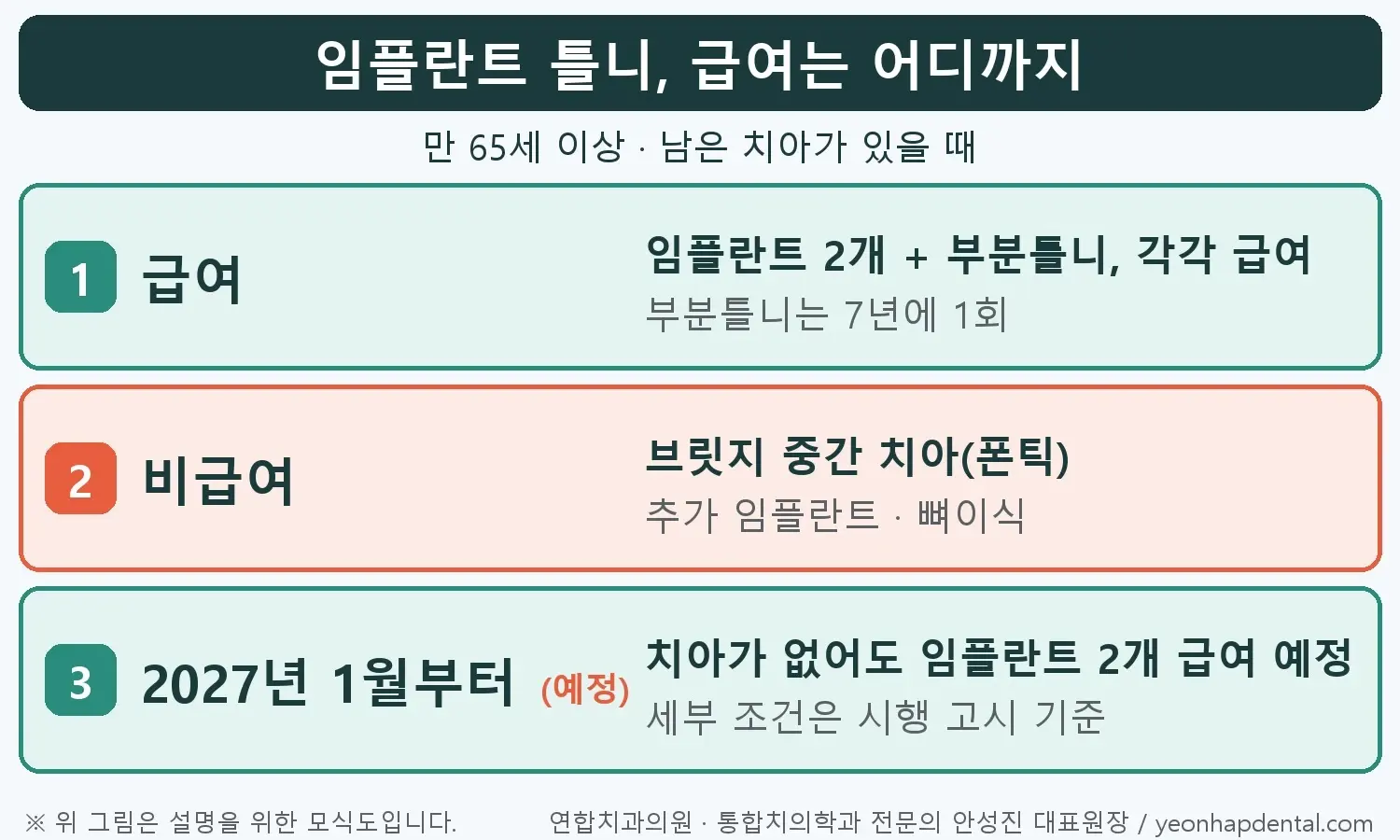
Diagram of NHI coverage for implant-supported dentures: two implants and the partial denture are each covered, the intermediate bridge teeth are not covered, and coverage for the completely edentulous is scheduled to expand in January 2027

NHI coverage may apply separately to the two implants and the partial denture

For patients aged 65 and over who are partially edentulous, NHI coverage may apply separately to the two implants and to the partial denture, while the intermediate bridge teeth, additional implants, and bone grafts are not covered. Coverage for the completely edentulous is scheduled to expand in January 2027. For the system overall, see the NHI Implant Guide.

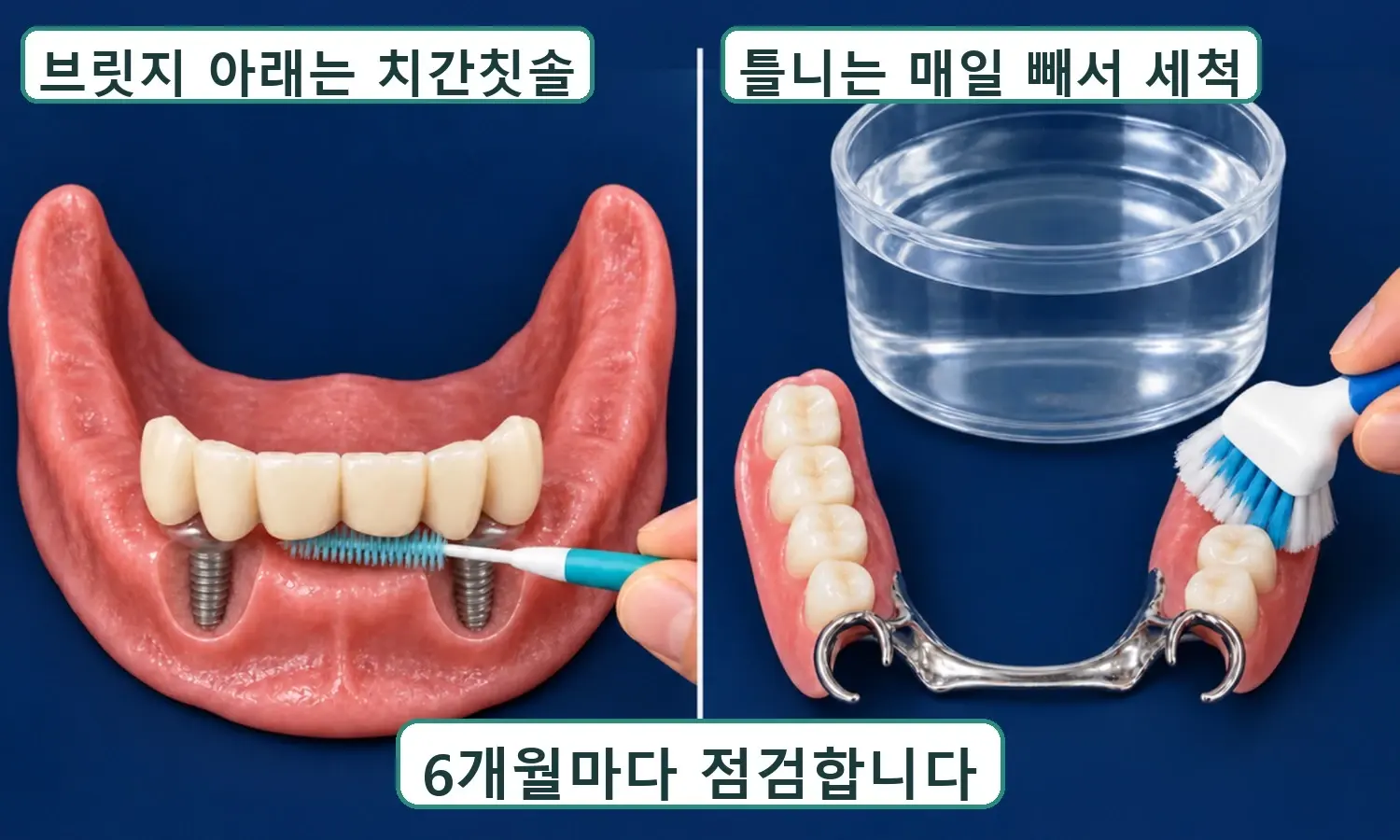
Realistic diagram of cleaning under an implant bridge with an interdental brush and brushing a removed partial denture

About 5 months for the lower jaw, then daily cleaning and a 6-month check-up

For the lower jaw, the second-stage surgery is about 3 months after placement, followed by about 2 weeks for the bridge and about 1 month for the partial denture, for a total of about 5 months. For the upper jaw, the schedule depends on how healing goes, and in the meantime you keep using your current denture after adjustment. After completion, you remove and clean it every day and have it checked every 6 months.

Before Visit

Helpful details before your visit

We reline the inside of your current denture and use it as a temporary denture, so please bring it with you.

  • The denture you currently use (we reline the inside and use it as a temporary denture)
  • Notes on any remaining teeth that are loose or painful
  • A list of medications you are taking (including anticoagulants and osteoporosis medication)
  • Whether you have ever used an NHI-covered implant or denture

The criteria Yeonhap Dental Clinic uses for implant-supported dentures

Method: A partial denture is attached with clasps and rests to a bridge fixed on the implants. We do not do snap-on overdentures. Basic design: For a completely edentulous lower jaw, two implants at #33 and #43 with a 6-unit front-tooth bridge; for a completely edentulous upper jaw, four implants with an 8-unit bridge. For a partially edentulous mouth, we look at the remaining teeth and the opposing molars to decide where to support the rear end. When we also consider other treatment: If four sites are available in the lower jaw, we also consider All-on-4, but when the NHI coverage conditions are met, some patients choose an implant-supported denture so they can use two NHI-covered implants together with an NHI-covered partial denture. For a completely edentulous upper jaw, we first consider a complete denture or All-on-6. Specifications: 10 mm in length and 4.0 mm in diameter, or 4.5 mm if the bone width allows. The bridge is made as a PFM with a metal occlusal surface so that the clasp and rest surfaces can be adjusted.

The basis and scope of the criteria for implant-supported dentures

Two implants in the lower jaw, four in the upper jaw, and the choice of sites are not values set by the literature but Yeonhap Dental Clinic's own clinical standards. We refer to the literature only to the extent that satisfaction and chewing function improved after converting a lower-jaw partial denture missing both rear sides to an implant-supported denture (Park 2020), and for NHI coverage we follow the National Health Insurance Service guidance and Ministry of Health and Welfare announcements. The expansion of coverage for completely edentulous patients in January 2027 is based on the announcement, and people who have already received an NHI-covered complete denture become eligible only after 7 years. For this reason, at the first consultation Yeonhap Dental Clinic looks at the implant sites and the remaining teeth on 3D CT, and first decides whether an implant-supported denture or another path is the right fit. References: Park 2020, meta-analysis of converting a lower-jaw bilateral posterior partial denture to an implant-supported denture · National Health Insurance Service, NHI coverage guide for dentures for older adults · Ministry of Health and Welfare, results of the Sept. 8, 2026 Health Insurance Policy Deliberation Committee (expanded dental coverage) Treatment results may vary depending on each person's oral condition. Whether NHI coverage applies depends on eligibility, coverage history, and design conditions.

Last updated:

Schedule a consultation by phone or Naver Booking

Leave a few details on our consultation page and we'll get back to you promptly.

Frequently Asked Questions

Q. Who is an implant-supported denture suited to?
Suited to people whose lower denture keeps lifting but who are reluctant to place many implants, especially those with two usable implant sites in the lower jaw. If four sites are available, Yeonhap Dental Clinic also considers All-on-4, but when the NHI coverage conditions are met, some patients choose an implant-supported denture so they can use two NHI-covered implants together with an NHI-covered partial denture. For a completely edentulous upper jaw, we first consider a complete denture or All-on-6.
Q. How is an implant-supported denture different from a complete denture?
A complete denture sits only on the gums and lifts especially easily in the lower jaw, whereas our implant-supported denture attaches to an implant bridge fixed at the front. In our basic lower-jaw design, the front tooth section is kept and only the molar section is removed and seated, and at Yeonhap Dental Clinic we explain that this difference is felt most in how much the denture lifts when chewing and in the sense of a foreign object.
Q. Do I have to have my remaining teeth pulled to get an implant-supported denture?
It is not a treatment that removes the teeth you have left. The remaining teeth support the denture together with the implant bridge, so at Yeonhap Dental Clinic we decide which teeth to keep based on prognosis and the treatment plan, and extract only the teeth that cannot be used. Once the teeth to keep are decided, the bridge positions are set to match those teeth and the opposing molars.
Q. Isn't an implant-supported denture hard to maintain?
The basics are to remove and clean the denture every day and to clean under the bridge with an interdental brush. There are no rubber rings to replace as with a snap-on type, but relining the inside of the denture, adjusting the clasps, and checking the screws are necessary. At Yeonhap Dental Clinic, we check the gums around the bridge and the gums that the denture touches every 6 months.
Q. Why do you not often recommend an implant-supported denture for the upper jaw?
The upper jaw often has soft bone and low height because of the maxillary sinus, so our clinic connects four implants there, and this is our own clinical standard. Even so, the result is still a removable denture, and if additional placement is possible, All-on-6 can also be considered, so for a completely edentulous upper jaw we first consider a complete denture supported by the palate or All-on-6, and choose an implant-supported denture depending on conditions.