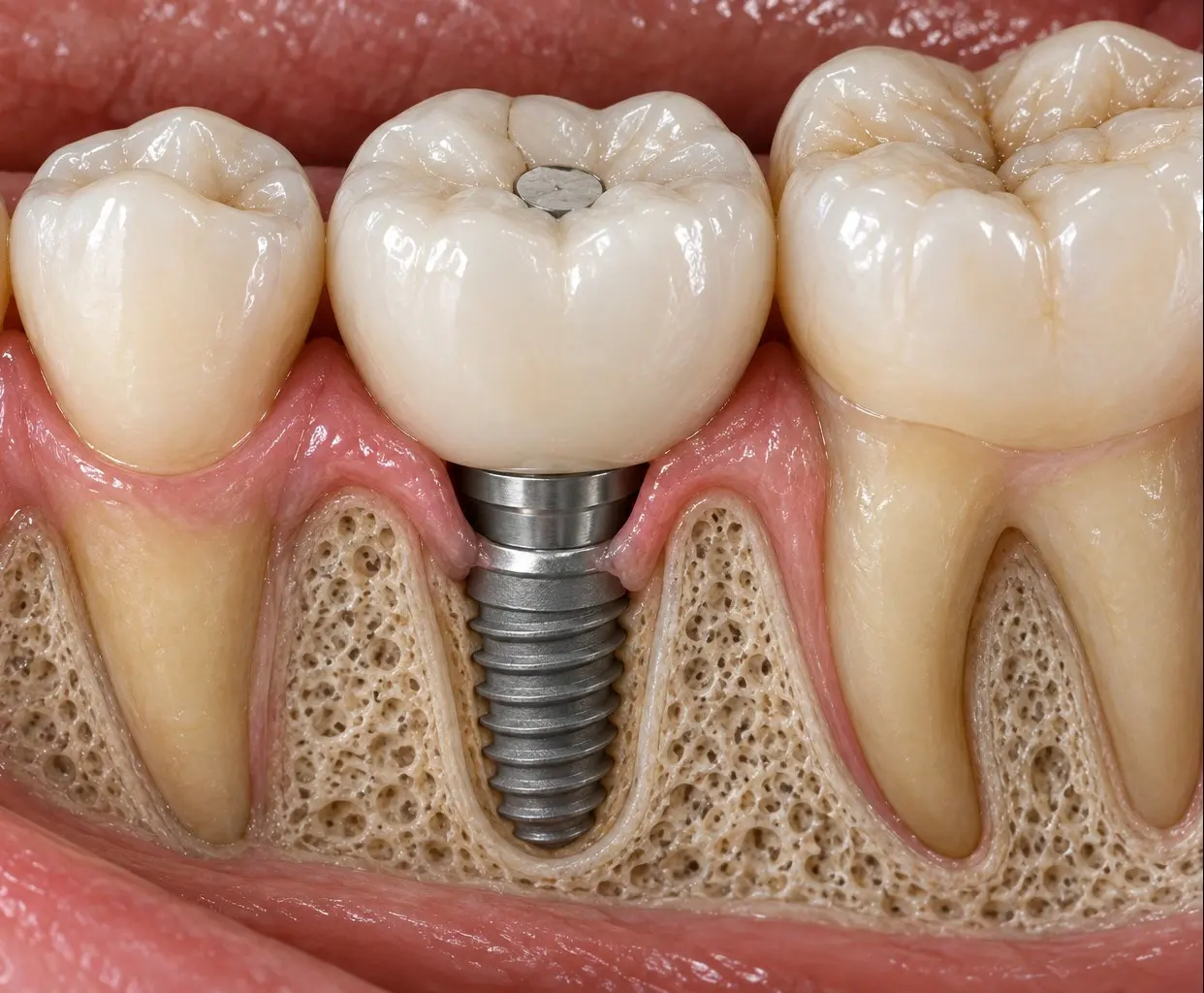
Realistic cross-section diagram of an implant placed in lower molar bone according to the criteria, with stable gum and bone around it

IMPLANT REVISION PREVENTION

Implant Revision Surgery What Do We Change When Placing It Again?

When placing an implant again, we confirm the cause of the previous failure and first decide what to change among bone graft, placement position, prosthesis shape, and thickness.

Why Diagnosis Matters

When placing it again, we start by changing the cause of the failure

When placing an implant again, if the cause of the previous failure is not addressed, the same problem may recur. So before placing it again, we first work out why it failed. What we change this time differs depending on whether the cheek-side bone was thin, whether depth, angle, or the shape of the prosthesis was off so that it could not be cleaned, or whether the implant body fractured. After waiting 2-3 months after removal, we look at the bone and prosthesis conditions and set the position, thickness, and length anew as for a first placement, and the existing crown and abutment are not reused but made anew. At Yeonhap Dental Clinic, depending on the cause of failure, we decide what to change among the bone graft, the depth, angle, and abutment design, and the implant size, and then place it again.

Consultation Checklist

What we check at your first consultation

At the consultation before re-placement, we use X-rays, 3D CT, an oral examination, and a medical history to work out why it failed, looking at the five items below.

  • Whether the cheek-side bone at the removed site was thin, and whether a bone graft is needed to create 2 mm when placing again
  • How far the previous implant's depth and angle deviated from 4 mm below the gum and parallel to the neighboring tooth
  • Whether the previous prosthesis was bulging so that the toothbrush could not reach the gum margin
  • Whether the implant failed because the body fractured, and if so, whether thickness needs to be increased
  • Smoking and the bite: whether you can stop smoking for one month after surgery, and whether the bite was concentrated on one side

Treatment Options

What we change this time, depending on the cause of failure

We divide it into three: sites where bone was lacking, sites where position, prosthesis, or bite was the problem, and sites where the body fractured.

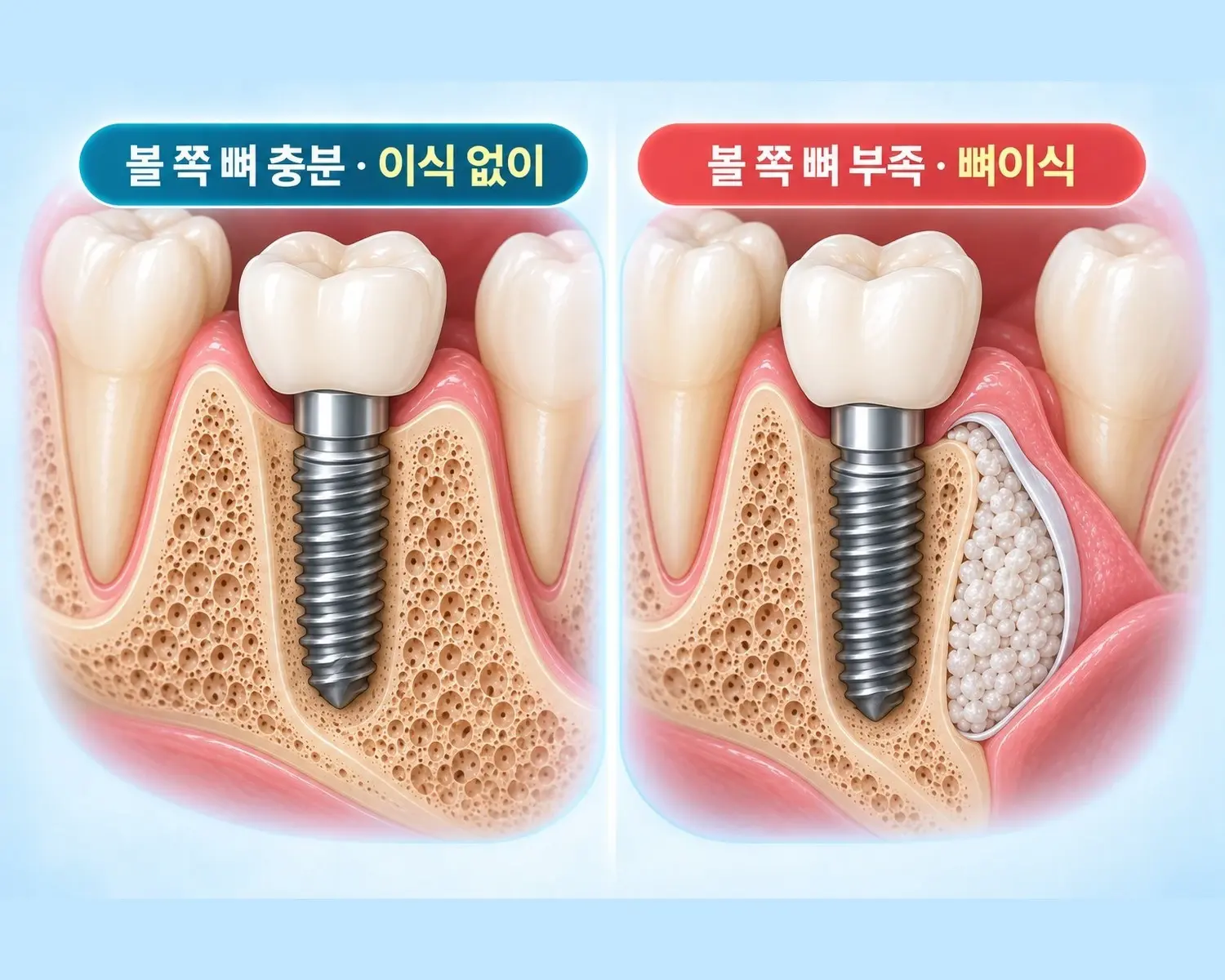
Cross-section diagram comparing an implant placed without a graft because the cheek-side bone was sufficient with one for which a bone graft created 2 mm because the cheek-side bone was lacking

Sites where bone was lacking: a cheek-side bone graft on the day of re-placement

At a site where the implant failed because the cheek-side bone was thin, there is even less bone once the implant is removed. When placing again, if a position that leaves 2 mm on the cheek side can be found, we place it there, but usually it cannot, so we do a sufficient cheek-side bone graft on the same day as placement and do not leave the bone thin.

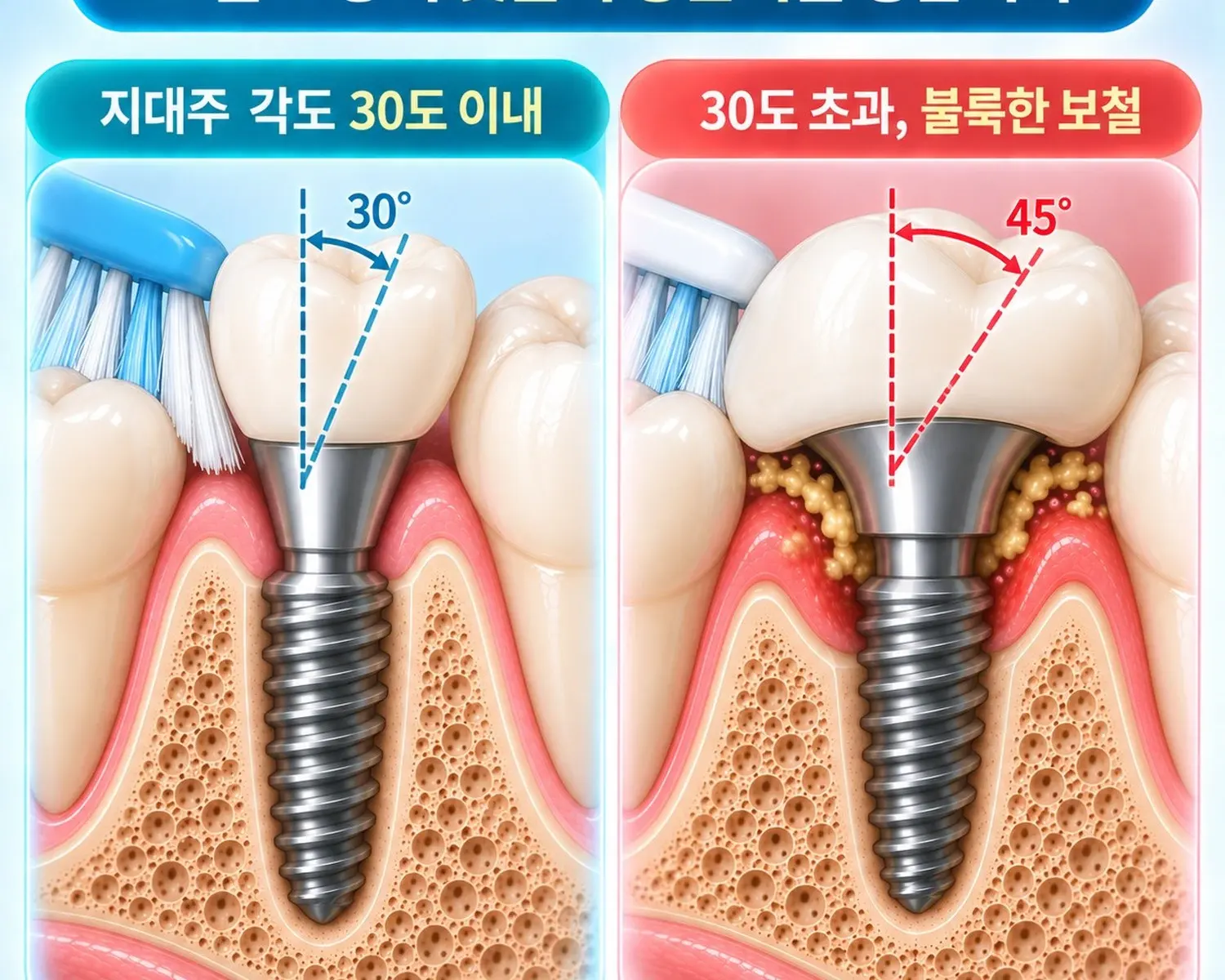
Cross-section diagram comparing a prosthesis with an emergence angle within 30 degrees that the toothbrush can reach with one that bulges beyond 30 degrees and that the toothbrush cannot reach

Sites where position, prosthesis, or bite was the problem: replan the depth, angle, and abutment

At a site where depth, angle, or the shape of the prosthesis was the problem, we replan and place the implant at about 4 mm below the gum and parallel, and make a new abutment in a shape that is easy to clean (emergence angle within 30 degrees). If the bite was the cause, we adjust the bite without lateral-force interference. The existing crown and abutment are not reused.

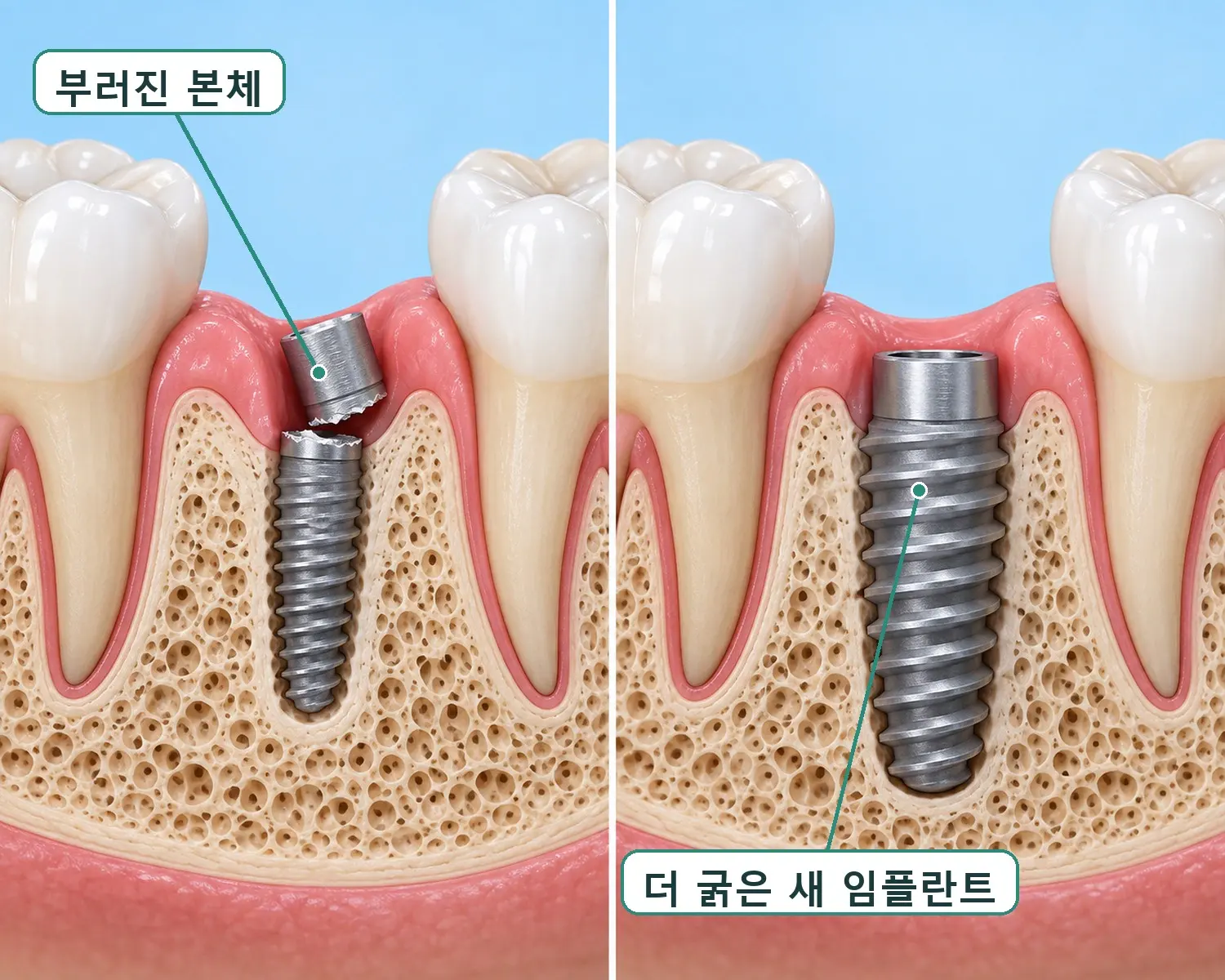
Cross-section diagram comparing an implant body fractured horizontally near the gum with a new, thicker implant placed at the same site

Sites where the implant body fractured: review the thickness and the force conditions

A fractured implant body means its thickness could not withstand the chewing force. After removal and 2-3 months, we look at the previous thickness and the force that site receives and place a thicker size to make up for it. The basic thickness and length criteria for each site remain the same.

Planning Points

The re-placement sequence and what to keep in mind afterward

We do not place it on the day of removal, and after re-placement we wait 3 months until the prosthesis.

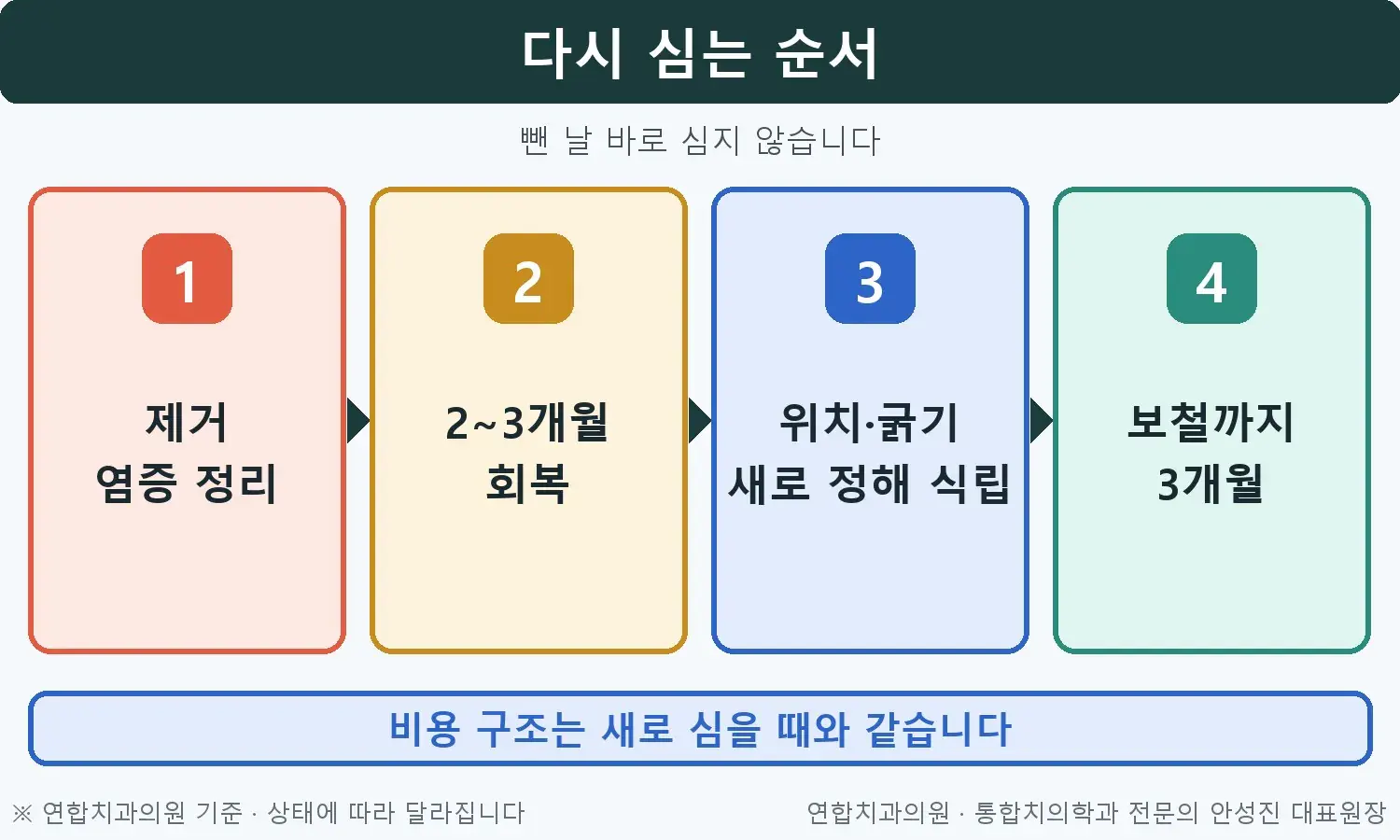
Infographic of the re-placement sequence: removal and clearing of inflammation, 2-3 months of recovery, placement with position and thickness set anew, and 3 months until the prosthesis

Removal → 2-3 months → set anew and place → 3 months until the prosthesis

We do not place it on the day of removal. After clearing inflammation during removal and recovering for 2-3 months, we look at the bone and prosthesis conditions and set the position, thickness, and length anew, as for a first placement. After re-placement, we wait 3 months until the prosthesis, and the cost has the same structure as a new placement; if a bone graft or sinus lift is needed, that cost is added.

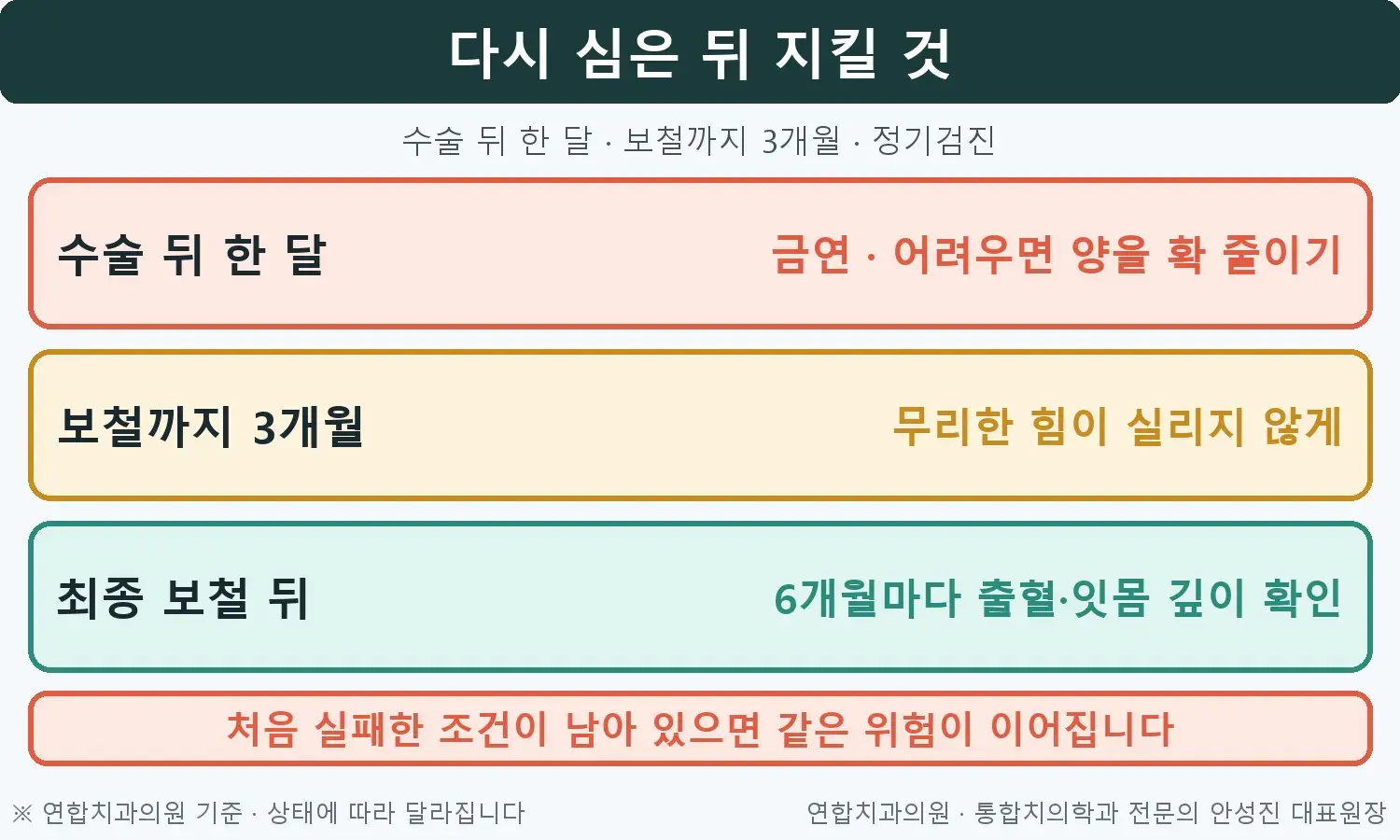
Infographic of what to keep in mind after re-placement: quit smoking or cut down for one month after surgery, avoid excessive force for 3 months until the prosthesis, and check bleeding and gum depth every 6 months after the final prosthesis

After re-placement: one month without smoking, and regular check-ups

At Yeonhap Dental Clinic, we advise you to stop smoking for at least one month after surgery, and if quitting is hard, we recommend cutting down sharply at least. After re-placement, we wait 3 months until the prosthesis and advise you to avoid putting excessive force on the surgical site. After the final prosthesis, we check bleeding and gum depth every 6 months.

Before Visit

Helpful details before your visit

If you let us know the items below, at the first consultation we can tell you together why it failed and what we will change this time.

  • When the implant was placed and how you were told why it had to be removed
  • How many times the gum swelled and subsided, and whether there was pus or odor
  • Whether chewing touched only one side, or the screw loosened repeatedly
  • Whether you take diabetes or osteoporosis medication or anticoagulants, and whether you smoke

What we change when placing again: Yeonhap Dental Clinic's criteria

Sites where bone was lacking: If a position that leaves 2 mm on the cheek side cannot be found, a sufficient cheek-side bone graft is done on the same day as placement. That is usually the case at a failed site, and we do not do staged surgery in which only the graft is done first. This is Yeonhap Dental Clinic's clinical standard, not a value from the literature. Sites where position, prosthesis, or bite was the problem: Depth and angle are replanned at about 4 mm below the gum surface and parallel to the neighboring tooth, and the abutment is made anew so that the emergence angle (the angle between the long axis of the implant and the prosthesis surface as it flares out) is within 30 degrees. The bite is adjusted without lateral-force interference, and the existing crown and abutment are not reused. Sites where the implant body fractured: We look at the previous thickness and the force that site receives, and make up for it with a thicker size. The basic thickness and length criteria for each site remain the same. Timing and smoking: We do not place it on the day of removal; after 2-3 months we set the position, thickness, and length anew, and after re-placement we wait 3 months until the prosthesis. We advise you to stop smoking for at least one month after surgery, or to cut down sharply if that is hard. The cost has the same structure as a new placement.

The criteria Yeonhap Dental Clinic follows when placing again

In a meta-analysis of 24 studies, the 1-year survival rate of implants placed again at a site where one was removed was 96.7%, but it was lower than for first-time implants, and a second re-placement at the same site was lower still (Gareb 2025). In a Korean study following 69 re-placements, age and smoking significantly raised the risk of repeat failure, all 8 that failed again did so during the bone-bonding period before the prosthesis was attached, and the authors considered patient factors to have a greater effect than implant factors (Park 2022). For implants with cheek-side bone under 2 mm, marginal bone loss one year after prosthesis connection was 0.36 mm, more than 10 times the 0.03 mm for those with 2 mm or more (39 implants, Nohra 2018). For this reason, Yeonhap Dental Clinic confirms the cause of the previous failure and decides which conditions to improve this time. What we change for each cause is as in the criteria above, and we wait 2-3 months after removal and then set the position, thickness, and length anew. Because a revision is a matter of conditions before it is a matter of technique, the same risk continues if the conditions that caused the first failure remain. References: Gareb 2025, systematic review and meta-analysis of implants placed again at failed sites (24 studies; 1-year survival 96.7%; lower than first-time implants; lower still for a second re-placement) · Park 2022, survival and risk factors of 69 re-placements in Korea (age and smoking; all 8 repeat failures were early; patient factors had a greater effect) · Nohra 2018, 1-year marginal bone loss after prosthesis connection of 0.36 mm in the group with under 2 mm of cheek-side bone versus 0.03 mm in the group with 2 mm or more (39-implant prospective study) Treatment results may vary depending on each person's oral condition.

Last updated:

Schedule a consultation by phone or Naver Booking

Leave a few details on our consultation page and we'll get back to you promptly.

Frequently Asked Questions

Q. How is implant revision surgery different from the first placement?
The way the implant is placed is the same, but before placing it again, we work out why it failed and change that cause. If the cheek-side bone was thin, a cheek-side bone graft is done on the same day as placement; if depth, angle, or the shape of the prosthesis was the problem, we replan, place it, and make a new abutment; and if the implant body fractured, we switch to a thicker size. At Yeonhap Dental Clinic, we wait 2-3 months after removal and then set the position, thickness, and length anew.
Q. Can the existing crown or abutment be reused in implant revision surgery?
They are not reused. When an implant is removed and a new one is placed, the position and angle change, so the abutment and crown are made anew to fit the new implant. Even for an implant placed at another clinic, it is removed and a new one is placed, so the information about the previous product is not needed.
Q. Does implant revision surgery cost more than the first time?
The structure is the same as a new placement. The fixture, abutment, and crown are included, and if a bone graft or sinus lift is needed, those items are added; there is no separate item added because it is a revision. However, bone has often shrunk at a site where an implant failed, so a bone graft is likely to be added, and Yeonhap Dental Clinic shows you the basis for that on CT.
Q. What should I do about smoking after implant revision surgery?
At Yeonhap Dental Clinic, we advise you to stop smoking for at least one month after the re-placement surgery, and if quitting is hard, we recommend cutting down sharply at least. Cutting down is not the same as quitting, and the smoking-related risk of failure may remain even after the implant is placed again.