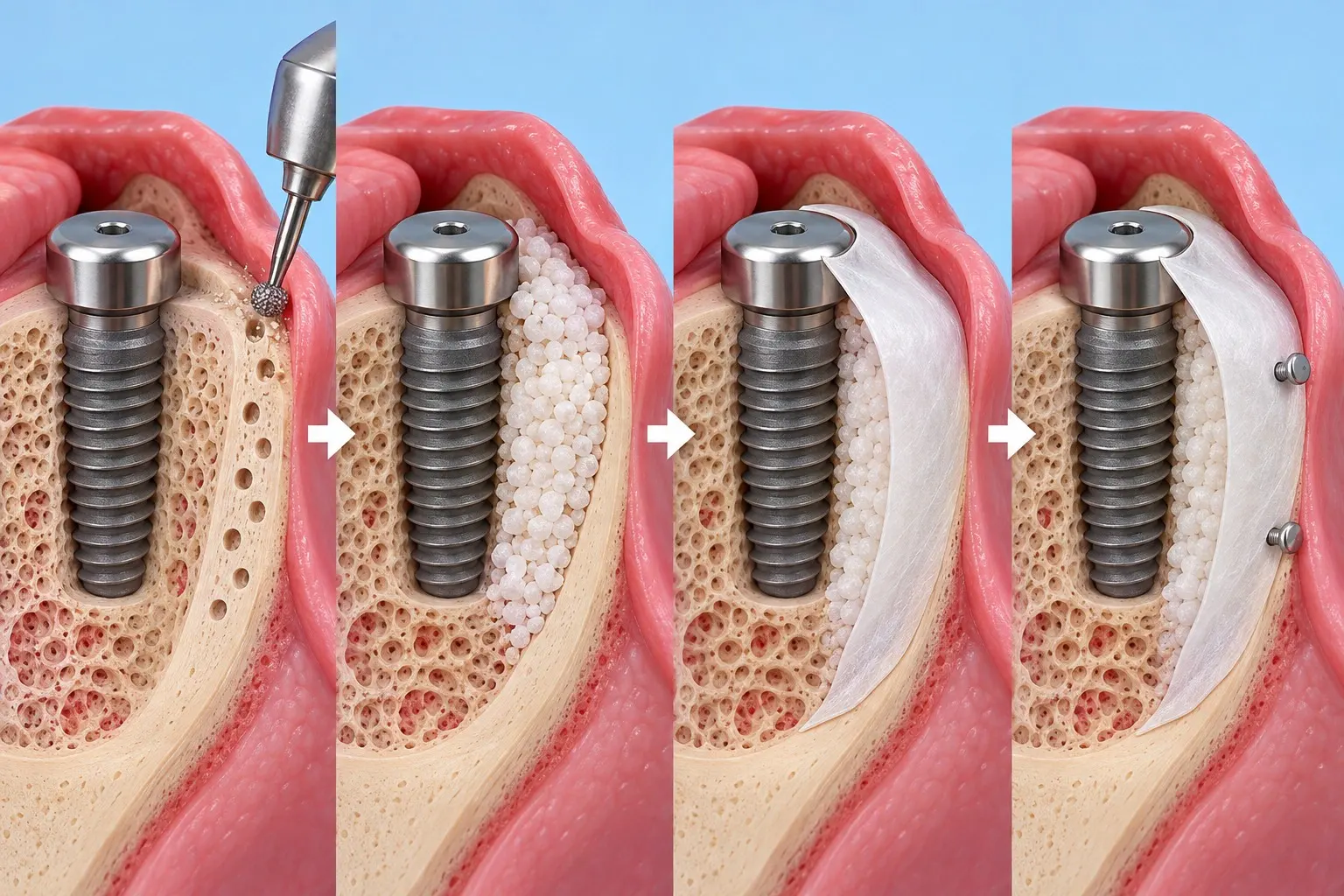
Diagram of the 4 steps of a bone graft at an implant site: perforating the outer bone, filling in the graft material, and fixing the barrier membrane by hooking it on the cap

BONE GRAFT METHOD

Bone Graft Implants What Goes In and How It Is Fixed Decides the Result

A bone graft does not end with putting in the material. Covering it with a membrane and fixing it so it does not move are all part of one set.

Why Diagnosis Matters

A bone graft is a set of material, membrane, and fixation

Once a bone graft is decided, the next questions are what goes in, what covers it, and how it is fixed. Yeonhap Dental Clinic uses xenograft as the baseline, mixes in the bone produced during drilling rather than harvesting autogenous bone separately, and the membrane is a resorbable barrier membrane. The membrane is fixed by hooking it on the wide cover cap or healing abutment attached to the implant, and for a wide graft a bone tack (pin) is added. Whether to do it is covered in Bone Graft Implants in Suwon, and the reasons by site in Bone Graft Implants in Gwonseon-gu.

Consultation Checklist

What we check at your first consultation

If a bone graft is needed, we decide the five points below at the first consultation.

  • Whether to use xenograft alone or mix in the autogenous bone produced during drilling
  • Whether the membrane can be hooked on a cover cap or healing abutment attached to the implant, or whether a bone tack is needed
  • Whether it is immediate placement on the day of extraction or delayed placement after healing
  • How much cheek-side bone is lacking (the graft range)
  • Whether the temporary denture or the opposing teeth press on the graft site

Treatment Options

The Material, Membrane, and Timing of Bone Grafting at Yeonhap Dental Clinic

What goes in, what covers it, and when it is done.

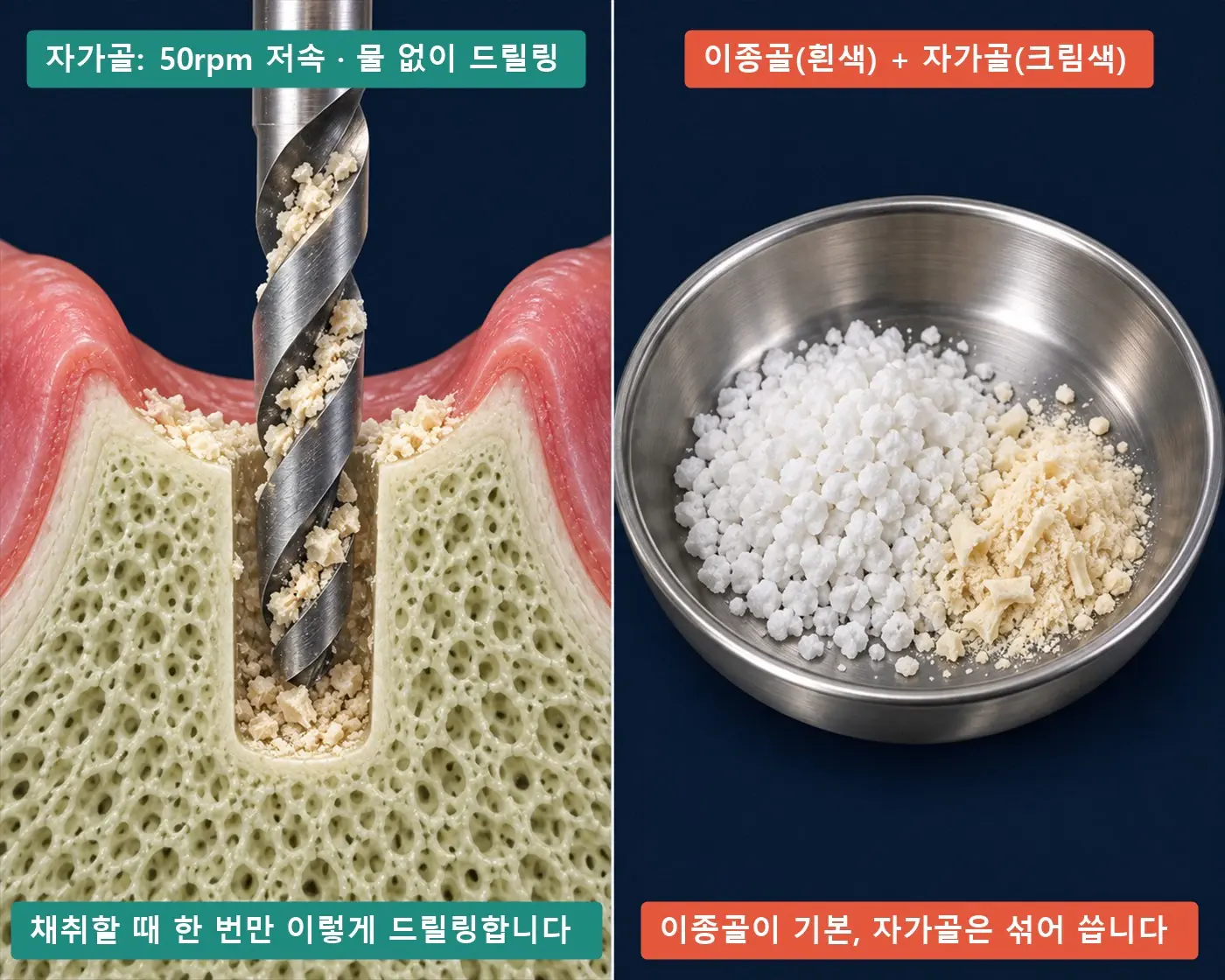
Infographic of the graft composition: xenograft as the baseline, mixed with autogenous bone collected without irrigation at 50 rpm during implant drilling

The graft material is xenograft, with autogenous bone collected during drilling

The baseline graft material is xenograft, which breaks down slowly so its volume remains for a long time. We do not harvest autogenous bone from another site; we mix in the bone fragments produced by drilling the implant site once at low speed (50 rpm) without water. Implants over bone made with particulate graft material and a collagen membrane are reported to have high survival (review of 20 studies, Wessing 2018).
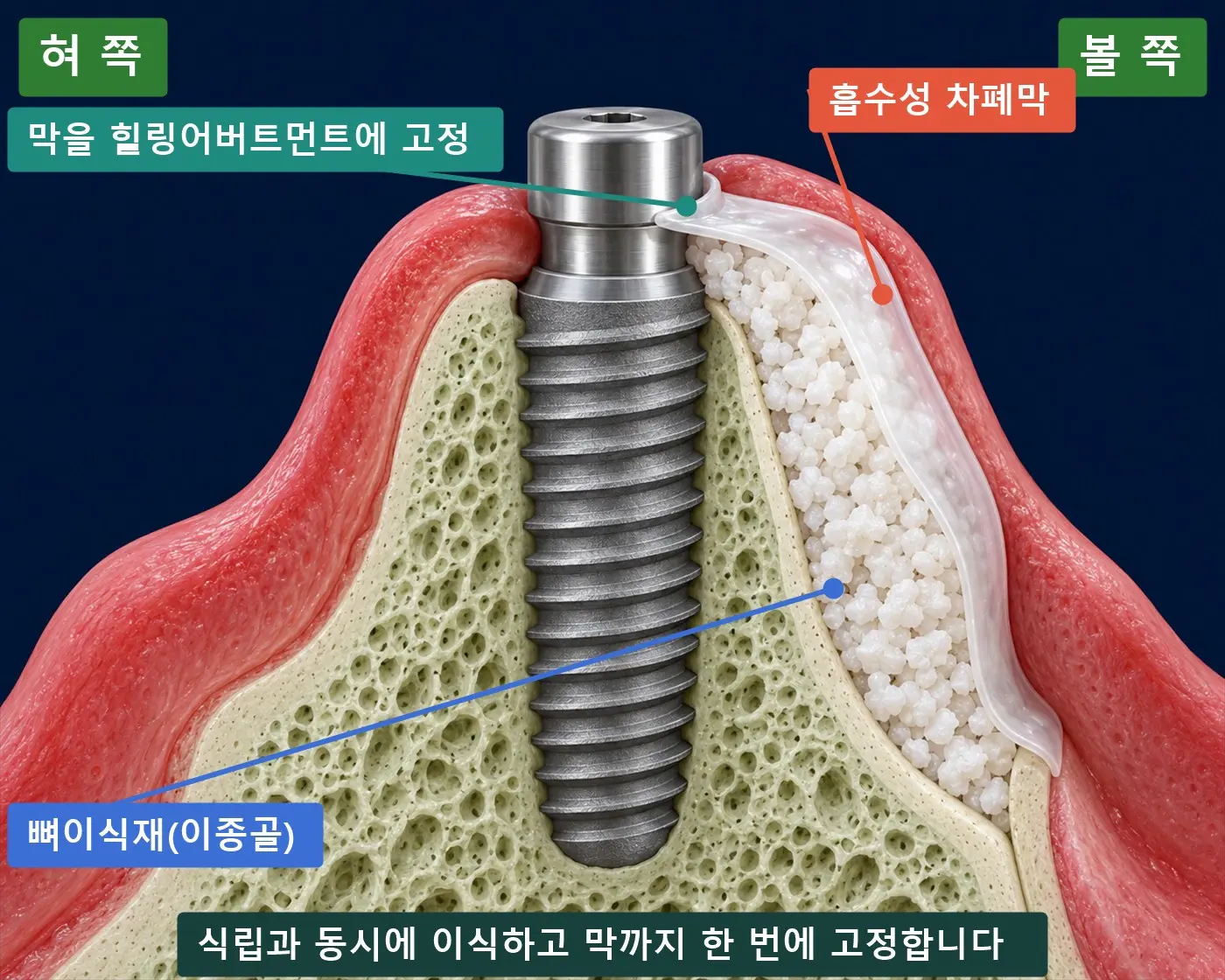
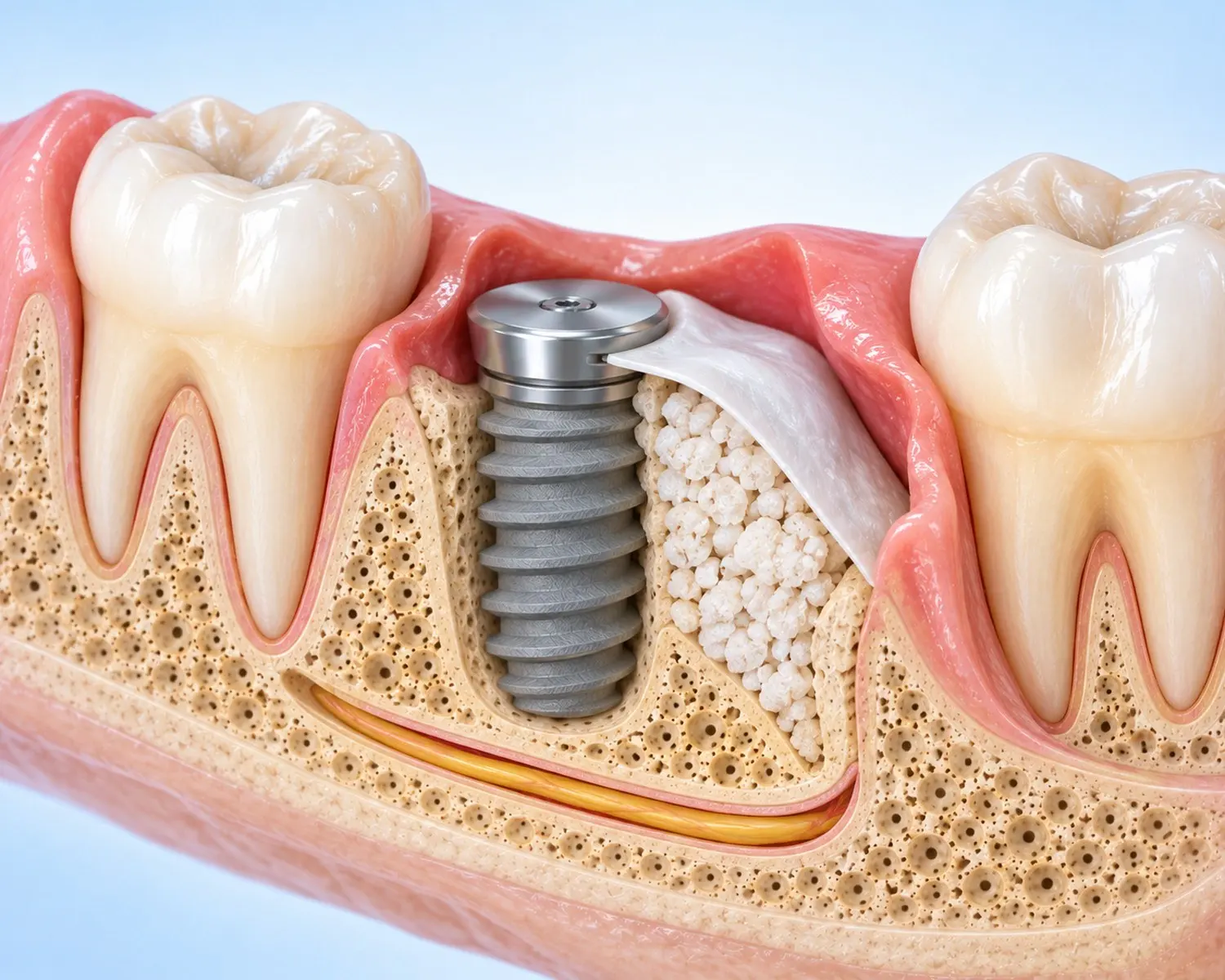
Cross-section infographic of a resorbable barrier membrane fixed by hooking it on a healing abutment attached to the implant

We fix a resorbable barrier membrane by hooking it on the implant

The graft is covered with a resorbable barrier membrane, and because the graft scatters if the membrane moves, we fix the membrane by hooking it on the wide cover cap or healing abutment attached to the implant. For a wide graft, we add a bone tack (pin). Horizontal bone gain was reported to be significantly smaller when the membrane was exposed in an edentulous site (meta-analysis of 8 studies, Garcia 2018), so fixation and suturing are a set.

Cross-section of filling the cheek side with bone graft material while placing the implant, covering it with a barrier membrane, and fixing it by hooking it on the cap above the implant

The bone graft is done at the same time as placing the implant

Yeonhap Dental Clinic does the bone graft on the same day as implant placement. That way the membrane can be fixed by hooking it on the implant, and the graft also settles within the period of bone bonding. We do not do staged surgery, in which only the bone graft is done first and the implant is placed later, or socket preservation. If placed on the day of extraction, the gap is large and the graft range widens (differences by site are in Bone Graft Implants in Gwonseon-gu).

Planning Points

After a Bone Graft: Period and Precautions

The time it takes for the graft to turn into bone, and the habits that protect the membrane meanwhile.

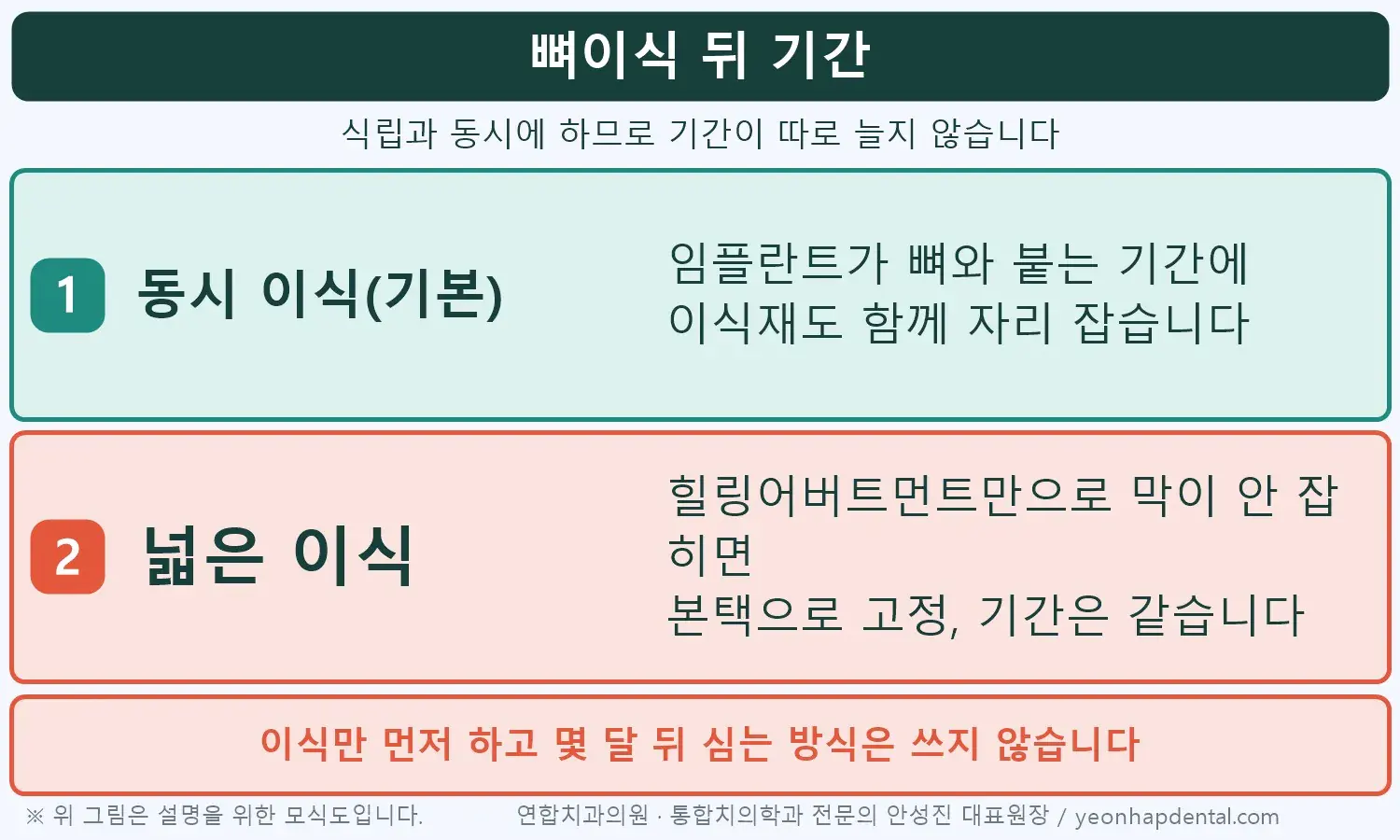
Infographic showing that same-day grafting with placement does not extend the period because of the bone graft, and that wide grafts are fixed with a bone tack

The period is not extended, because the graft is done simultaneously with placement

Because the bone graft is done on the same day as placement, the graft also settles within the period of bone bonding (usually 3–6 months), so the bone graft does not extend the period. The period is the same even when fixed with a bone tack. With lateral bone grafting done simultaneously with placement, the bone defect height is reported to have decreased by a mean of 4.3 mm (meta-analysis of 40 studies, Sanz-Sánchez 2015).

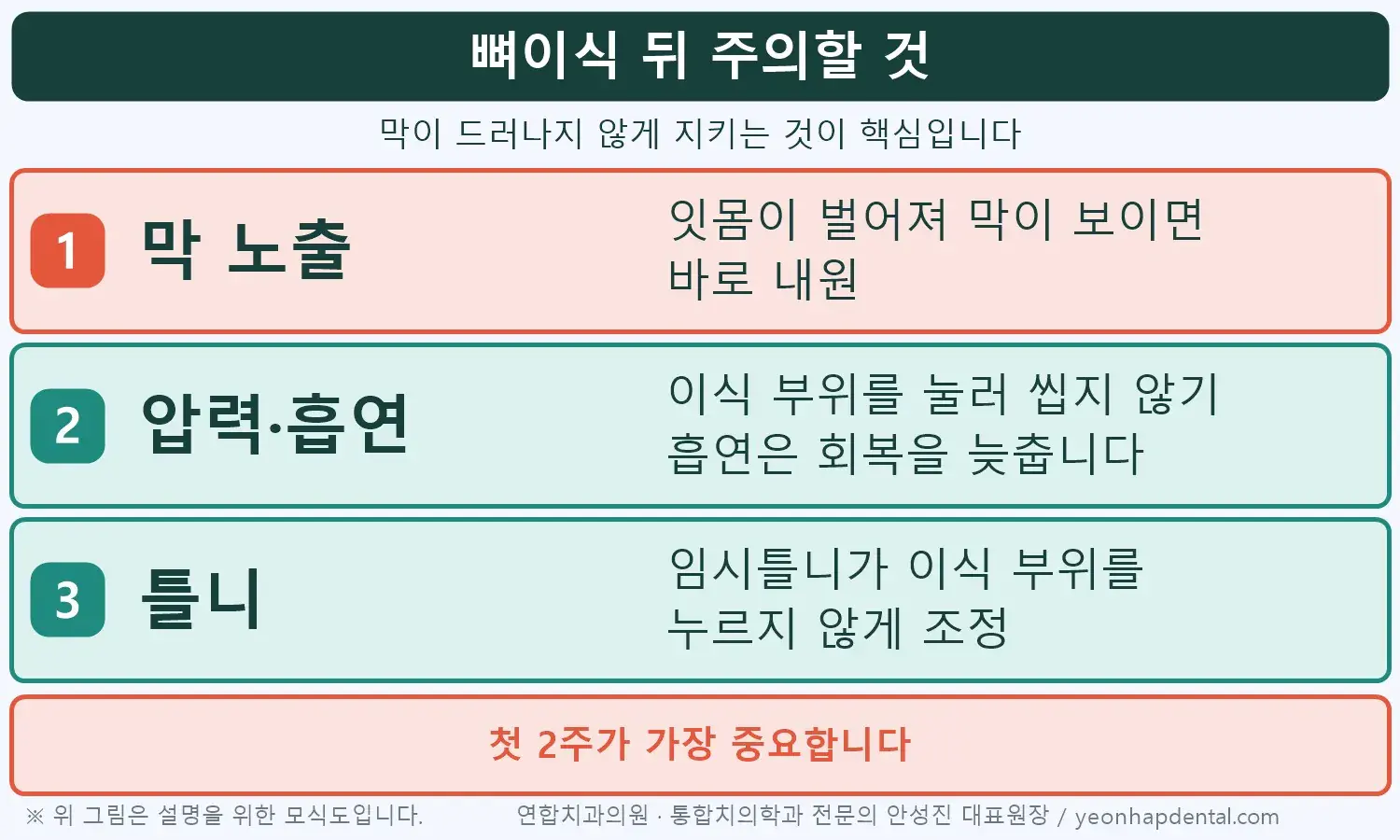
Infographic of precautions after a bone graft: preventing membrane exposure, avoiding pressure, quitting smoking

The first 2 weeks are a period of keeping the membrane from being exposed

If the membrane is exposed outside the gum, bone formation is reported to decrease substantially (Garcia 2018). So do not chew on the graft site, have the temporary denture adjusted so it does not press on that spot, and avoid smoking, which slows recovery. If the gum opens and a white membrane is visible, come in right away to have it checked.

Before Visit

Helpful details before your visit

If you tell us the points below at your first visit, we will explain the graft method and even the time frame that same day.

  • When the tooth was extracted, or whether it is going to be extracted
  • The names of the medications you take (osteoporosis drugs, anticoagulants, diabetes drugs)
  • Whether you smoke
  • Whether you have a temporary denture that you use now

Bone Graft Criteria: Yeonhap Dental Clinic

Material: Xenograft is the baseline, and autogenous bone is collected once during implant drilling at low speed (50 rpm) without water and mixed in. Membrane: It is a resorbable barrier membrane, so there is no removal surgery. Fixation: The membrane is hooked on the wide cover cap or healing abutment attached to the implant, and for wide grafts a bone tack (pin) is added. Timing: Done on the same day as placement. We do not do staged surgery, in which only the bone graft is done first and the implant is placed later, or socket preservation. Period and precautions: The graft also settles within the 3–6 months of bone bonding; for the first 2 weeks, do not chew on the graft site, adjust the temporary denture, and quit smoking, and come in right away if a white membrane is visible.

Bone Graft Material and Method: The Criteria Set by Yeonhap Dental Clinic

A bone graft is decided by four things: material, membrane, fixation, and timing. Xenograft as the baseline, a resorbable barrier membrane, fixation by hooking on the wide cover cap or healing abutment (with a bone tack if wide), and the same day as placement. Keeping the membrane from moving or being exposed is the condition that decides the result of a bone graft. Evidence: Implants over bone grafted with particulate graft material and a collagen membrane show high survival, and membrane fixation is weakly associated with more vertical bone gain, and decortication (perforating the outer bone) with more horizontal bone gain (systematic review of 20 studies, Wessing 2018). In edentulous sites, horizontal bone gain was significantly smaller when the membrane was exposed (meta-analysis of 8 studies, Garcia 2018), and with lateral bone grafting done simultaneously with placement, the defect height decreased by a mean of 4.3 mm (meta-analysis of 40 studies, Sanz-Sánchez 2015). References: Wessing 2018, systematic review and meta-analysis of guided bone regeneration with collagen membrane and particulate graft (20 studies) · Garcia 2018, meta-analysis of the effect of membrane exposure on guided bone regeneration outcomes (significantly less horizontal bone gain at exposed sites) · Sanz-Sánchez 2015, systematic review and meta-analysis of the effect of lateral bone augmentation (40 studies, simultaneous approach defect height −4.28 mm) Treatment results may vary by individual oral condition.
Last updated:

Schedule a consultation by phone or Naver Booking

Leave a few details on our consultation page and we'll get back to you promptly.

Frequently Asked Questions

Q. What material is used for implant bone grafts?
As the bone graft material for implants, Yeonhap Dental Clinic uses xenograft as the baseline, which breaks down slowly so its volume remains for a long time. If autogenous bone is needed, bone fragments collected once at low speed (50 rpm) without irrigation during implant drilling are mixed into the xenograft.
Q. Does autogenous bone grafting for an implant take bone from somewhere else?
Autogenous bone grafting at Yeonhap Dental Clinic does not involve surgery to harvest bone from another site. Because we collect the bone fragments produced by drilling the implant site once at low speed (50 rpm) without spraying water, there is no additional wound.
Q. Does the implant bone graft barrier membrane have to be removed later?
The bone graft barrier membrane used at Yeonhap Dental Clinic is resorbable, so it dissolves over time and no removal surgery is needed. Because the bone graft is done on the same day as implant placement, the membrane is fixed by hooking it on the wide cover cap or healing abutment attached to the implant, and if a wide graft is not held by that alone, a bone tack is added.
Q. What should I do if, after an implant bone graft, the gum opens and I see something white?
If the gum opens after a bone graft and a white membrane is visible, it is membrane exposure, which can reduce bone formation, so you should come in right away (Garcia 2018). Yeonhap Dental Clinic advises not chewing on the graft site for the first 2 weeks, adjusting the temporary denture, and quitting smoking together.