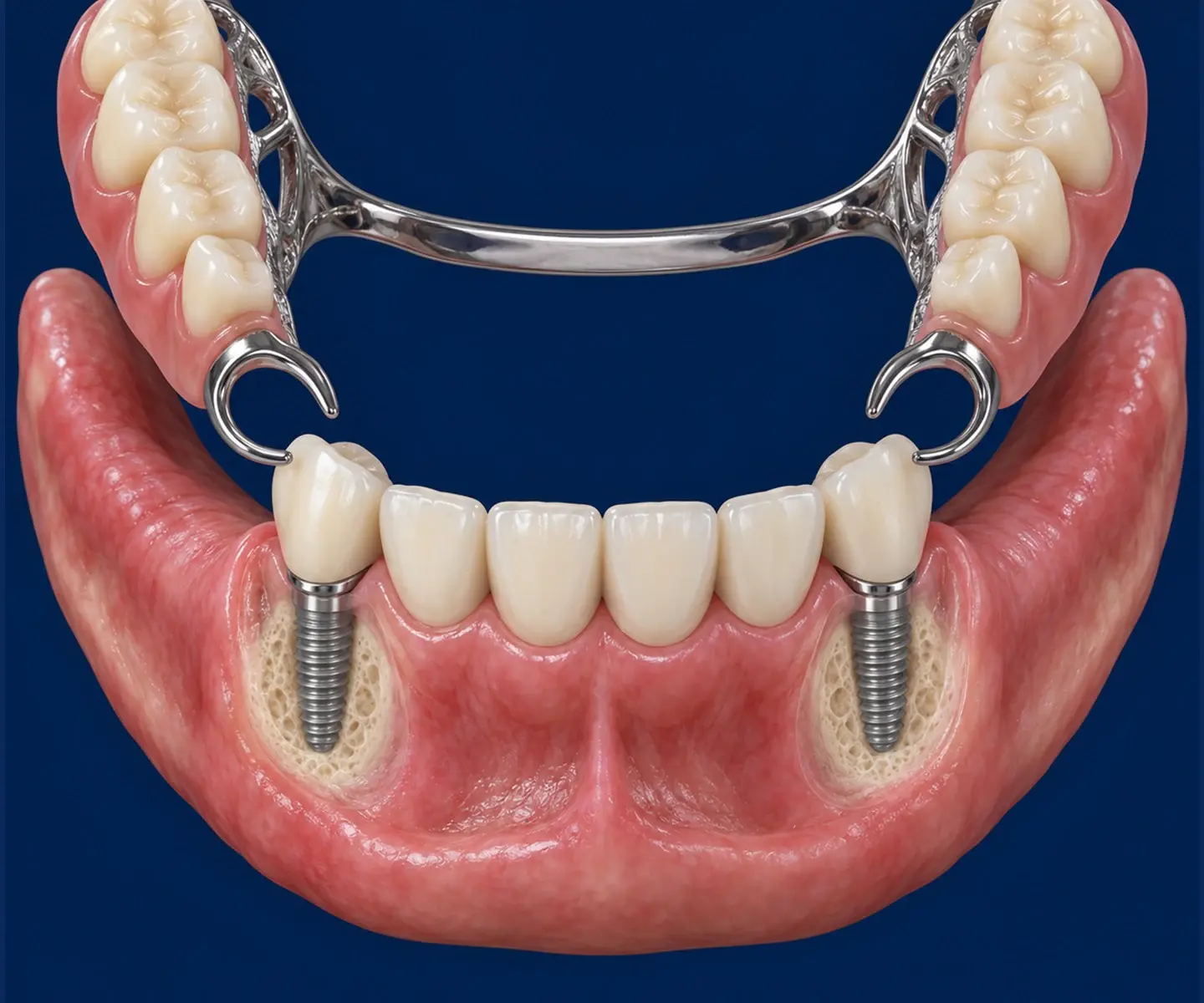
Diagram of a partial denture attached to a bridge over two implants at the lower canine sites

IMPLANT DENTURE

Implant-Supported Dentures, Three Design Criteria

The key is not the number but where the rear end of a denture resting on the gums is supported.

Why Position Matters

With an implant-supported denture, where you place the implants decides your comfort

If your lower denture keeps lifting, it can improve without placing many implants. The key is not the number but deciding where to support the rear end of a denture resting on the gums, and our basic design is 2 implants at the canine sites for a completely edentulous lower jaw and 4 for the upper jaw.

Consultation Checklist

What we check at your first consultation

At the first consultation, we look at the three items below on 3D CT and decide where and how many to place.

  • Which side the remaining teeth and the opposing molars are on
  • Whether the rear end of your current denture rests on the gums on both sides or one side
  • Whether a 10 mm implant fits at the implant sites, and whether four sites are available in the lower jaw

Treatment Options

Implant-Supported Dentures: Three Designs That Decide the Sites

The principle when teeth remain, the basic design for the lower jaw, and the basic design for the upper jaw.

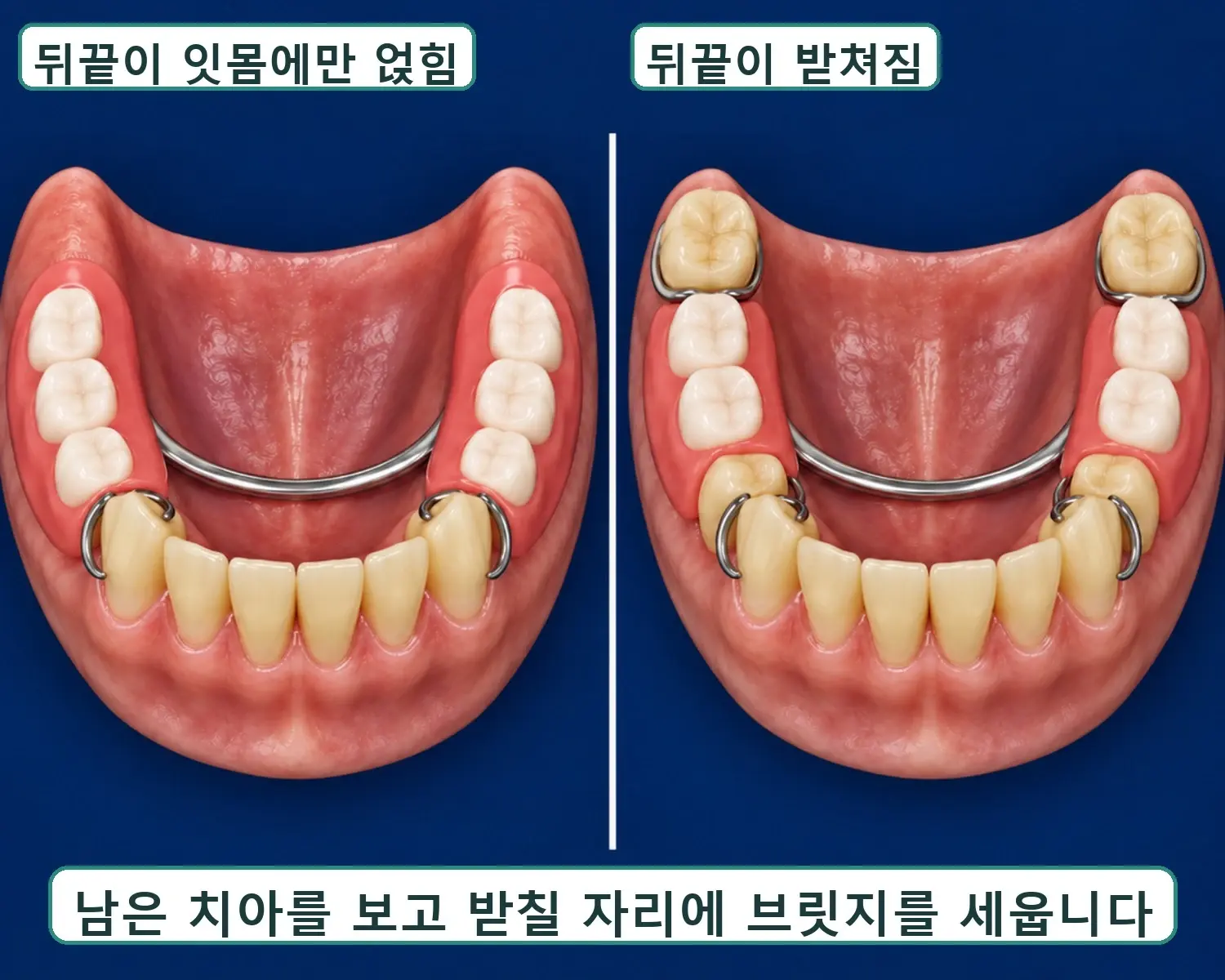
Realistic diagram of a partial denture comparing a rear end that rests only on the gums with a rear end supported by a tooth

If teeth remain, place support where the rear end rests

A rear end that rests only on the gums sinks when chewing and loosens the clasp tooth. We look at the remaining teeth and the opposing molars and set a bridge where it supports that rear end. If only the lower front teeth remain, we place a 3-unit bridge at #34-#36 or #44-#46, on the side with more opposing molars.

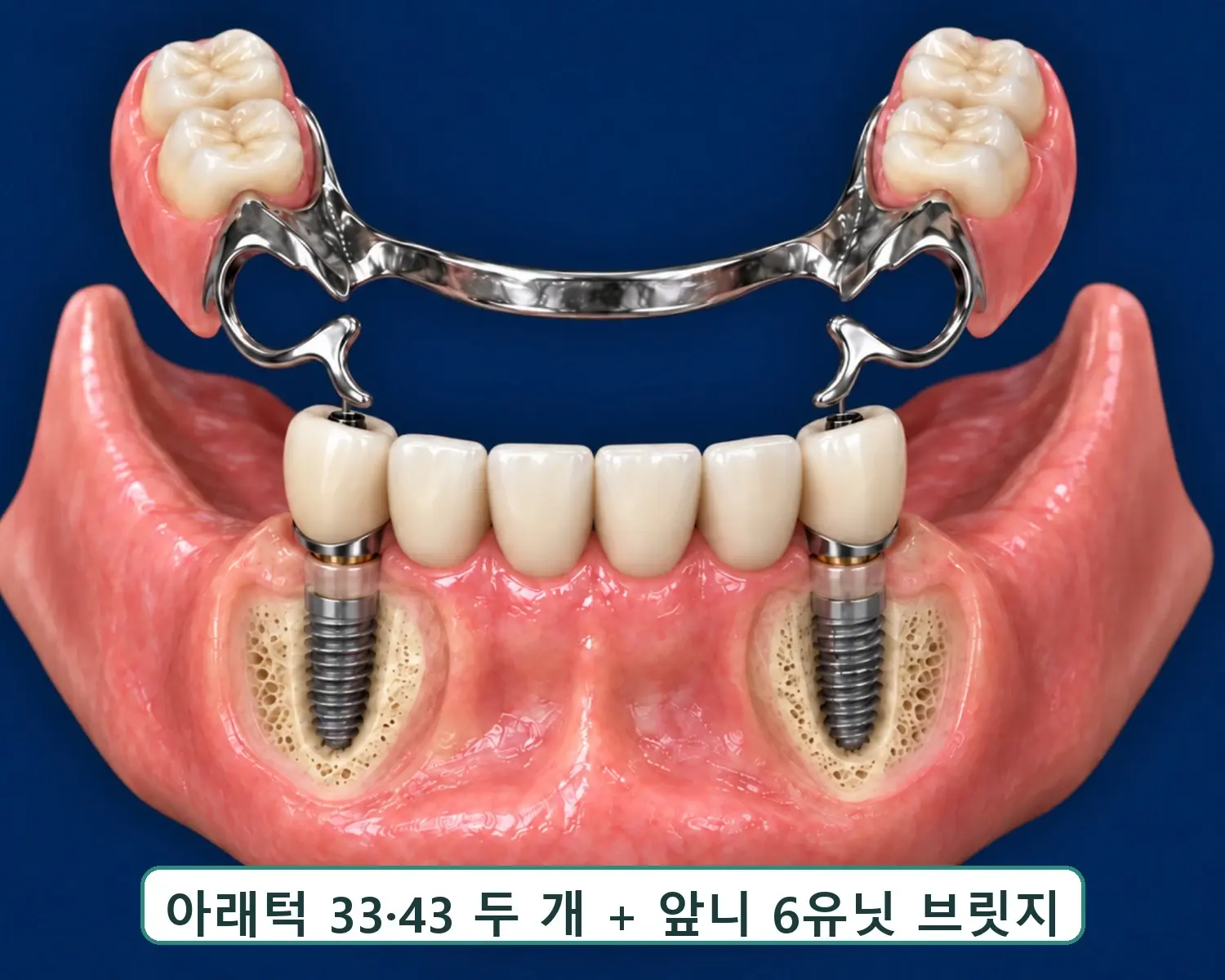
Realistic diagram of a partial denture attached with metal clasps to a 6-unit front-tooth bridge over two implants at #33 and #43 in the lower jaw

Completely edentulous lower jaw: two implants at #33 and #43 and a 6-unit front-tooth bridge

We place 2 implants at the canines #33 and #43, fix the six front teeth as a bridge, and fill only the molar area with a partial denture. When placed symmetrically, the bridge takes the lifting movement from the front and the force is shared between left and right, whereas placing them only at the molars on one side makes the force and rotation axis uneven.

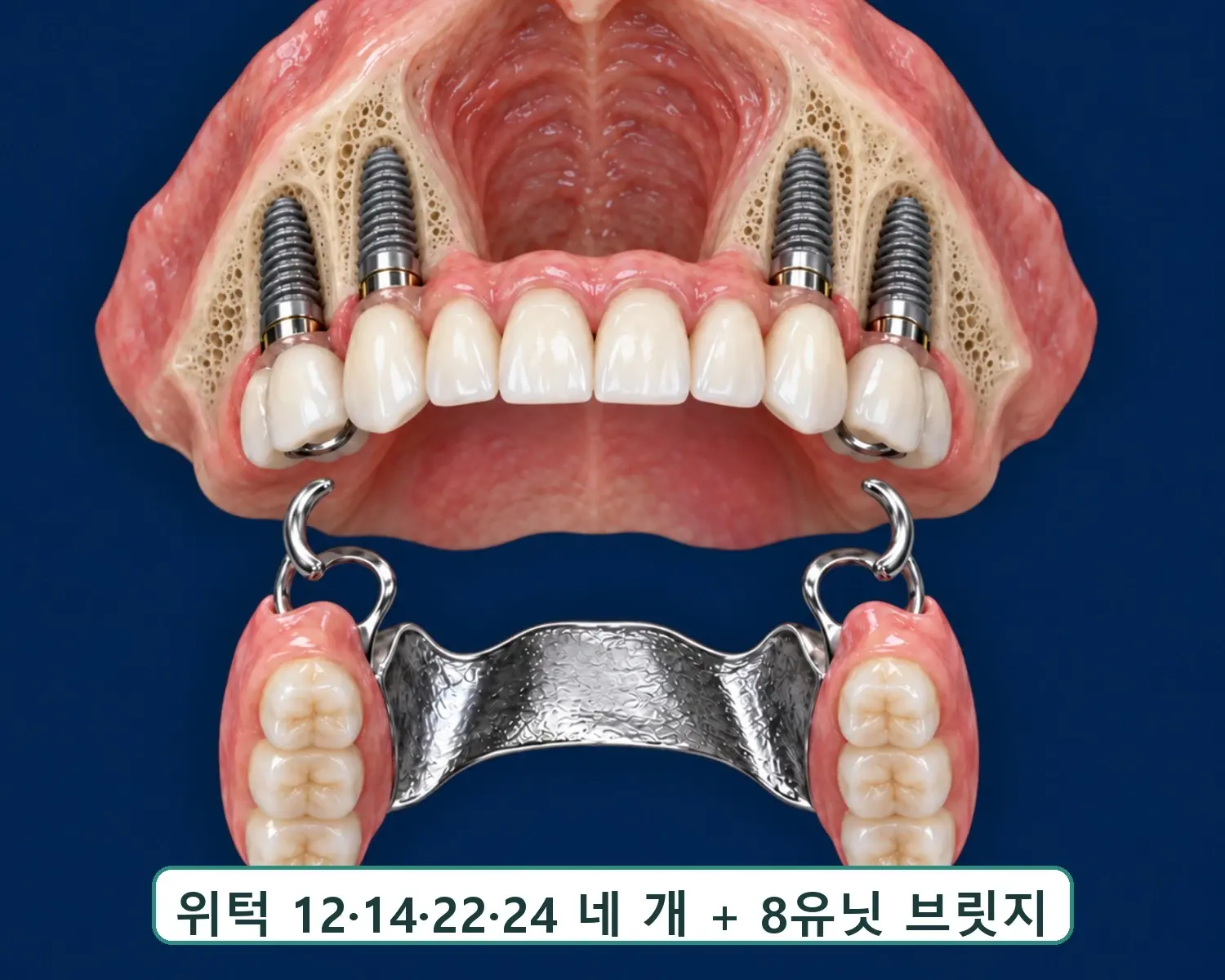
Realistic diagram of a partial denture attached to an 8-unit bridge over four implants at #12, #14, #22, and #24 in the upper jaw

Completely edentulous upper jaw: four implants at #12, #14, #22, and #24 and an 8-unit bridge

The upper jaw often has soft bone and low height because of the maxillary sinus, so our clinic connects four implants at #12, #14, #22, and #24 with an 8-unit bridge. If the front tooth sites are difficult, we set 3-unit bridges on both sides at #14-#16 and #24-#26 and do a sinus lift if needed.

Planning Points

Two sites or four sites, and the timeline

If four sites are available, we also consider All-on-X, and the lower-jaw implant-supported denture takes about 5 months.

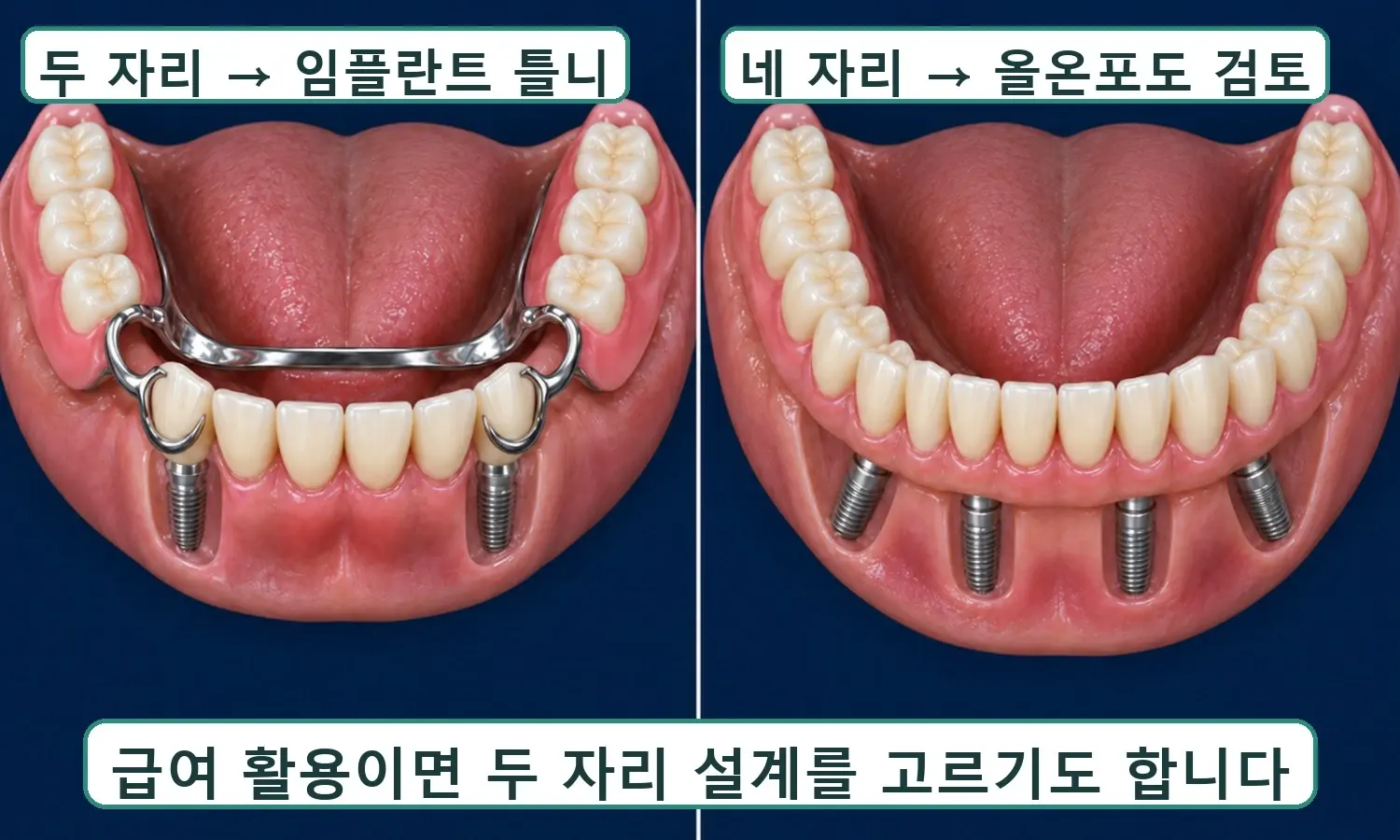
Realistic diagram comparing a bridge and partial denture over two lower-jaw implant sites with All-on-4 over four sites

With two sites, an implant-supported denture; with four sites, we also consider All-on-4

If four sites are available, we also consider All-on-4 (full-arch implant, 4 implants), which is not removed. When the NHI coverage conditions are met, some patients choose an implant-supported denture so they can use two NHI-covered implants together with an NHI-covered partial denture. For a completely edentulous upper jaw, we first consider a complete denture or All-on-6 (6 implants).

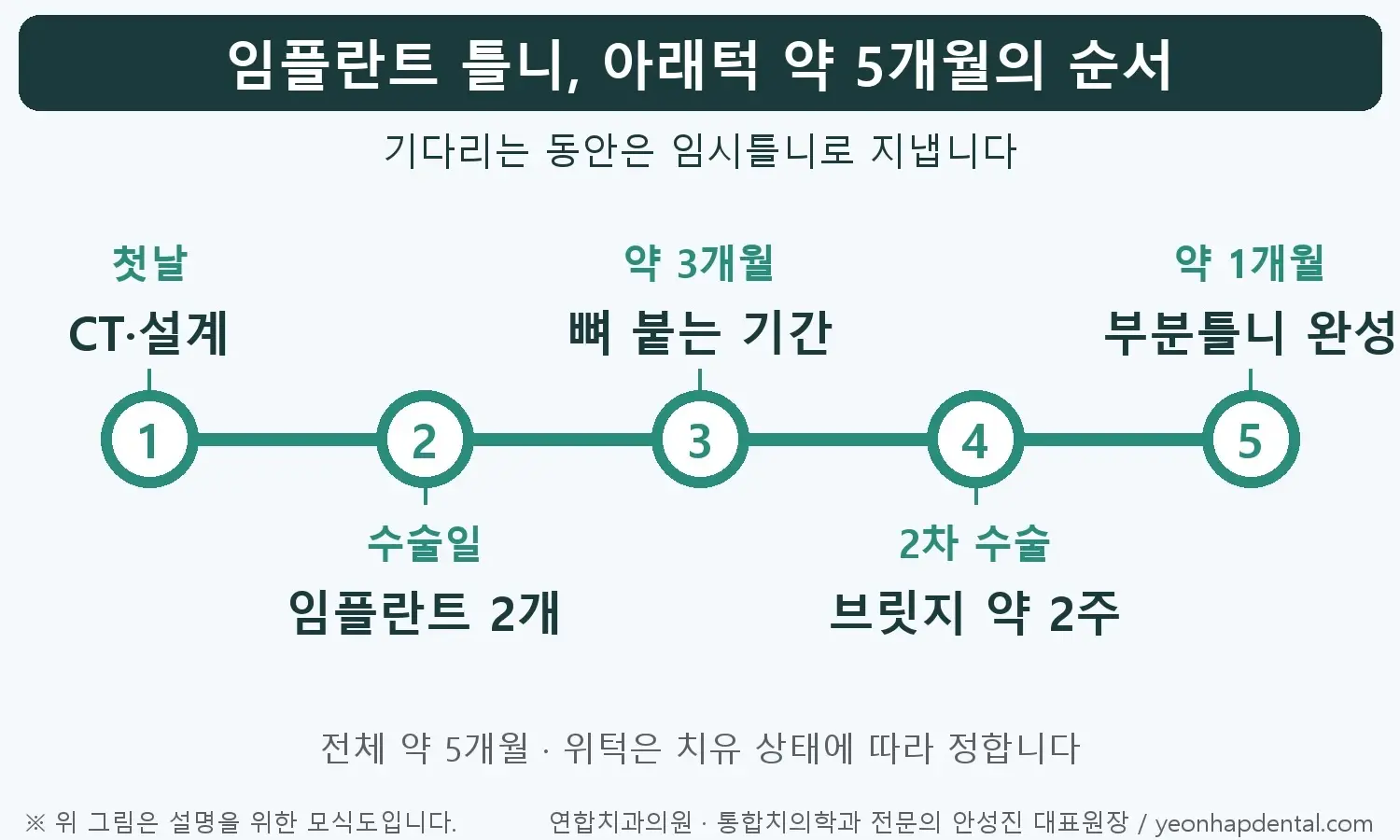
Five-step diagram of the lower-jaw implant-supported denture sequence: CT design, 2 implants, about 3 months for bone bonding, second-stage surgery and bridge about 2 weeks, partial denture about 1 month, total about 5 months

About 5 months for the lower jaw; the upper jaw depends on healing

For the lower jaw, it is about 3 months of waiting after placement, second-stage surgery, about 2 weeks for the bridge, and about 1 month for the partial denture, for a total of about 5 months. For the upper jaw, the timing of the second-stage surgery is set by the extent of sinus lift and bone graft and the state of healing, and if there is a lot of bone grafting, we go through a provisional bridge to the final bridge.

Before Visit

Helpful details before your visit

Your current denture can be adjusted and used as a temporary denture, so please bring it with you.

  • The denture you currently use (we can adjust it and use it as a temporary denture)
  • A list of medications you are taking (antithrombotics and osteoporosis medication)
  • When your teeth began to be lost and how long you have used a denture
  • If you are 65 or older, your history of NHI-covered implants and dentures

Implant-supported denture design: the criteria Yeonhap Dental Clinic uses

Principle for the sites: We place a bridge at the site that supports the rear end of a denture that otherwise rests on the gums. The remaining teeth and the opposing molars decide the site. Completely edentulous lower jaw: 2 implants at #33 and #43 and a 6-unit front-tooth bridge. Support is provided from the front, symmetrically on both sides. Completely edentulous upper jaw: 4 implants at #12, #14, #22, and #24 and an 8-unit bridge. If placement at the front teeth is difficult, 3-unit bridges on both sides at #14-#16 and #24-#26, with a sinus lift if needed. Specifications and material: 10 mm in length and 4.0 mm in diameter, or 4.5 mm if the bone width allows. The bridge is made as a PFM with a metal occlusal surface so that the clasp and rest surfaces can be designed and adjusted; it is not the case that only PFM is possible because of NHI coverage. When it is hard to apply: If a 10 mm implant, our standard, cannot be placed at #33 and #43, or only 2 implants can be placed in a completely edentulous upper jaw, we plan a complete denture or another approach.

The basis and scope of the criteria for implant-supported denture design

Two implants in the lower jaw, four in the upper jaw, and the choice of sites are not values set by the literature but Yeonhap Dental Clinic's own clinical standards. We refer to the literature only within the range of the finding that satisfaction and chewing function improved after converting a lower-jaw partial denture missing both rear sides to an implant-supported denture (Park 2020), and the report that even implant-supported partial dentures need maintenance such as relining the inside, repairs, and loosened screws (de Freitas 2012). For this reason, at the first consultation Yeonhap Dental Clinic looks at the implant sites, the remaining teeth, and the opposing molars on 3D CT and decides where and how many to place. References: Park 2020, meta-analysis of converting a lower-jaw bilateral posterior partial denture to an implant-supported denture · de Freitas 2012, systematic review of implant-supported partial dentures in the lower jaw Treatment results may vary depending on each person's oral condition. The number and positions of implants vary with the remaining bone and teeth and the opposing teeth.

Last updated:

Schedule a consultation by phone or Naver Booking

Leave a few details on our consultation page and we'll get back to you promptly.

Frequently Asked Questions

Q. How many implants are placed for an implant-supported denture?
At Yeonhap Dental Clinic, we place 2 implants at #33 and #43 for a completely edentulous lower jaw and 4 implants at #12, #14, #22, and #24 for a completely edentulous upper jaw, and this is our own clinical standard. For a partially edentulous mouth, we look at the remaining teeth and the opposing molars to decide the position and number of supports for the rear end of the denture, and if four sites are available in the lower jaw, we also consider All-on-4.
Q. How is an implant-supported denture different from a snap-on denture?
Our implant-supported denture attaches a partial denture with clasps to a bridge over the implants, whereas a snap-on (overdenture) fits rubber rings inside the denture onto button components on the implants. Snap-on rubber rings must be replaced periodically and are excluded from NHI coverage; the bridge method has no snap-on retention parts to replace, but maintenance such as relining the inside of the denture and adjusting the clasps is still needed.
Q. Is an implant-supported denture covered by National Health Insurance?
For patients aged 65 and over who are partially edentulous, NHI coverage may apply separately to the two implants and the partial denture, while the intermediate bridge teeth, additional implants, bone grafts, and sinus lifts are not covered. For the NHI-covered implant prosthesis, you can choose between PFM and zirconia. For the completely edentulous, coverage of 2 implants is scheduled to expand from January 2027, and people who previously received an NHI-covered complete denture become eligible only after 7 years. For the system overall, see the NHI Implant Guide.
Q. If I get an implant-supported denture, do I have to throw away my current denture?
During treatment, we hollow out the inside of your current denture and fill it with a soft material to use temporarily, or make a temporary denture if needed. While the implants bond to the bone, we keep the denture from pressing on them, and once the bridge is in place, we make a new partial denture to fit that bridge.
Q. Can I get an implant-supported denture in the upper jaw too?
Yes. Our standard is 4 implants at #12, #14, #22, and #24 with an 8-unit bridge, and if placement at the front teeth is difficult, we use 3-unit bridges on both sides at #14-#16 and #24-#26. However, in a completely edentulous upper jaw, the palate supports the denture so a complete denture tends to stay in place fairly well, and if additional placement is possible, All-on-6 can also be considered, so Yeonhap Dental Clinic first considers a complete denture or All-on-6 and chooses an implant-supported denture depending on conditions.