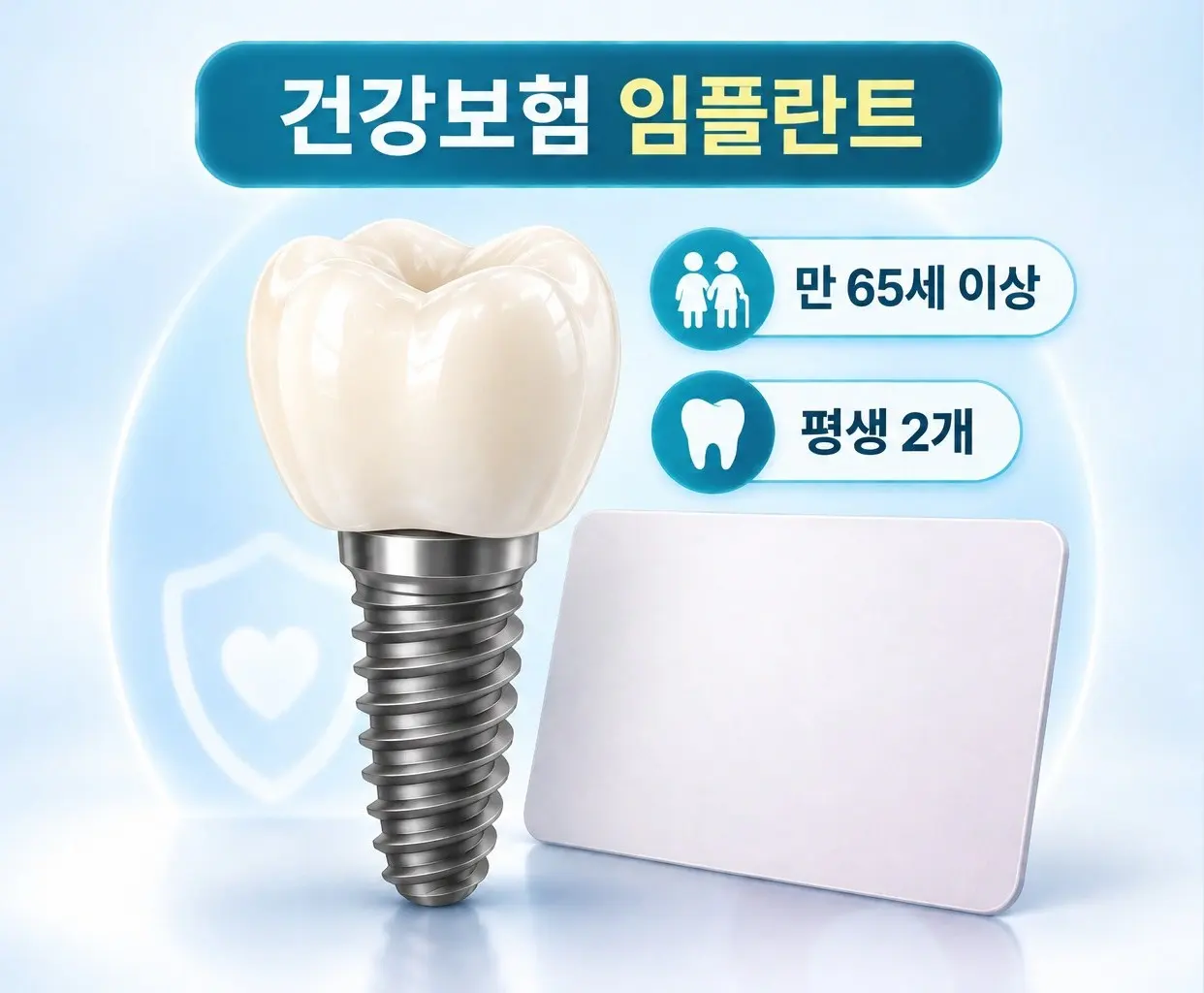
Implant diagram showing National Health Insurance coverage of 2 implants per lifetime for ages 65 and older

IMPLANT INSURANCE

NHI-Covered Implants: Three Key Things to Check Before Registering

If you are 65 or older and still have some natural teeth, National Health Insurance applies to up to 2 implants per lifetime. At the first consultation, Yeonhap Dental Clinic checks the copayment, the non-covered items, and the registration procedure with you.

Why Diagnosis Matters

NHI-covered implants have set conditions, so checking first makes the cost clear

For NHI-covered implants, the total cost becomes clear once you check three things before registering: eligibility and number, patient copayment, and coverage scope. At the first consultation, Yeonhap Dental Clinic checks your NHIS eligibility and explains separately the covered items and the items added as non-covered.

Consultation Checklist

What we check at your first consultation

At the first consultation, we confirm the three points below through the NHIS eligibility inquiry and an oral exam.

  • If you are 65 or older, how many covered implants you have used and how many remain (NHIS eligibility inquiry)
  • Whether some natural teeth remain. If you have none at all, you are currently not eligible for covered implants
  • Whether the site needs a bone graft or sinus lift. If so, that part is non-covered

Treatment Options

NHI-Covered Implants: Eligibility, Copayment, and Coverage Scope

These are who can receive it, how much you pay, and how far coverage extends.

Handing over a health insurance card and ID at the reception desk

Eligibility: age 65 or older, some natural teeth remaining, 2 per lifetime

If you are 65 or older and still have some natural teeth, coverage applies to up to 2 implants per lifetime, upper and lower jaws combined. If you have no teeth at all, you are currently not eligible, and from January 2027, 2 implants are scheduled to be covered for people with no teeth as well (7 years after receipt for existing users of NHI-covered complete dentures). The number remaining is confirmed through the NHIS eligibility inquiry.

Looking at a treatment cost guide at the payment counter

Patient copayment: 30% under NHI, 10–20% under Medical Aid

The patient copayment is 30% under National Health Insurance, 10% for Medical Aid Type 1 and 20% for Type 2, and 10–20% for the near-poverty copayment reduction group. In the same jaw, a covered implant and a covered partial denture can be used at the same time. Yeonhap Dental Clinic checks which category applies to you and tells you the amount you will pay first.

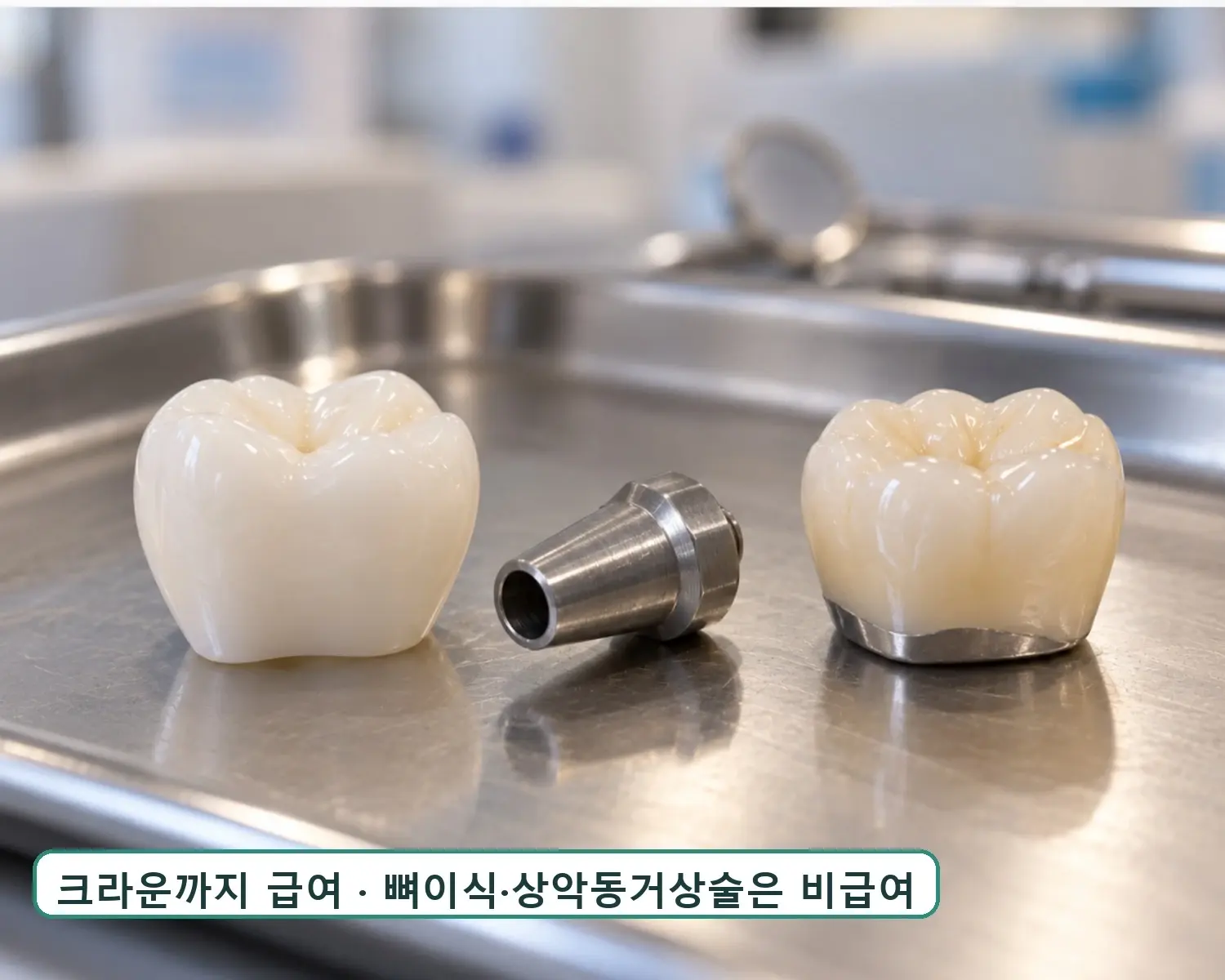
A tray holding a zirconia crown and a porcelain-fused-to-metal crown

Coverage scope: covered up to the crown; bone graft and sinus lift are non-covered

Coverage extends to the implant body and crown (porcelain-fused-to-metal or zirconia). Bone grafts and sinus lifts are non-covered, and if you choose another crown material or a one-piece implant, the entire procedure becomes non-covered. The standard fees for non-covered items are on our Non-covered Treatment Fees page.

Planning Points

The Registration Procedure and What Yeonhap Dental Clinic Checks With You

The 2 covered implants cannot be undone once used, so we decide the procedure and prosthetic plan first.

Dental clinic staff processing NHI implant registration on a computer

Procedure: eligibility inquiry → registration application → diagnosis, placement, and prosthesis

After the dental clinic determines whether you are eligible, it applies for registration with the NHIS, and once approved, treatment proceeds in three stages: diagnosis, placement, and prosthesis. Yeonhap Dental Clinic handles the NHI registration application, and for Medical Aid we guide you through the registration procedure with the responsible administering authority.

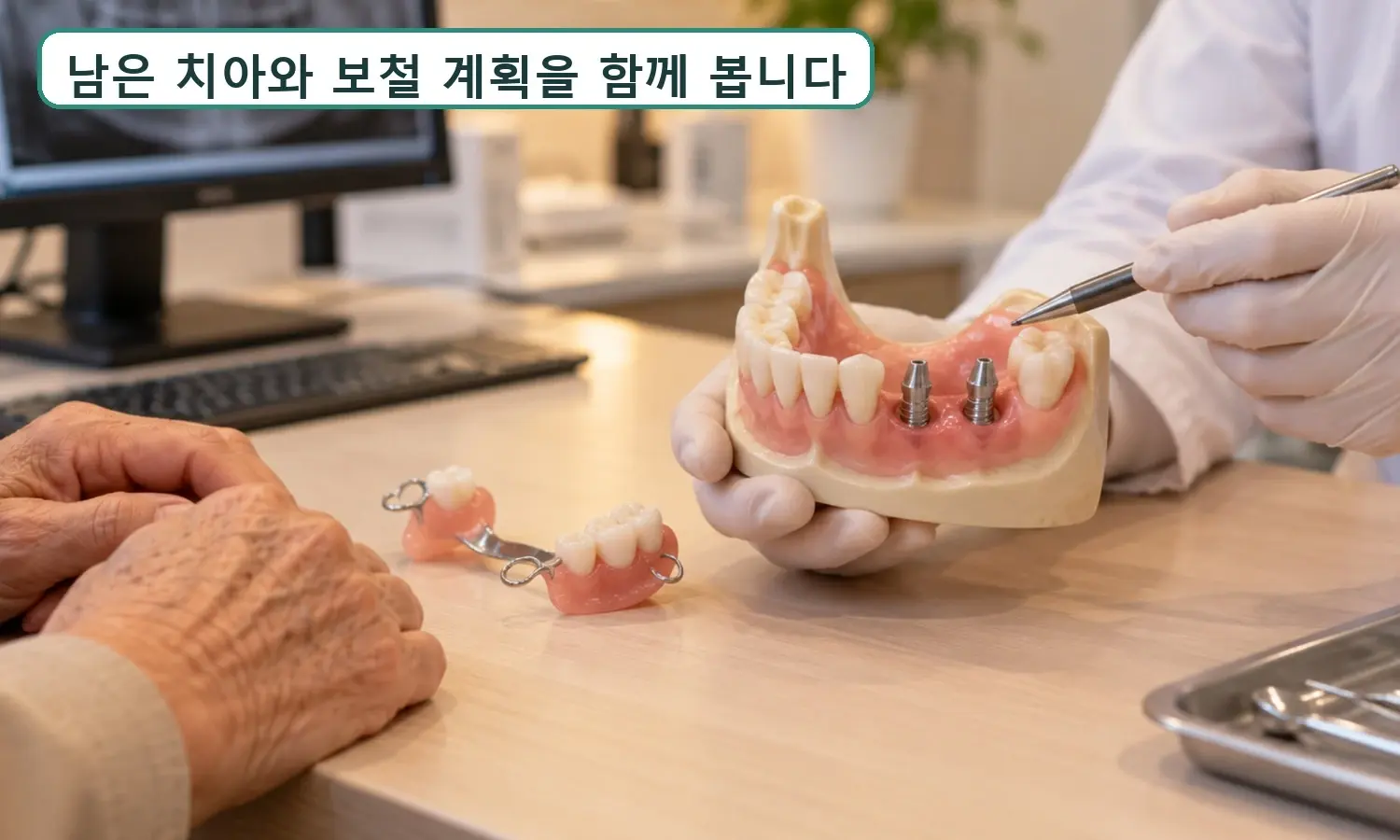
Explaining the remaining teeth and the prosthetic plan with a model

After the insurance check, we look at the remaining teeth and the prosthetic plan together

When several teeth are missing, where to use the 2 covered implants is important. Yeonhap Dental Clinic looks at the remaining teeth and the teeth they bite against, and plans to place the 2 mostly in the lower jaw, so that they later serve as the posts for an implant-supported denture. How they are used in practice is covered in the next article.

Before Visit

Helpful details before your visit

If you tell us the points below at your first visit, we can tell you that day whether coverage applies.

  • Whether you fall under National Health Insurance, Medical Aid (Type 1/2), or the near-poverty group
  • Whether you have previously had a covered implant or covered denture made
  • The names of the medications you take (blood pressure, diabetes, osteoporosis, anticoagulants)
  • If you have a denture you use now, please bring it

NHI-Covered Implants: The Criteria Yeonhap Dental Clinic Checks

Eligibility and number: Age 65 or older, some natural teeth remaining, up to 2 per lifetime, upper and lower jaws combined. If you have no teeth at all, you are currently not eligible, and from January 2027, 2 implants are scheduled to be covered for people with no teeth as well (7 years after receipt for existing users of NHI-covered complete dentures). Patient copayment: 30% under National Health Insurance, 10% for Medical Aid Type 1 and 20% for Type 2, and 10–20% for the near-poverty copayment reduction group. In the same jaw, a covered implant and a covered partial denture can be used at the same time. Coverage scope: Up to the implant body and crown (porcelain-fused-to-metal or zirconia). Bone grafts and sinus lifts are non-covered, and if you choose a crown other than porcelain-fused-to-metal or zirconia, or a one-piece implant, the entire procedure becomes non-covered. Procedure: Eligibility inquiry on the first day → registration application (handled by Yeonhap Dental Clinic) → approval → diagnosis, placement, and prosthesis. For Medical Aid, we guide you through the registration procedure with the responsible administering authority (city, county, or district). Our plan: We look at the remaining teeth and the teeth they bite against, and decide together the 2 covered sites and the future prosthesis.
NHI-Covered Implants: Sources of the Criteria and Their Limits

The conditions above follow the Ministry of Health and Welfare's coverage standards for senior dental implants (age 65 or older, partial edentulism, 2 per person), the National Health Insurance Service and Medical Aid copayment standards, and Ministry of Health and Welfare Notice No. 2025-23 (effective February 1, 2025, expanding coverage to zirconia crowns). Whether coverage applies and how many remain are confirmed by the NHIS eligibility inquiry, and whether a bone graft or sinus lift is needed is decided after examination. For this reason, Yeonhap Dental Clinic first checks the program conditions, explains covered and non-covered items separately, and then builds a prosthetic plan that suits your remaining teeth. Sources for the criteria: National Health Insurance Service, dental implant coverage guide · Ministry of Health and Welfare Notice No. 2025-23, dental implant recognition criteria (posted by HIRA) · Ministry of Health and Welfare press release: patient copayment for dental implants for ages 65 and older reduced from 50% to 30% · Ministry of Health and Welfare announcement of September 8, 2026 (coverage of implants for completely edentulous patients scheduled to expand in January 2027) Treatment results may vary by individual oral condition. Whether coverage applies and the cost may change after the NHIS eligibility inquiry and examination.

Last updated:

Schedule a consultation by phone or Naver Booking

Leave a few details on our consultation page and we'll get back to you promptly.

Frequently Asked Questions

Q. How many implants does insurance cover?
If you are 65 or older and still have some natural teeth, coverage applies to up to 2 implants per lifetime, upper and lower jaws combined. The patient copayment is 30% under National Health Insurance, 10% for Medical Aid Type 1 and 20% for Type 2, and 10–20% for the near-poverty copayment reduction group. On the first day, Yeonhap Dental Clinic checks through the NHIS eligibility inquiry how many you have already used and how many remain.
Q. Does implant insurance also cover bone grafts?
Bone grafts and sinus lifts are not included in coverage, so if needed they are added as non-covered items. If you choose a crown other than porcelain-fused-to-metal or zirconia (such as gold) or a one-piece implant, the entire procedure becomes non-covered. At the first consultation, Yeonhap Dental Clinic explains separately which parts are covered and which parts have non-covered items added, and whether a bone graft is needed is decided after examination.
Q. What crown materials are used in insured implants?
The crown of a covered implant is porcelain-fused-to-metal (PFM), and since February 2025, zirconia crowns have also been covered. If you choose another crown material such as gold, or a one-piece implant, the entire procedure becomes non-covered. For a custom abutment, only the abutment material is non-covered. When you choose a material, Yeonhap Dental Clinic first explains how coverage changes.
Q. Does implant insurance apply even if I have no teeth at all?
For completely edentulous patients with no teeth at all, implants are not currently covered. From January 2027, coverage of 2 implants is scheduled to expand to completely edentulous patients aged 65 or older (announced by the Ministry of Health and Welfare on September 8, 2026). Those who previously received support for NHI-covered complete dentures become eligible for the expansion only after 7 years have passed. Even if only 1–2 teeth remain, Yeonhap Dental Clinic first looks at whether they can be saved, and builds the future prosthetic plan together with the 2 covered implants.