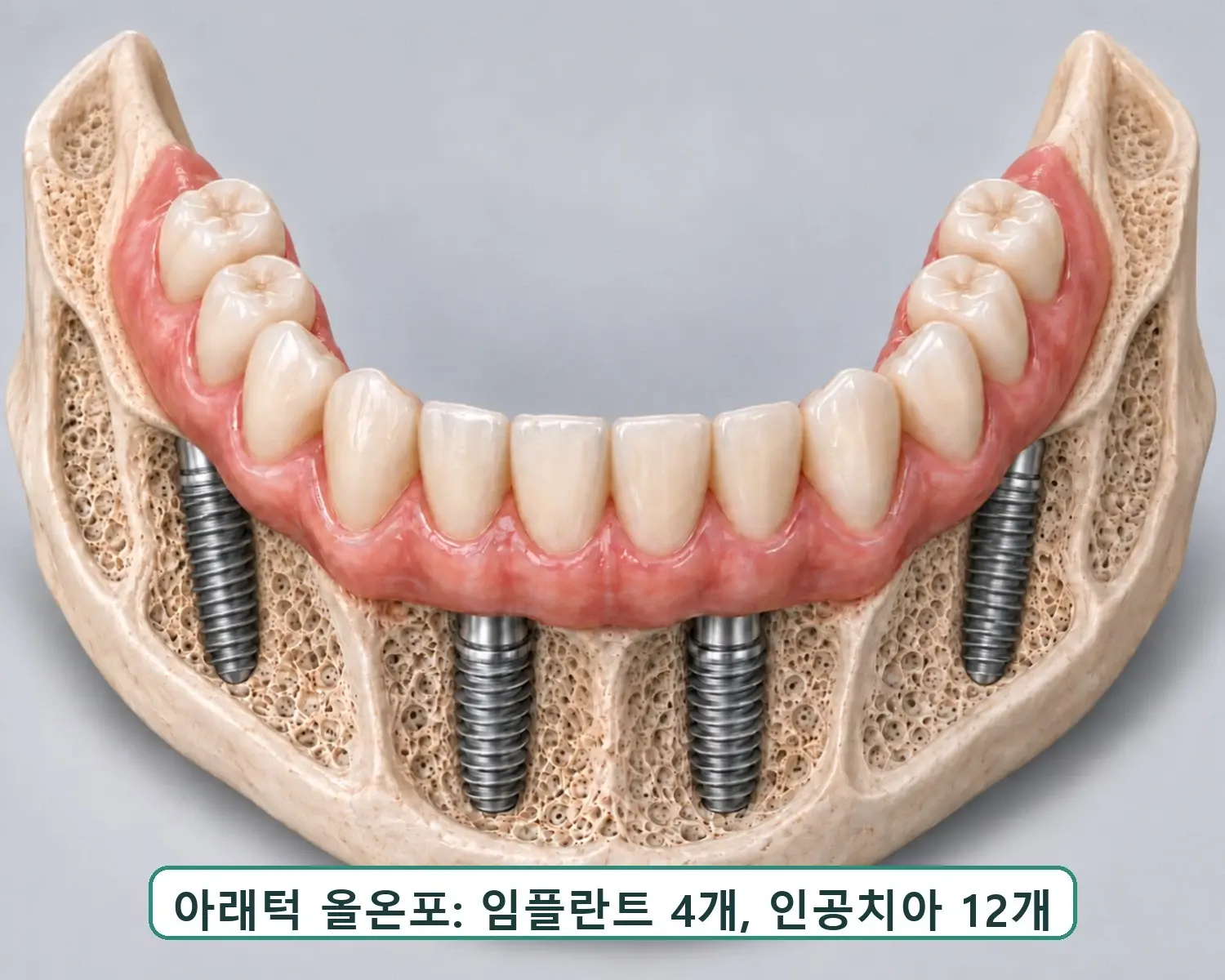
Realistic cross-section diagram of All-on-4, with 12 artificial teeth fixed as a single piece on four lower-jaw implants

ALL-ON-X IMPLANT

Full-Arch Implants (All-on-X): How They Differ from Full-Mouth Implants, and Their Advantages

If the bone allows, we first look at a three-segment fixed prosthesis, in which only the affected segment can be repaired, and choose a single-piece All-on-X depending on placement constraints, cost, and your preference.

All-on-X

All-on-X is a single piece; our full-mouth implant is three segments

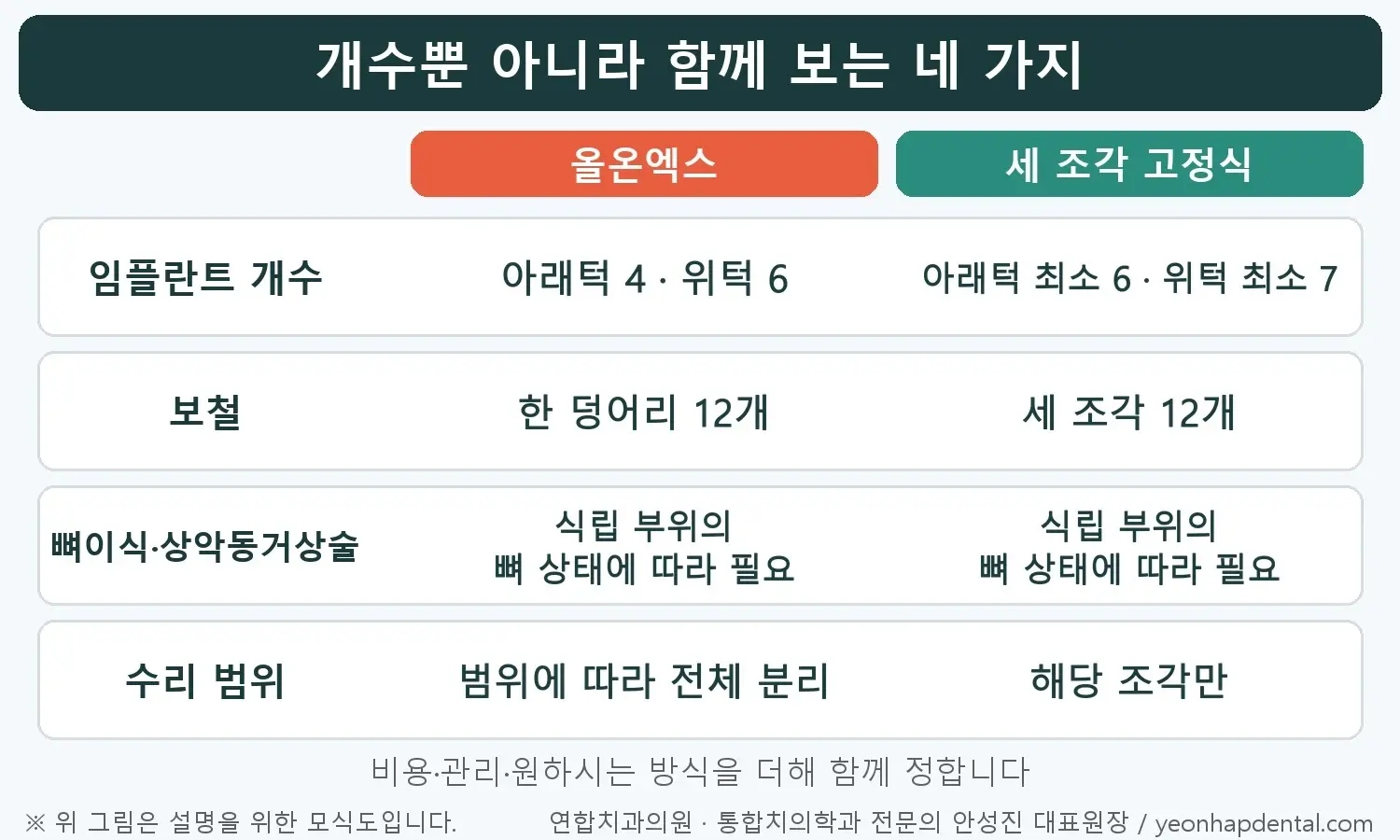
A full-arch implant (All-on-X) is a method of placing 4-6 implants in one jaw and fixing 12 artificial teeth as a single-piece prosthesis, whereas our full-mouth implant (three-segment fixed prosthesis) places enough implants to divide the 12 artificial teeth into three segments. If the bone allows, Yeonhap Dental Clinic first considers a three-segment fixed prosthesis, in which only the segment with a problem can be repaired or replaced, and chooses All-on-X depending on placement constraints, cost, maintenance, and the patient's wishes. The number and positions are our clinic's design criteria.

CT Planning

What we check at your first consultation

At the first consultation, we look at the three items below on 3D CT and decide which is right for you, a three-segment fixed prosthesis or All-on-X.

  • Whether the lower-jaw molar sites have at least 5 mm of bone remaining above the nerve canal
  • Whether implants can be placed at the upper-jaw front tooth sites and whether a sinus lift is needed
  • Cost and maintenance conditions, and the prosthesis method you prefer (single piece or three segments)

Two Cases

Conditions for choosing All-on-X: lower jaw, upper jaw, and the provisional prosthesis

The bone at the molar sites, the front tooth sites, and the provisional prosthesis conditions common to both methods.

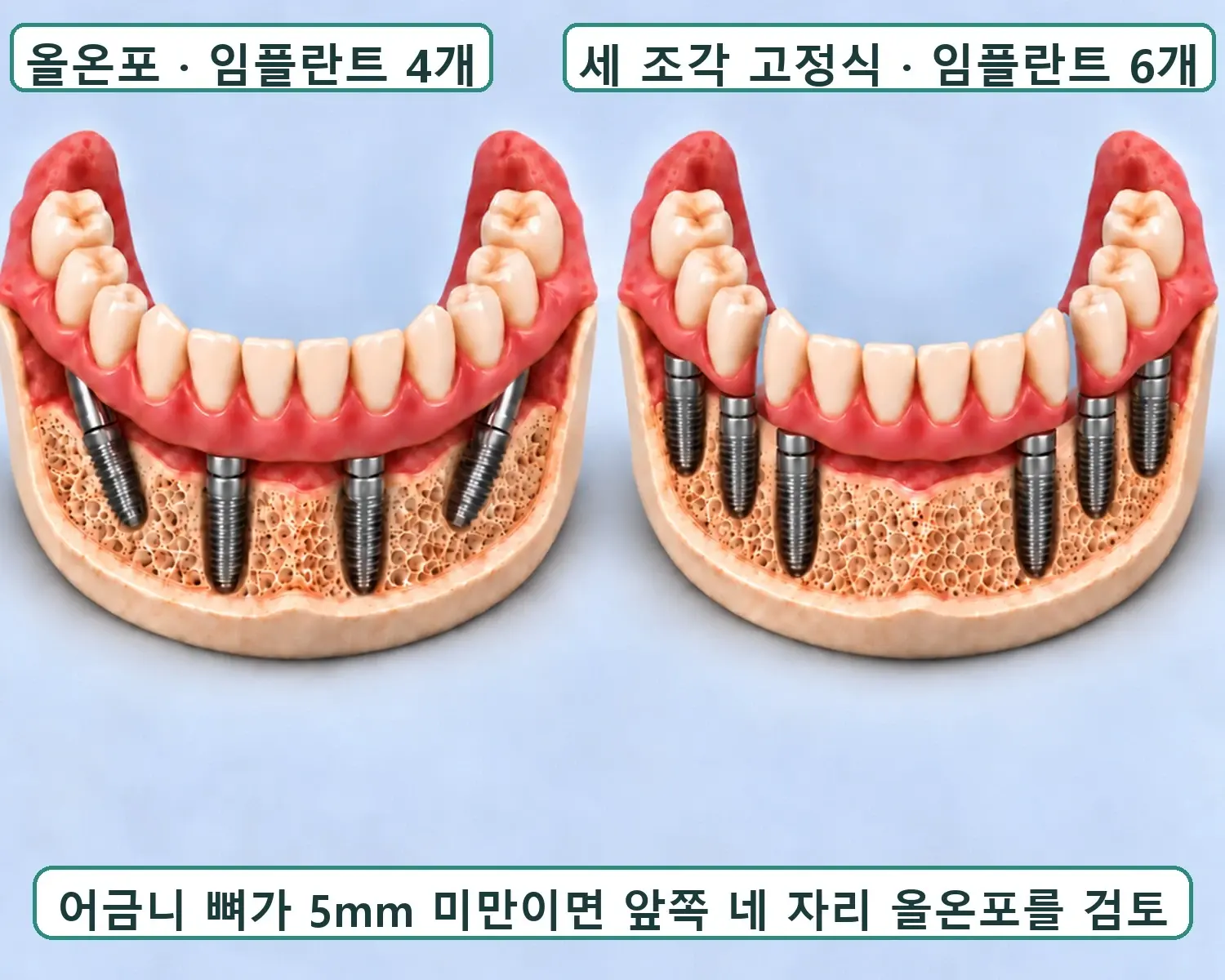
Realistic cross-section diagram comparing, in a completely edentulous lower jaw, a six-implant three-segment fixed prosthesis with a single-piece All-on-4 prosthesis on four front implants

Lower jaw: if the molar bone is under 5 mm, we consider All-on-4 at the four front sites

If the bone above the nerve canal at the molar sites is under 5 mm, we leave those sites empty and place implants at the four front sites where bone remains and make the 12 artificial teeth as a single piece. Behind the last implant, two molars are extended on each side, and we check the length and bite, and No. 7 (the second large molar) is not made.

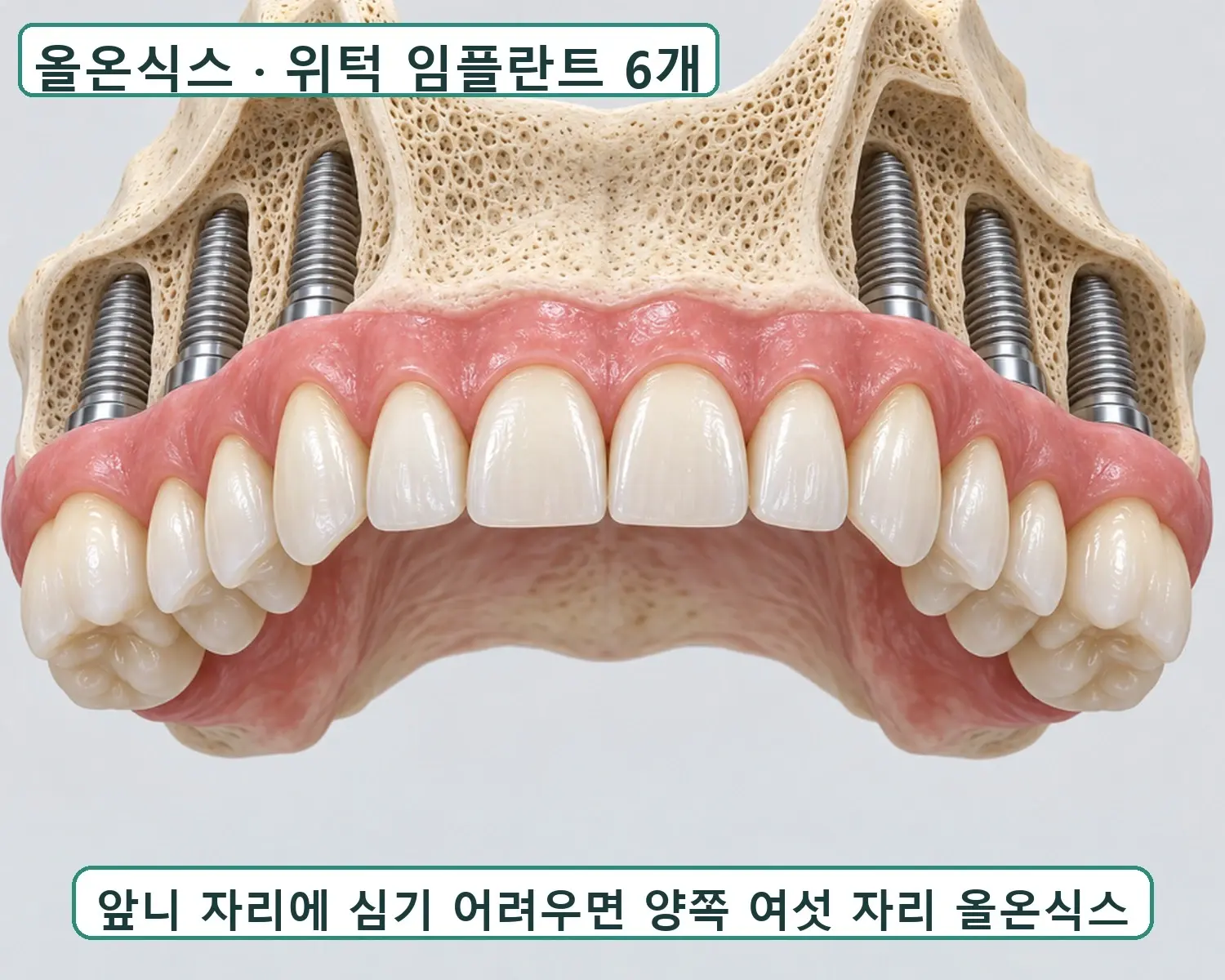
Realistic cross-section diagram of All-on-6 in a completely edentulous upper jaw: no implants at the front tooth area, with 12 artificial teeth, including the front teeth, placed as a single piece on 6 implants toward the premolars and molars on both sides

Upper jaw: if the front tooth sites are difficult, we consider All-on-6 at six sites on both sides

If implants can be placed at the front tooth sites, we first look at a three-segment fixed prosthesis (at least 7). If placement at the front tooth sites is difficult, we place implants at six sites toward the molars on both sides and attach the 12 artificial teeth as a single piece, and a sinus lift is often done together.

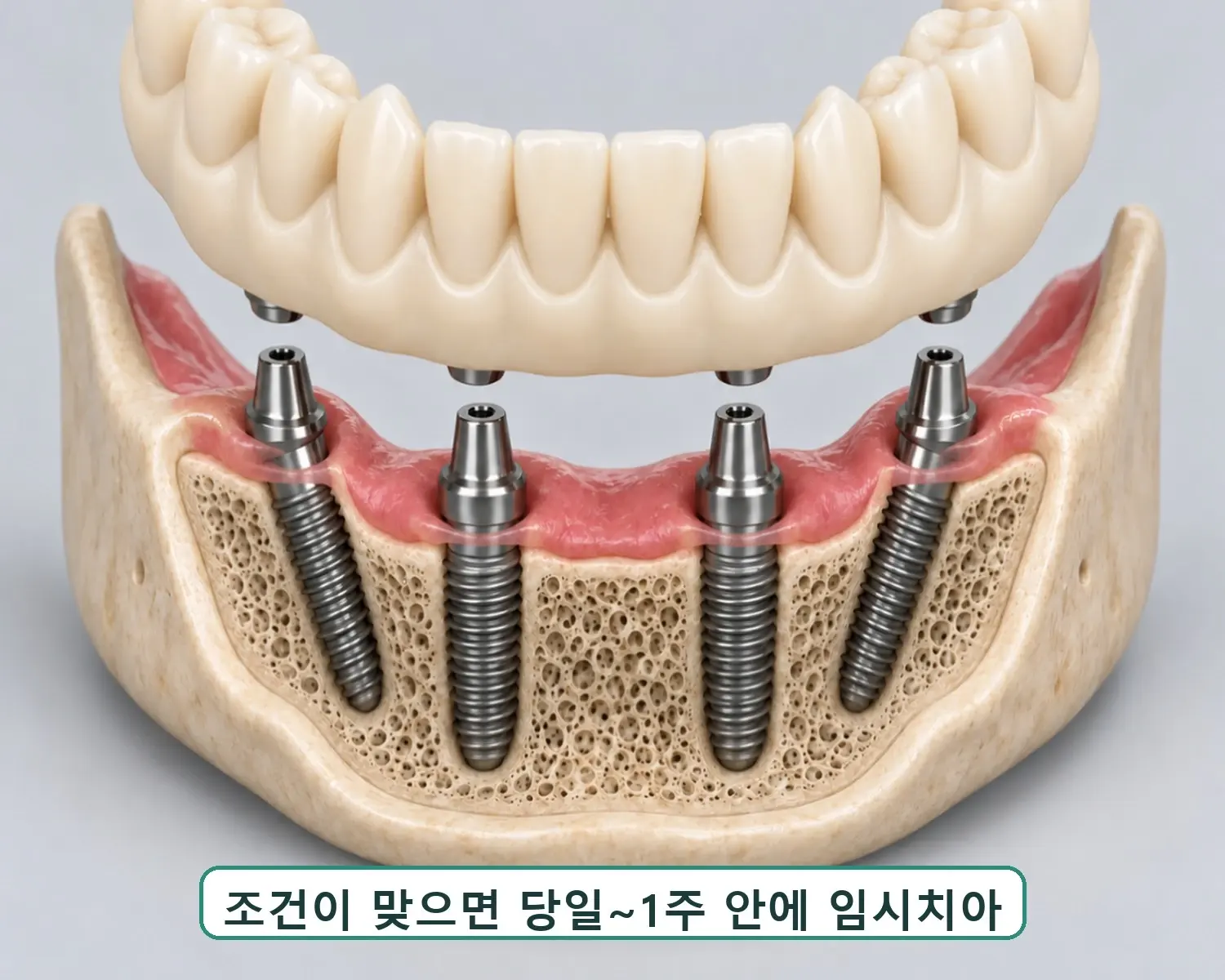
Realistic cross-section diagram of a fixed provisional prosthesis connected to four lower-jaw implants

Provisional prosthesis: the same day to 1 week if there are 4 qualifying implants in the lower jaw or 6 in the upper jaw

If the lower jaw has 4 and the upper jaw has 6 implants with a diameter of 4 mm or more, a length of 8.5 mm or more, and an initial stability of 30 Ncm or more, and the connection design is suitable, we attach a provisional prosthesis within the same day to 1 week. About 90% of Yeonhap Dental Clinic's lower-jaw full-mouth cases qualified.

Why Not Everyone

Prosthesis structure and maintenance, and cost and choice

We do not choose by number alone. We look together at the extent of repair, cleaning, bone graft, cost, and the method you prefer.

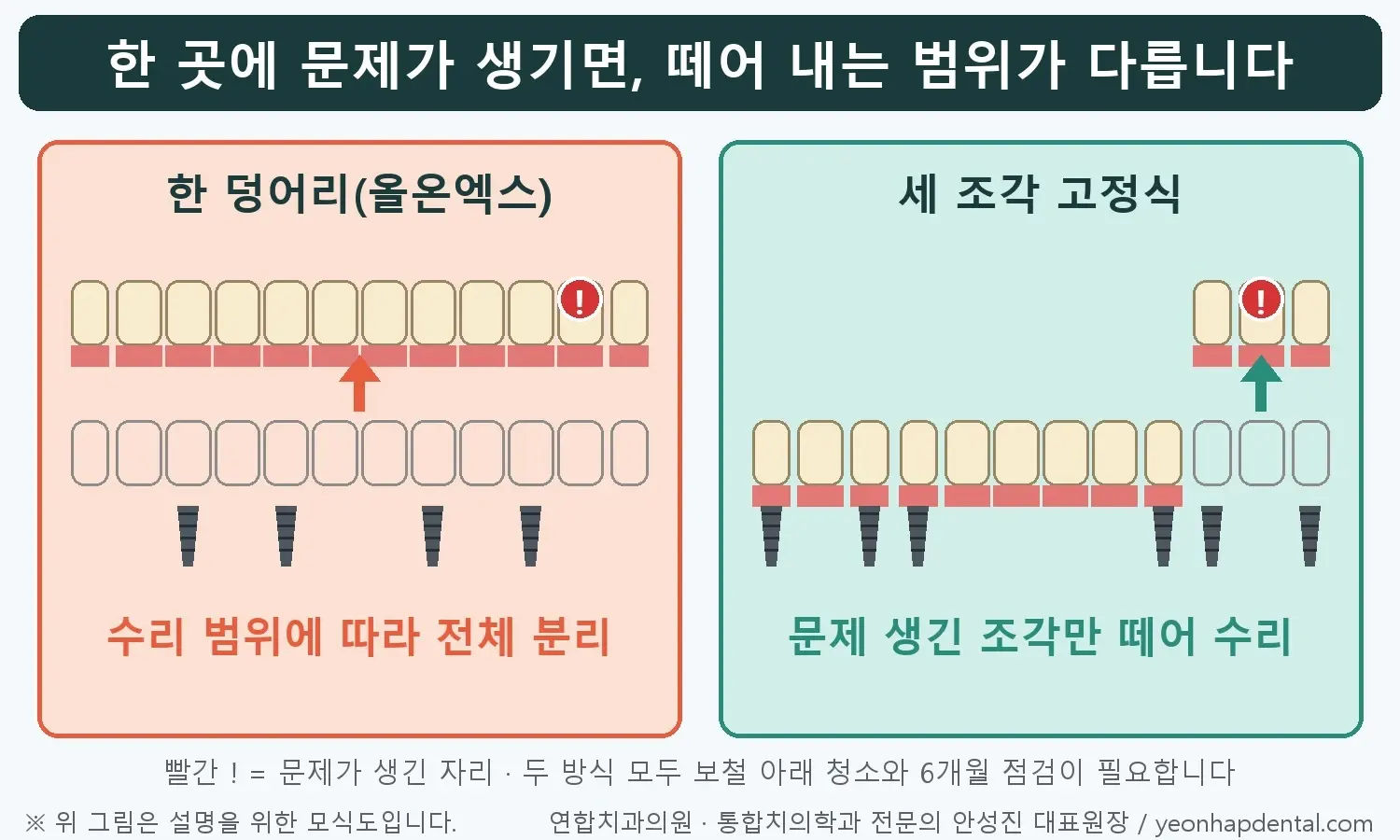
Diagram showing that a single-piece prosthesis may have to be removed entirely depending on the extent of repair, whereas a three-segment fixed prosthesis allows only the affected piece to be removed

A single piece and three segments differ in how much is removed for repair

Because the All-on-X prosthesis is a single piece, depending on the extent, the whole prosthesis may have to be removed for repair, whereas with a three-segment fixed prosthesis only the segment with a problem is repaired or replaced. With both methods, cleaning under the prosthesis is important, and every 6 months we check for loose screws, the bite, and peri-implantitis.

Diagram of the four items considered together when choosing between All-on-X and a three-segment fixed prosthesis: number of implants, number of prosthesis segments, bone graft and sinus lift, and extent of repair and maintenance

Cost is judged by the prosthesis, bone graft, and maintenance, not just the number

It is hard to compare the total cost by the number of implants alone. We compare with a three-segment fixed prosthesis by adding the number of prosthesis segments, bone graft and sinus lift, extent of repair and maintenance, and the method you prefer, and if you want to reduce cost, we consider All-on-X for both jaws.

Before Visit

Helpful details before your visit

Bring them if you have them. If not, we will calculate from CT on the first day.

  • The area and symptoms that bother you most right now
  • The denture you currently use (we can adjust it and use it as a temporary denture)
  • Medications you are taking, especially osteoporosis medication and antiplatelet drugs

All-on-X: the criteria Yeonhap Dental Clinic uses

Design criteria: All-on-4 with 4 implants in the lower jaw (#32, #34, #42, #44), All-on-6 with 6 in the upper jaw, and a three-segment prosthesis with at least 6 in the lower jaw and at least 7 in the upper jaw (based on 12 artificial teeth). When we consider All-on-X: when the bone above the nerve canal at the lower-jaw molar sites is under 5 mm, when placement at the upper-jaw front tooth sites is difficult, or when you want to reduce cost. Even if the bone allows, you can choose All-on-4 if you prefer, and even if four sites are available, you can choose an implant-supported denture depending on NHI coverage conditions. Provisional prosthesis: For an upper jaw where a sinus lift is done together, we do not attach a provisional prosthesis immediately. If the conditions are not met, we repair and adjust your existing denture or use a new temporary denture, and the provisional bridge after the second-stage surgery also depends on your condition. Immediate loading is meant to reduce the discomfort of waiting. Timeline: We expect about 4 months from placement to the final prosthesis for the lower jaw and about 4-8 months for the upper jaw. If a sinus lift is done first, we explain the total timeline separately, and the details are in the timeline guide and the sinus lift guide.

The basis and scope of the criteria for All-on-X

The number and positions of implants and the provisional prosthesis specifications are Yeonhap Dental Clinic's standards. We referred to the literature for the All-on-4 treatment concept (Soto-Peñaloza 2017) and the initial stability conditions for immediate loading of a full arch (Gallucci 2014). The figure of about 90% for the lower jaw is from Yeonhap Dental Clinic's full-mouth case experience, and NHI coverage follows the Health Insurance Review and Assessment Service notice and Ministry of Health and Welfare announcements. For this reason, at the first consultation Yeonhap Dental Clinic first looks at the bone at the molar sites and the front tooth sites on CT. References: Soto-Peñaloza 2017, systematic review of the All-on-4 treatment concept · Gallucci 2014, consensus statement on implant loading protocols · Health Insurance Review and Assessment Service, recognition criteria for dental implants (Notice No. 2025-23) · Ministry of Health and Welfare, results of the Sept. 8, 2026 Health Insurance Policy Deliberation Committee (expanded dental coverage) Treatment results may vary depending on each person's oral condition. The applicable methods and course of healing vary from person to person depending on the remaining bone and general health.

Last updated:

Schedule a consultation by phone or Naver Booking

Leave a few details on our consultation page and we'll get back to you promptly.

Frequently Asked Questions

Q. Are full-arch implants and All-on-X the same thing?
At Yeonhap Dental Clinic, we describe the method of fixing 12 artificial teeth as a single-piece prosthesis on 4-6 implants as a full-arch implant (All-on-X), and distinguish it from Yeonhap Dental Clinic's full-mouth implants (three-segment fixed prosthesis), in which the prosthesis is divided into three pieces. With 4 in the lower jaw it is All-on-4, and with 6 in the upper jaw it is All-on-6.
Q. How many implants does Yeonhap Dental Clinic place for upper-jaw All-on-X?
At Yeonhap Dental Clinic, we design the upper jaw as All-on-6, with 6 implants placed toward the molars on both sides. We consider it when placement at the front tooth sites is difficult or to reduce cost, and a sinus lift is often needed as well.
Q. Isn't All-on-4 with 4 implants weaker than 6?
We do not judge it to be weak by the number of implants alone. At Yeonhap Dental Clinic, we check together the bone and fixation at the four front sites and the length and bite of the prosthesis extending toward the back. All-on-4 connects 12 artificial teeth as a single piece and does not make No. 7, and the extent of repair also differs from a three-segment fixed prosthesis.
Q. How is it different from an implant-supported denture?
Yeonhap Dental Clinic's implant-supported denture fixes a bridge on two implants at #33 and #43 in the lower jaw (four in the upper jaw) and attaches a removable partial denture to that bridge, whereas All-on-X fixes 12 artificial teeth on 4-6 implants and is not removed. If the four front sites are difficult, we consider an implant-supported denture, and even if four sites are available, some patients choose an implant-supported denture depending on cost, maintenance, and NHI coverage conditions. The design is in the Implant-Supported Denture Guide.
Q. Is All-on-X covered by National Health Insurance?
Implants for the completely edentulous are currently not eligible for NHI coverage, and only a complete denture is covered, once every 7 years for those aged 65 and over, with the patient copayment rate varying by coverage type. Expansion of coverage to 2 implants for the completely edentulous from January 2027 has been announced, but this does not mean All-on-X or the entire three-segment fixed prosthesis is covered, those who have already received an NHI-covered complete denture must wait 7 years, and the detailed criteria must be checked in subsequent notices.