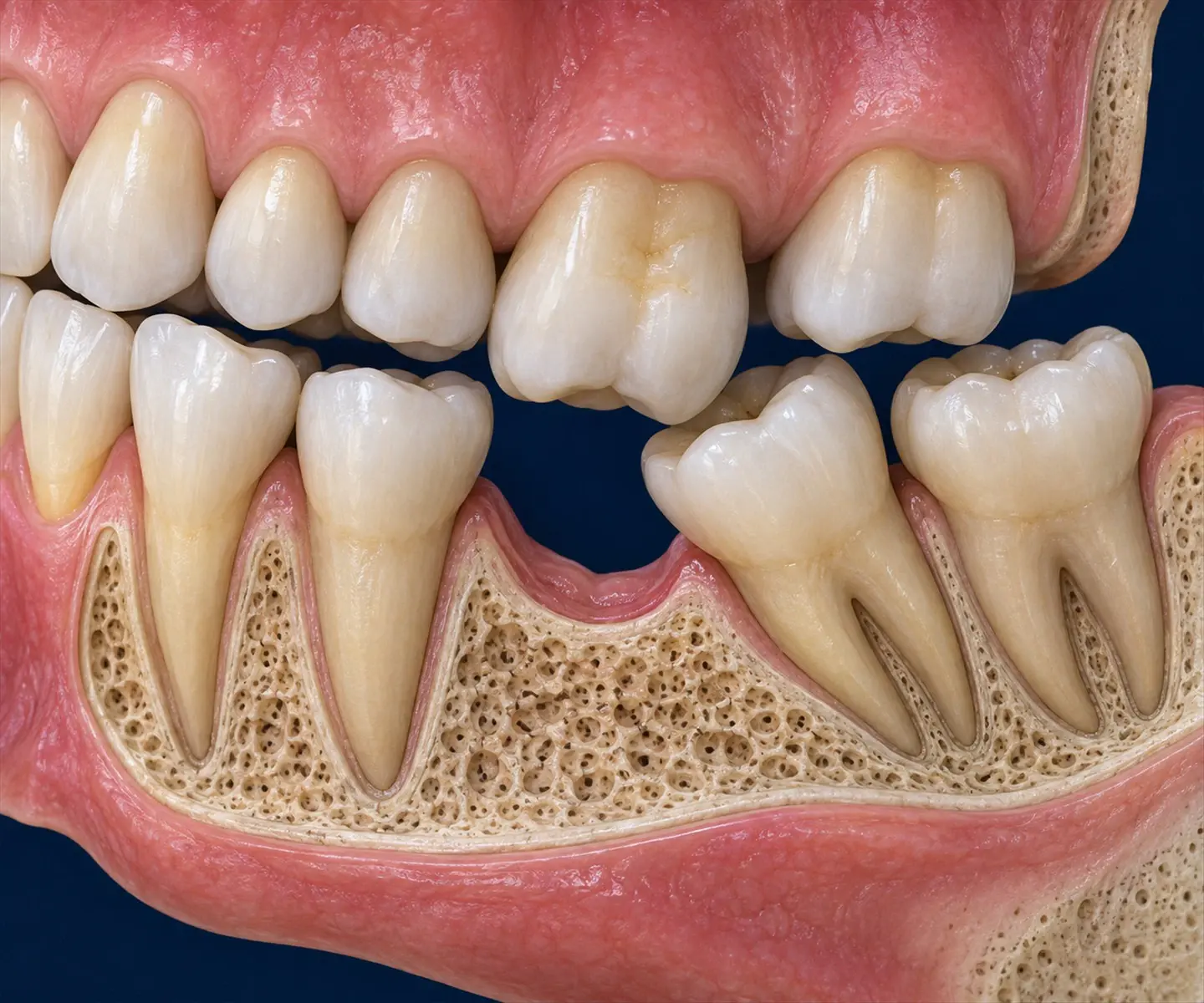
Consultation diagram for a dental implant in Geumgok-dong: cross-section showing a missing molar, with the bone lowered and the opposing upper molar drifting down over time

IMPLANT · GEUMGOK

Implant Decision Timeline For a molar, the reference point is 3 months after extraction

“Can't I manage without just one?” is what we hear most often. An empty space does not stay still.

Why Not Wait

An empty space does not stay still

Even if you live with one molar missing, at first there is not much discomfort. So people put it off, but in the meantime three things move: the opposing tooth moves down (supraeruption), the neighboring tooth tilts toward the empty side, and the bone in the empty space shrinks. Bone shrinks quickly in the first 3 to 6 months after extraction, and the major change occurs within a year. For this reason, Yeonhap Dental Clinic uses three months after extraction as the reference point for placing an implant in a molar. Up to about six months there is generally little difference in the plan, but we advise that after a year the bone has dropped considerably.

Consultation Checklist

What we check at your first consultation

If you have left a space empty, we look at the following five things.

  • How long ago the tooth was lost (3-month, 6-month, and 1-year reference points)
  • Whether the opposing tooth has dropped and whether the neighboring tooth has tilted
  • Bone height and width in the empty space (whether a bone graft is needed)
  • Whether there is still room for the implant
  • Whether to place it now or do other treatment first

What Changes Over Time

What happens when a space is left empty

Even one missing tooth sets the neighboring teeth and the teeth above and below in motion.

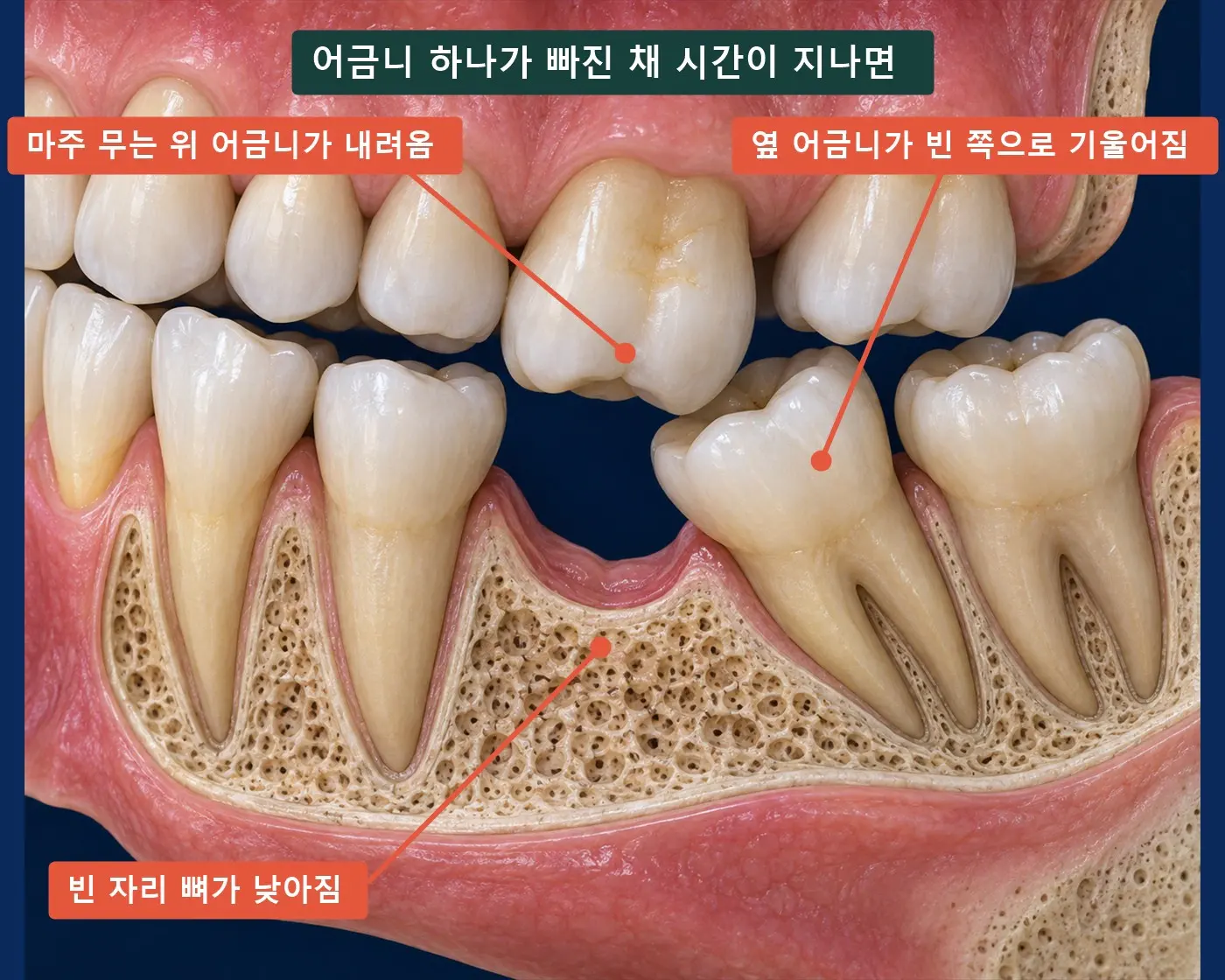
Cross-section of a single missing molar over time: the upper molar drops, the neighboring molar tilts, and the bone in the empty space lowers

The upper tooth drops, the neighboring tooth tilts, and the bone lowers

The opposing tooth has nothing to meet, so it moves down (supraeruption), and the neighboring tooth tilts toward the gap and narrows the space for the implant. The bone in the empty space shrinks because it is no longer used. If the space is left empty for more than 5 years, the curve of the whole chewing surface can be thrown off. That is how one implant can later grow into treatment of several teeth.

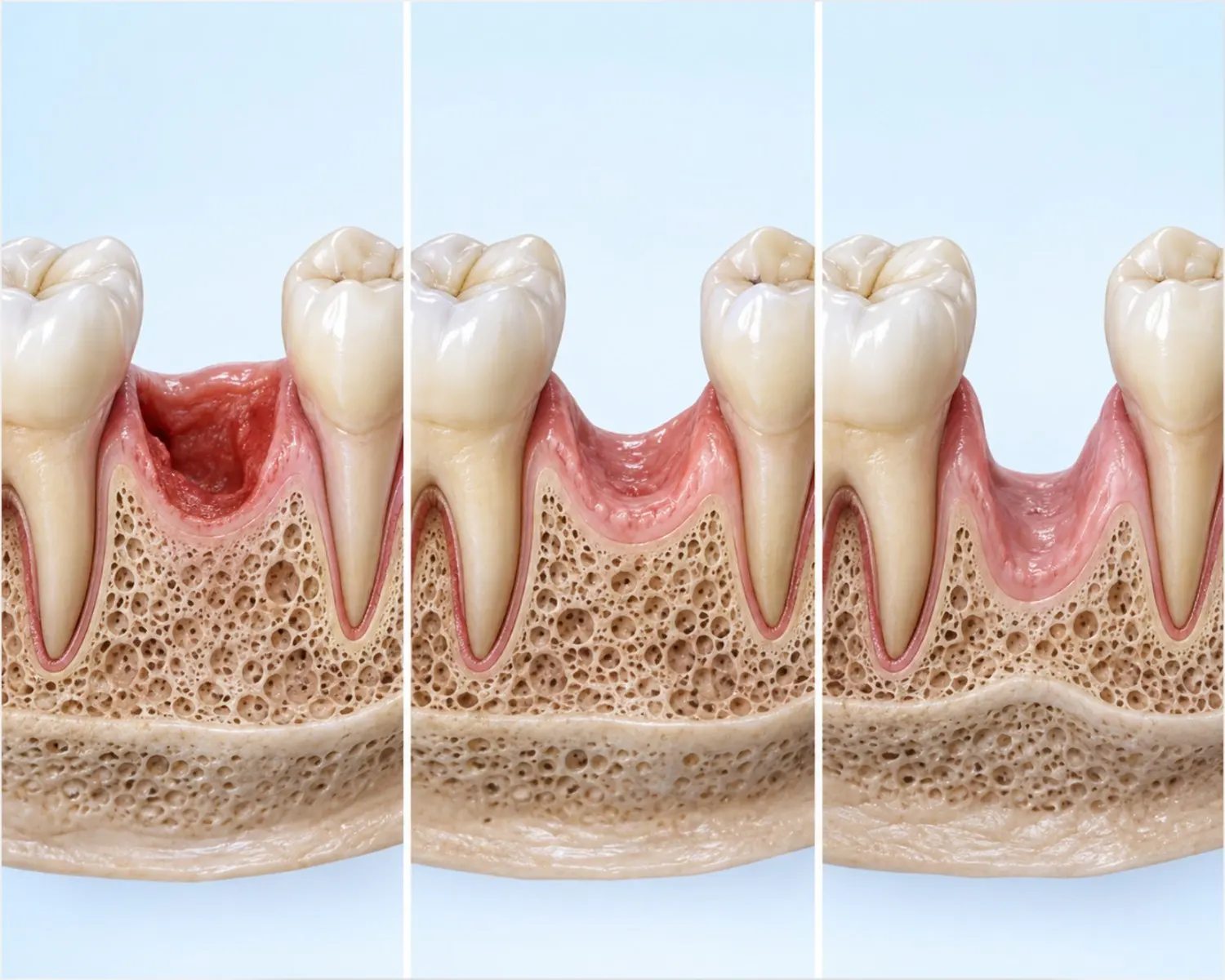
Cross-section side by side showing the bone of the empty space gradually becoming lower and narrower immediately after extraction of a lower molar, at 3 months, and at 1 year

For molars, 3 months is the reference; up to 6 months is within the plan

Bone shrinks quickly in the first 3 to 6 months after extraction, and the major change occurs within a year. Yeonhap Dental Clinic plans around placement 3 months later for molars; up to about 6 months there is generally little difference in the plan, and we advise that after a year a bone graft becomes more likely. If all infection can be cleared and the socket bone can hold the implant firmly, we may also place it on the day of extraction.

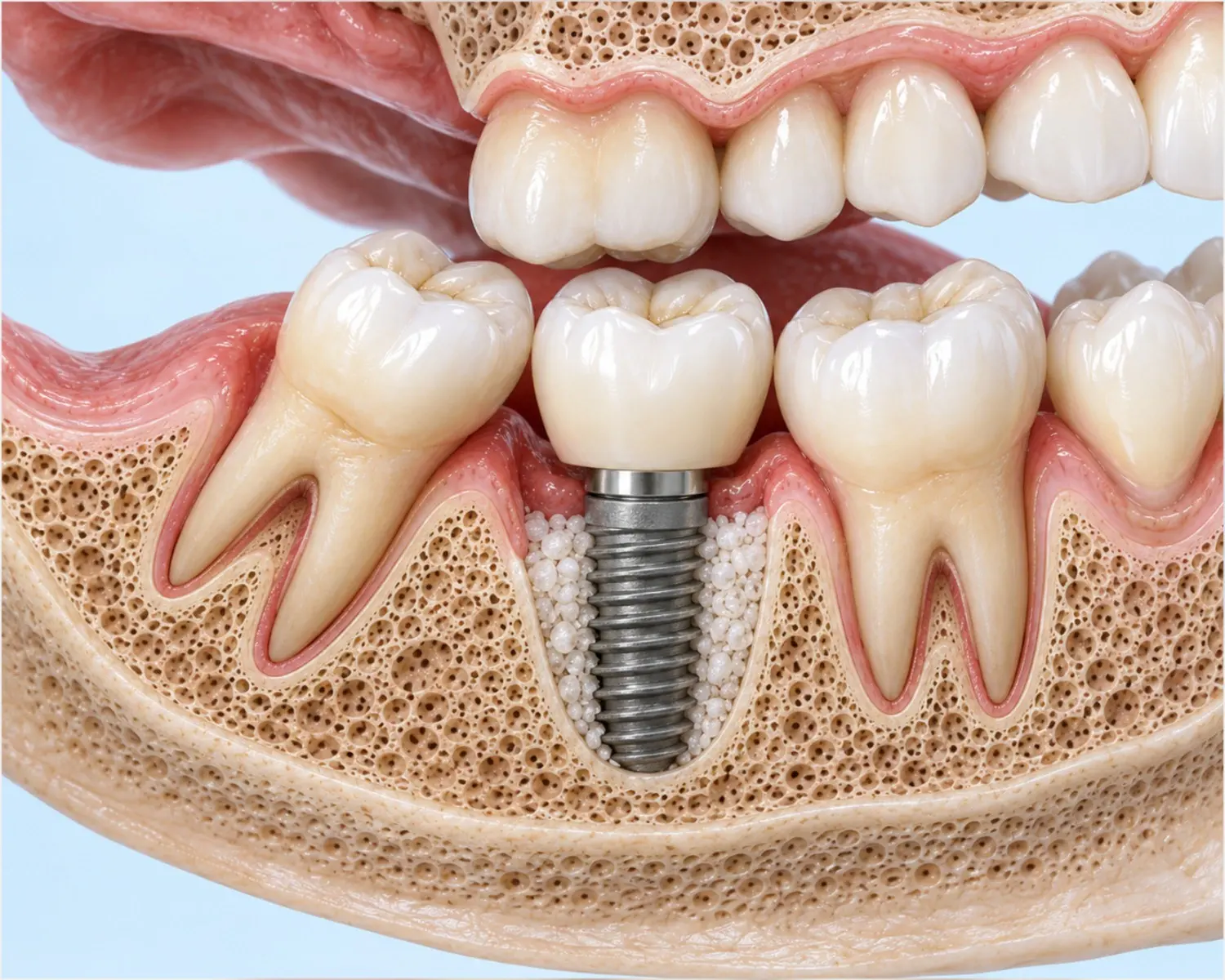
Cross-section of an implant placed in a long-empty lower molar site with bone graft material filled in, showing the neighboring molar tilted and the upper molar dropped

Three changes make the treatment bigger

The dropped upper tooth may later need to be ground down or crowned, the tilted neighboring tooth makes the implant angle difficult, and the shrunken bone calls for a bone graft. What could have ended with one implant can grow into several treatments, and that is the cost of leaving the space empty.

When to Decide

Implants: How Long Can You Wait Before Deciding?

If it has already been a long time, now is the earliest you can start.

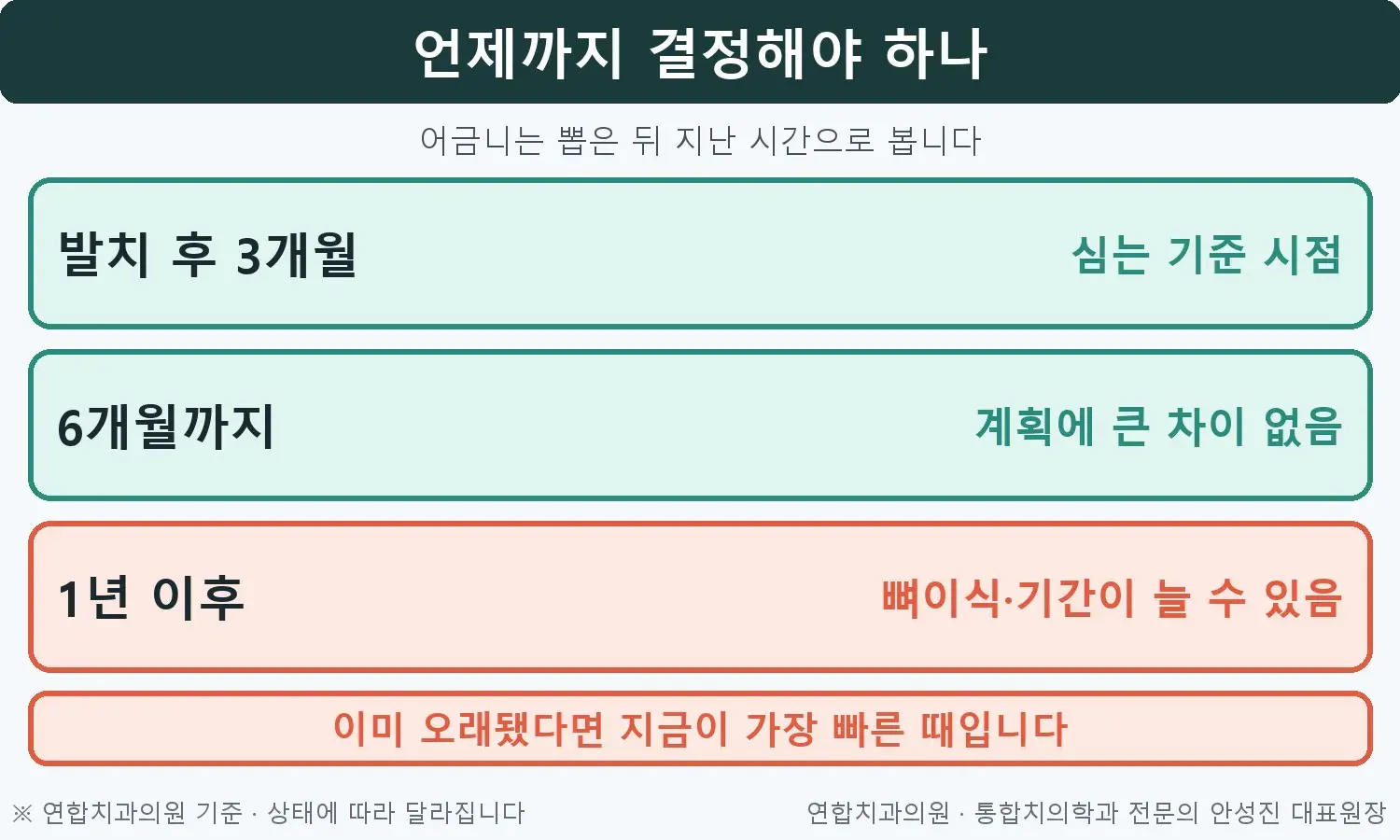
Infographic on the implant decision timeline, divided into 3 months, 6 months, and after 1 year following extraction

We look at three periods: 3 months, 6 months, and 1 year

For a molar, 3 months is the reference point, and in many cases up to 6 months makes little difference to the plan. After a year, the bone has dropped considerably, and a bone graft and a longer treatment period may follow. If several years have already passed, we measure the remaining bone on CT and decide the method. Being late does not mean it cannot be done.

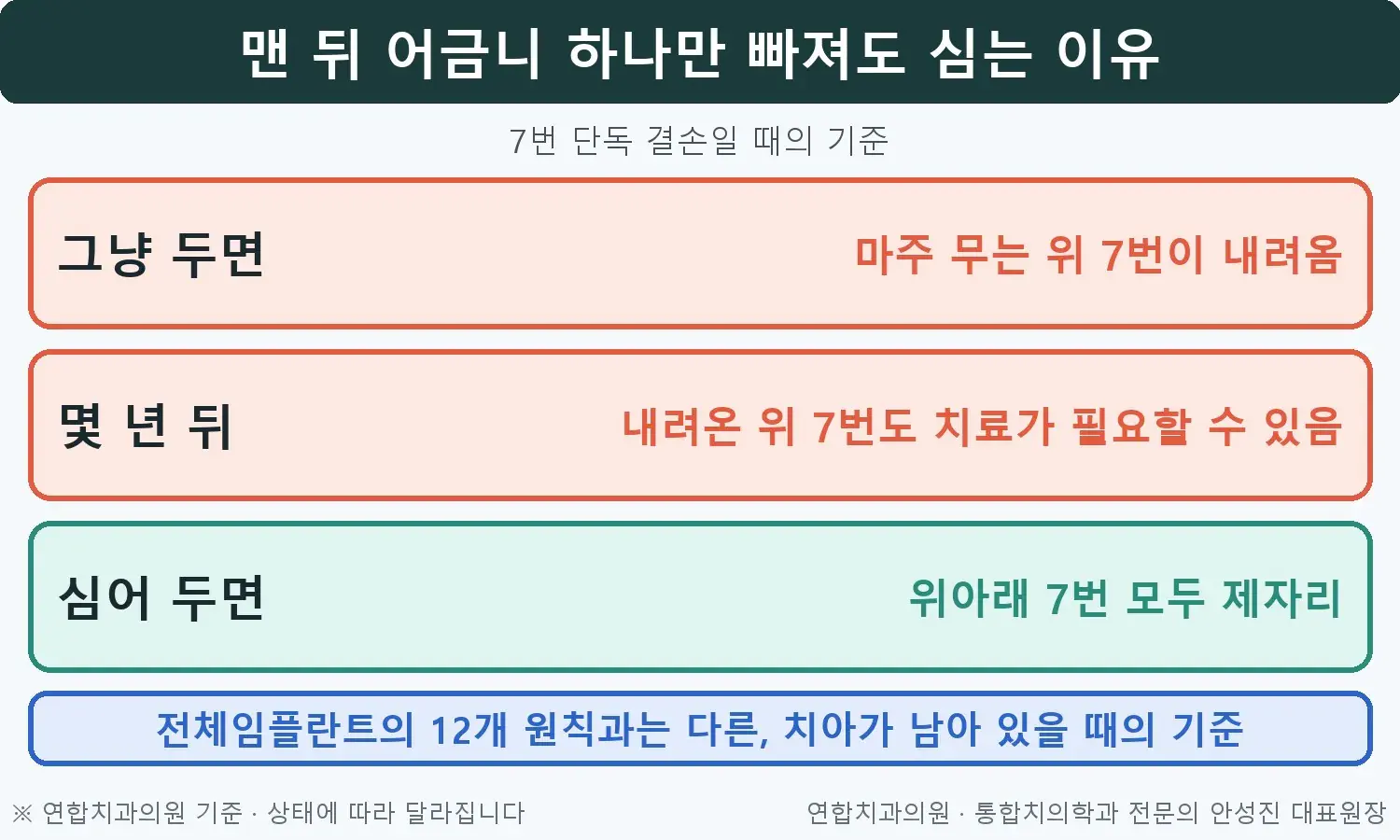
Infographic comparing what happens when only the very last molar is missing: leaving it, a few years later, and having it replaced

Even if only the very last molar is missing, we place an implant

When one No. 7 tooth (the large molar at the very back) is missing, many people leave it because chewing is not much of a problem. However, the opposing upper No. 7 may drop, and that tooth may then need treatment as well. For this reason, Yeonhap Dental Clinic recommends placing an implant even for a single missing No. 7. This is a different standard from the 12 principles for not making a No. 7 in full-mouth implants; it applies when natural teeth remain.

Before Visit

Helpful details before your visit

How long ago the tooth was lost is the first question.

  • When the tooth was lost (extracted)
  • What has changed since then when chewing (food getting caught, chewing only on the other side)
  • A list of medications you are taking
  • If you are 65 or older, whether you have used the NHI-covered implant benefit

Why we use three months after extraction as the reference, Yeonhap Dental Clinic

In a systematic review pooling 20 studies, the width of the jawbone after extraction shrank by 32% at 3 months and by 29-63% at 6-7 months. The average loss at 6 months was 3.79 mm in width and 1.24 mm in height on the cheek side, with the fastest shrinkage in the first 3 to 6 months (Tan 2012). In a study that followed 46 people for 12 months after a single tooth was extracted, the major change also occurred within one year of extraction (Schropp 2003). There is also a report that when an opposing tooth is left without a partner for more than 5 years, it shifts enough to leave the curve of the chewing surface (Craddock 2006). For this reason, Yeonhap Dental Clinic uses three months after extraction as the reference point for placing an implant in a molar. Up to about six months there is generally little difference in the plan, but we advise not letting it go past a year. We recommend placing an implant even when only the very last molar is missing, and if all infection can be cleared and the socket bone can hold the implant firmly, we place it on the day of extraction. References: Schropp 2003, prospective study of bone and soft tissue changes for 12 months after single-tooth extraction (46 people; major change within one year) · Tan 2012, systematic review of alveolar bone and soft tissue changes after extraction (width loss of 32% at 3 months and 29-63% at 6-7 months; 6-month average 3.79 mm and cheek-side height 1.24 mm) · Craddock 2006, deviation from the occlusal curve more than 5 years after loss of posterior teeth Treatment results may vary depending on each person's oral condition.

Last updated:

Schedule a consultation by phone or Naver Booking

Leave a few details on our consultation page and we'll get back to you promptly.

Frequently Asked Questions

Q. How long after a tooth is pulled should an implant be placed?
For a molar, three months after extraction is the usual point for placing an implant (two months for a front tooth), and up to about six months there is generally little difference in the plan. After a year, the bone has often dropped considerably, and a bone graft becomes more likely. At Yeonhap Dental Clinic, if all infection can be cleared and the socket bone can hold the implant firmly, we also consider placing it on the day of extraction.
Q. Can I just leave one missing molar without an implant?
If a single molar is simply left missing, the opposing tooth moves down, neighboring teeth tilt, and the bone in the empty space shrinks. At first there may be no discomfort, but a few years later one implant can grow into treatment of the upper tooth plus a bone graft. At Yeonhap Dental Clinic, we recommend placing an implant even when only the very last molar is missing.
Q. My tooth has been missing for several years. Can I still get an implant?
Even if the tooth has been missing for several years, an implant is possible in most cases. However, the bone may have shrunk and need a bone graft, or the dropped upper tooth and the tilted neighboring tooth may need to be treated at the same time. At Yeonhap Dental Clinic, we measure the remaining bone and space on CT on the first day and then decide the order of treatment.
Q. If I put off the implant, how much does the bone in the empty space shrink?
The width of the jawbone at the missing site shrinks by 32% at 3 months after extraction and by 29-63% at 6-7 months, and the average loss at 6 months is 3.79 mm in width and 1.24 mm in height on the cheek side (Tan 2012). It shrinks quickly in the first 3 to 6 months, and the major change occurs within a year (Schropp 2003). For this reason, Yeonhap Dental Clinic uses placement 3 months after extraction as the reference point for molars.