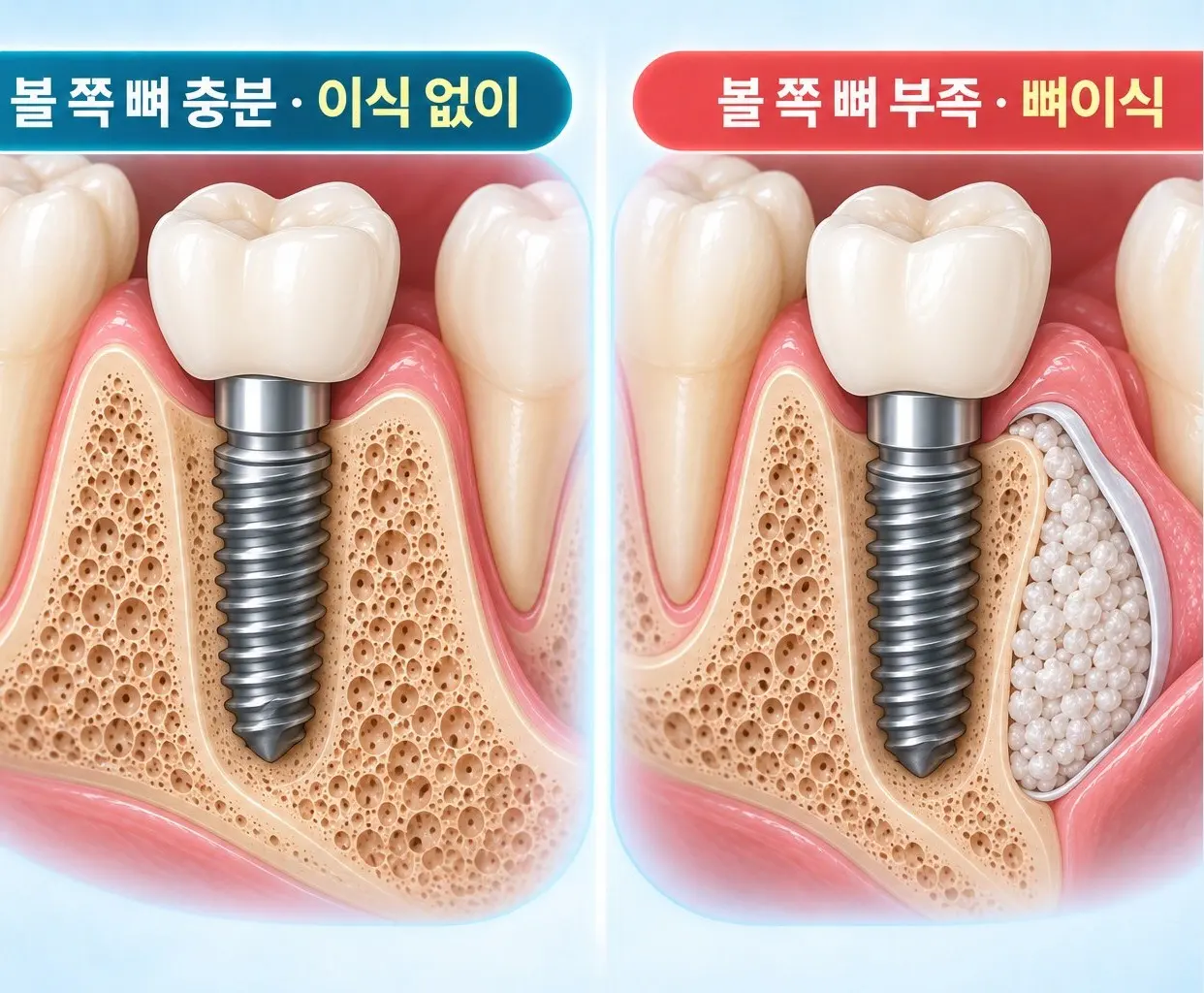
Comparative cross-section diagram of an implant placed without a graft because the cheek-side bone was sufficient, and an implant with a bone graft because the cheek-side bone was lacking

BONE GRAFT BY SITE

Bone Graft Implants Why Bone Grafts Come Into Play Differently for Front Teeth and Molars

A bone graft is not a single procedure. Why it is or is not done differs for front teeth, lower molars, and upper molars.

Why Diagnosis Matters

A bone graft has a different reason at each site

The reason a bone graft comes into play differs depending on where the implant is placed. For front teeth, the graft that fills the cheek-side gap created by placing toward the palate is one part of immediate placement; for lower molars, a short implant is used instead of building bone; and for upper molars, it is a height issue, so it falls under the sinus lift section. At Yeonhap Dental Clinic, we separate the three sites on CT on the first day, and look for a position that gives 2 mm and 1.5 mm only within the width of the opposing tooth. The criteria for whether to do it or not are in Bone Graft Implants in Suwon.

Consultation Checklist

What we check at your first consultation

At the first consultation, we check the following five items for each site.

  • Whether the missing tooth is a front tooth, a lower molar, or an upper molar
  • For a front tooth, whether it can be placed on the day of extraction (whether infection can be removed and the gum has not collapsed)
  • For a lower molar, whether a 5.0 mm diameter, 4-6 mm length short implant fits when 2 mm above the nerve canal cannot be achieved
  • For an upper molar, whether the bone remaining to the sinus is 7 mm or more
  • Whether shifting the position gives 2 mm and 1.5 mm, and whether that position is within the width of the opposing tooth

Treatment Options

At each site, the reason for a bone graft differs

Front teeth: part of immediate placement. Lower molars: rarely. Upper molars: the sinus lift section.

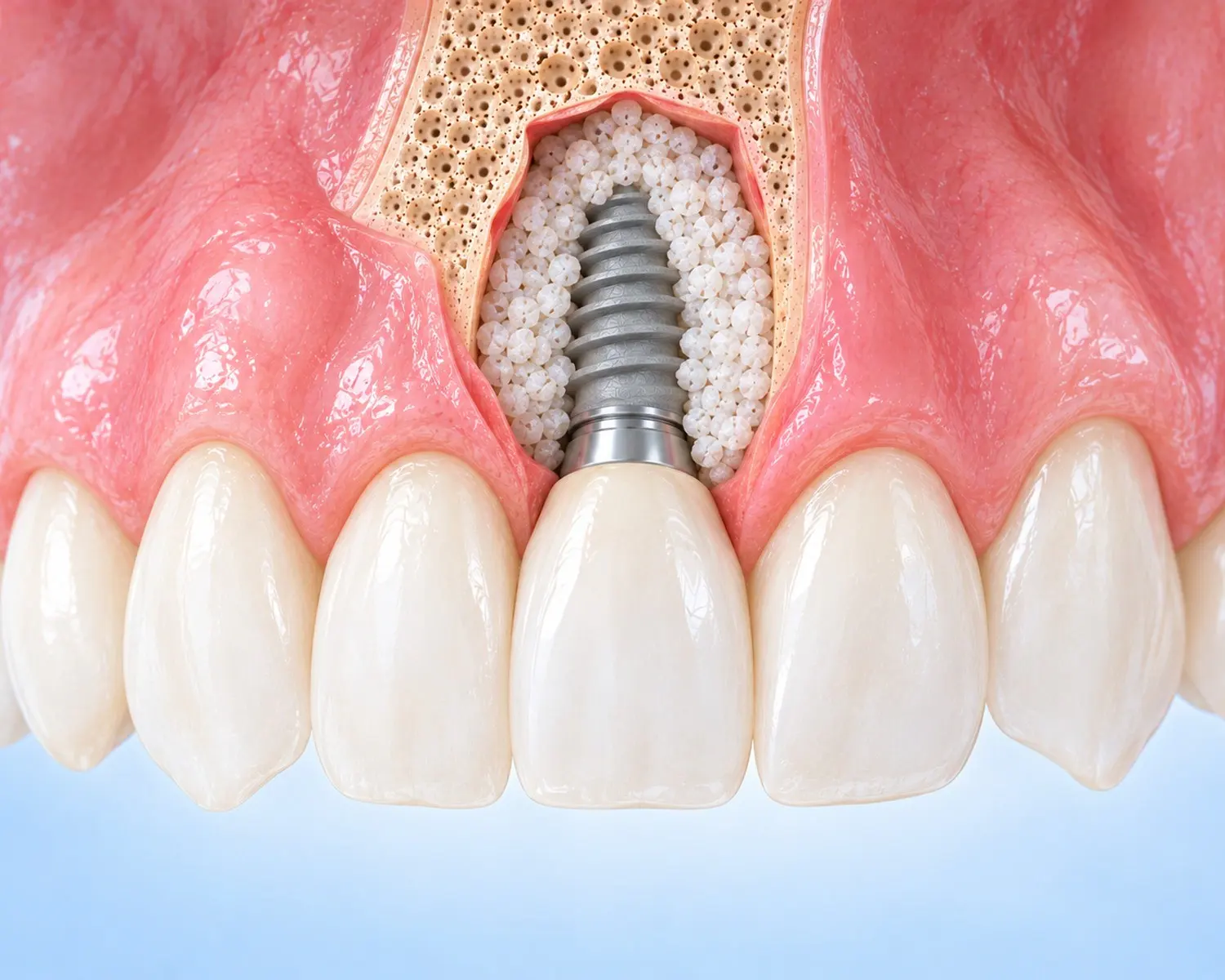
Front view of an implant placed at one upper front-tooth site, with bone graft material covering the lip side, between the natural front teeth on either side

A front-tooth bone graft is one part of immediate placement

The cheek-side bone of a front tooth is thin, so if you wait after extraction, it resorbs first. For this reason, if the infection can be removed, the gum has not collapsed, and initial stability is achieved, the implant is placed on the day of extraction toward the palate, and the gap created on the cheek side is filled with bone graft material to make 2 mm. A front-tooth bone graft is not an extra procedure but one part of immediate placement, so there are few cases in which it is left out.

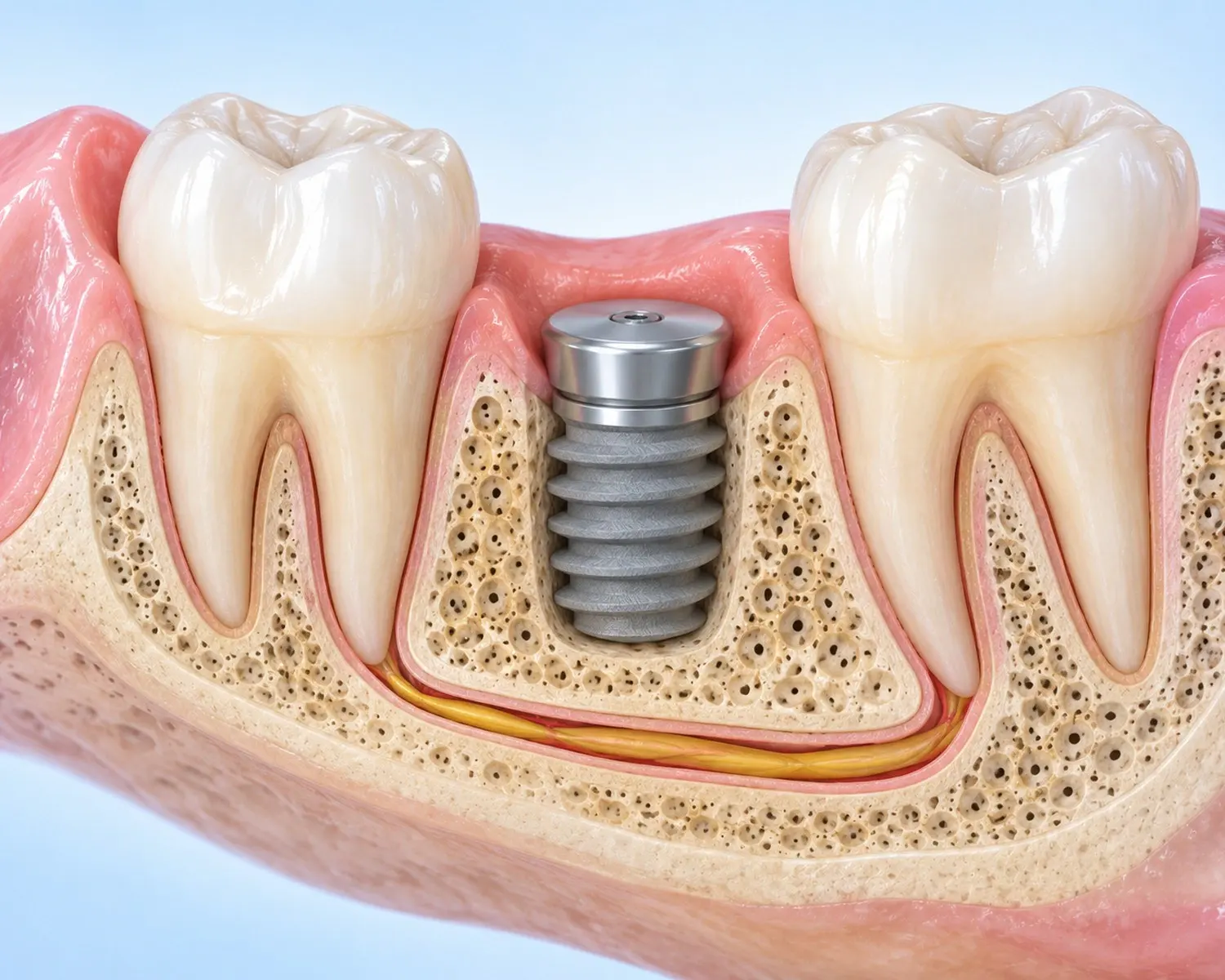
Cross-section of a short, wide implant placed at a lower molar site with a margin left above the nerve canal

Lower molars rarely need a bone graft

In a lower molar, 2 mm must be left above the nerve canal, so a graft that builds bone above it is difficult. If 2 mm cannot be achieved, Yeonhap Dental Clinic uses a 5.0 mm diameter, 4-6 mm length short implant instead of a bone graft, making up for the length with width. A bone graft is effectively never added in a lower molar, and if even a short implant is difficult, no implant is placed at that site.

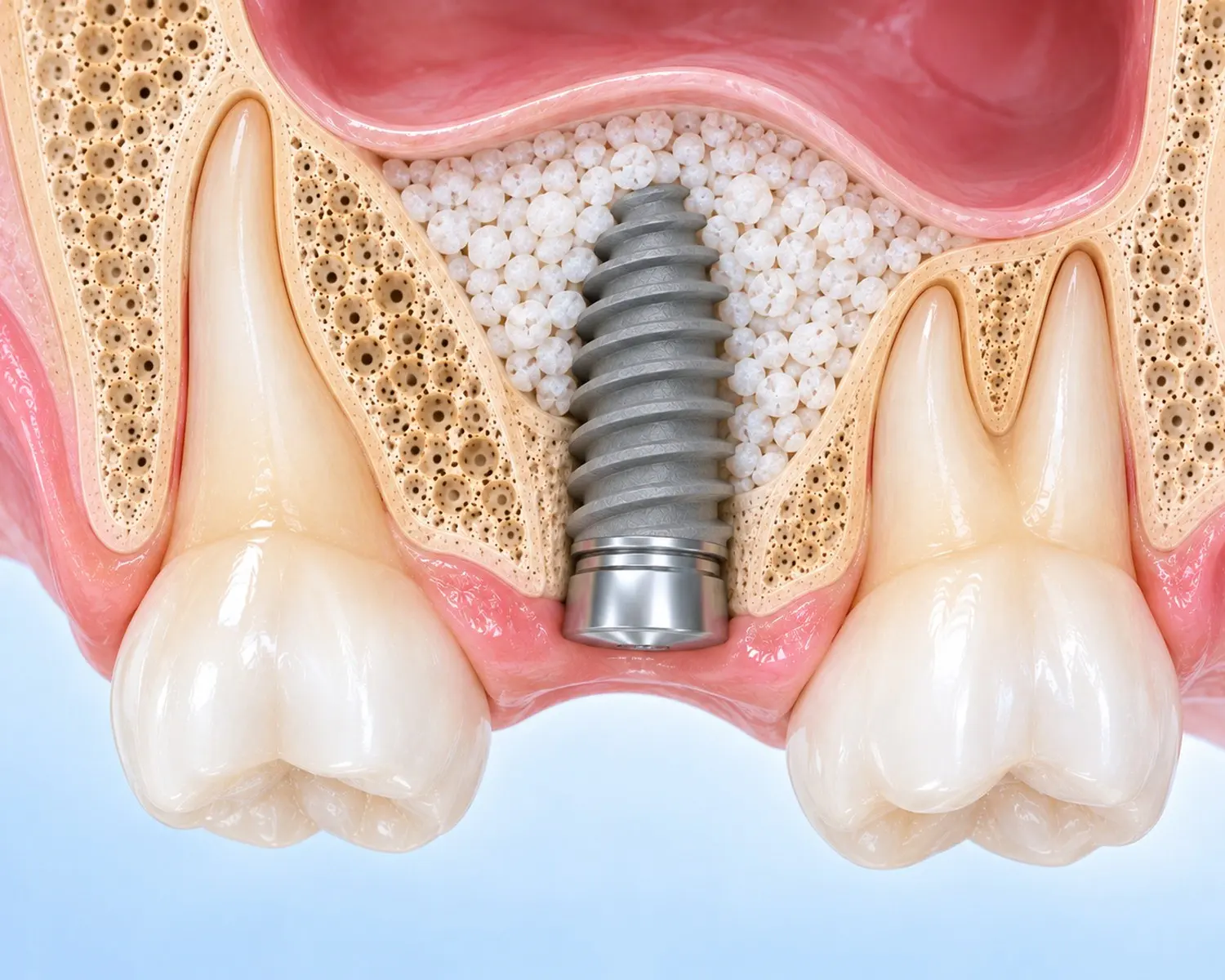
Cross-section of an implant placed at an upper molar site after lifting the sinus floor membrane and filling it with bone graft material

Bone shortage in an upper molar falls under the sinus lift section

What is lacking in an upper molar is not thickness but the height to the maxillary sinus. If the remaining bone is 7 mm or more, we place the implant without a sinus lift, and if it is under 7 mm, we create height with a sinus lift and then place an 8.5 mm implant. Upper molar bone is soft and height can be created with a sinus lift, so we use a sinus lift instead of a short implant.

Planning Points

Two things we keep when avoiding a bone graft

There are limits to shifting the position, and the timing of placement decides how much graft is needed.

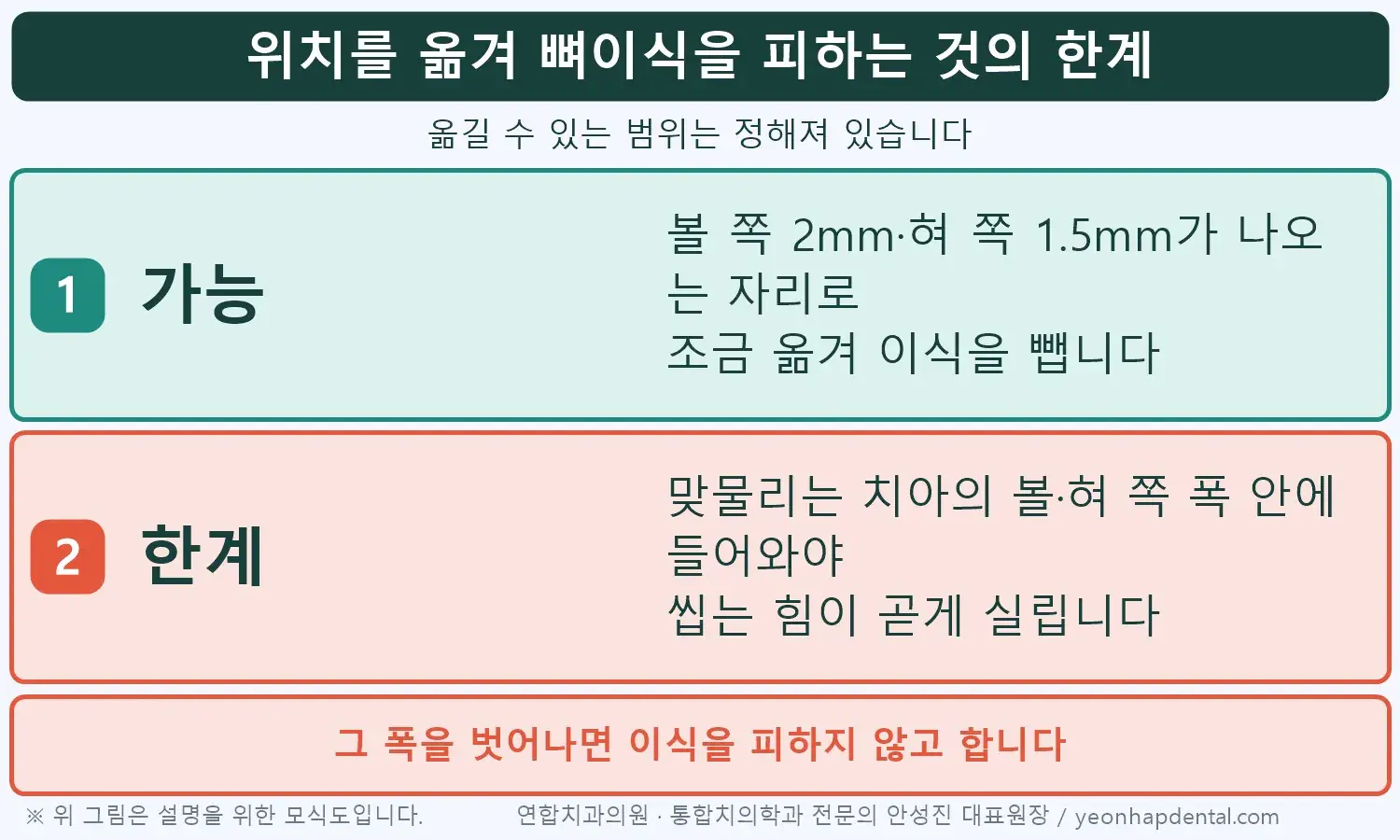
Infographic showing that the range in which shifting the implant position can avoid a bone graft is within the width of the opposing tooth

Shifting the position to avoid a graft has limits

If the implant is shifted slightly and gives 2 mm on the cheek side and 1.5 mm on the tongue side, it is placed without a graft. However, how far it can be shifted is limited to the cheek-to-tongue width of the opposing tooth. Beyond that, chewing force is applied at an angle and puts strain on the implant, so Yeonhap Dental Clinic does the graft in that case rather than avoiding it.

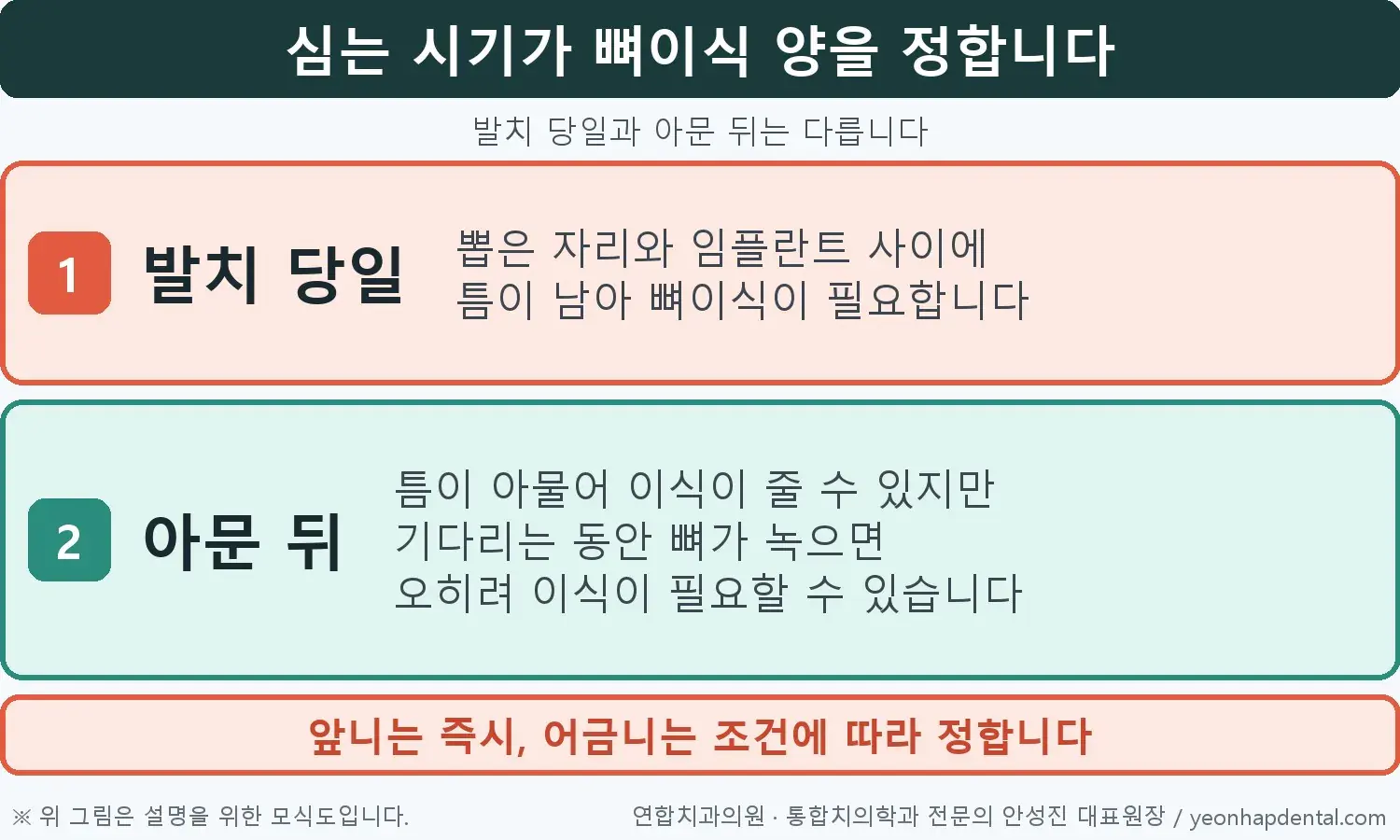
Infographic explaining why the need for a bone graft differs between immediate placement on the day of extraction and delayed placement after healing

The timing of placement decides how much graft is needed

With immediate placement on the day of extraction, a gap remains between the extraction socket and the implant, so a bone graft is needed. With delayed placement after healing, the gap heals and the amount of graft may decrease, but if the cheek-side bone resorbs while waiting, a graft may actually be needed. For front teeth we use immediate placement to protect the cheek-side bone, and for molars we decide the timing by looking at infection and bone condition.

Before Visit

Helpful details before your visit

If you let us know the items below at your first visit, we can explain on the same day whether a bone graft is needed at each site.

  • Which site the missing tooth, or the tooth to be extracted, is in
  • When the tooth was extracted and whether there was infection at the extraction site
  • Names of medications you are taking (osteoporosis drugs, anticoagulants, diabetes medication)
  • The area and symptoms that bother you most right now

Reference numbers by site, Yeonhap Dental Clinic

Front teeth: place the implant toward the palate and fill the cheek-side gap with graft material to create 2 mm of cheek-side bone. This is one part of immediate placement. Lower molars: 2 mm above the nerve canal is the standard, and if 2 mm cannot be achieved, we use a 5.0 mm diameter, 4-6 mm length short implant. There is effectively no bone graft. Upper molars: if the height to the sinus is under 7 mm, we place an 8.5 mm implant after a sinus lift. This is covered in the sinus lift section. Common: a position that gives 2 mm on the cheek side and 1.5 mm on the tongue side is sought only within the cheek-to-tongue width of the opposing tooth; if it is outside that, a graft is done.

Bone grafts by site: the criteria Yeonhap Dental Clinic uses to tell them apart

A bone graft is not one single thing. For front teeth it is one part of immediate placement, for lower molars it is a short implant, and for upper molars it falls under the sinus lift section. If shifting the position gives 2 mm and 1.5 mm, no graft is done, but that range is within the width of the opposing tooth. At Yeonhap Dental Clinic, we first sort out which case applies on CT on the first day, and then tell you whether a graft is needed. Basis for keeping 2 mm in front teeth: when the cheek-side bone at placement was under 2 mm, marginal bone loss one year after prosthesis connection was 0.36 mm, greater than the 0.03 mm in the group with 2 mm or more (prospective study of 39 implants, Nohra 2018), and in immediately placed upper front teeth, the proportion in which the gum receded by more than 1 mm is reported as a median of 26% across 8 studies (range 9-41%, 1 to 3 years after placement) (Chen 2014). References: Nohra 2018, 1-year marginal bone loss after prosthesis connection of 0.36 mm in the group with under 2 mm of cheek-side bone versus 0.03 mm in the group with 2 mm or more; prospective pilot with 39 implants · Monje 2023, systematic review of buccal bone thickness and changes in peri-implant hard and soft tissue · Chen 2014, systematic review of esthetic outcomes of immediate placement in front teeth (median 26% gum recession over 1 mm) Treatment results may vary depending on each person's oral condition.

Last updated:

Schedule a consultation by phone or Naver Booking

Leave a few details on our consultation page and we'll get back to you promptly.

Frequently Asked Questions

Q. Is a bone graft always necessary for a front-tooth implant?
For a front-tooth implant, the cheek-side bone is thin, so when the implant is placed on the day of extraction, a bone graft filling the gap on the cheek side comes with immediate placement as one part of it. At Yeonhap Dental Clinic, we fill this gap to create 2 mm of cheek-side bone, and there are few cases in which a front tooth is placed without a bone graft.
Q. Is a bone graft done for lower molar implants too?
For a lower molar implant, 2 mm must be left above the nerve canal, so it is hard to build bone upward, and if 2 mm cannot be achieved, we solve it with a 5.0 mm diameter, 4-6 mm length short implant instead of a graft. At Yeonhap Dental Clinic, we effectively do not perform bone grafts in lower molars, and if the bone is too short, we do not place an implant at that site and change the plan.
Q. I was told I have no bone for an upper molar implant. Do I need a bone graft?
For upper molars, the bone shortage is mostly not a matter of thickness but of the height to the maxillary sinus, so it is covered in the sinus lift section. At Yeonhap Dental Clinic, if the bone remaining below the sinus is under 7 mm, we create height with a sinus lift and then place an 8.5 mm implant; if it is 7 mm or more, we place it without a sinus lift.
Q. Can shifting the implant position always avoid a bone graft?
If shifting the implant position gives 2 mm on the cheek side and 1.5 mm on the tongue side, it can be placed without a bone graft, but how far it can be shifted is limited to the cheek-to-tongue width of the opposing tooth. At Yeonhap Dental Clinic, if the position goes beyond that width, chewing force is applied at an angle, so we do not avoid the graft and do it.