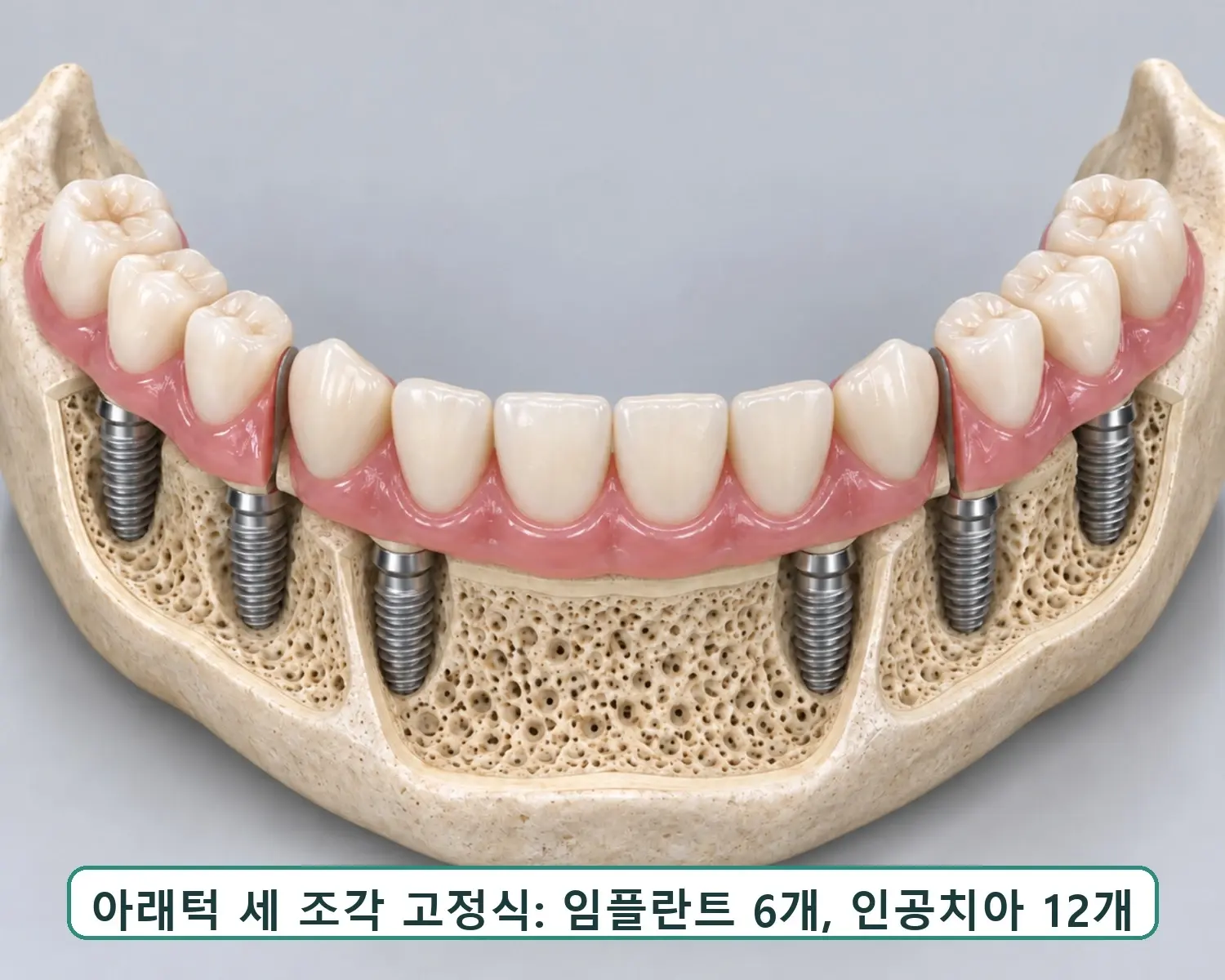
Realistic cross-section diagram of a three-segment fixed prosthesis, with 12 artificial teeth divided into three pieces and fixed on six lower-jaw implants

FULL MOUTH IMPLANT

Full-Mouth Implants, Three Key Points

What is restored, how it differs from partial implants, and how many implants Yeonhap Dental Clinic places and how. These three are the starting point of the plan.

Two Approaches

Full-mouth implants restore the teeth and bite of an entire jaw together

A full-mouth implant is a treatment that restores the teeth and bite of an entire jaw with implants when all the teeth in the jaw are missing or cannot be kept. If the bone allows, Yeonhap Dental Clinic's basic approach is a three-segment fixed prosthesis that divides 12 artificial teeth into three segments, with at least 6 implants in the lower jaw and at least 7 in the upper jaw. Depending on the placement positions, cost, maintenance, and your wishes, we also compare All-on-X and implant-supported dentures.

Three Numbers

What we check at your first consultation

At the first consultation, we look at the three items below on 3D CT and decide whether to go with the basic design or compare other methods.

  • If you have remaining teeth, whether they can be preserved or whether full-mouth treatment is the way to go
  • Whether implants can be placed at the lower-jaw molar sites and upper-jaw front tooth sites, and whether a bone graft is needed
  • Whether to go with a three-segment fixed prosthesis or compare it with All-on-X and an implant-supported denture

In Pictures

Three things for understanding full-mouth implants

What is different, how many are placed, and why it is divided into three segments.

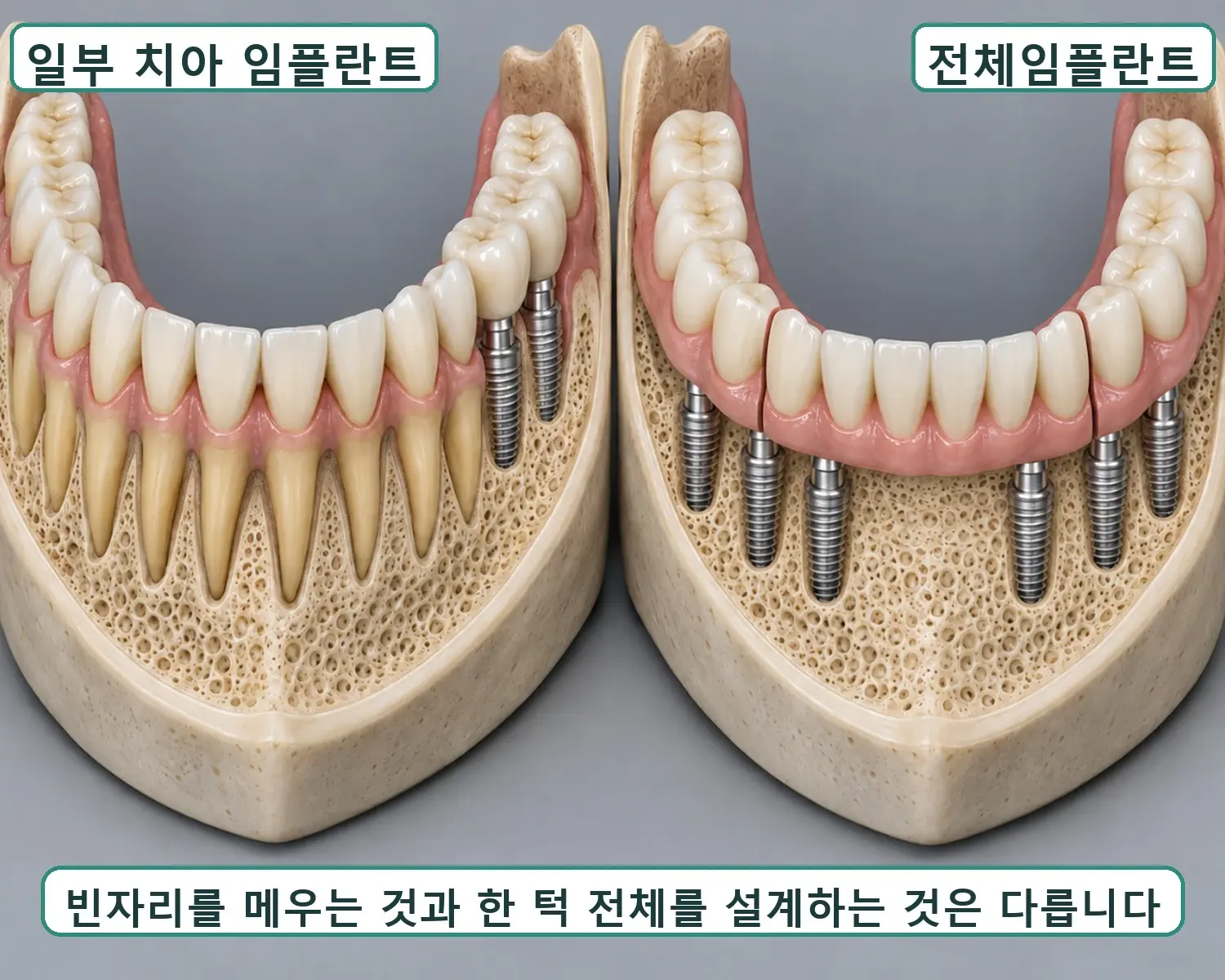
Realistic diagram placing side by side a partial treatment with two implants between remaining teeth and a full-mouth implant restoring an entire jaw with implants

Replacing some teeth is different from restoring an entire jaw

Partial implants fill the gaps between remaining teeth. Full-mouth implants, when a jaw has no teeth or the remaining teeth are hard to keep, design the whole jaw, including the arrangement, bite, and cleaning space. What differs is not the number placed but the extent restored.

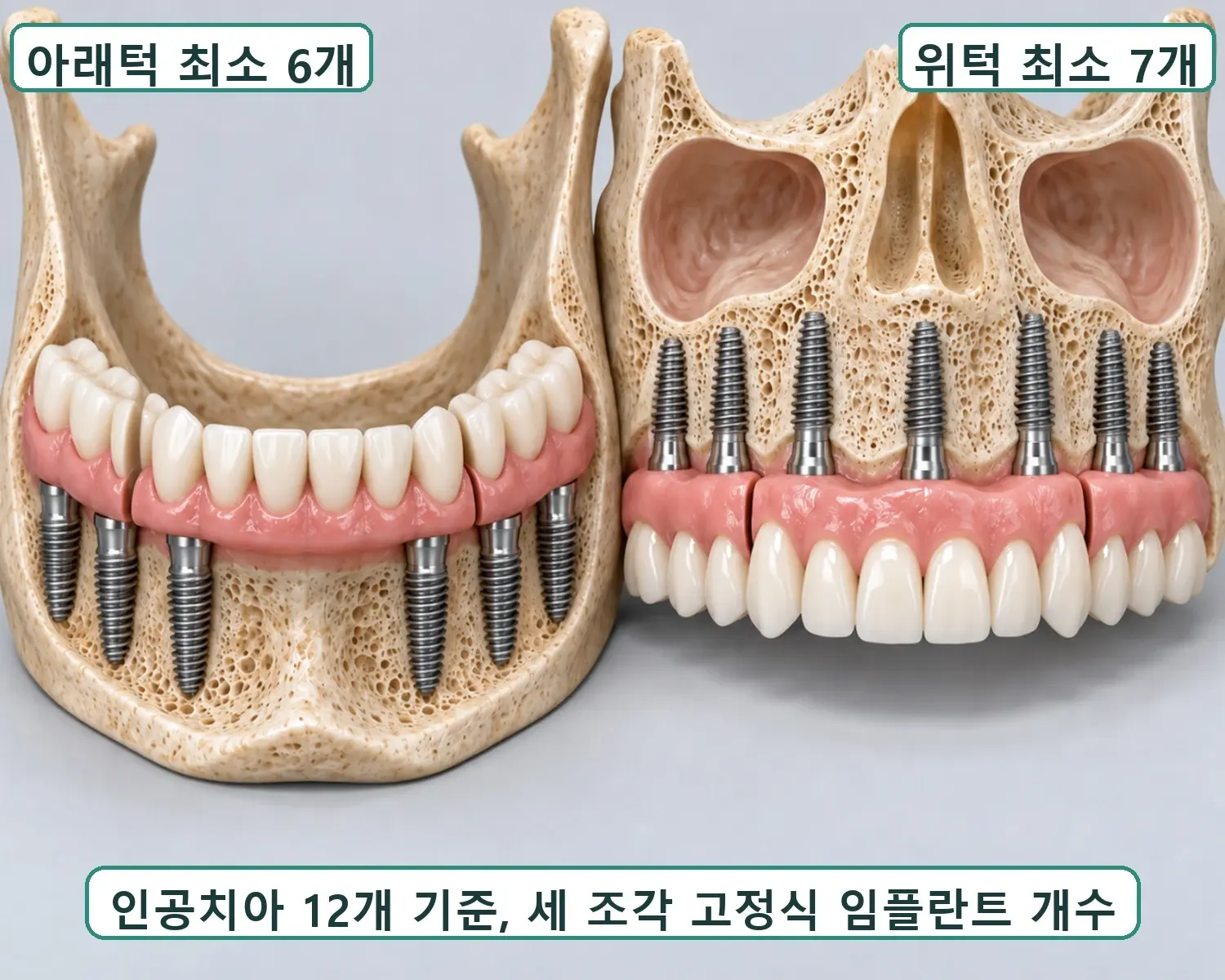
Realistic diagram of Yeonhap Dental Clinic's basic design: 12 artificial teeth each fixed in three segments on 6 lower-jaw implants and 7 upper-jaw implants

How many are placed? The basic design is at least 6 in the lower jaw and at least 7 in the upper jaw

Based on 12 artificial teeth, Yeonhap Dental Clinic places at least 6 implants in the lower jaw and at least 7 in the upper jaw for a three-segment fixed prosthesis. With All-on-X, 4 in the lower jaw and 6 in the upper jaw are used, and a detailed comparison of the two methods is in the Full-Arch Implant (All-on-X) Guide.

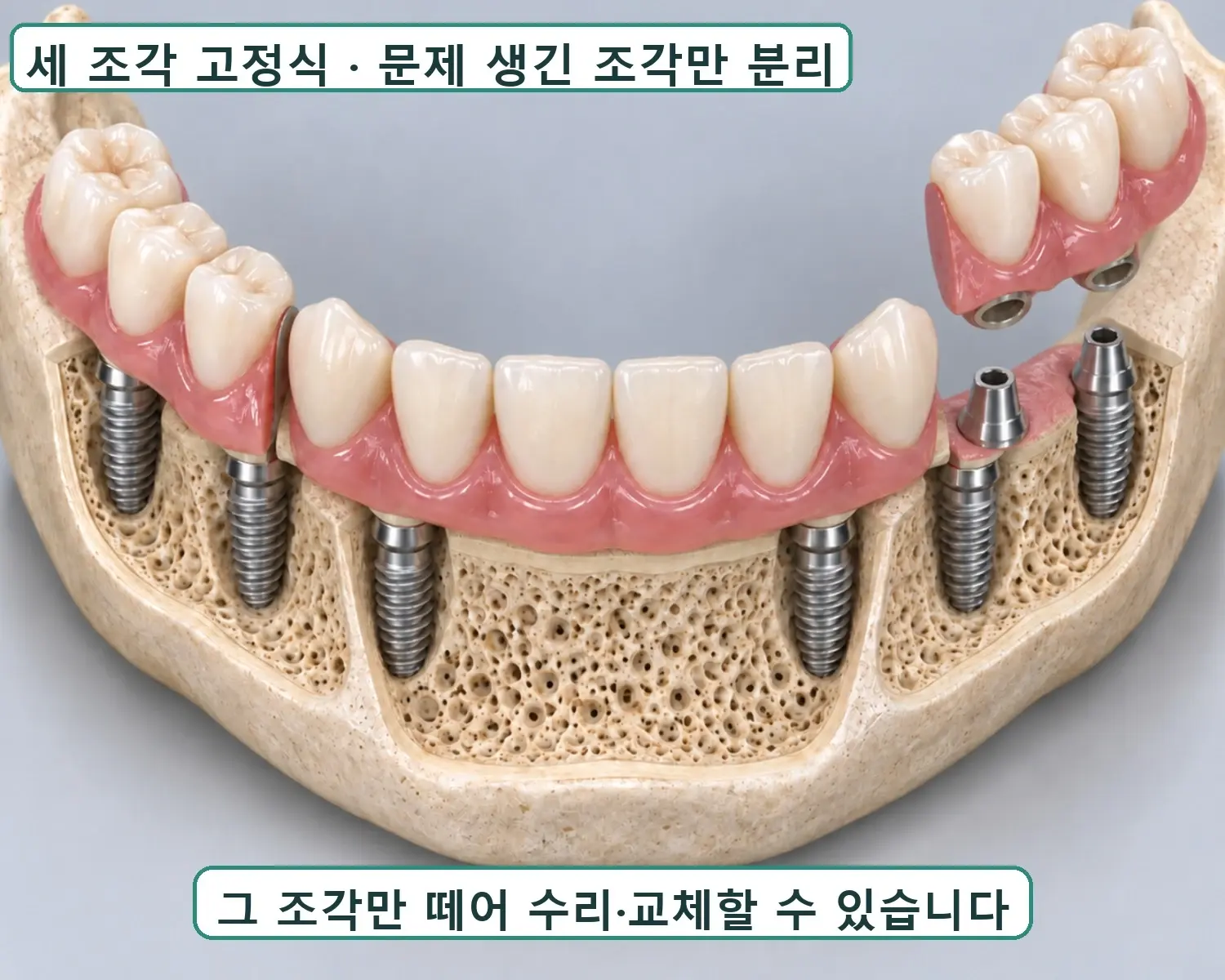
Realistic diagram of a single problem segment of a three-segment fixed prosthesis being detached from the implants and lifted away

Why is it divided into three segments? So that only the segment with a problem is repaired or replaced

The 12 artificial teeth are divided into three segments and fixed: one side's molars, the front teeth, and the other side's molars. If a problem occurs, only that segment can be removed for repair or replacement, so if the bone allows, Yeonhap Dental Clinic first considers a three-segment fixed prosthesis. Depending on bone, cost, maintenance, and your wishes, we also compare other methods.

Twelve First

Why we start with 12, and the overall flow

The conditions for adding the No. 7 teeth, and the flow from consultation to the final prosthesis.

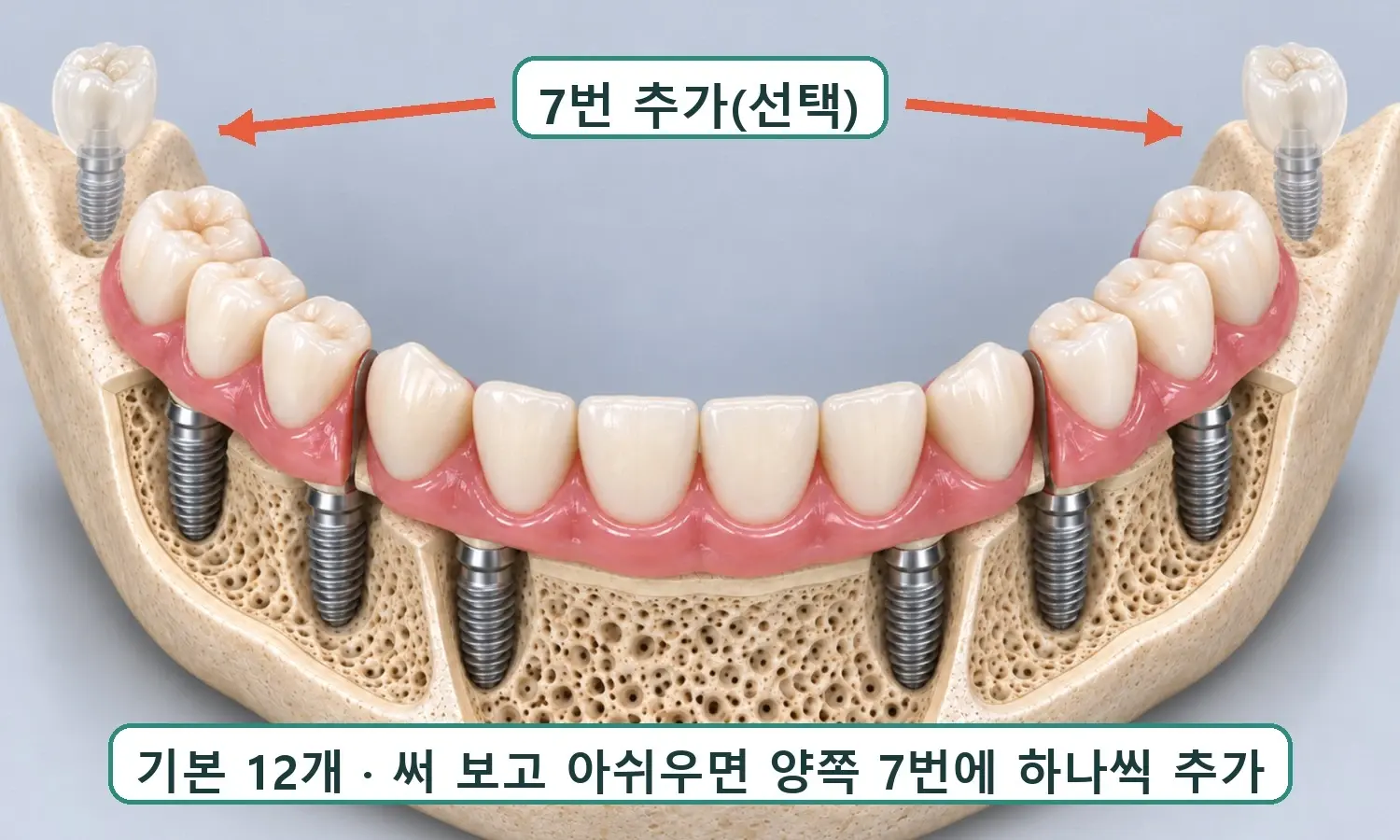
Realistic diagram showing translucent implants and crowns floating at the No. 7 sites on both sides above a lower-jaw three-segment fixed prosthesis of 12 teeth, illustrating the option of adding them

Start with 12, and add the No. 7 teeth later if needed after trying them out

Yeonhap Dental Clinic's three-segment fixed prosthesis is based on 12 artificial teeth up to the first molar (No. 6). If the back feels lacking after using it, we check the placement conditions and add one at each No. 7 tooth (second molar) on both sides, and it can also be designed with 14 from the start.

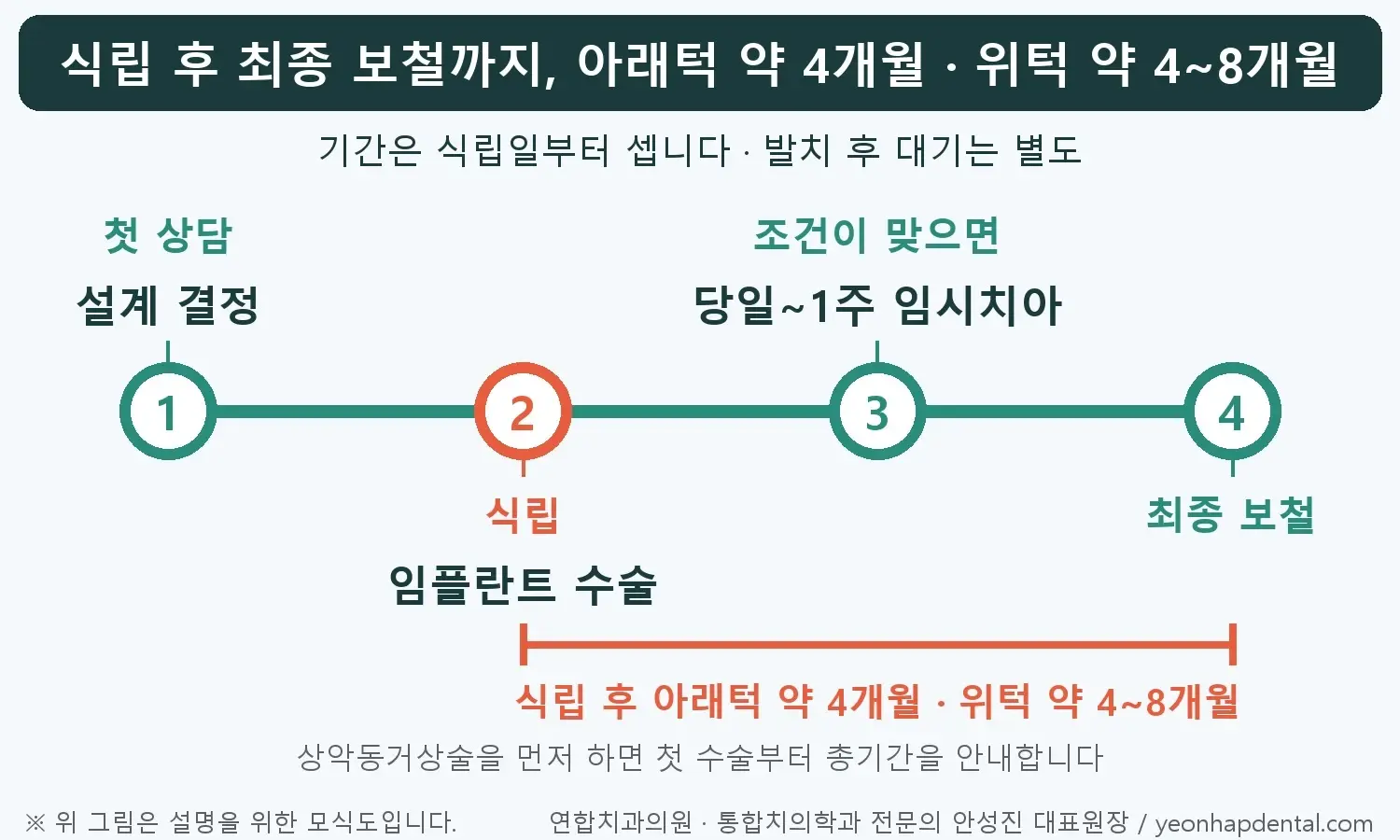
Timeline of the full-mouth implant flow: first-visit design, placement, provisional prosthesis from the same day to 1 week, and about 4 months for the lower jaw and about 4-8 months for the upper jaw from placement to the final prosthesis

Overall flow: about 4 months for the lower jaw and about 4-8 months for the upper jaw from placement to the final prosthesis

We decide the design at the first consultation, and after placement, if conditions allow, we attach a provisional prosthesis within the same day to 1 week. We expect about 4 months for the lower jaw and about 4-8 months for the upper jaw from placement to the final prosthesis. The wait after extraction is separate, and if a sinus lift is done first, we explain the total timeline from the first surgery.

Before Visit

Helpful details before your visit

Bring them if you have them. If not, we will calculate from CT on the first day.

  • The area and symptoms that bother you most right now
  • The denture you currently use and your history of previous prosthodontic treatment
  • Medications you are taking, especially osteoporosis medication and antiplatelet drugs

Full-mouth implants: the criteria Yeonhap Dental Clinic uses

Basic design: A three-segment fixed prosthesis that divides 12 artificial teeth into three segments, with at least 6 in the lower jaw and at least 7 in the upper jaw. For 14 teeth, at least 8 in the lower jaw and at least 9 in the upper jaw. Adding No. 7: With a three-segment fixed prosthesis, you use 12 teeth, and only patients who find it lacking have their placement conditions checked and one implant added at each No. 7 site. In Yeonhap Dental Clinic's experience it is about 1 in 10 people, and even if added later, the total number is the same as if you had gone with 14 from the start. Comparing other methods: When the bone above the nerve canal at the lower-jaw molar sites is under 5 mm, when placement at the upper-jaw front tooth sites is difficult, or when you want to reduce cost, we compare Full-Arch Implants (All-on-X), and depending on NHI coverage conditions and maintenance, an implant-supported denture. Process and timeline: About 4 months from placement to the final prosthesis for the lower jaw and about 4-8 months for the upper jaw. If conditions allow, a provisional prosthesis is attached within the same day to 1 week. Estimates by starting point are in the timeline guide.

The basis and scope of the criteria for full-mouth implants

The number of implants and the plan of 12 as the basis with No. 7 added later are Yeonhap Dental Clinic's standards. The shortened dental arch literature (Kanno 2006) is referred to as background showing that it is not necessary to restore every molar, and it is not direct evidence for Yeonhap Dental Clinic's implant design. The proportion who add No. 7 is Yeonhap Dental Clinic's experience, and NHI coverage for the completely edentulous follows the Health Insurance Review and Assessment Service notice and Ministry of Health and Welfare announcements. For this reason, at the first consultation Yeonhap Dental Clinic first looks at the remaining teeth and implant sites on CT and starts by explaining the basic design of 12. References: Kanno 2006, literature review of the shortened dental arch concept · Health Insurance Review and Assessment Service, recognition criteria for dental implants (Notice No. 2025-23) · Ministry of Health and Welfare, results of the Sept. 8, 2026 Health Insurance Policy Deliberation Committee (expanded dental coverage) The detailed methods for the design by jaw, treatment process, cost, and timeline are in the five guides under the related links below, and the conditions for choosing All-on-X are in the full-arch implant guide. Treatment results may vary depending on each person's oral condition. The applicable methods and course of healing vary from person to person depending on the remaining teeth, bone, and general health.

Last updated:

Schedule a consultation by phone or Naver Booking

Leave a few details on our consultation page and we'll get back to you promptly.

Frequently Asked Questions

Q. How many implants are placed for full-mouth implants?
Yeonhap Dental Clinic's basic approach, based on 12 artificial teeth, is a three-segment fixed prosthesis with at least 6 implants in the lower jaw and at least 7 in the upper jaw. Depending on the sites, cost, and maintenance, we compare All-on-X (4 in the lower jaw, 6 in the upper jaw) and implant-supported dentures, and the difference in number comes from the design approach and the remaining bone.
Q. How are partial implants different from full-mouth implants?
Partial implants fill gaps between remaining teeth, whereas full-mouth implants design the tooth arrangement, bite, prosthesis support, and cleaning space for an entire jaw. Even All-on-4 restores the whole jaw with 4 implants, so Yeonhap Dental Clinic distinguishes them not by the number of implants but by the extent restored.
Q. Do full-mouth implants have to include all the way to the No. 7 molar?
Yeonhap Dental Clinic's three-segment fixed prosthesis is explained as 12 teeth up to the first molar by default, and only patients who find it lacking after using it have their placement conditions checked and one more implant added at each No. 7 site. In our experience it is about 1 in 10 people, and even if added later, the total number is the same as if you had gone with 14 from the start.
Q. If I don't have enough bone, can't I get full-mouth implants?
Depending on the site, we maintain the three-segment fixed prosthesis with a bone graft or sinus lift, or leave that site empty and design All-on-X. Because Yeonhap Dental Clinic compares both methods and even implant-supported dentures, it is rare for bone alone to leave only one option.
Q. Can I find out the cost of full-mouth implants before a consultation?
A figure comes out only after the number of implants, whether a bone graft or sinus lift is needed, and the prosthesis method are decided, so before a consultation we give only a range. At the first-visit CT, Yeonhap Dental Clinic decides these three items and gives you an estimate divided by item, and implants for the completely edentulous are currently not eligible for NHI coverage.