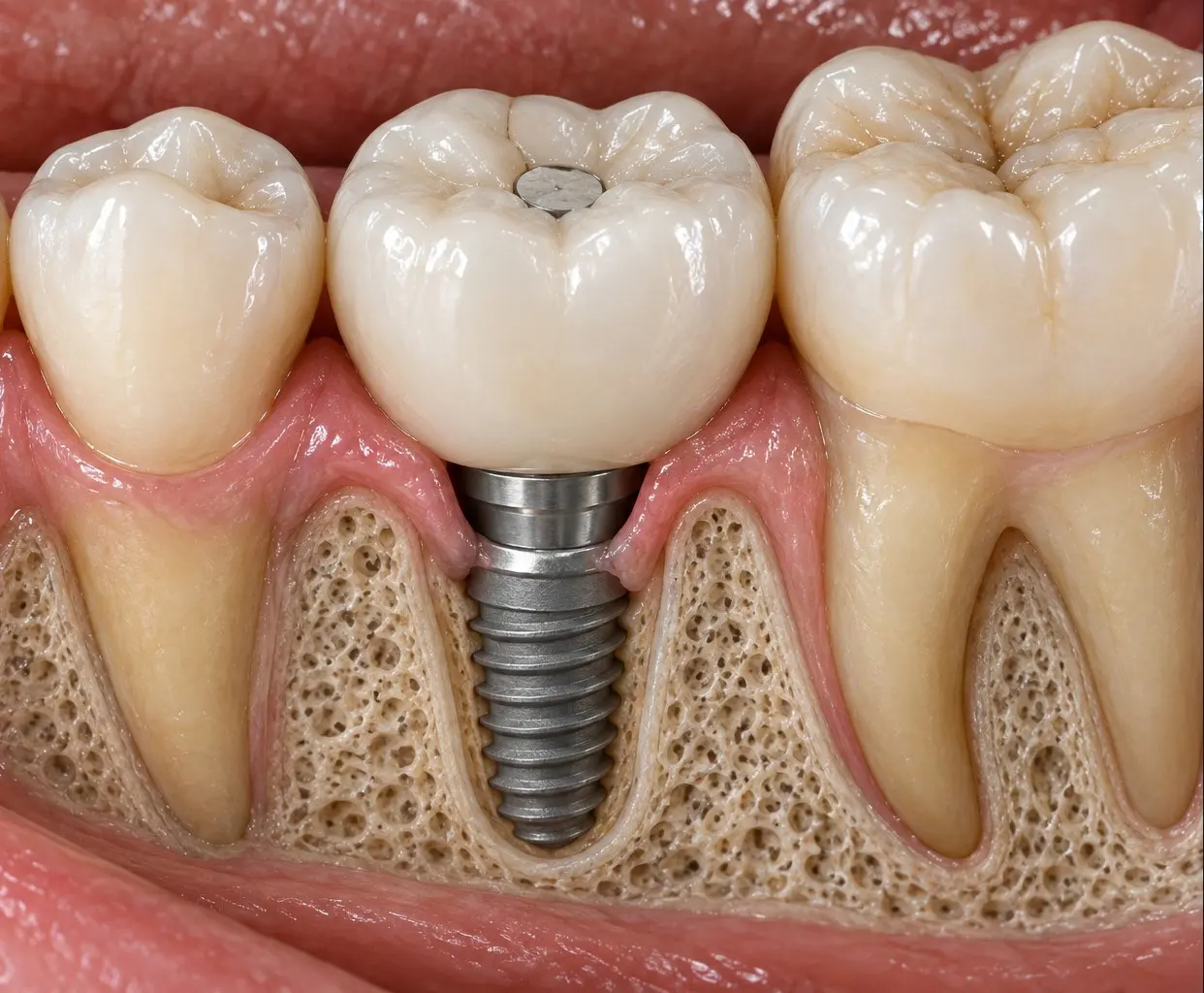
Cross-section diagram of an implant placed in a lower molar site bonded to the jawbone

IMPLANT TIMELINE

Implant Timeline: How Long It Takes Differs by Site

We expect about 3 months for the lower jaw and 4–6 months for the upper jaw from placement to the final prosthesis. The wait after extraction and a sinus lift have different starting points, so at the first consultation Yeonhap Dental Clinic tells you the expected schedule in months.

Why It Takes Months

Looking at the starting point and the end point separately keeps the implant timeline from being confusing

With an implant, the chewing prosthesis is attached after the artificial root has bonded with the bone, so the timeline differs depending on whether you count from the day of placement, the day of extraction, or the day of the sinus lift. At the first consultation, Yeonhap Dental Clinic looks at the site and remaining bone on a 3D CBCT and tells you the expected schedule in months.

Total Time At A Glance

What we check at your first consultation

At the first consultation, we look at the site and the CBCT and decide which of the following applies. The numbers are Yeonhap Dental Clinic's expected schedule, and we also note where each period is counted from.

  • Lower molars and front teeth: about 3 months from placement to the final prosthesis
  • Upper molars: 4–6 months from placement to the final prosthesis. We allow more time where the bone is soft
  • If we cannot place on the extraction day: placement after waiting 2 months for front teeth and more than 3 months for molars
  • Sinus lift: from the first surgery to the final prosthesis, about 4–5 months if the condition is good, about 6–7 months if adaptation to a temporary tooth is needed, and about 7–8 months if done first with placement later
  • Full-mouth implants: about 4–8 months after placement. Varies with bone quality and whether a sinus lift is done

Why That Long

Implant Timeline, Seen from Three Starting Points

The period counted from the day of placement, the period counted from the day of extraction, and the total period counted from the sinus lift are different clocks.

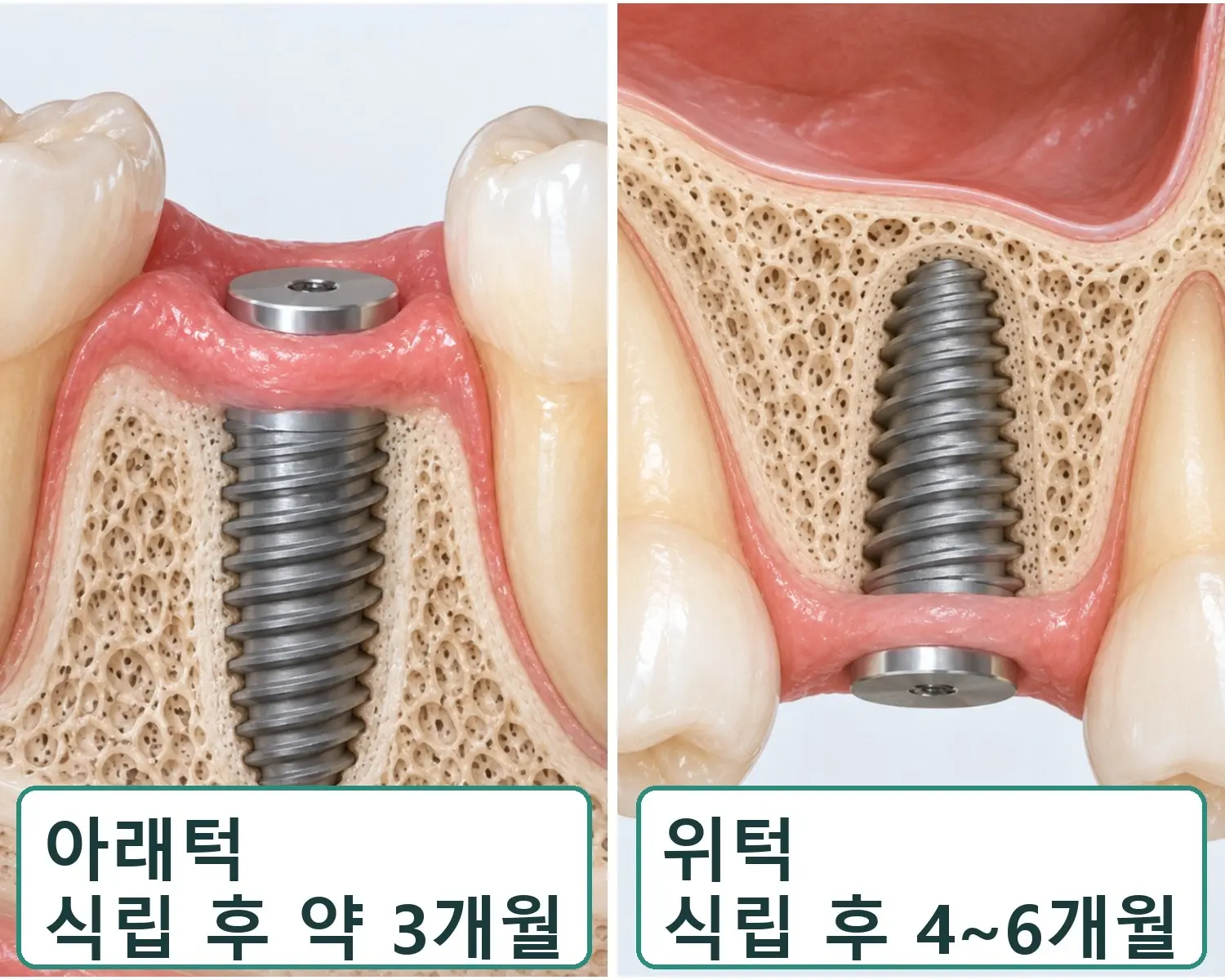
Cross-section comparison of implants placed in the dense lower jaw bone and in the sparse upper jaw bone with the maxillary sinus above it

From placement to the final prosthesis: about 3 months for the lower jaw, 4–6 months for the upper jaw

Lower jaw bone is dense and tends to hold the implant firmly on the day of placement, while upper jaw bone is sparse and has the maxillary sinus above it, so we wait longer. Yeonhap Dental Clinic gives an expected schedule from placement to the final prosthesis of about 3 months for the lower jaw and 4–6 months for the upper jaw.

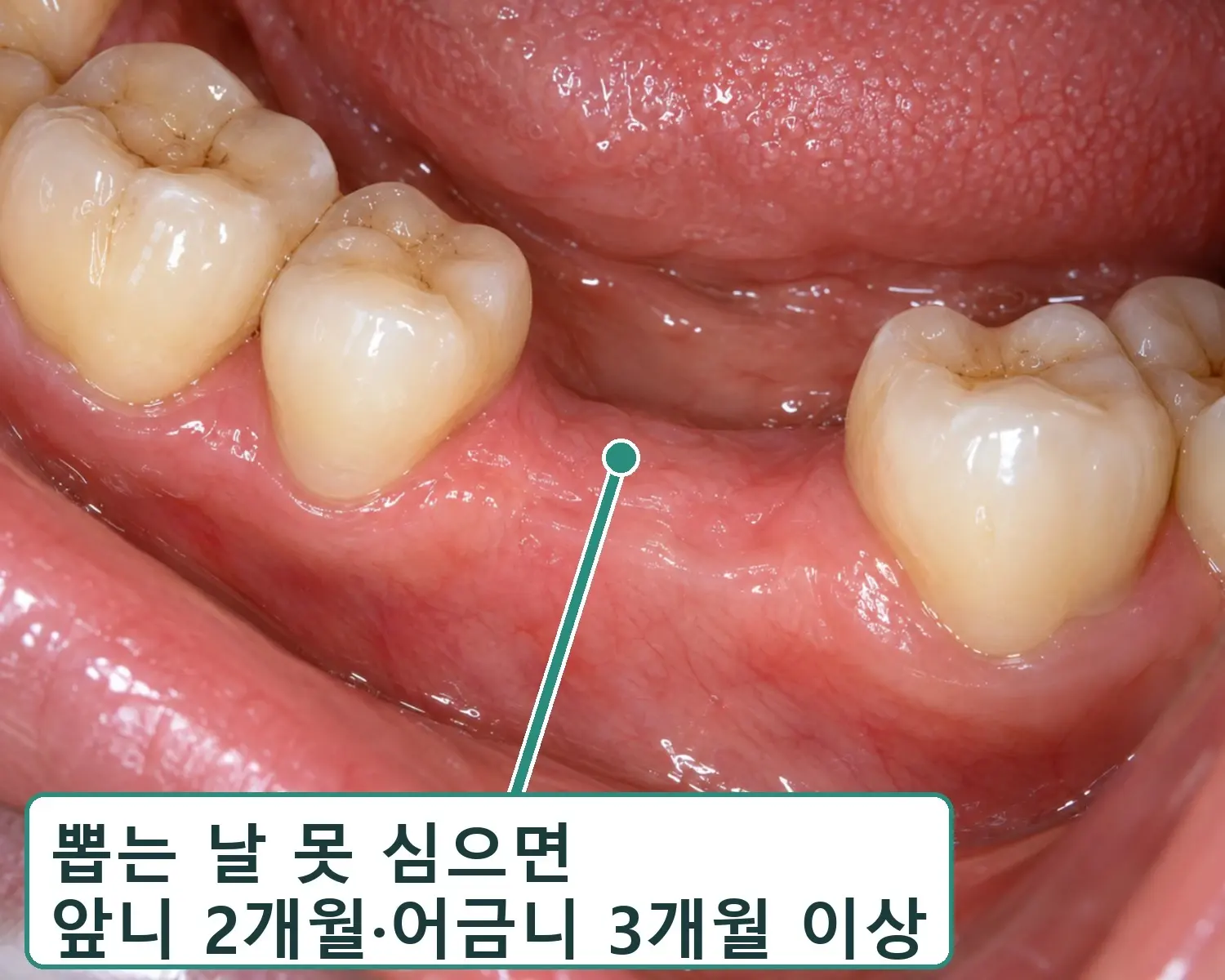
Oral photo showing a site where the gum has healed after tooth extraction

Waiting after extraction: place on the day, or wait

Even with infection, if the socket can be cleanly curetted and stability is achieved, we place on the extraction day. If not, we wait 2 months for front teeth and more than 3 months for molars before placing, and the time for bone bonding is the same. The conditions are in our guide to immediate placement after extraction.

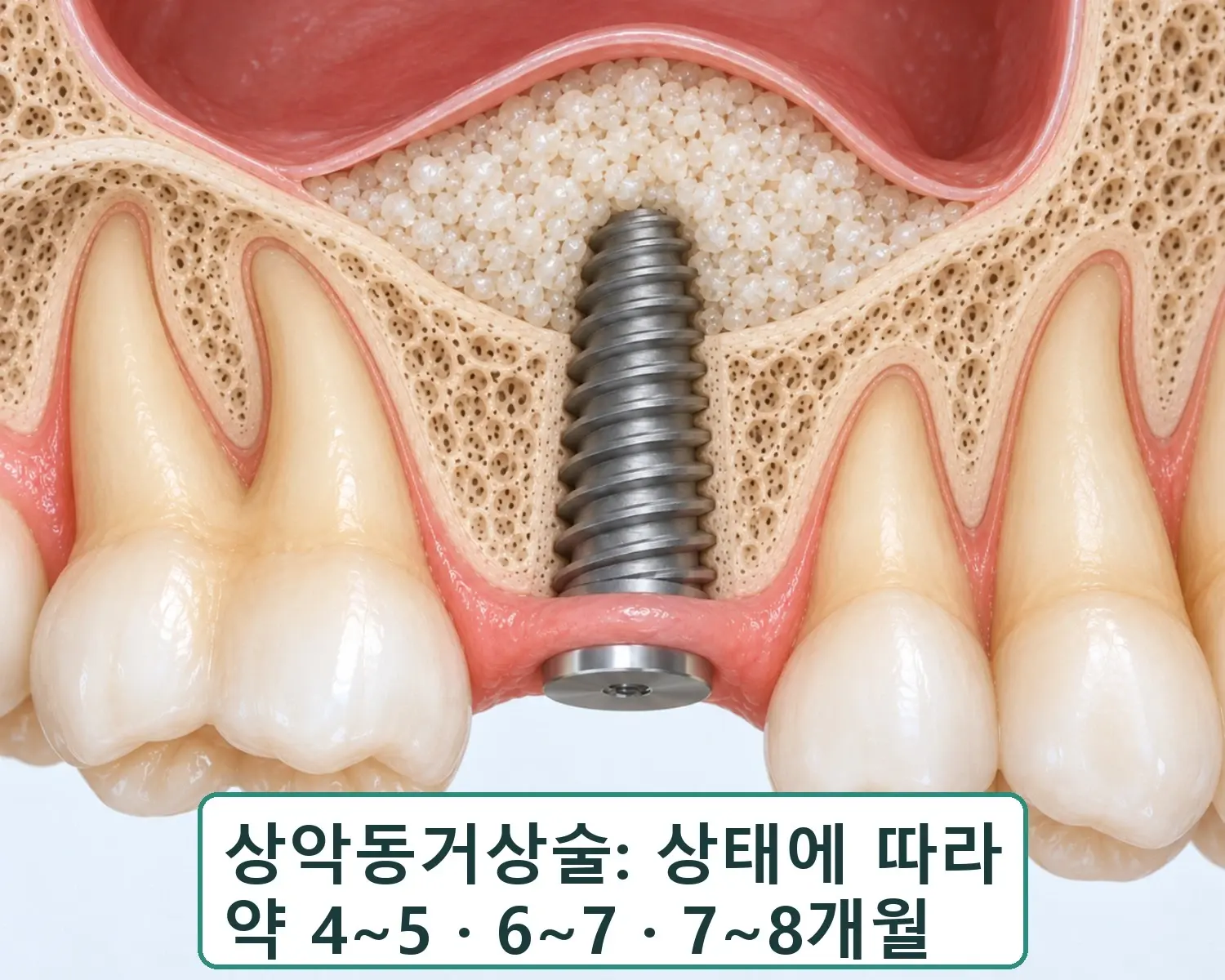
Cross-section diagram of an upper molar in which the sinus membrane was lifted, bone graft material was placed, and an implant was placed on the same day

Sinus lift: the timeline depends on the remaining bone and the stability and healing

With a sinus lift, if the remaining bone and the stability and healing are good, it is about 4–5 months to the final prosthesis, and about 6–7 months if bone formation and adaptation to a temporary tooth are needed. If the sinus lift is done first and the implant is placed later, it is about 7–8 months. This is the total period counted from the first surgery.

What Changes The Total

Typical Situations That Change the Implant Timeline and the Schedule We Explain at the First Consultation

The expected schedule changes depending on the wait after extraction, a sinus lift, and the adaptation process with a temporary tooth.

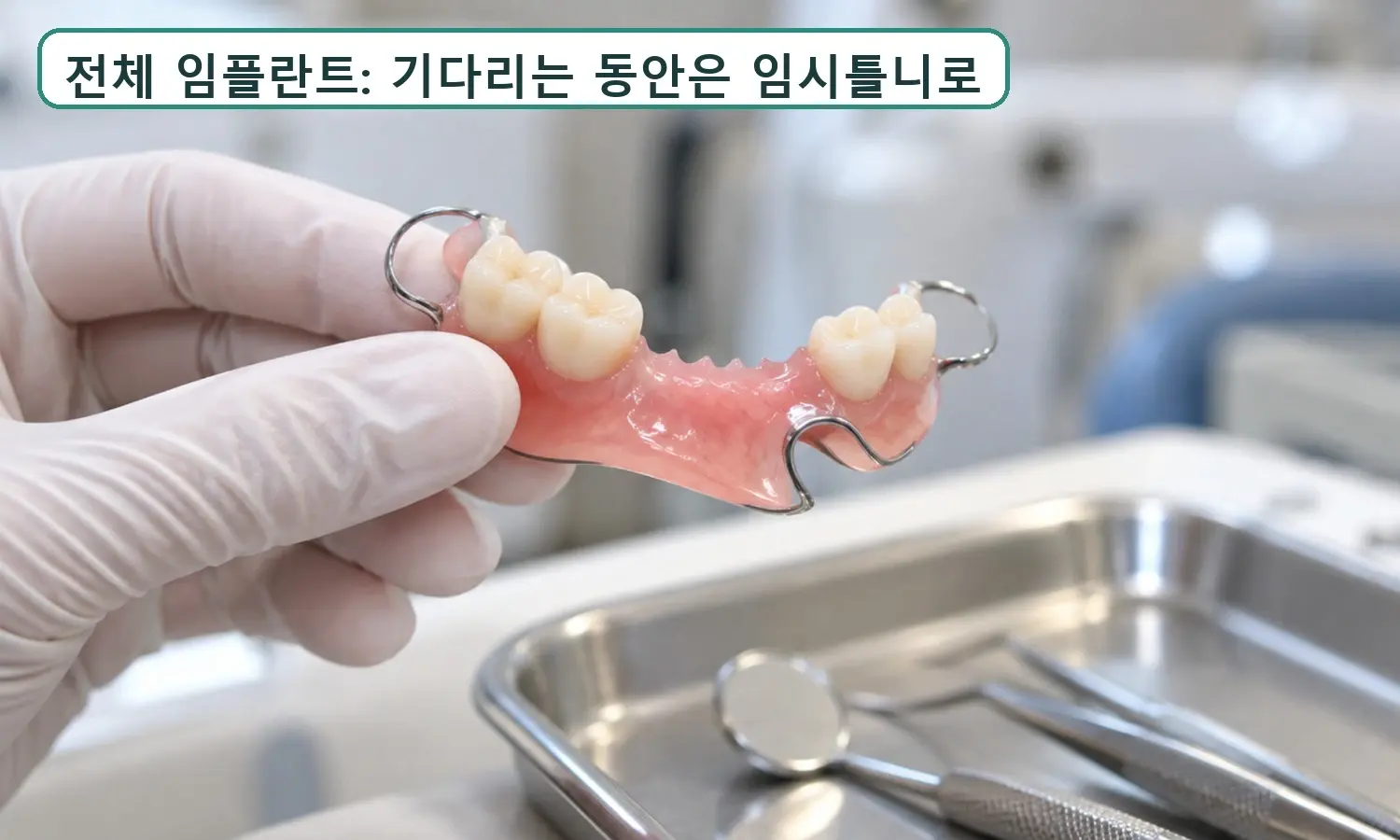
Holding a temporary denture used while waiting during full-mouth implants

Full-mouth implants and reoperation: situations that change the timeline

Full-mouth implants take about 4–8 months from placement to the final prosthesis, depending on whether a sinus lift is done and the adaptation process with a temporary tooth. If you wait after extraction before placing, that wait is added to the front, and the same goes for reoperation. Yeonhap Dental Clinic looks at these conditions together to set the expected schedule.

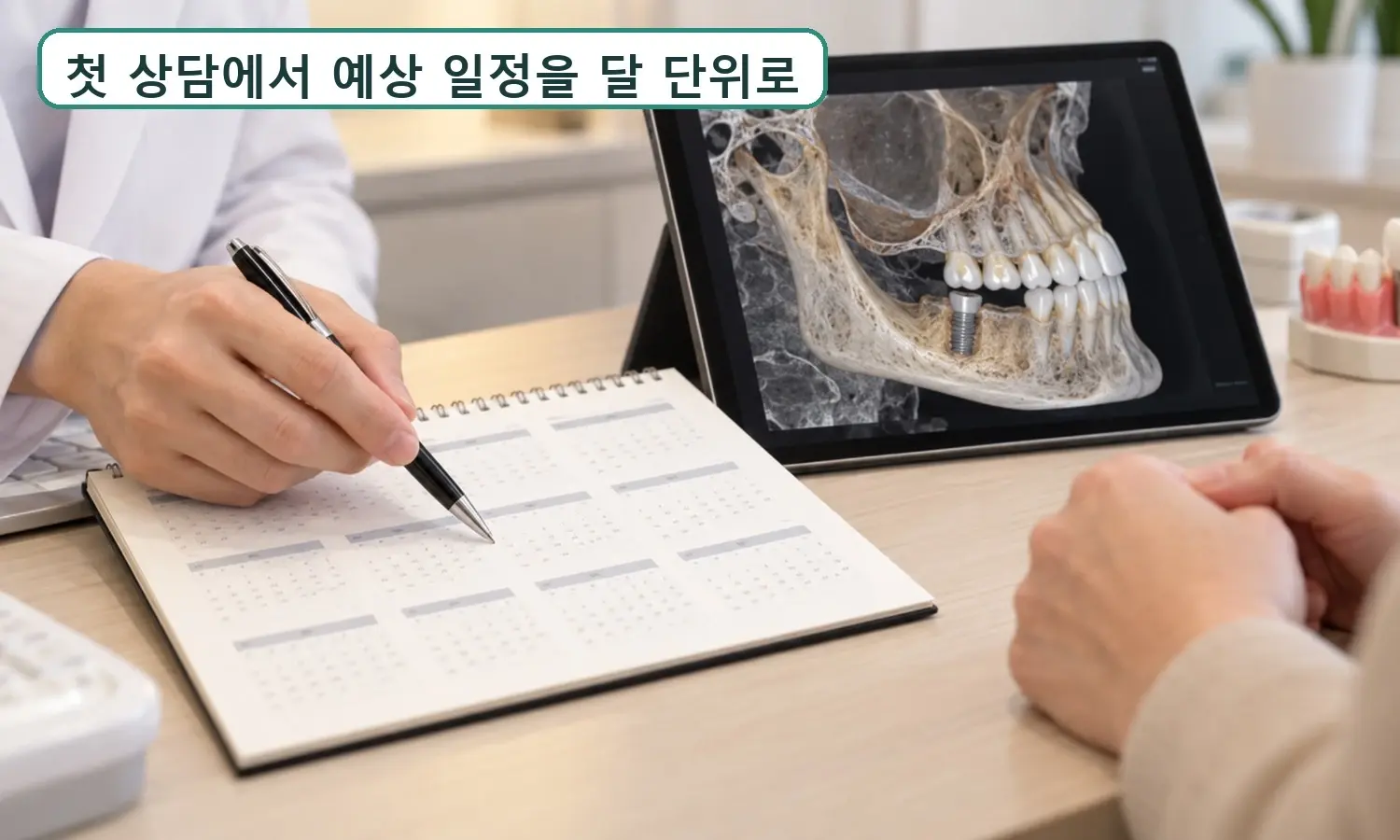
Explaining the expected implant schedule with a calendar in the consultation room

The schedule we explain at the first consultation, and what we check along the way

At the first consultation, Yeonhap Dental Clinic sets the expected schedule in months, and checks infection at 1 week after surgery and, at 1 month, progress such as the periapical X-ray, pain, and pus. If there is no problem, we take the impression as planned; if anything abnormal is seen, we adjust the schedule and explain again.

Before Visit

Helpful details before your visit

If you tell us the points below, we can tell you the expected schedule in months at the first consultation.

  • Whether the missing site is in the upper or lower jaw, and whether it is a front tooth or a molar
  • If the tooth is not extracted yet, whether it has ever swollen or had pus. We gauge whether it can be placed on the extraction day
  • For an upper molar, whether you have ever been treated for sinusitis
  • Whether there are circumstances in which a front tooth cannot be left empty while you wait. We reflect this in the temporary tooth plan

Implant Timeline: Yeonhap Dental Clinic's Expected Schedule

From placement to the final prosthesis: About 3 months for lower molars and front teeth, 4–6 months for upper molars. Waiting after extraction: If we cannot place on the extraction day, we wait 2 months for front teeth and more than 3 months for molars before placing. Reoperation: After removal, we wait about 2–3 months before considering replacement. Sinus lift: From the first surgery to the final prosthesis, about 4–5 months if the condition is good, about 6–7 months if bone formation and adaptation to a temporary tooth are needed, and about 7–8 months if the implant is placed separately after the sinus lift. Full-mouth implants: About 4–8 months after placement, depending on bone quality and whether a sinus lift is done. Interim checks: Infection at 1 week after surgery; at 1 month, progress such as the periapical X-ray, pain, and pus. All are expected schedules and may vary with recovery and prosthesis fabrication.

Implant Timeline: The Evidence and Its Limits

The timing of placement (immediate, early, delayed) and the timing of loading (immediate, early, conventional) are treated separately in the literature (Gallucci 2018), and evidence is summarized as insufficient to establish differences in failure or bone loss by loading timing (Esposito 2013). These papers reviewed clinical outcomes by combination; they did not verify specific schedules such as 3 months for the lower jaw, 4–6 months for the upper jaw, or the schedule after a sinus lift. Buccal bone loss and gum recession are still observed after immediate placement, so we do not explain immediate placement as a way to preserve bone (Chen·Buser 2014). For this reason, Yeonhap Dental Clinic presents the numbers above not as fixed values from the literature but as our own expected schedule, and proceeds to the final prosthesis after waiting the recovery period determined by your condition. References: Gallucci 2018, systematic review of placement and loading timing combinations in partial edentulism · Esposito 2013, Cochrane review comparing implant loading times · Chen·Buser 2014, systematic review of esthetic outcomes of immediate placement Treatment results may vary by individual oral condition.

Last updated:

Schedule a consultation by phone or Naver Booking

Leave a few details on our consultation page and we'll get back to you promptly.

Frequently Asked Questions

Q. How long does an implant usually take?
From placement to the final prosthesis, we expect about 3 months for a lower molar, 4–6 months for an upper molar, and about 3 months for a front tooth. This is because the artificial root needs time to bond with the bone, and upper jaw bone is softer. The waiting period after extraction before placement and the total period counted from a sinus lift are calculated separately, and at the first consultation Yeonhap Dental Clinic looks at the site and remaining bone on a 3D CBCT and tells you the expected schedule in months.
Q. How much longer does an implant take if I have a sinus lift?
If a sinus lift and placement are done on the same day and the remaining bone and the stability and healing are good, we expect about 4–5 months to the final prosthesis; if bone formation and gradual loading adaptation are needed, about 6–7 months. In the latter case, a second-stage surgery is usually done at month 5, followed by about a month with a temporary tooth. If initial stability is not achieved and a sinus lift is done first, the implant is placed about 4–5 months later and the prosthesis is attached about 3 months after that, for a total of 7–8 months. All are total expected periods counted from the first surgery, and may vary with recovery and prosthesis fabrication.
Q. Does placing an implant on the day of extraction shorten the timeline?
If the implant is placed on the day of extraction, the waiting period for the socket to heal disappears, but the time the implant needs to bond with the bone stays the same. If the socket can be cleanly curetted even with infection and stability is achieved in the bone below, we place it on the extraction day; if the conditions are not met, we wait 2 months for front teeth and more than 3 months for molars before placing. Yeonhap Dental Clinic places on the extraction day only at sites that meet the conditions, which are explained in our guide to immediate implants after extraction.
Q. Does immediate loading shorten the time to the final prosthesis?
Immediate loading is a method of connecting a fixed temporary tooth early after placement; at our clinic, its purpose is not to bring forward the final prosthesis but to reduce inconvenience with a fixed temporary tooth while you wait. We do it only when connecting multiple implants that meet the conditions of 4 mm diameter, 8.5 mm length, and 30 Ncm initial stability. This is a different matter from immediate placement, in which one molar is placed on the day of extraction.