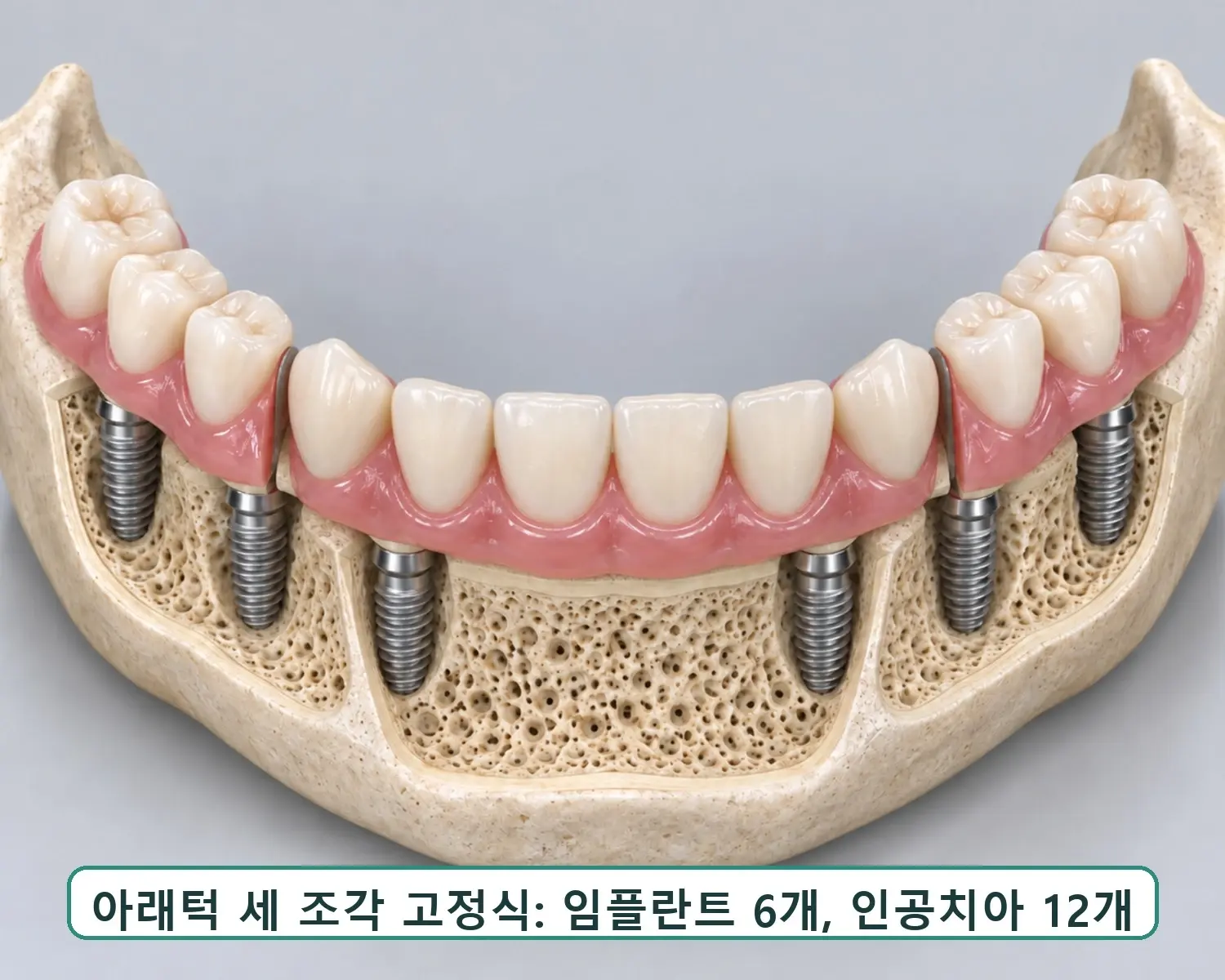
Realistic cross-section diagram of a three-segment fixed prosthesis, with 12 artificial teeth divided into three pieces and fixed on six lower-jaw implants

MANDIBLE FULL ARCH

Lower Jaw Full-Mouth Implants, Three Key Points for Deciding Where to Place Them

The bone above the nerve canal at the molar sites, the bone width at the front tooth sites, and the options when conditions are not met. In the lower jaw, these three decide where to place.

Mandible

Lower Jaw Full-Mouth Implants: The Bone Height at the Molar Sites Decides the Design

A full-mouth implant (also called a total implant) is a treatment that restores the teeth and the bite of an entire jaw. In the lower jaw, basal bone exists at the front tooth sites, so placement is possible in most cases when a bone graft is added, and the bone height remaining above the nerve canal at the molar sites decides the design. Yeonhap Dental Clinic's basic design is a three-segment fixed prosthesis in which at least 6 implants (2 at each molar site and 2 at the canine sites) support 12 artificial teeth, and if the molar bone is insufficient, we consider All-on-4 at the four front sites.

CT Planning

What we check at your first consultation

At the first consultation, we measure the remaining bone and the nerve canal position at each lower-jaw site on 3D CT and decide the design.

  • Molar sites: whether the bone remaining above the nerve canal is 5 mm or more
  • Front tooth sites: whether 2 mm on the cheek side and 1.5 mm on the tongue side remain, and whether a bone graft is needed
  • If even the four front sites are difficult: whether to go with an implant-supported denture after checking the conditions at the two canine sites

Three Things

Three things that decide where to place in the lower jaw

The molar sites, the front tooth sites, and the options when bone is lacking.

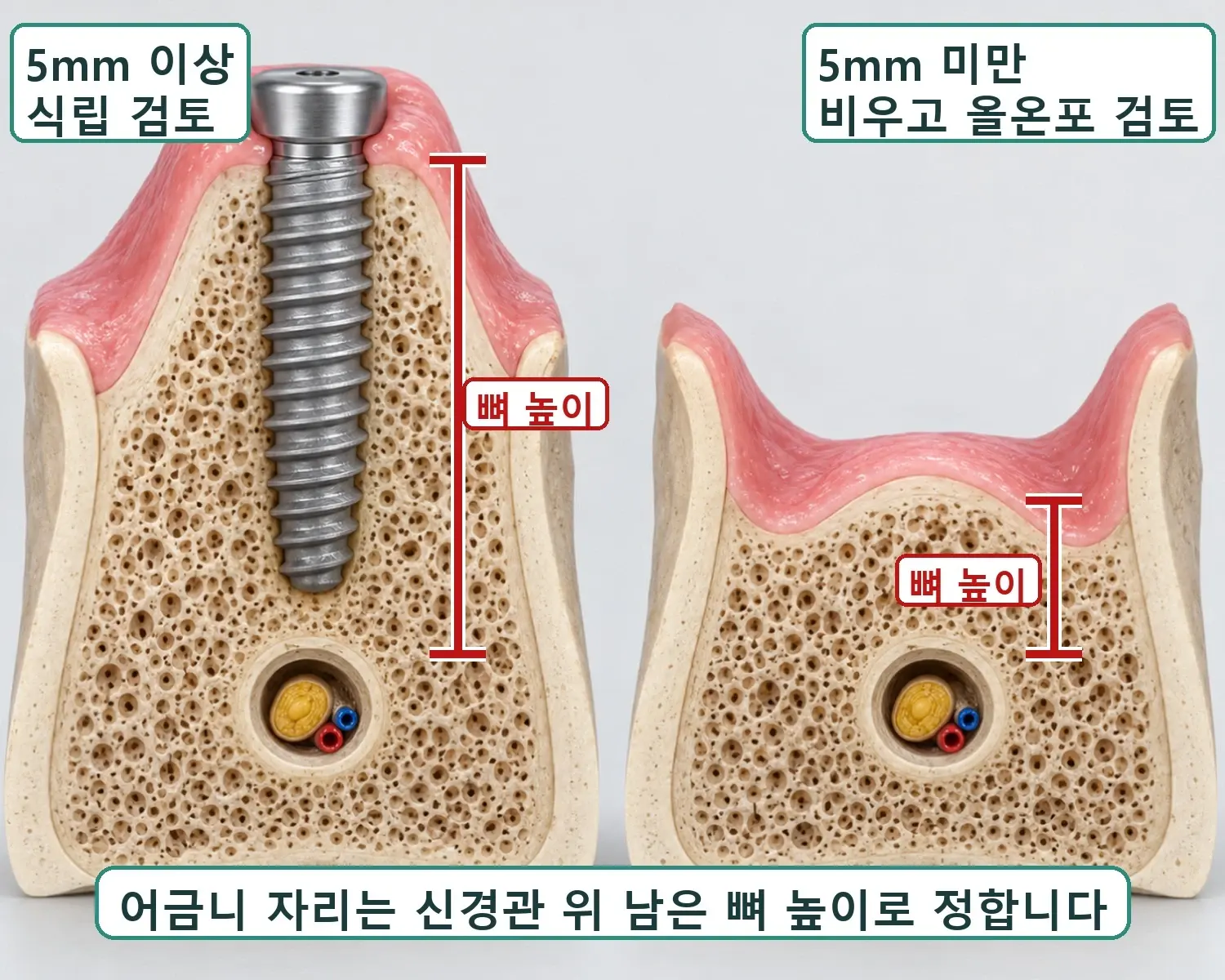
Realistic diagram comparing the bone height remaining above the nerve canal at a lower molar site against the 5 mm reference; below it, not even a short implant is planned, and All-on-4 at the four front sites is considered

Molar sites: placement feasibility is judged by 5 mm of bone above the nerve canal

If the bone above the nerve canal is 5 mm or more, we consider placement while also looking at the width and the position of the nerve. If it is under 5 mm, Yeonhap Dental Clinic does not plan even a short implant at that site and considers All-on-4 at the four front sites.

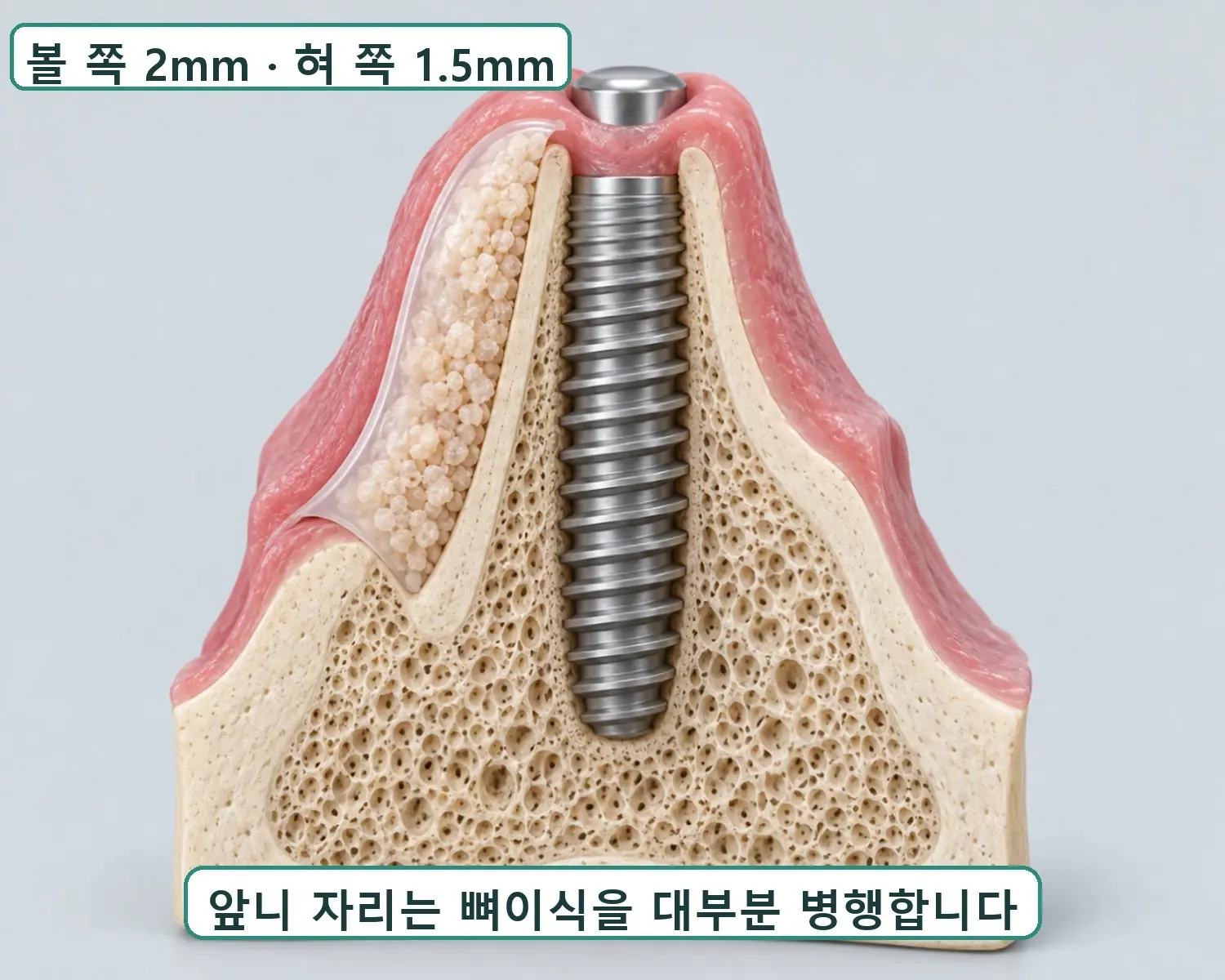
Realistic diagram of a lower front tooth site in cross-section: an implant placed with bone graft material and a barrier membrane added where the cheek-side bone is thin

Front tooth sites: Yeonhap Dental Clinic places implants in most cases with a bone graft

In the lower front tooth sites, basal bone exists, so in most cases an implant can be placed if a bone graft is added. The bone is often narrow and a graft follows; we look for a position that leaves 2 mm on the cheek side and 1.5 mm on the tongue side around the implant, and if that cannot be secured, we graft on the same day.

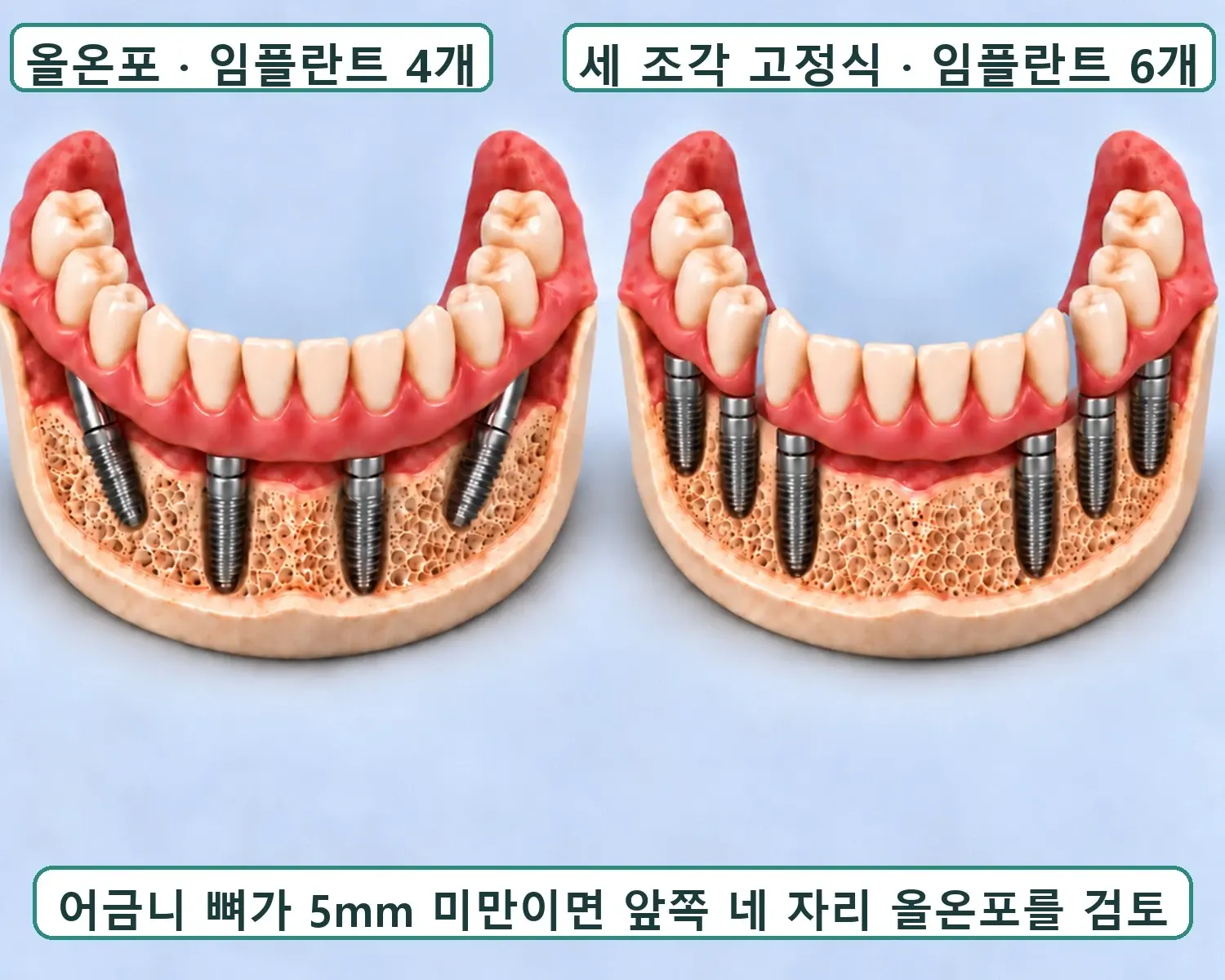
Realistic cross-section diagram comparing, in a completely edentulous lower jaw, a six-implant three-segment fixed prosthesis with a single-piece All-on-4 prosthesis on four front implants

Options: three segments with 6 implants is the basis; All-on-4 if bone is lacking

If the bone allows, we first consider a three-segment fixed prosthesis with at least 6 implants. If the molar bone is insufficient, we consider All-on-4, and if even the four front sites are difficult, we check the conditions at two sites and consider an implant-supported denture. Besides the number of sites, we also take cost, maintenance, and the patient's wishes into account.

Four Months

The provisional prosthesis and timeline for lower-jaw treatment

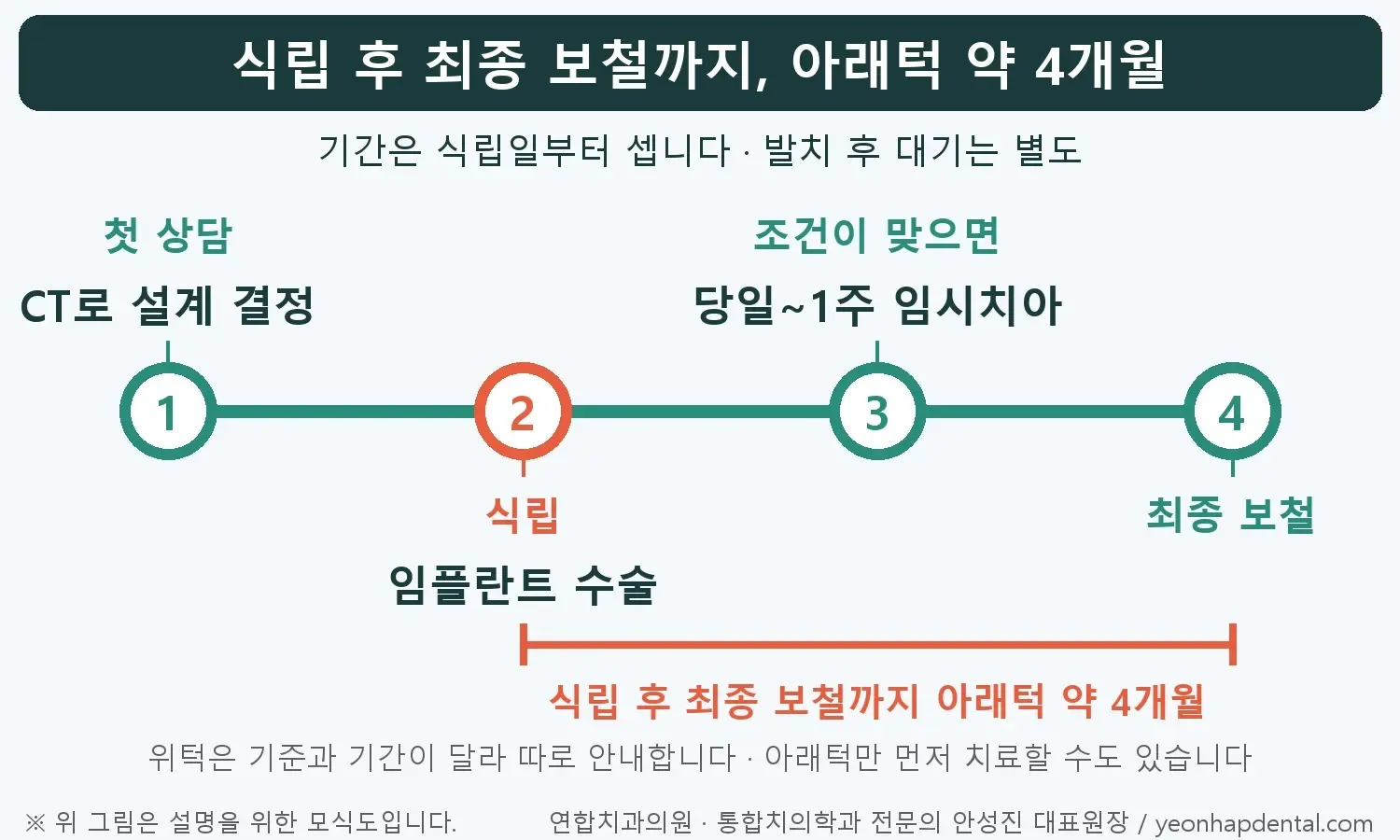
The timeline is counted from the day of placement. The upper jaw has different criteria and timelines and is explained separately.

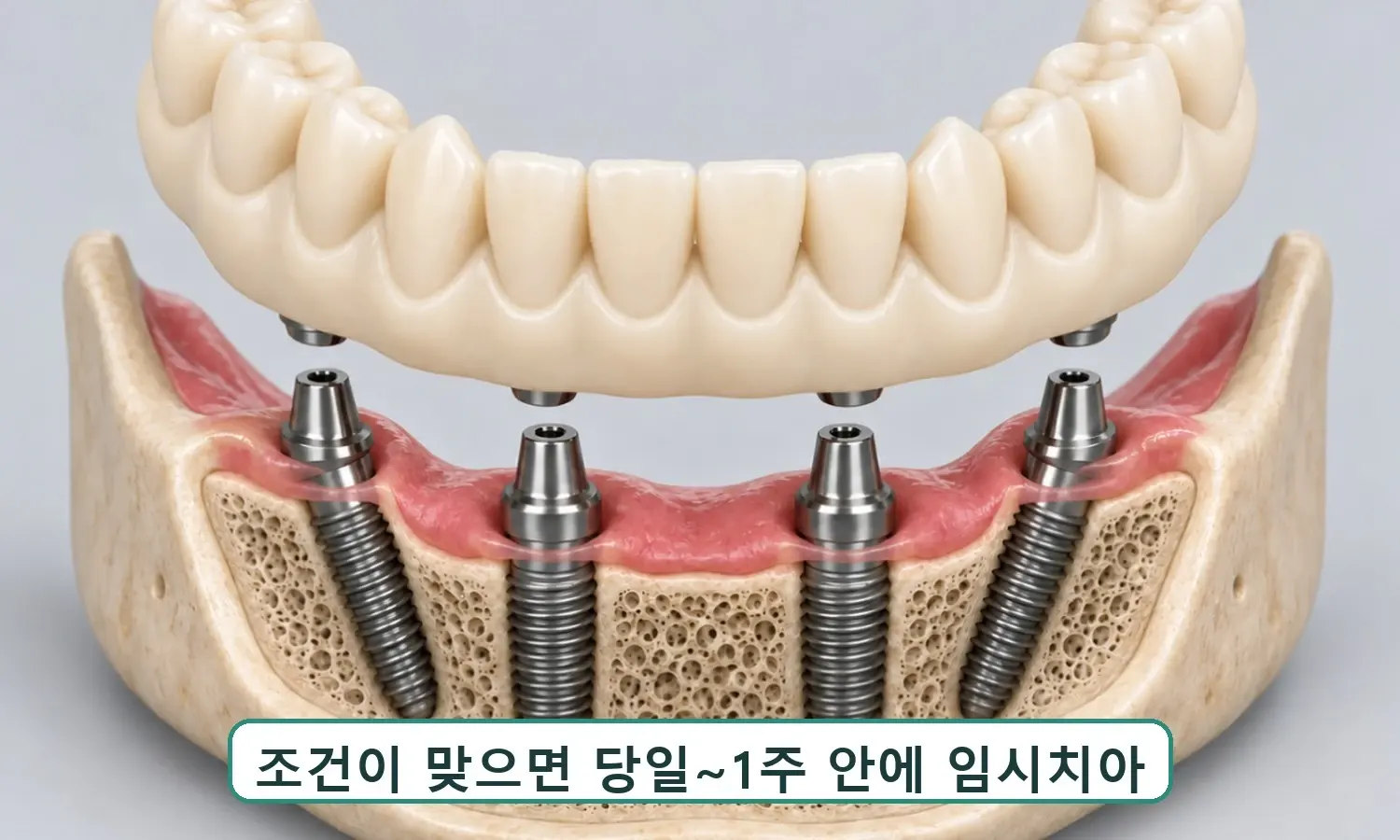
Realistic cross-section diagram of a fixed provisional prosthesis connected to four lower-jaw implants

Provisional prosthesis: the same day to 1 week once four implants meeting the conditions are secured

If four implants with a diameter of 4 mm or more, a length of 8.5 mm or more, and an initial stability of 30 Ncm or more are secured and the connection design is suitable, a fixed provisional prosthesis is attached within the same day to 1 week. Even if six are placed, we select the four that meet the conditions and connect them, and about 90% of lower-jaw full-mouth cases qualified.

Lower-jaw full-mouth implant timeline: first-visit design and placement; if conditions are met, a provisional prosthesis from the same day to 1 week; about 4 months from placement to the final prosthesis

Timeline: about 4 months from placement to the final prosthesis in the lower jaw

We expect about 4 months from placement to the final prosthesis, and the wait after extraction is separate. If conditions allow, we place on the day of extraction; if not, we wait and then place. The lower jaw can be treated first on its own, and because the upper jaw has different criteria and timelines, see the upper-jaw guide.

Before Visit

Helpful details before your visit

Bring them if you have them. If not, we will calculate from CT on the first day.

  • The area and symptoms that bother you most right now
  • The denture you currently use and your history of previous prosthodontic treatment
  • Medications you are taking, especially osteoporosis medication and antiplatelet drugs

Lower-jaw full-mouth implants: the criteria Yeonhap Dental Clinic uses

Basic design: A three-segment fixed prosthesis uses at least 6 implants (2 at each molar site and 2 at the canine sites) to support 12 artificial teeth. All-on-4 supports 12 artificial teeth as a single piece on 4 implants at the four front sites, and No. 7 is not made. Judging the sites: If the bone above the nerve canal at a molar site is under 5 mm, we do not plan even a short implant there and consider All-on-4 at the four front sites. At the front tooth sites, basal bone exists, so placement is possible in most cases when a bone graft is added, and if 2 mm on the cheek side and 1.5 mm on the tongue side cannot be achieved, we graft on the same day. Choice: Even if the bone allows it, you can choose All-on-4 if you prefer, and even if the four front sites are available, an implant-supported denture can be chosen depending on NHI coverage conditions. A comparison of the two methods is in the Full-Arch Implant (All-on-X) Guide. Provisional prosthesis and timeline: If there are four implants meeting the conditions, within the same day to 1 week; if not, you use a temporary denture. It takes about 4 months from placement to the final prosthesis, and the estimates by starting point are in the timeline guide. Whether to place on the day of extraction is judged separately.

The basis and scope of the criteria for lower-jaw full-mouth implants

The number and positions of implants, the 5 mm reference, and the provisional prosthesis specifications are Yeonhap Dental Clinic's own standards. The margin above the nerve canal is 2 mm by default, and our clinic has an exception only for short implants, placing a 4 mm implant at 5 mm of remaining height to leave 1 mm of margin, so a site with less than 5 mm is not planned. This exception is our clinical judgment, not a value verified in the literature; we referred to Soto-Peñaloza 2017 for the All-on-4 treatment concept and Gallucci 2014 for immediate loading conditions. The figure of about 90% is an experience figure from Yeonhap Dental Clinic's lower-jaw full-mouth cases. For this reason, in a lower-jaw full-mouth consultation, Yeonhap Dental Clinic measures the bone height above the nerve canal at the molar sites in millimeters on the first-visit CT, and if six implants are feasible, we recommend the three-segment fixed prosthesis first. References: Soto-Peñaloza 2017, systematic review of the All-on-4 treatment concept · Gallucci 2014, consensus statement on implant loading protocols The upper-jaw implant sites and the plan for treating both jaws together are explained in the related links below. Treatment results may vary depending on each person's oral condition. Which methods are applicable and how healing proceeds vary from person to person depending on the remaining bone and general health.

Last updated:

Schedule a consultation by phone or Naver Booking

Leave a few details on our consultation page and we'll get back to you promptly.

Frequently Asked Questions

Q. How many implants are placed for a lower-jaw full-mouth implant?
Yeonhap Dental Clinic places at least 6 implants for a three-segment fixed prosthesis based on 12 artificial teeth. If the bone at the molar sites is under 5 mm above the nerve canal, we consider All-on-4 with four implants at the front; if the four front sites are difficult, we check the placement conditions at the two canine sites and consider an implant-supported denture.
Q. For a lower-jaw full-mouth implant, which is better, 6 or 4?
If the bone allows, Yeonhap Dental Clinic first considers six implants with a three-segment fixed prosthesis, because only the segment that has a problem can be repaired or replaced. All-on-4 with four implants is a choice made when the bone at the molar sites is insufficient or depending on cost and preference, and we do not consider it weak simply because of the number of implants.
Q. Is the provisional prosthesis for a lower-jaw full-mouth implant attached on the day of placement?
At Yeonhap Dental Clinic, if four implants with a diameter of 4 mm or more, a length of 8.5 mm or more, and an initial stability of 30 Ncm or more are secured and the connection design is suitable, a fixed provisional prosthesis is attached within the same day to 1 week. Even if six are placed, the provisional prosthesis is connected only to the four that meet the conditions. About 90% of our lower-jaw full-mouth cases qualified, and if the conditions are not met, you use a temporary denture in the meantime.
Q. Can I do the lower jaw first for a full-mouth implant?
Yes. We expect about 4 months from placement to the final prosthesis, and the wait after extraction is separate. For the upper jaw, the criteria differ at the front tooth sites and the maxillary sinus, so see the guide to upper jaw implant sites, and for the plan when both jaws are treated together, see the guide to the full-mouth implant treatment plan and process.