Representative illustration for a guide on reducing cost items through planning: a desk with a pen resting on an implant estimate checked off item by item

IMPLANT COST PLAN

Implant Cost A Plan to Reduce Non-covered Items

Implant cost is determined by three variables: number, additional procedures, and type of prosthesis. The plan to reduce those three variables comes before the estimate.

Why Diagnosis Matters

The price of an implant is set first in the plan

Implant cost is determined by three variables: how many are placed, whether a bone graft or sinus lift is added, and what kind of prosthesis finishes the treatment. At Yeonhap Dental Clinic, we decide the three variables on CT on the first day, and sites that meet the criteria are placed without additional procedures. The amounts for each item are in the Non-covered Treatment Fees.

Consultation Checklist

What we check at your first consultation

At the first consultation, we check the items below to decide the three cost variables.

  • The number and sites of missing teeth: how many implants are placed and how many sites are bridged with pontics
  • The width and remaining height of the jawbone: whether a bone graft or sinus lift is needed
  • If you are 65 or older: whether you still have your two NHI-covered implants and where to place them

Treatment Options

Three plans from Yeonhap Dental Clinic to reduce non-covered items

Reduce bone grafts, reduce the number, and use NHI coverage as supports.

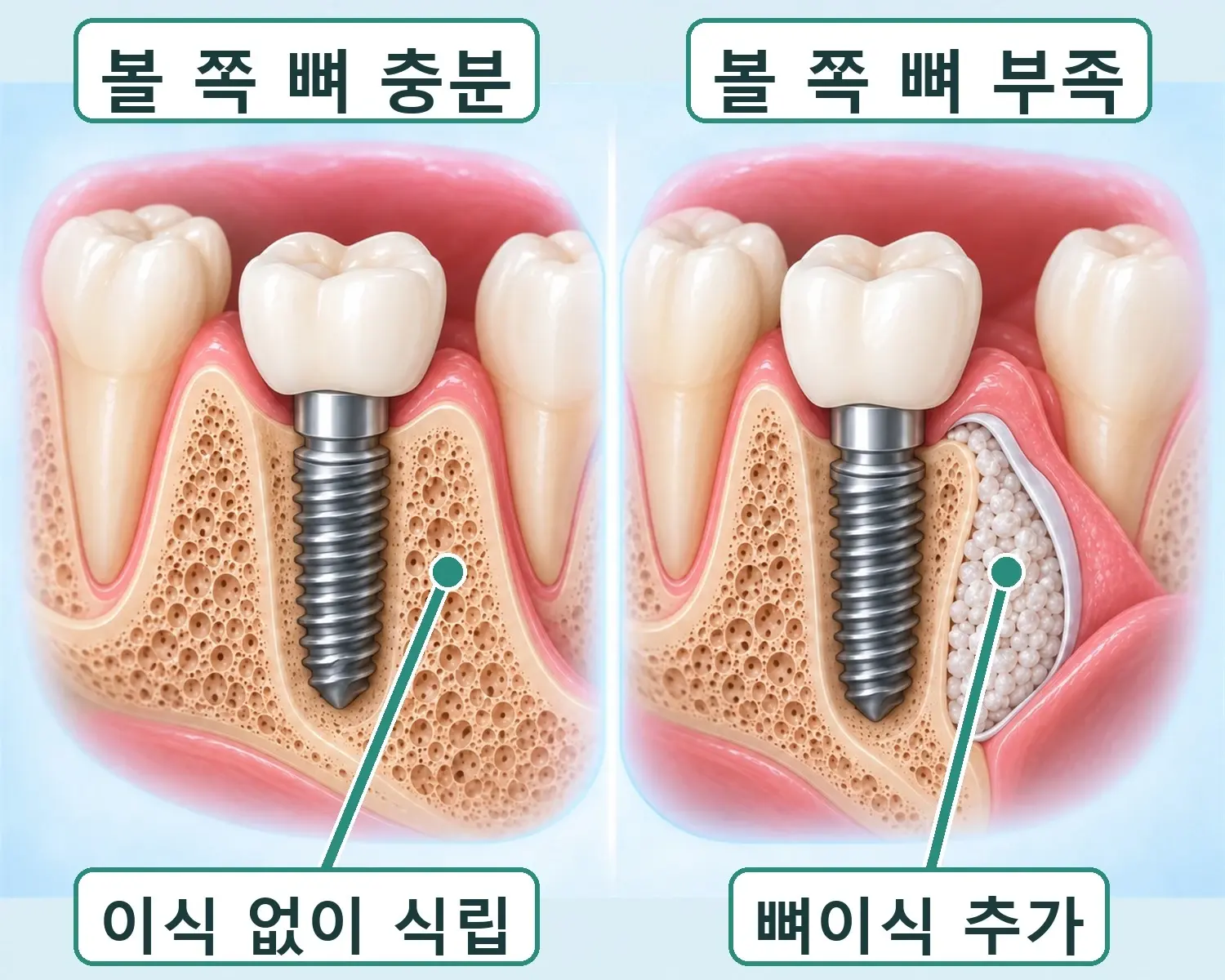
Cross-section diagram comparing placement without a graft when the cheek-side bone is sufficient with placement plus a bone graft when it is lacking

Additional surgery: bone graft and sinus lift only when the criteria cannot be met

At Yeonhap Dental Clinic, if CT shows a site that leaves 2 mm of cheek-side bone and 1.5 mm of tongue-side bone, the implant is placed without a bone graft. For upper molars, if the height to the sinus is 7 mm or more, no sinus lift; for lower molars, if a standard-length implant would not leave a 2 mm margin above the nerve canal, we consider a short implant.

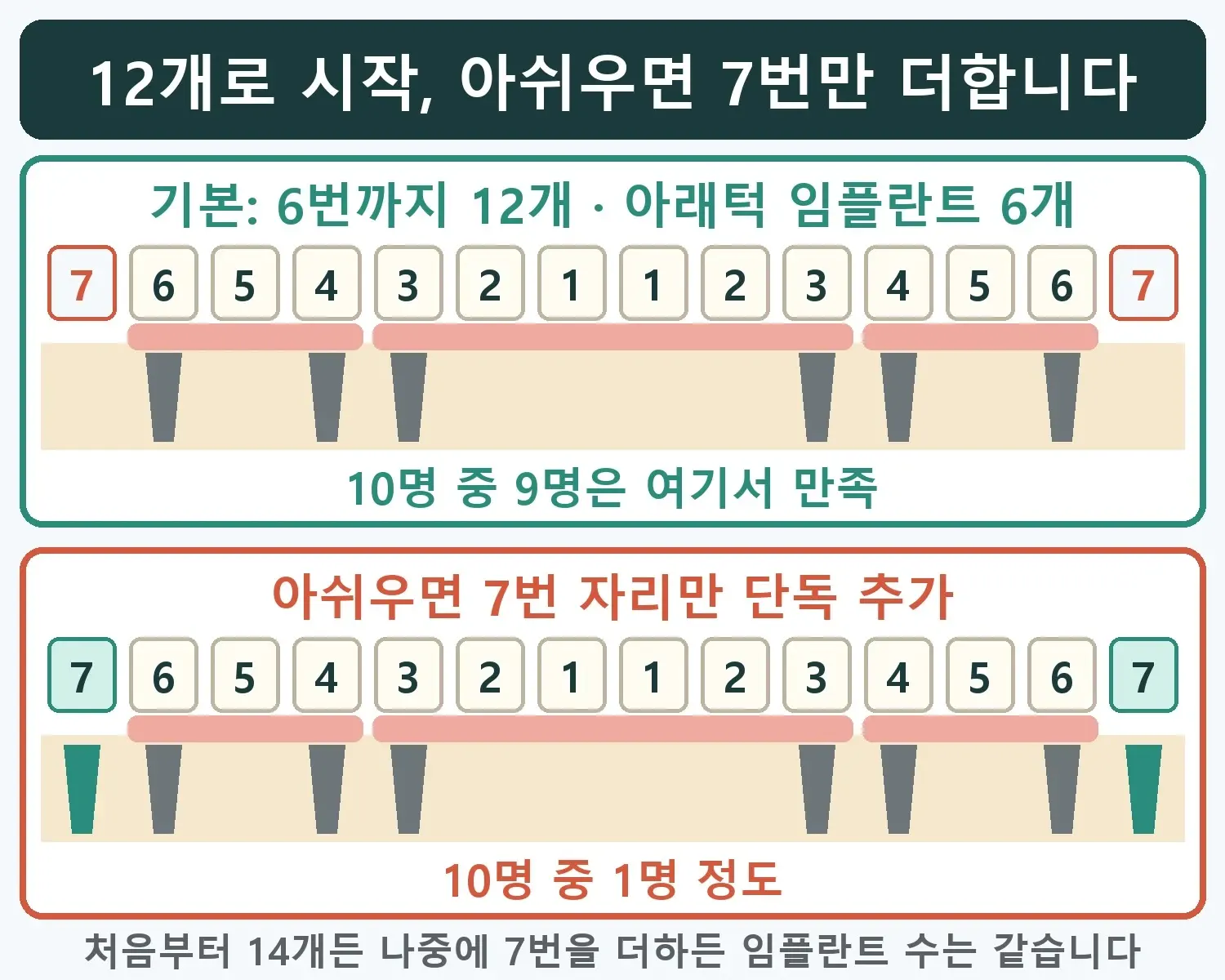
Diagram of a full-mouth implant plan that starts with 12 teeth and adds No. 7 on its own only when needed

For a jaw with no teeth, we start from 12

At Yeonhap Dental Clinic, the basic approach is a three-segment fixed prosthesis that makes 12 artificial teeth up to No. 6 with at least 6 implants in the lower jaw and at least 7 in the upper jaw. If you miss No. 7, only that site is added later, and in practice about 1 in 10 people adds it.

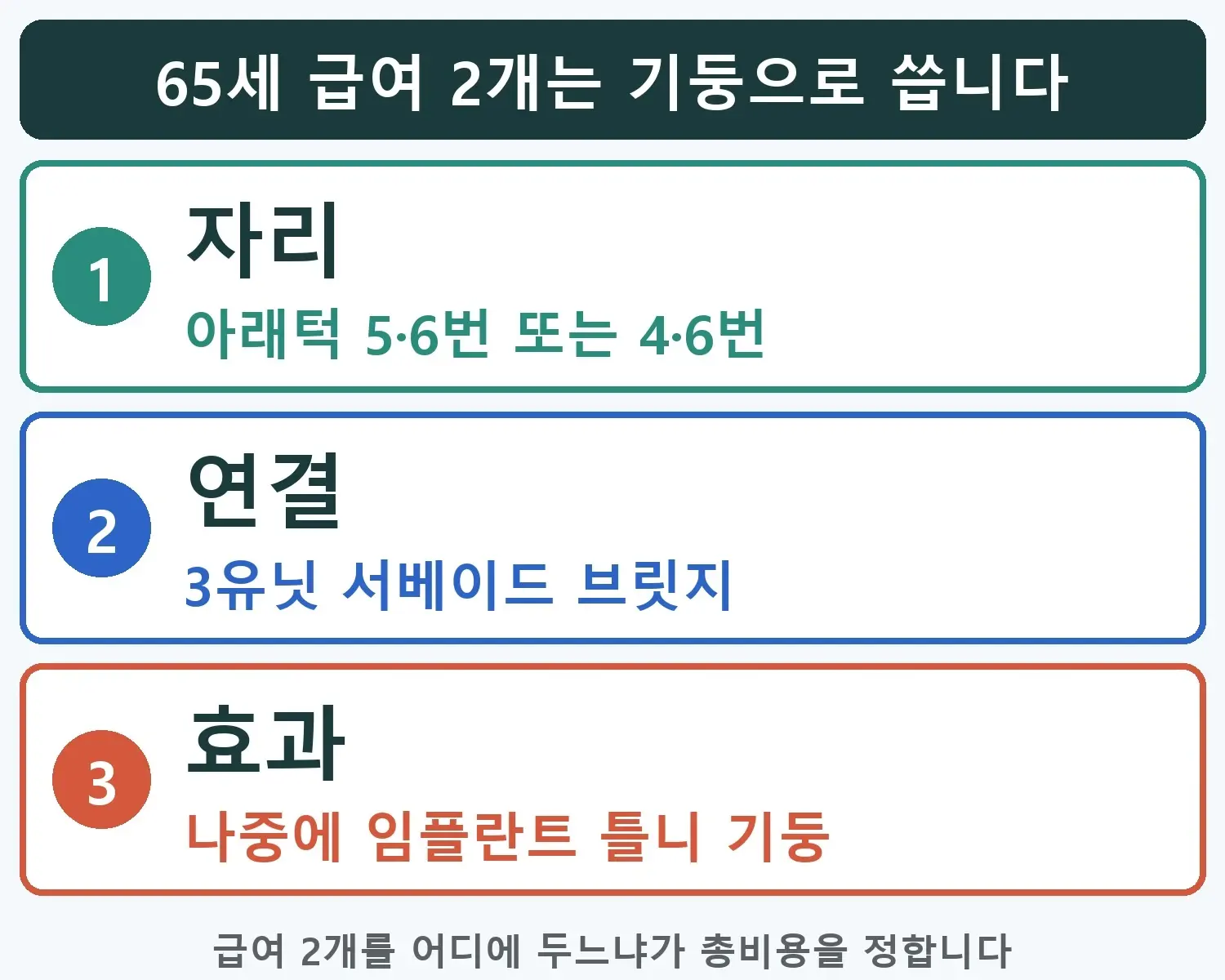
Infographic of placing the two NHI-covered implants at age 65 at the lower-jaw support sites to reduce non-covered costs later

Place the two NHI-covered implants at age 65 where they reduce later cost

For patients aged 65 or older who have some natural teeth remaining and meet the coverage conditions, NHI-covered implants are limited to 2 per lifetime. Yeonhap Dental Clinic places them at lower-jaw teeth No. 4 and 6 or No. 5 and 6 and bridges them, and if the upper molars are missing, places them at the two canine sites on both sides of the lower jaw. These two can be used as the supports of an implant-supported denture.

Planning Points

Two things to know before an estimate

The variables that raise cost, and the conditions under which non-covered items are added.

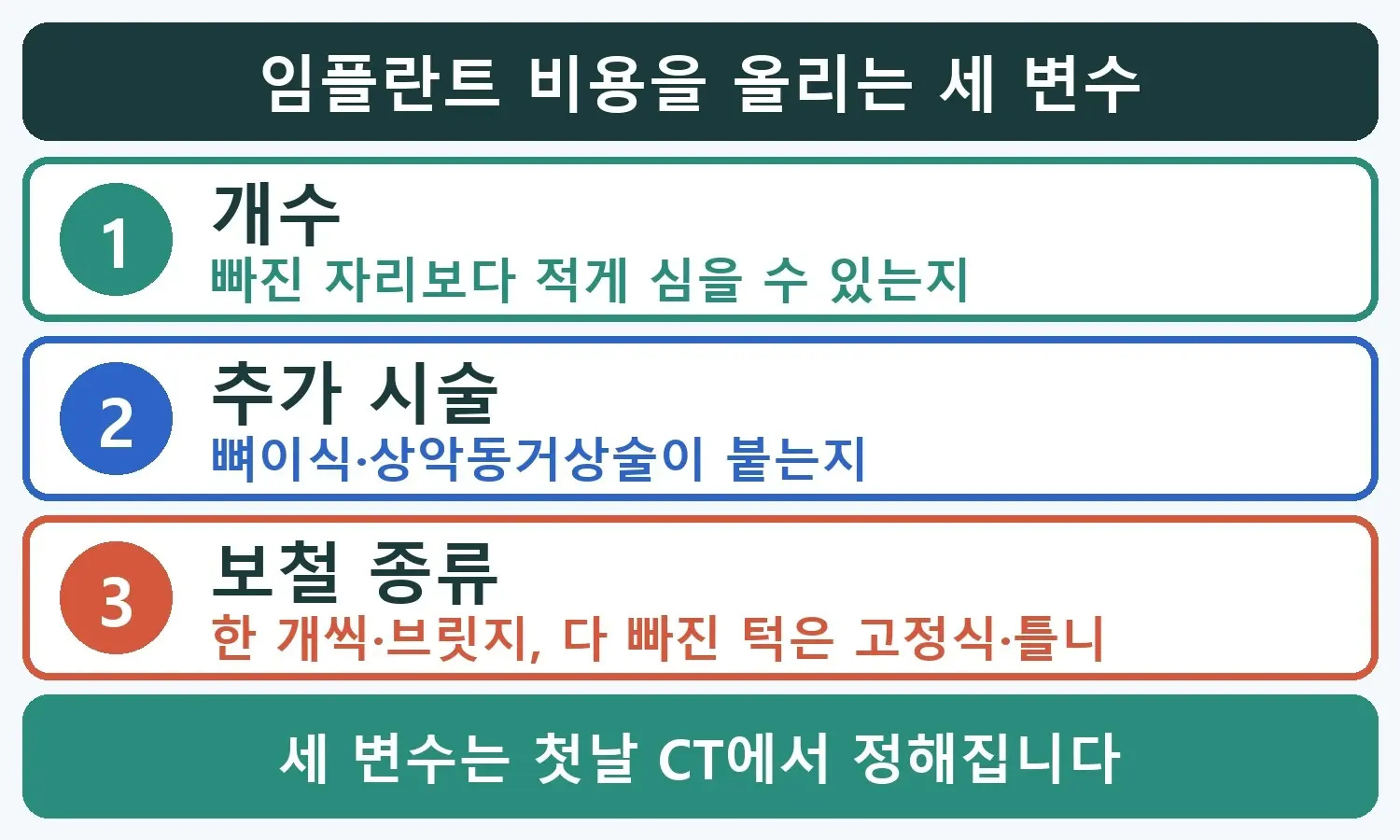
Infographic of the three variables that raise implant cost: number, additional procedures, and type of prosthesis

The variables that raise cost are the number, additional procedures, and the type of prosthesis

It depends on how many are placed, whether a bone graft or sinus lift is added, and whether each tooth gets its own crown or they are bridged with a pontic. For a jaw with no teeth, a choice among a three-segment fixed prosthesis, All-on-X, and an implant-supported denture is added. The three variables are decided on the first-day CT and the bite.

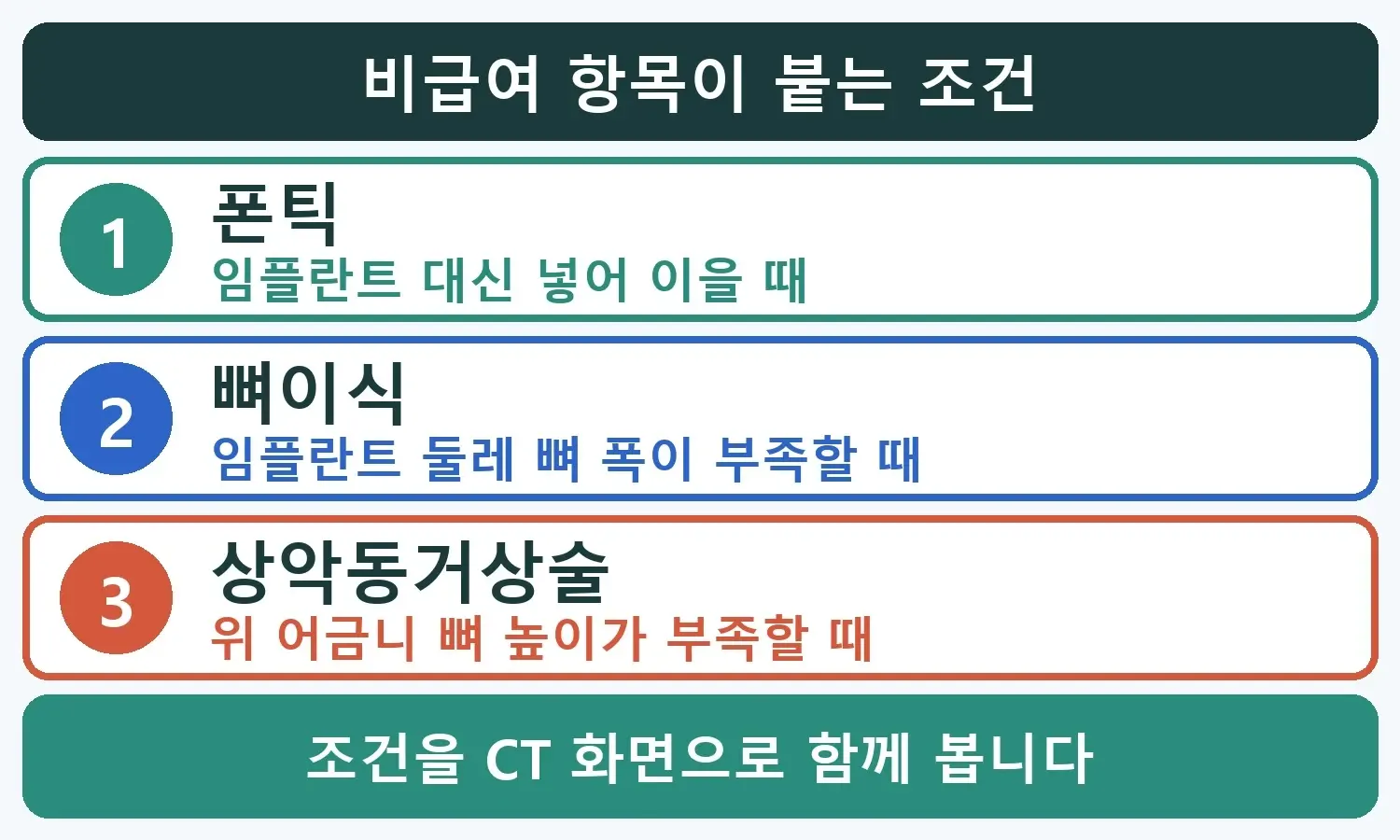
Infographic of the conditions under which pontics, bone grafts, and sinus lifts are added to an estimate

Non-covered items are added only when conditions call for them

A bridge pontic is included in the estimate only when it is used in place of an implant to connect teeth, a bone graft only when bone width is lacking, and a sinus lift only when the bone height of an upper molar is lacking. Yeonhap Dental Clinic looks at these conditions together with you on the CT screen.

Before Visit

Helpful details before your visit

If you let us know the items below at your first visit, you can receive an itemized estimate on the same day.

  • The sites and number of missing teeth, and when they were extracted
  • If you are 65 or older, whether you have already used your two NHI-covered implants
  • Whether you currently use a denture or bridge
  • Names of medications you are taking (osteoporosis drugs, anticoagulants, diabetes medication)

A plan to reduce implant cost: Yeonhap Dental Clinic's criteria

Number: For a partial loss, 2-3 implants for 3 sites and 3-4 implants for 4 sites, with the rest bridged by pontics; for a jaw with no teeth, at least 6 in the lower jaw and 7 in the upper jaw to make 12 teeth. Bone graft: Not done if CT shows a position that leaves 2 mm of cheek-side bone and 1.5 mm of tongue-side bone. Sinus lift and short implants: For an upper molar, if the height to the sinus is 7 mm or more, we place the implant without a sinus lift; for a lower molar, if a standard-length implant would not leave a 2 mm margin above the nerve canal, we consider a 4-6 mm short implant, using a 4 mm implant at 5 mm of remaining height and not planning one below 5 mm. Prosthesis and amount: The type of prosthesis is decided at the first-day consultation, and the base fees are in the Non-covered Treatment Fees.

The basis for implant cost criteria

When the cheek-side bone at placement is under 2 mm, marginal bone loss one year after prosthesis connection is reported to be about 12 times greater, 0.36 mm versus 0.03 mm (Nohra 2018). For upper molars, there is a meta-analysis showing that the difference in survival rate between a short 5-8 mm implant and a long implant after a sinus lift is not large (Fan 2017). For this reason, Yeonhap Dental Clinic keeps the bone criteria, does not add a bone graft when moving the position meets the criteria, and for upper molars considers a short implant first. References: Nohra 2018, buccal bone thickness and 1-year marginal bone loss · Fan 2017, meta-analysis of short implants versus sinus lift in upper molars Treatment results and cost may vary depending on each person's oral condition.

Last updated:

Schedule a consultation by phone or Naver Booking

Leave a few details on our consultation page and we'll get back to you promptly.

Frequently Asked Questions

Q. Why does the price of an implant differ from person to person?
The price of an implant varies with three variables: how many implants are placed, whether a bone graft or sinus lift is added, and what kind of prosthesis finishes the treatment. Yeonhap Dental Clinic decides these variables on CT on the first day and explains the amounts item by item, and the base fees are in the Non-covered Treatment Fees.
Q. Does an implant without a bone graft cost less?
A bone graft is a non-covered item added separately to the implant price, so if it is not done, the cost goes down by that amount. At Yeonhap Dental Clinic, if a position that leaves 2 mm on the cheek side and 1.5 mm on the tongue side is found, we place the implant without a bone graft, and we add the item only when the criteria cannot be met.
Q. How many implants should be placed for full-mouth implants to keep the cost reasonable?
For full-mouth implants, the basic approach is to make 12 artificial teeth with at least 6 implants in the lower jaw and at least 7 in the upper jaw, and No. 7 is added later only if needed. Yeonhap Dental Clinic explains that whether you build with 14 from the start or use 12 and later add No. 7, the total number of implants is the same, so deciding after trying it out costs nothing extra in terms of count, and in practice about 1 in 10 people adds No. 7.
Q. If I use my two NHI-covered implants at age 65, what happens to the remaining cost?
For patients aged 65 or older who have some natural teeth remaining and meet the coverage conditions, NHI-covered implants are limited to 2 per lifetime, and other implants, bone grafts, and sinus lifts are not covered. Yeonhap Dental Clinic looks at the remaining teeth, the opposing teeth, and the partial denture plan to decide the two NHI-covered sites, so that additional placement can be reduced if treatment later moves on to an implant-supported denture.